



Connection Items
The Assembling Objects section of the ASVAB measures your spatial reasoning skills. It tests your ability to mentally manipulate and compare shapes by connecting, rotating, or assembling them. Because this section asks you to visualize how objects relate to one another in space, it is the most abstract section of the test.
The key to success here is don’t get intimidated. You simply need a strategy to solve these, which we will guide you through.
There are two types of questions in this section:
- Connection Items
- Puzzle Items
For each question, you’ll be given five boxes, each with a picture inside. The box on the far left is the prompt box with the question. The four boxes to the right are your answer options, labeled A, B, C, and D.
Connection items
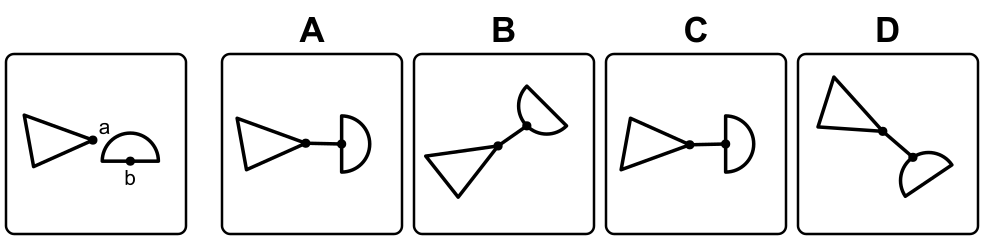
In the Connection Items section, you’ll be asked to identify the correct way to draw a straight line from one object to another. In the prompt box, you’ll see two objects, each with a black dot, labeled a and b. Then you’ll be asked to select the answer option that correctly shows how to connect those two dots with a line.
Let’s look at an example.
Strategies
There are two main strategies for connection items: identifying the anchor points and using the process of elimination.
The anchor point is where each dot is positioned on its object. For instance, is the dot on the side of the object or at a corner? If on the side, is it on a curved side, flat side, short side, or long side? Is it in the middle or closer to one edge? Knowing where your dot is on each object is key.
Next, you’ll use the process of elimination to eliminate any answer options that don’t match your identified anchor points.
Finally, you’ll look at what the whole picture would look like when we connect the dots and match it to one of our remaining answer options.
Let’s work through an example.
Example 1
Using our process from above, let’s start with dot labeled a and see where it anchors to its object. We would describe it as “on the tip of the triangle”. Checking our answers, all of them have dot a in the correct location, so we cannot eliminate any options yet.
Let’s move to the next dot. Dot b can be described as “in the middle of the straight side” of its object. We can now eliminate answer options B and D, as those locations have the dot in the middle of the curved side rather than the straight side.
We’re now down to just options A and C. While the location of the dots and connections is correct in both of these options, the orientation of the shapes is not. Option C flips the triangle backward. Thus, option A is our best answer.