



Angular momentum and angular impulse
In linear motion, momentum tells you how difficult it is to change an object’s motion. In rotational motion, the analogous quantity is angular momentum, which tells you how difficult it is to change an object’s spin.
In this sub-chapter we cover:
Angular momentum of a particle
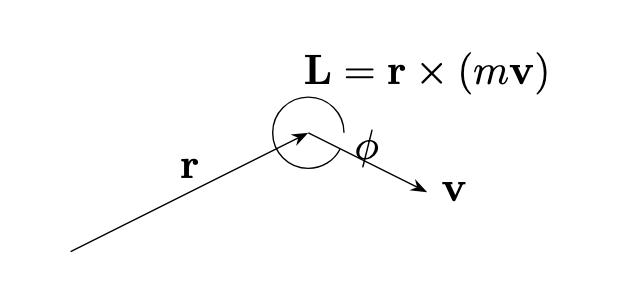
Consider a particle of mass at position (measured from an origin ) moving with velocity . Its angular momentum about is defined as
and its magnitude is
where is the angle between and .
A useful special case is when the particle moves directly toward or away from the origin. Then the velocity is purely radial (), so and therefore .
Angular momentum of a rigid body
For a rigid body rotating about a fixed axis with angular speed , each mass element at distance from the axis moves with tangential speed . That element contributes angular momentum
Adding the contributions from all mass elements gives
where
is the moment of inertia about that axis.
Conservation of angular momentum
If a system experiences no net external torque about a chosen axis, then the system’s total angular momentum about that axis stays constant.
Equivalently,
Here, depending on the situation, you’ll typically use
- “No net external torque” means all torques due to forces from outside the system sum to zero.
- Internally generated torques (action-reaction pairs within the system) can’t change the system’s total .
- This is the rotational analogue of Newton’s first law for linear momentum. Illustration 1:
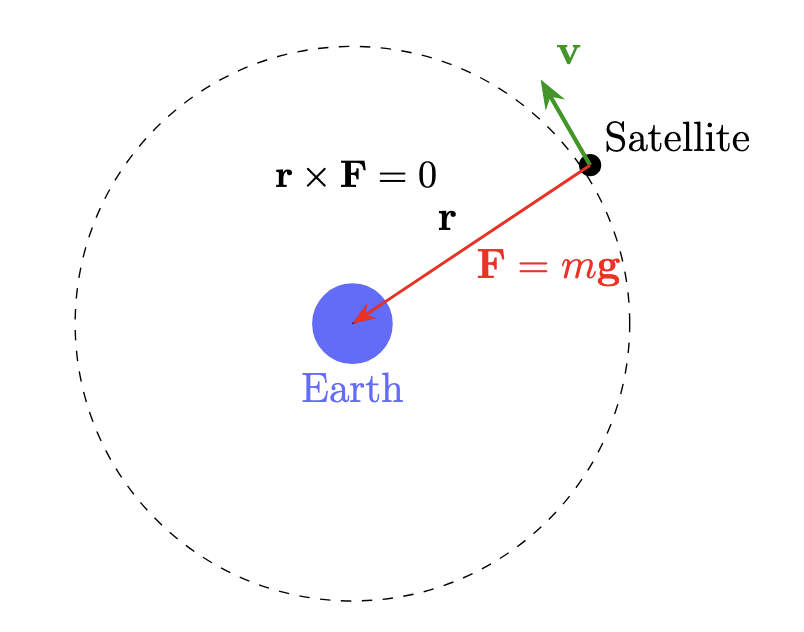
A satellite moves under gravity, which always acts along the line from Earth’s center to the satellite (the radial vector ). Since torque is and , we have . With no external torque, the satellite’s angular momentum remains constant throughout its orbit. Illustration 2:
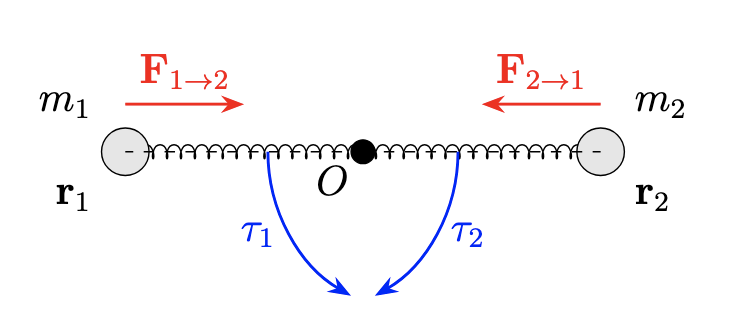
This diagram shows two masses and connected by an internal “spring” (coiled line). The forces and act along the line joining them. Each mass is at a lever arm from the rotation axis at , producing internal torques and . Because these torques are equal in magnitude and opposite in direction, they cancel pairwise. That leaves no net external torque, so the total angular momentum of the system is conserved.
Angular impulse-momentum theorem
Torque plays the same role in rotation that force plays in translation.
- A constant force acting for time gives a linear impulse and changes momentum by .
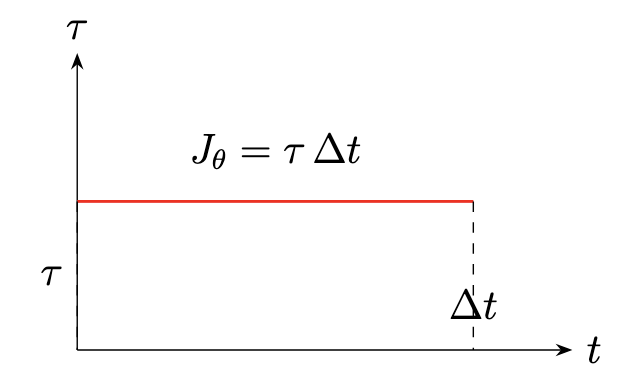
- A constant torque acting for time gives an angular impulse
and changes angular momentum by
If the torque varies with time, the total impulse is found by adding up (or integrating) the contributions from small time intervals. In AP-level problems, you’ll most often work with constant-torque cases.
Reasoning practice
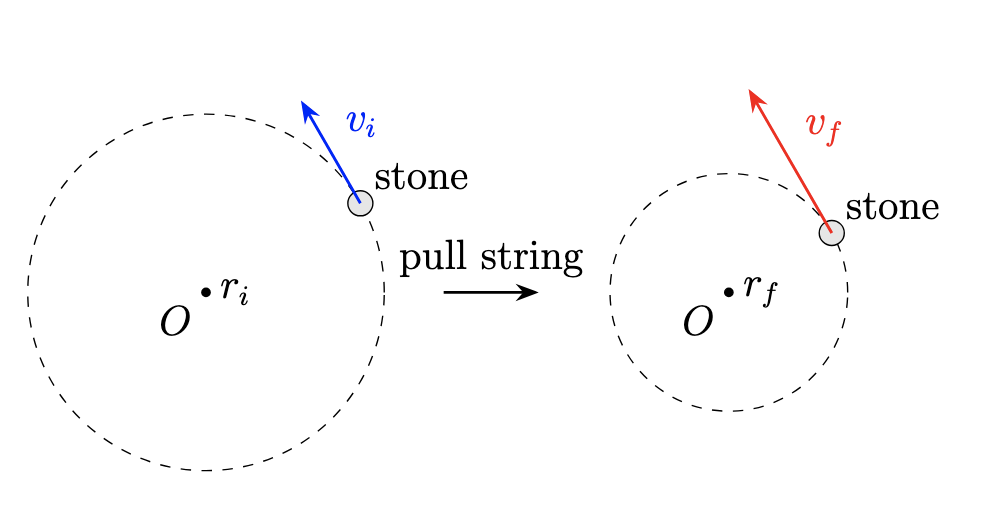
- You whirl a small stone on a string in a horizontal circle. Without external torque, you pull the string in so that the stone’s radius decreases.
Questions:
- What happens to the stone’s angular speed ?
- Which quantity remains constant, and why?
Solution:
- As decreases, increases so that remains constant.
- The angular momentum is conserved because no external torque acts (tension in the string is radial, so ).
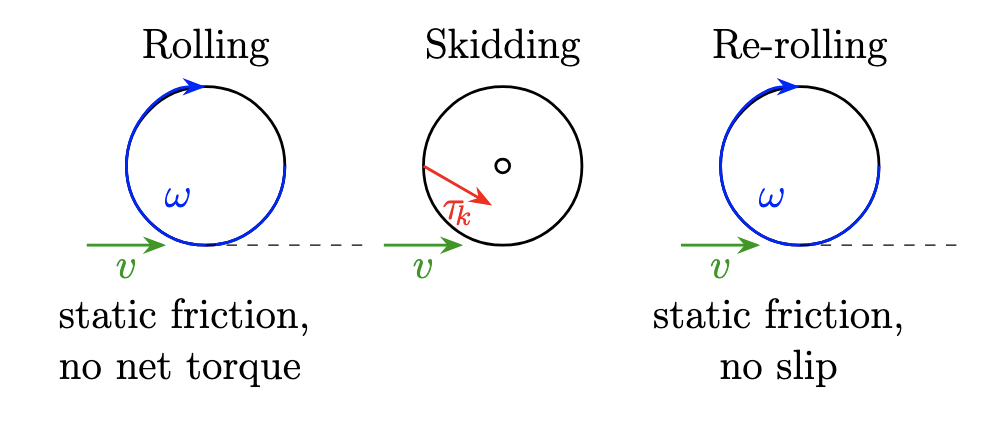
- A car’s wheels lock and skid (no rotation) on an icy patch, then regain traction and spin again at the same forward speed.
Questions:
- Compare the angular momentum of a wheel about its axle before lock, during skid, and after regaining traction.
- What external torques act during each phase?
Solution:
- Before lock: . During skid: . After traction: wheels spin so (same as before if no slip).
- Before lock: static friction provides torque to spin wheel but net torque about axle is zero for steady rolling. During skid: kinetic friction exerts a torque opposing wheel spin (bringing ). After traction: static friction again enforces rolling without slipping (no net torque if speed constant).
- A satellite moves in an elliptical orbit around Earth. As it swings inward toward perigee, its speed increases; as it moves outward to apogee, its speed decreases.
Questions:
- Why does the satellite’s angular momentum about Earth remain constant?
- Which component of its velocity contributes to ?
Solution:
- The only force is gravity, which acts along the line from Earth to satellite (radial). A radial force produces zero torque about Earth, so is conserved.
- Only the transverse (perpendicular to the radius vector) component contributes, since .
- A heavy flywheel spins freely. A brake pad is pressed suddenly against its rim, applying a large torque for a very short time, then released.
Questions:
- How does the flywheel’s angular momentum change during the brake pulse?
- Why does a large torque for a short time produce the same as a smaller torque for a longer time?
Solution:
- The brake’s frictional torque (opposite rotation) reduces by until it stops or slows by the impulse delivered.
- Angular impulse depends on the product (the area under the torque-time curve), so a higher torque for shorter duration can equal the impulse of a lower torque for longer duration.
Example problem 1
A uniform rod of length m and mass kg is free to rotate about its center. A mass kg moving at m/s strikes the rod perpendicularly at m and sticks. Find immediately after collision:
a. Angular momentum .
b. Angular speed .
Solution:
The rod is initially at rest, so the system’s initial angular momentum comes from the incoming mass:
Moment of inertia:
Example problem 2
A turntable (kg·m) spins at rad/s. A kg lump of clay drops onto the rim at m. Find final .
Solution:
Compute the initial angular momentum and the added moment of inertia from the clay:
Then use conservation of angular momentum, :
Example problem 3
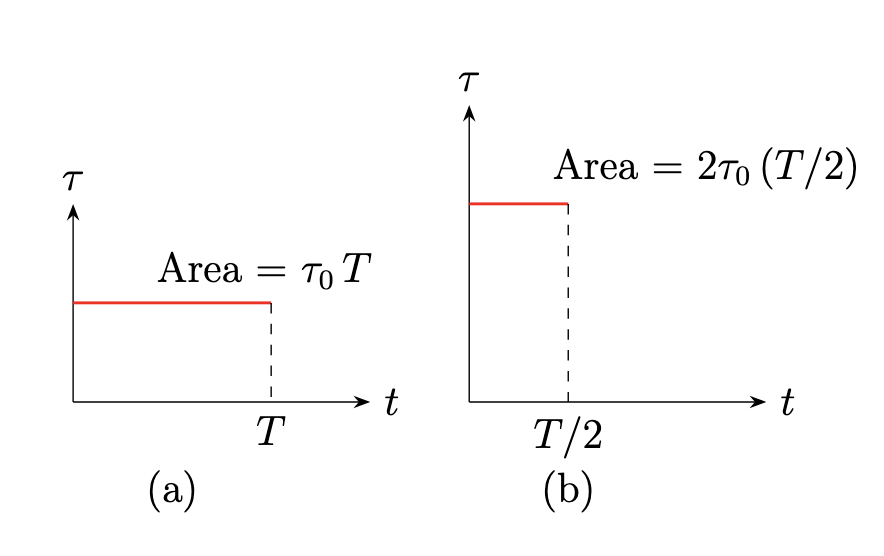
Compare angular impulse when
-
First case:
-
Second case:
-
Conclusion: , so both deliver the same - impulse depends on the area under the - graph.
Example problem 4
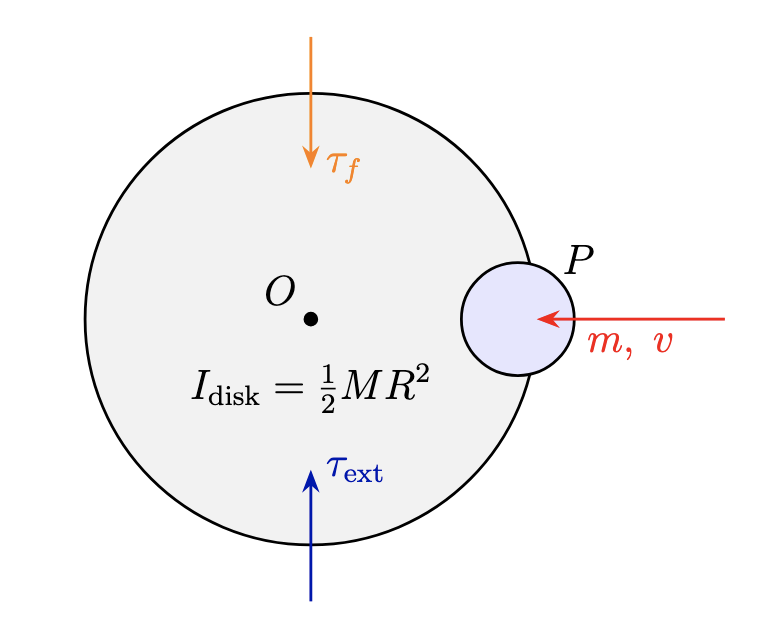
A uniform solid disk of mass and radius is mounted on a frictionless axle through its center so it can rotate freely in a horizontal plane. Initially the disk is at rest. A small clay ball of mass is projected horizontally, strikes and sticks to the rim of the disk at point , and comes instantaneously to rest relative to the disk (see figure). After the collision, an external constant torque is applied to the disk-ball system for a time interval . Finally, a small frictional torque (constant in magnitude, opposite to the direction of rotation) acts until the system comes to rest again.
(a) Angular speed after collision
-
Initial angular momentum (disk at rest, ball of momentum at radius ):
-
Final angular momentum of disk+ball:
-
Conservation
(b) Speed after external torque applied for time
-
Angular impulse from constant torque:
-
Change in angular momentum
-
Solve for :
(c) Work done by
Since is constant and the angular displacement from to is , the work can be found via the change in rotational kinetic energy:
(d) Angular impulse from friction until rest
-
Friction acts with constant magnitude opposite rotation.
-
To bring to zero, it must deliver an impulse satisfying
-
Its magnitude is .
(e) Energy dissipated by friction
All the rotational kinetic energy at is lost: