



Simple harmonic motion
When an object oscillates back and forth about an equilibrium position under a restoring force proportional to its displacement, the motion is called simple harmonic motion (SHM). Here are some real-life scenarios that show the same basic idea:
In SHM, the acceleration always points toward equilibrium and satisfies
where
is the angular frequency, is the mass, is the spring constant, and is the displacement from equilibrium.
Mass-spring derivation
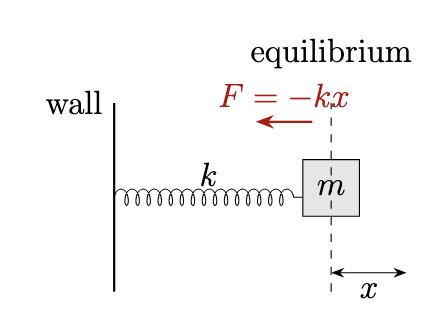
Free‐body diagram:
Equation of motion. Apply Newton’s second law along the horizontal direction:
Rearrange:
Define
so the differential equation becomes
You don’t need to do the calculus to use SHM results in most problems. The derivatives here are included to show how the standard formulas fit together.
A standard solution to this equation is
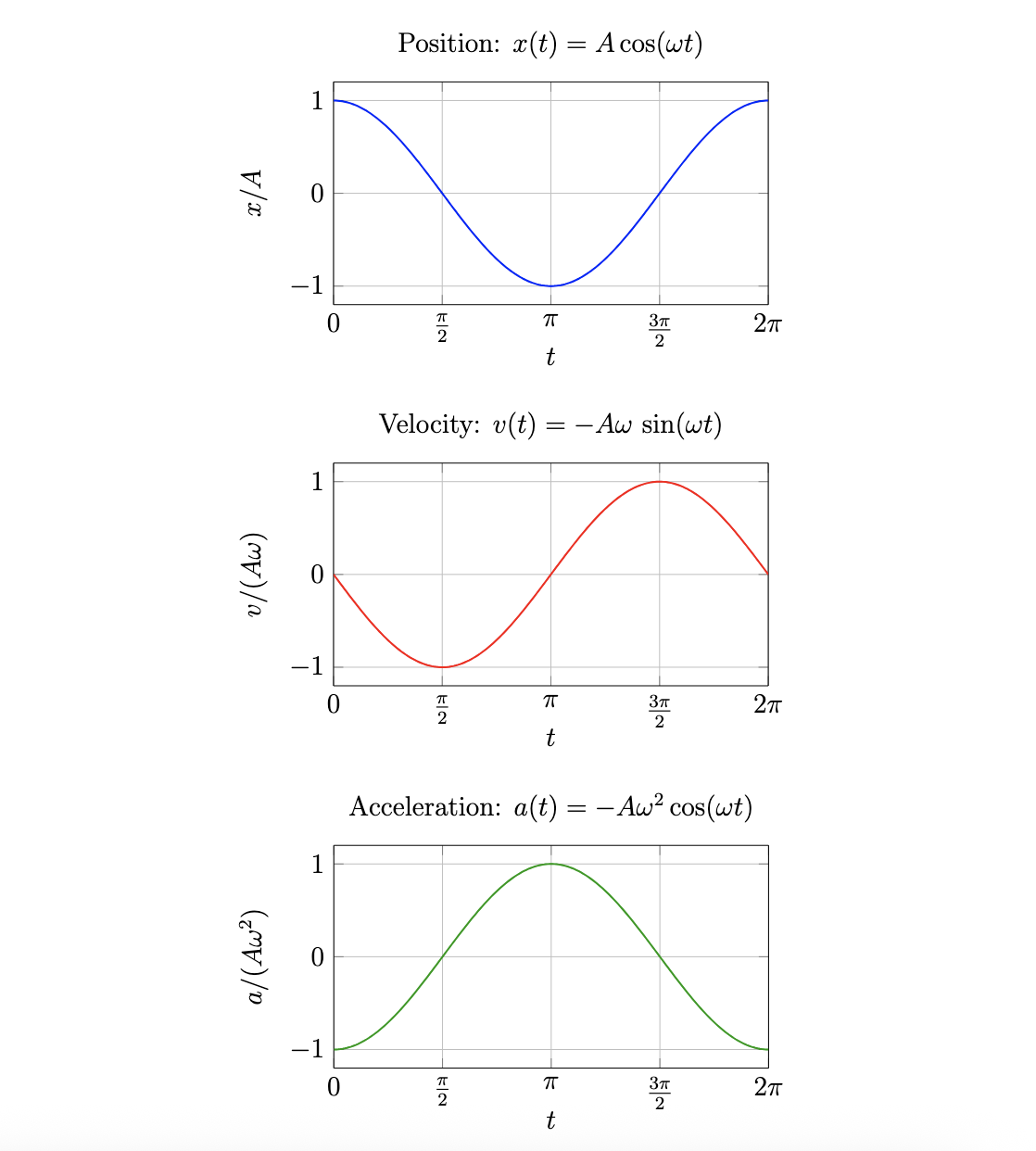
where is the amplitude (maximum displacement) and is the phase constant (set by the initial conditions). Once is known, velocity and acceleration come from differentiation:
Thus:
- Velocity leads displacement by a quarter-cycle (90°).
- Acceleration is in phase with displacement but opposite in sign.
Period and frequency in SHM
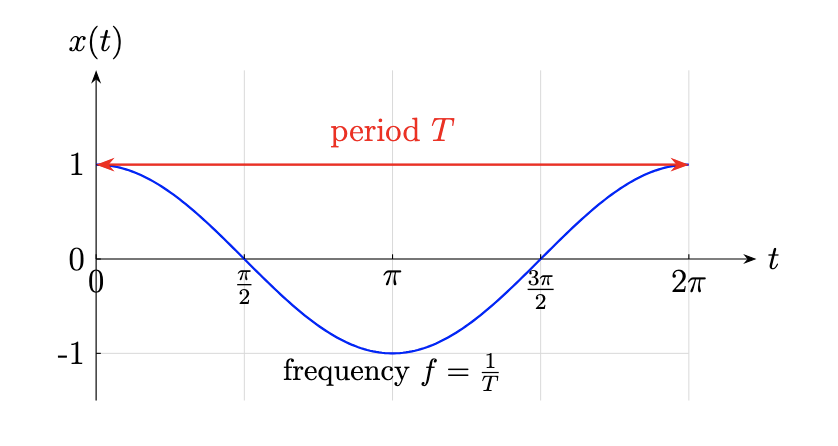
In simple harmonic motion, the period is the time required to complete one full oscillation (returning to the same displacement and velocity). The frequency is the number of complete oscillations per unit time. By definition,
Since the displacement in SHM can be written
the argument must increase by for one full cycle. That gives
Because for a mass-spring system (or for a small-angle pendulum), the period depends only on the system’s parameters:
Graphical representation of SHM
Here the solid blue curve is and the red dashed curve is .
Simple pendulum (small‐angle approximation)
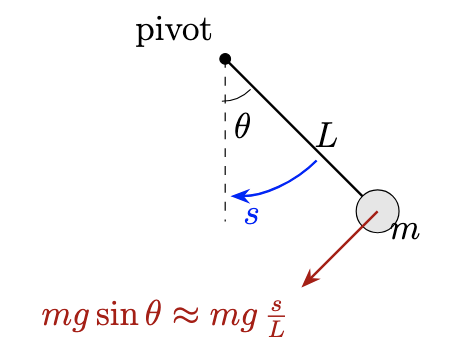
A simple pendulum consists of a point mass suspended from a fixed pivot by a light rod or string of length . If you displace it by a small angle and release it, it executes simple harmonic motion under gravity.
Restoring force and equation of motion
At an angular displacement , the component of the weight acting along the arc is
For small angles , . If is the arc length from equilibrium, then
so the tangential force becomes
Apply Newton’s second law in the tangential direction:
This matches the SHM form with
General solution
The displacement along the arc varies sinusoidally:
where is the maximum arc displacement (amplitude) and is the phase constant set by initial conditions. Differentiating,
Period and frequency
One full oscillation corresponds to the argument of the cosine increasing by :
In the small-angle limit, the pendulum behaves like a mass-spring system, with .
Example Problem 1
A block of mass kg is attached to a horizontal spring of constant N/m on a frictionless table. The block is pulled to the right and released from rest at a displacement m. (a) Find the angular frequency and period .
(b) Write the equation of motion assuming at release.
Released from rest at implies phase , so
(c) Determine the block’s speed when it passes through m.
In SHM,
Thus
Since the block is moving toward equilibrium, take m/s.
(d) Determine the acceleration of the block at m.
Acceleration in SHM is :
The negative sign shows the acceleration is toward equilibrium (leftward).
Example Problem 2
A simple pendulum of length m oscillates with a maximum angular displacement rad (about ). Take m/s. (a) Compute the angular frequency and period .
For small angles,
(b) Write assuming and released from rest.
Initial conditions , give phase :
(c) Find the maximum tangential speed of the bob.
Tangential speed . Since ,
(d) Find the maximum tangential acceleration of the bob.
Tangential acceleration . Since ,