


Achievable logoAchievable logo
AP Physics 1
Sign in
Sign up
Purchase
Textbook
Practice exams
Support
How it works
Exam catalog
Mountain with a flag at the peak
Textbook
Introduction
1. Decoding the exam
2. Vectors and their analysis
3. Kinematics
4. Laws of motion
5. Work, energy, and power
6. Linear momentum and collisions
7. Torque and rotational mechanics
8. Oscillations
8.1 Simple harmonic motion
8.2 Energy and dynamics in SHM
9. Fluids
Wrapping up
Achievable logoAchievable logo
8.2 Energy and dynamics in SHM
Achievable AP Physics 1
8. Oscillations
Our AP Physics 1 course is currently in development and is a work-in-progress.

Energy and dynamics in SHM

11 min read
Font
Discuss
Share
Feedback

In this sub-chapter we talk about:

  • Energy considerations in SHM
  • Spring potential energy
  • Energy conversion and graphical representation

Potential and kinetic energy

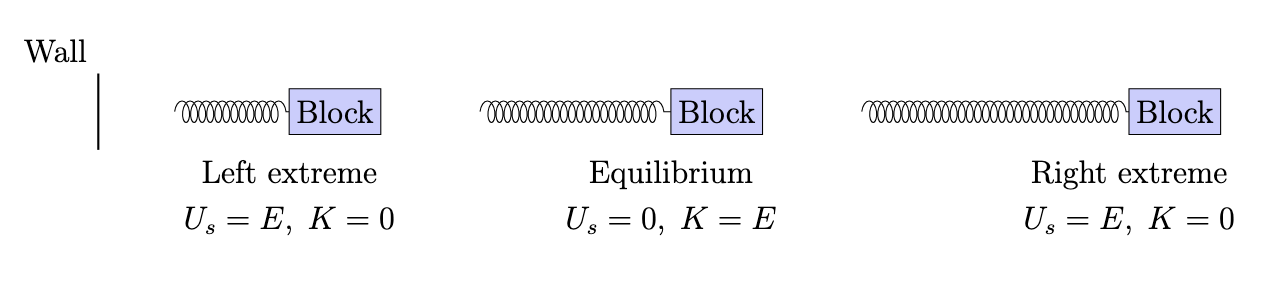
In simple harmonic motion (SHM), the system’s mechanical energy continually shifts between:

  • elastic potential energy stored in the spring
  • kinetic energy of the moving mass

Because we’re assuming no non-conservative forces (a frictionless system), the total mechanical energy stays constant.

Spring potential energy
When a spring with constant k is displaced by x from its equilibrium length, the work required to stretch or compress it becomes stored as spring potential energy:

Us​(x)=∫0x​kx′dx′=21​kx2.

Kinetic energy
A mass m moving with speed v has kinetic energy:

K=21​mv2.

In SHM, v changes with position x. We can find that relationship using energy conservation.

Total energy and relationship
At any instant, the total mechanical energy is

E=K+Us​=21​mv2+21​kx2=constant.

At the turning points x=±A, the mass is momentarily at rest (v=0), so all the energy is spring potential energy:

E=Us​(±A)=21​kA2.

That means for any displacement x,

21​mv2+21​kx2=21​kA2,

which we can rearrange to solve for the speed as a function of position:

v(x)=±ωA2−x2​,ω=mk​​.

Energy exchange and graphical representation

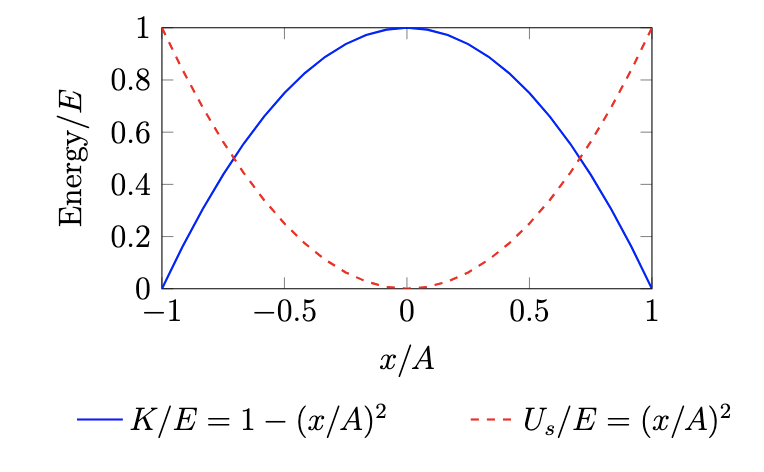
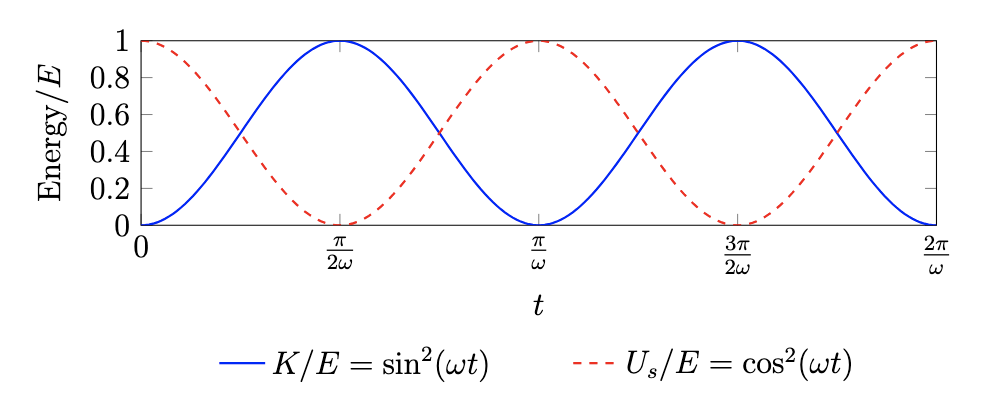
You can visualize the energy exchange in SHM by plotting kinetic and potential energy versus displacement x or versus time t.

Energy vs. displacement

Energy vs displacement curve for SHM

In this normalized plot (A=1, E=21​kA2=1):

  • K is maximum at x=0 and zero at x=±1.
  • Us​ is zero at x=0 and maximum at x=±1.

This matches the physical picture: the mass moves fastest at equilibrium and stops at the turning points.

Energy vs. time

Energy vs time curve

The kinetic and potential energies oscillate out of phase: when one is maximum, the other is zero. Throughout the motion, their sum stays constant at E=21​kA2.

Energy at mean and extreme positions

Dynamics: force and acceleration restoring force and acceleration

The spring’s restoring force points toward equilibrium and is proportional to displacement:

F=−kx.

Applying Newton’s second law gives the SHM equation of motion:

mx¨=−kx⟹x¨+ω2x=0,ω2=mk​.

So the acceleration is proportional to x and always directed toward equilibrium.

Reasoning practice

  1. A block of mass m on a frictionless horizontal spring oscillates with small amplitude A1​. It is then given an impulse so that its new amplitude is A2​=2A1​.

    (a) How does the period T compare before and after?

Answer: T=2πm/k​ is independent of amplitude, so

Tbefore​=Tafter​.

(b) How does the total mechanical energy E compare before and after?

Answer:

E=21​kA2,

so

E2​/E1​=21​kA12​21​k(2A1​)2​=4,

i.e. E2​=4E1​.

(c) At x=A1​/2, how do K and Us​ before and after compare?

Answer:

EK​=1−(Ax​)2,EUs​​=(Ax​)2.

Before: x/A1​=0.5⇒K1​/E1​=0.75,U1​/E1​=0.25.

After: x/A2​=0.25⇒K2​/E2​=0.9375,U2​/E2​=0.0625. Since E2​=4E1​,

K1​=0.75E1​,U1​=0.25E1​;K2​=0.9375×4E1​=3.75E1​,U2​=0.0625×4E1​=0.25E1​.

Thus K2​>K1​ (five-times larger) while U2​=U1​.

  1. A simple pendulum of length L swings with small amplitude inside a car. First the car is at rest, then it accelerates forward at constant a.

    (a) How does the period compare before and after?

Answer: In the accelerating frame the effective gravity is geff​=g2+a2​, so

Tnew​=2πgeff​L​​<2πgL​​=Told​.

(b) Explain qualitatively how the restoring torque changes.

Answer: The torque about the pivot is τ=−mgeff​Lθ for small θ. Since geff​>g, the magnitude of the restoring torque is larger, so the pendulum swings back toward equilibrium more strongly.

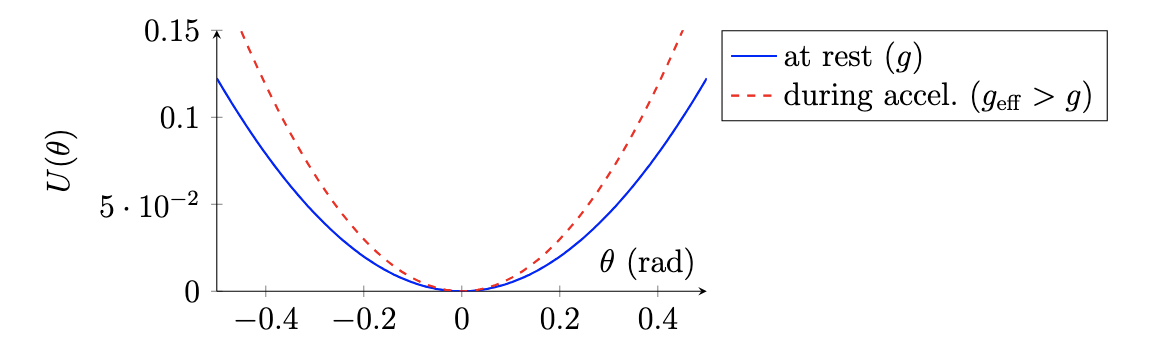
(c) Sketch U(θ) before and after acceleration.

Answer:

U(θ)=mgL(1−cosθ)⟶mgeff​L(1−cosθ).

On the same axes the post-acceleration curve is steeper (a narrower well) than the original.

Potential energy before and after acceleration
  1. Two mass-spring systems execute SHM with the same amplitude A and period T. In system I: (mI​,kI​); in II: (mII​=4mI​,kII​=4kI​).

    (a) Verify both have the same period.

Answer:

T=2πkm​​,TI​=2πkI​mI​​​,TII​=2π4kI​4mI​​​=TI​.

(b) At x=A/2, compare the speeds.

Answer:

v=ωA2−x2​,ω=mk​​.

Since k/m is the same in both, and A is the same, vI​=vII​.

(c) Compare the maximum spring force in each system.

Answer:Fmax​=kA, so

Fmax,I​=kI​A,Fmax,II​=4kI​A=4Fmax,I​.

Thus system II’s spring exerts four times the maximum force.

Solved examples

Example Problem 1 : (exam style FRQ)
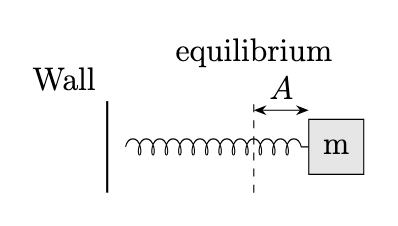
A block of massm is attached to a horizontal spring of force constant k on a frictionless surface. The block is pulled to the right until the spring is stretched by an amount A and released from rest. The block then executes simple harmonic motion about the equilibrium position.

Spring mass system according to the question

(a) Derive an expression for the total mechanical energy E of the oscillating block in terms of k and A.

(b) Starting from E=K+Us​, show that the speed v of the block as a function of its instantaneous displacement x from equilibrium is

v(x)=±ωA2−x2​,ω=mk​​.

(c) For a particular system, m=0.500kg, k=200N/m, and A=0.100m:

(i) Calculate the numerical value of the total energy E (in joules). (ii) Determine the kinetic energy K and spring potential energy Us​ when x=0.060m. (iii) Compute the block’s speed v at x=0.060m.

(d) At what displacement x (in terms of A) is the kinetic energy equal to one-quarter of the total energy? Show your reasoning.

Solution

(a) At the turning point (x=±A) all energy is spring potential:

E=Us​(A)=21​kA2.

(b) Start with

E=K+Us​=21​mv2+21​kx2=21​kA2.

Rearrange for v2:

21​mv2=21​k(A2−x2)⟹v2=mk​(A2−x2)=ω2(A2−x2).

Thus

v(x)=±ωA2−x2​.

(c)

(i)

E=21​kA2=21​(200)(0.100)2=1.00J.

(ii) At x=0.060m,

Us​=21​kx2=21​(200)(0.060)2=0.36J,

K=E−Us​=1.00−0.36=0.64J.

(iii)

v=m2K​​=0.5002(0.64)​​=2.56​=1.60m/s.

(d) We require

K=41​E⟹1−A2x2​=41​⟹A2x2​=43​⟹x=±23​​A.

Example Problem 2:
A blockm=0.300kg on a frictionless table is attached to a spring with k=80.0N/m. It is pulled out to A=0.150m and released from rest.

(a) Compute the total energy E. (b) At what displacement x is the kinetic energy equal to the potential energy? (c) What is the speed at that point? (d) What fraction of the total energy is kinetic at x=0.100m?

Solution.

(a)

E=21​kA2=21​(80.0)(0.150)2=0.900J.

(b) Set K=Us​=21​E=0.450J:

21​kx2=0.450⟹x2=80.02(0.450)​=0.01125⟹x=0.106m.

(c)

K=0.450J=21​mv2⟹v=0.3002(0.450)​​=3.00​=1.732m/s.

(d) At x=0.100m,

Us​=21​(80.0)(0.100)2=0.400J,K=0.900−0.400=0.500J,

fraction kinetic = 0.500/0.900≈0.556.

Example Problem 3:
A simple pendulum of lengthL=0.800m oscillates with small amplitude Θ=0.200rad.

(a) Find its total energy in terms of mass m. (b) When the angular displacement is θ=0.150rad, find the potential and kinetic energies. (c) Determine the angular speed ω at θ=0.150rad.

Solution.

(a)

E=21​mgLΘ2=21​m(9.80)(0.800)(0.200)2=0.1568mJ.

(b) At θ=0.150rad,

U=21​mgLθ2=0.0882mJ,K=0.1568m−0.0882m=0.0686mJ.

(c) From K=21​m(Lω)2,

ω=m(0.800)22(0.0686m)​​=0.463rad/s.

Energy in Simple Harmonic Motion (SHM)

  • Mechanical energy shifts between kinetic and spring potential energy
  • Total energy constant if no non-conservative forces (frictionless)
  • E=K+Us​=21​mv2+21​kx2=21​kA2

Spring potential and kinetic energy

  • Spring potential: Us​(x)=21​kx2
  • Kinetic energy: K=21​mv2
  • Speed as function of position: v(x)=±ωA2−x2​, ω=k/m​

Energy exchange and graphs

  • K maximum at x=0, Us​ maximum at x=±A
  • K and Us​ oscillate out of phase; E always constant
  • Energy-position and energy-time graphs illustrate exchange

Dynamics: Force and acceleration

  • Restoring force: F=−kx
  • Acceleration: a=−ω2x, always toward equilibrium
  • SHM equation: x¨+ω2x=0, ω2=k/m

Key Reasoning Practice Takeaways

  • Period T=2πm/k​ independent of amplitude
  • Total energy E∝A2 (quadruples if amplitude doubles)
  • At given x, K/E=1−(x/A)2, Us​/E=(x/A)2
  • For pendulum in accelerating frame: geff​=g2+a2​, period decreases
  • Maximum spring force: Fmax​=kA
  • For systems with same k/m and A, speeds at same x are equal

Solved Example Highlights

  • At turning points, all energy is potential: E=21​kA2
  • K=Us​ when x=±A/2​
  • Kinetic energy fraction at x: K/E=1−(x/A)2
  • For pendulum: E=21​mgLΘ2 (small angles)
  • Angular speed at θ: ω=2K/(mL2)​

Essential formulas

  • Us​(x)=21​kx2
  • K=21​mv2
  • E=21​kA2
  • v(x)=±ωA2−x2​
  • F=−kx
  • a=−ω2x
  • Pendulum (small angle): E=21​mgLΘ2

AP Physics 1 Skills

  • Interpret and sketch energy-position and energy-time graphs
  • Relate amplitude to energy and maximum speed/acceleration
  • Explain force, acceleration, and energy relationships in SHM

Sign up for free to take 7 quiz questions on this topic

Previous
Next  | 9.1 Static fluids
All rights reserved ©2016 - 2026 Achievable, Inc.

Energy and dynamics in SHM

In this sub-chapter we talk about:

  • Energy considerations in SHM
  • Spring potential energy
  • Energy conversion and graphical representation

Potential and kinetic energy

In simple harmonic motion (SHM), the system’s mechanical energy continually shifts between:

  • elastic potential energy stored in the spring
  • kinetic energy of the moving mass

Because we’re assuming no non-conservative forces (a frictionless system), the total mechanical energy stays constant.

Spring potential energy
When a spring with constant k is displaced by x from its equilibrium length, the work required to stretch or compress it becomes stored as spring potential energy:

Us​(x)=∫0x​kx′dx′=21​kx2.

Kinetic energy
A mass m moving with speed v has kinetic energy:

K=21​mv2.

In SHM, v changes with position x. We can find that relationship using energy conservation.

Total energy and relationship
At any instant, the total mechanical energy is

E=K+Us​=21​mv2+21​kx2=constant.

At the turning points x=±A, the mass is momentarily at rest (v=0), so all the energy is spring potential energy:

E=Us​(±A)=21​kA2.

That means for any displacement x,

21​mv2+21​kx2=21​kA2,

which we can rearrange to solve for the speed as a function of position:

v(x)=±ωA2−x2​,ω=mk​​.

Energy exchange and graphical representation

You can visualize the energy exchange in SHM by plotting kinetic and potential energy versus displacement x or versus time t.

Energy vs. displacement

In this normalized plot (A=1, E=21​kA2=1):

  • K is maximum at x=0 and zero at x=±1.
  • Us​ is zero at x=0 and maximum at x=±1.

This matches the physical picture: the mass moves fastest at equilibrium and stops at the turning points.

Energy vs. time

The kinetic and potential energies oscillate out of phase: when one is maximum, the other is zero. Throughout the motion, their sum stays constant at E=21​kA2.

Dynamics: force and acceleration restoring force and acceleration

The spring’s restoring force points toward equilibrium and is proportional to displacement:

F=−kx.

Applying Newton’s second law gives the SHM equation of motion:

mx¨=−kx⟹x¨+ω2x=0,ω2=mk​.

So the acceleration is proportional to x and always directed toward equilibrium.

Reasoning practice

  1. A block of mass m on a frictionless horizontal spring oscillates with small amplitude A1​. It is then given an impulse so that its new amplitude is A2​=2A1​.

    (a) How does the period T compare before and after?

Answer: T=2πm/k​ is independent of amplitude, so

Tbefore​=Tafter​.

(b) How does the total mechanical energy E compare before and after?

Answer:

E=21​kA2,

so

E2​/E1​=21​kA12​21​k(2A1​)2​=4,

i.e. E2​=4E1​.

(c) At x=A1​/2, how do K and Us​ before and after compare?

Answer:

EK​=1−(Ax​)2,EUs​​=(Ax​)2.

Before: x/A1​=0.5⇒K1​/E1​=0.75,U1​/E1​=0.25.

After: x/A2​=0.25⇒K2​/E2​=0.9375,U2​/E2​=0.0625. Since E2​=4E1​,

K1​=0.75E1​,U1​=0.25E1​;K2​=0.9375×4E1​=3.75E1​,U2​=0.0625×4E1​=0.25E1​.

Thus K2​>K1​ (five-times larger) while U2​=U1​.

  1. A simple pendulum of length L swings with small amplitude inside a car. First the car is at rest, then it accelerates forward at constant a.

    (a) How does the period compare before and after?

Answer: In the accelerating frame the effective gravity is geff​=g2+a2​, so

Tnew​=2πgeff​L​​<2πgL​​=Told​.

(b) Explain qualitatively how the restoring torque changes.

Answer: The torque about the pivot is τ=−mgeff​Lθ for small θ. Since geff​>g, the magnitude of the restoring torque is larger, so the pendulum swings back toward equilibrium more strongly.

(c) Sketch U(θ) before and after acceleration.

Answer:

U(θ)=mgL(1−cosθ)⟶mgeff​L(1−cosθ).

On the same axes the post-acceleration curve is steeper (a narrower well) than the original.

  1. Two mass-spring systems execute SHM with the same amplitude A and period T. In system I: (mI​,kI​); in II: (mII​=4mI​,kII​=4kI​).

    (a) Verify both have the same period.

Answer:

T=2πkm​​,TI​=2πkI​mI​​​,TII​=2π4kI​4mI​​​=TI​.

(b) At x=A/2, compare the speeds.

Answer:

v=ωA2−x2​,ω=mk​​.

Since k/m is the same in both, and A is the same, vI​=vII​.

(c) Compare the maximum spring force in each system.

Answer:Fmax​=kA, so

Fmax,I​=kI​A,Fmax,II​=4kI​A=4Fmax,I​.

Thus system II’s spring exerts four times the maximum force.

Solved examples

Example Problem 1 : (exam style FRQ)
A block of massm is attached to a horizontal spring of force constant k on a frictionless surface. The block is pulled to the right until the spring is stretched by an amount A and released from rest. The block then executes simple harmonic motion about the equilibrium position.

(a) Derive an expression for the total mechanical energy E of the oscillating block in terms of k and A.

(b) Starting from E=K+Us​, show that the speed v of the block as a function of its instantaneous displacement x from equilibrium is

v(x)=±ωA2−x2​,ω=mk​​.

(c) For a particular system, m=0.500kg, k=200N/m, and A=0.100m:

(i) Calculate the numerical value of the total energy E (in joules). (ii) Determine the kinetic energy K and spring potential energy Us​ when x=0.060m. (iii) Compute the block’s speed v at x=0.060m.

(d) At what displacement x (in terms of A) is the kinetic energy equal to one-quarter of the total energy? Show your reasoning.

Solution

(a) At the turning point (x=±A) all energy is spring potential:

E=Us​(A)=21​kA2.

(b) Start with

E=K+Us​=21​mv2+21​kx2=21​kA2.

Rearrange for v2:

21​mv2=21​k(A2−x2)⟹v2=mk​(A2−x2)=ω2(A2−x2).

Thus

v(x)=±ωA2−x2​.

(c)

(i)

E=21​kA2=21​(200)(0.100)2=1.00J.

(ii) At x=0.060m,

Us​=21​kx2=21​(200)(0.060)2=0.36J,

K=E−Us​=1.00−0.36=0.64J.

(iii)

v=m2K​​=0.5002(0.64)​​=2.56​=1.60m/s.

(d) We require

K=41​E⟹1−A2x2​=41​⟹A2x2​=43​⟹x=±23​​A.

Example Problem 2:
A blockm=0.300kg on a frictionless table is attached to a spring with k=80.0N/m. It is pulled out to A=0.150m and released from rest.

(a) Compute the total energy E. (b) At what displacement x is the kinetic energy equal to the potential energy? (c) What is the speed at that point? (d) What fraction of the total energy is kinetic at x=0.100m?

Solution.

(a)

E=21​kA2=21​(80.0)(0.150)2=0.900J.

(b) Set K=Us​=21​E=0.450J:

21​kx2=0.450⟹x2=80.02(0.450)​=0.01125⟹x=0.106m.

(c)

K=0.450J=21​mv2⟹v=0.3002(0.450)​​=3.00​=1.732m/s.

(d) At x=0.100m,

Us​=21​(80.0)(0.100)2=0.400J,K=0.900−0.400=0.500J,

fraction kinetic = 0.500/0.900≈0.556.

Example Problem 3:
A simple pendulum of lengthL=0.800m oscillates with small amplitude Θ=0.200rad.

(a) Find its total energy in terms of mass m. (b) When the angular displacement is θ=0.150rad, find the potential and kinetic energies. (c) Determine the angular speed ω at θ=0.150rad.

Solution.

(a)

E=21​mgLΘ2=21​m(9.80)(0.800)(0.200)2=0.1568mJ.

(b) At θ=0.150rad,

U=21​mgLθ2=0.0882mJ,K=0.1568m−0.0882m=0.0686mJ.

(c) From K=21​m(Lω)2,

ω=m(0.800)22(0.0686m)​​=0.463rad/s.

Key points

Energy in Simple Harmonic Motion (SHM)

  • Mechanical energy shifts between kinetic and spring potential energy
  • Total energy constant if no non-conservative forces (frictionless)
  • E=K+Us​=21​mv2+21​kx2=21​kA2

Spring potential and kinetic energy

  • Spring potential: Us​(x)=21​kx2
  • Kinetic energy: K=21​mv2
  • Speed as function of position: v(x)=±ωA2−x2​, ω=k/m​

Energy exchange and graphs

  • K maximum at x=0, Us​ maximum at x=±A
  • K and Us​ oscillate out of phase; E always constant
  • Energy-position and energy-time graphs illustrate exchange

Dynamics: Force and acceleration

  • Restoring force: F=−kx
  • Acceleration: a=−ω2x, always toward equilibrium
  • SHM equation: x¨+ω2x=0, ω2=k/m

Key Reasoning Practice Takeaways

  • Period T=2πm/k​ independent of amplitude
  • Total energy E∝A2 (quadruples if amplitude doubles)
  • At given x, K/E=1−(x/A)2, Us​/E=(x/A)2
  • For pendulum in accelerating frame: geff​=g2+a2​, period decreases
  • Maximum spring force: Fmax​=kA
  • For systems with same k/m and A, speeds at same x are equal

Solved Example Highlights

  • At turning points, all energy is potential: E=21​kA2
  • K=Us​ when x=±A/2​
  • Kinetic energy fraction at x: K/E=1−(x/A)2
  • For pendulum: E=21​mgLΘ2 (small angles)
  • Angular speed at θ: ω=2K/(mL2)​

Essential formulas

  • Us​(x)=21​kx2
  • K=21​mv2
  • E=21​kA2
  • v(x)=±ωA2−x2​
  • F=−kx
  • a=−ω2x
  • Pendulum (small angle): E=21​mgLΘ2

AP Physics 1 Skills

  • Interpret and sketch energy-position and energy-time graphs
  • Relate amplitude to energy and maximum speed/acceleration
  • Explain force, acceleration, and energy relationships in SHM

More from Oscillations

  • Simple harmonic motion