



Static fluids
Fluids at rest (liquids and gases) exert pressure on any surface they touch and produce buoyant forces on objects immersed in them.
The goal is to build a clear conceptual picture and then support it with algebra and worked examples.
Density & specific weight
Definition & physical meaning.
The mass density of a substance tells you how much mass is packed into a given volume:
- Higher density means more mass per unit volume (for example, lead).
- Lower density means less mass per unit volume (for example, air).
Multiplying density by the acceleration of gravity gives the specific weight:
Specific weight tells you the weight of one unit volume of the material under gravity.
Example Problem 1
A block of oak has mass kg and volume m³. Calculate its density and specific weight.
-
Compute density:
-
Compute specific weight:
Discussion.
Oak, with kg/m³, is less dense than water (kg/m³), which is why it floats. Its specific weight N/m³ means each cubic meter of oak would have that weight under gravity.
Hydrostatic pressure
In a fluid at rest, pressure increases with depth because deeper layers must support the weight of the fluid above them.
Pressure definition:
You can feel this effect when you dive deeper in a pool: the pressure on your ears increases because there’s more water above you.
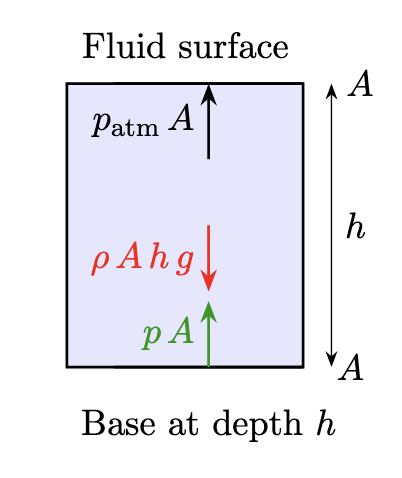
Derivation of the hydrostatic law. Consider a vertical column of fluid with cross-sectional area and height .
- The volume is .
- The mass is .
- The weight is
That weight is supported by the pressure force at the bottom, :
This is the gauge pressure due only to the fluid above the point.
Absolute pressure. If the fluid surface is open to the atmosphere, the total (absolute) pressure at depth is
Example problem 2
What is the pressure 20 m below the surface of freshwater? Use kg/m³, m/s² and Pa.
-
Compute gauge pressure:
-
Add atmospheric pressure:
Interpretation.
At 20 m depth, the water contributes nearly twice atmospheric pressure on its own. Any diver or submarine must withstand that extra pressure.
Pascal’s principle & hydraulic machines Pascal’s principle statement
Any change in pressure applied to an enclosed incompressible fluid is transmitted equally in all directions throughout the fluid.
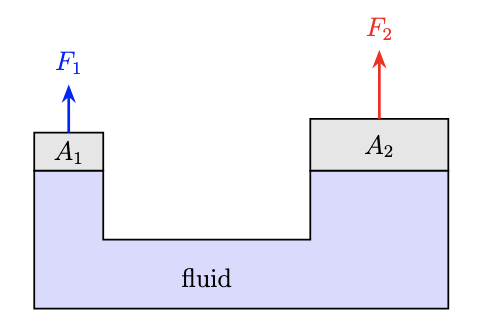
Consequence. If two pistons are connected by the same enclosed fluid, the pressure is the same at both pistons. That means a small force applied over a small area can produce a larger force over a larger area.
Since , we have
Example Problem 3
A hydraulic jack has small piston area m² and large piston area m². Find the force needed to lift a car of weight N.
-
Use .
-
Solve:
Buoyancy & archimedes’ principle Physical origin of buoyancy
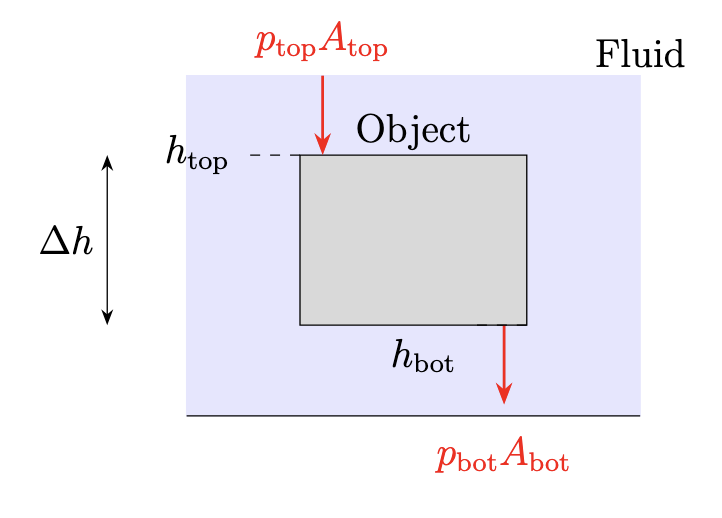
In a fluid, pressure increases with depth. So for an immersed object, the pressure on the bottom surface is greater than the pressure on the top surface. That pressure difference creates a net upward force called the buoyant force.
Here
The net upward force on the block is
where is the volume of fluid displaced.
Archimedes’ principle.
This holds whether the object is fully or partially submerged.
Example Problem 4
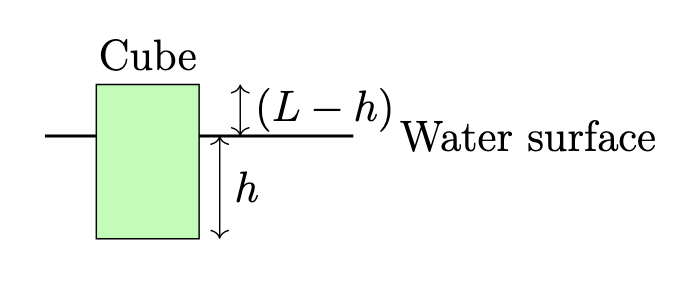
A cube of side m and density kg/m³ floats in water. Sketch the equilibrium and find (a) the submerged depth , (b) the height above water.
Solution. Weight , buoyant force . At equilibrium, set :
Height above water m.
Example problem 5
A solid sphere of radius m and density kg/m³ is attached to a scale and fully submerged in oil (kg/m³). What does the scale read? (m/s²)
Solution.
- Volume of sphere m³.
- Weight of sphere N.
- Buoyant force N.
- Net downward force N. Thus the scale reads .
Reasoning practice
(a) Why is the hydrostatic pressure at a given depth the same in a very wide lake as in a narrow canal?
Explanation: Hydrostatic pressure depends only on depth (and fluid density): . For any chosen area , a vertical column of depth contains mass , so the weight per unit area at the bottom is the same. The lake’s width doesn’t appear in .
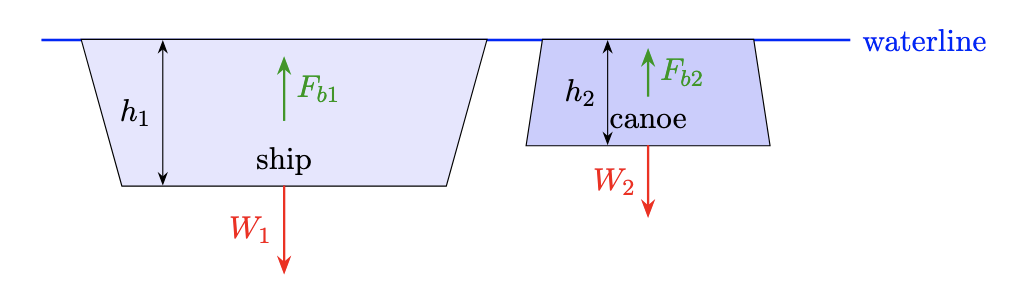
(b) A large steel cargo ship and a small wooden canoe both float in the same lake. Using Archimedes’ principle, explain why each vessel displaces exactly its own weight in water, and why the vastly different hull shapes do not change this equilibrium condition.
Explanation: Archimedes’ principle gives the buoyant force:
For a floating object in equilibrium, the net force is zero, so the buoyant force must equal the object’s weight :
So the displaced volume is set by the object’s mass and the fluid density, not by the hull shape. Shape affects how the object sits in the water (and its stability), but it can’t change the requirement that the displaced water’s weight matches the object’s weight.
(c) A sealed container full of fluid is shaken vigorously. Will the pressure at the bottom change compared to when it is at rest? Explain.
Explanation: If the fluid remains incompressible and the container has no net acceleration as a whole, the time-averaged pressure difference with depth is still described by . Shaking can create temporary local pressure fluctuations, but once the fluid settles back to rest, the pressure at depth returns to .
(d) Two pistons of equal area are connected by oil. One piston is pushed down slowly. Describe how Pascal’s principle dictates the motion and why the force on the second piston equals your push.
Explanation:
Piston 1 applies a force over area , creating a pressure increase . Pascal’s principle says that same is transmitted throughout the fluid, including to piston 2. Since piston 2 has the same area , the force it experiences is . So the second piston responds with the same force as your push.
Example problem 6
A wooden block (density kg/m³) of volume m³ floats in water. Determine the submerged volume and the height floating above the surface.
-
Weight of block:
-
Buoyant force at equilibrium equals weight:
-
Solve for submerged volume:
-
Fraction submerged . Thus 60% submerged, 40% above water.
Example problem 7
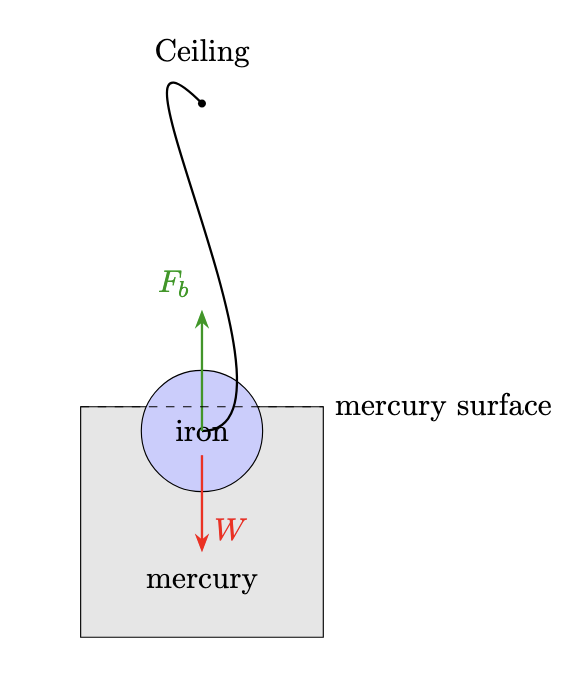
A solid iron sphere of mass kg is attached to a string and slowly lowered into mercury (kg/m³). When fully submerged and left to stabilize, what tension does the string finally read? Take m/s². Solution :
When the iron sphere is fully submerged in mercury, its buoyant force exceeds its weight:
so . A string can only pull, not push, so it can’t provide the downward force needed to hold the sphere fully submerged. The string goes slack, and the sphere rises until it reaches floating equilibrium where . Thus the tension is