



Dynamic fluids
In this sub-chapter, we’ll focus on fluid dynamics: what happens when fluids flow. We’ll study:
Fluid flow and the continuity equation
In steady, incompressible, streamline flow, the mass of fluid passing any cross-section per unit time stays the same. If is the (constant) density and is the cross-sectional area at position , then the mass flow rate is
Because is uniform for an incompressible fluid, this simplifies to the continuity equation:
Derivation (Algebraic):
Physical Interpretation:
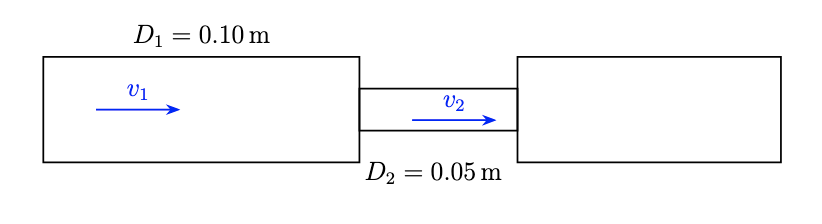
- If the pipe narrows (), then . The fluid speeds up to keep the same mass flow rate.
- If the pipe widens, the fluid slows down.
Example Problem 1
Water flows through a horizontal pipe whose diameter decreases from m to m. If the speed in the wide section is m/s, find .
Solution.
Continuity
Example Problem 2
Oil (density ) flows at through a circular nozzle whose inlet diameter is and outlet diameter is . Find the speeds and .
Convert volumetric flow rate to SI:
Compute cross‐sectional areas:
Use continuity :
Example Problem 3
A small piston of area moves down at , forcing fluid to a larger piston of area . What is the speed of the large piston?
Continuity demands
Example Problem 4
A river m wide and m deep flows at . It narrows to m width and deepens to m. Is continuity satisfied? Compute the new speed .
Initial area and flow rate:
New area:
Continuity
Check: , . Continuity is satisfied.
Bernoulli’s principle
Bernoulli’s principle describes how pressure, speed, and height trade off in an ideal flowing fluid. For a fluid that flows steadily along a streamline with no viscosity, the mechanical energy per unit volume stays constant.
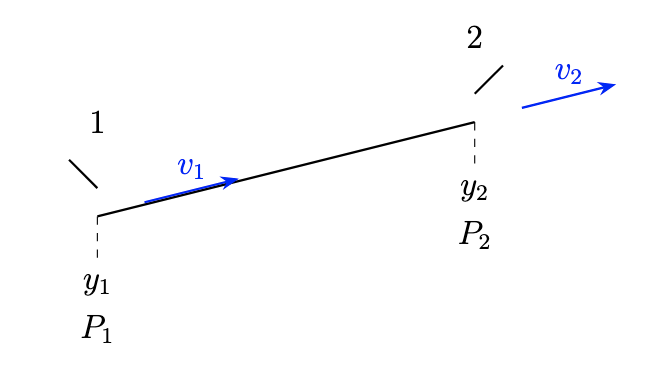
For any two points 1 and 2 on the same streamline:
- Pressure energy per unit volume: .
- Kinetic energy per unit volume: .
- Gravitational PE per unit volume: .
No losses the sum is constant along the streamline.
Terms in Bernoulli’s Equation:
Example Problem 5
Water (kg/m) flows through a horizontal Venturi tube narrowing from m to m. The pressure drop Pa. Find .
Solution. Continuity . Bernoulli (horizontal tube so )
So m/s.
Reasoning practice
Answer each with clear reference to continuity and/or Bernoulli.
(a) Pressure in a horizontal pipe. A pipe narrows smoothly from section A to B to C. Rank the pressures . Solution: Continuity narrower higher speed: . Bernoulli (horizontal) higher speed lower pressure: .
(b) Garden‐hose nozzle. You partially cover the end of a garden hose with your thumb, producing a narrow jet that reaches farther than without your thumb. Explain why. Solution: Covering the end reduces exit area by continuity the exit speed increases. Higher speed greater kinetic energy the water can travel farther.
(c) Chimney draft. On a windy day, the breeze blows across the top of a chimney and the draft increases, drawing more smoke upward. Why? Solution: High wind speed over the chimney top by Bernoulli the static pressure there drops. Lower pressure above the chimney than inside a net upward pressure difference on the smoke. Bigger pressure difference stronger draft.
(d) Perfume atomizer. Blowing across a small tube in a perfume bottle causes perfume to rise and spray. Explain mechanism. Solution: Fast air over the tube reduces pressure at its opening (Bernoulli). The higher pressure inside the bottle pushes liquid up the tube. The liquid enters the fast airstream and breaks into droplets.
(e) Drinking straw. When you suck on a straw, liquid rises into your mouth. Why does it not require a perfect seal? Solution: Suction lowers the pressure inside the straw above the liquid. Atmospheric pressure on the liquid surface is still higher than the pressure in the straw. That pressure difference pushes the liquid up until pressures balance.
Example Problem 6
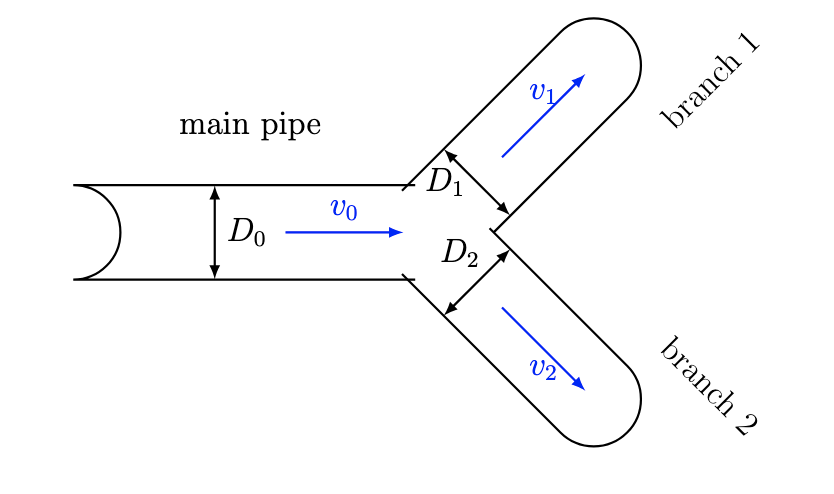
A main pipeline of diameter carries water at a steady volumetric flow rate . Downstream it splits into two branches of diameters and . If the speed in branch 1 is twice the speed in branch 2, find:
- The speeds and in the two branches.
- The flow rates and in each branch.
Solution.
Continuity at the junction:
where . Relation between speeds: Given , substitute into continuity:
Compute areas:
Solve for :
Then . Flow rates:
Check: m/s (rounding).
Example Problem 7
Water (kg/m) flows through a Venturi meter whose inlet diameter is cm and throat diameter cm. A mercury manometer (density kg/m) measures a column‐height difference mm between the two pressure taps. Neglect elevation changes. Find:
- The pressure difference from the manometer.
- The flow speed in the inlet.
- The volumetric flow rate .
Solution.
Manometer pressure difference:
Bernoulli + continuity:
Thus
Solve for :
Flow rate :
Example Problem 8
A hydraulic jack has a small piston of area m and a large piston of area m. A mechanic applies a downward force N on the small piston. The large piston supports a car of weight N.
- Using Pascal’s principle, compute the upward force on the large piston.
- Determine whether the jack remains static or accelerates upward, and if so find the upward acceleration.
Solution.
Pressure transmitted:
Compare forces on large piston: Upward N vs. weight N. Net downward force:
so the piston (and car) accelerate downward. Acceleration:
(Negative sign indicates downward motion.)