


Achievable logoAchievable logo
AP Physics 1
Sign in
Sign up
Purchase
Textbook
Practice exams
Support
How it works
Exam catalog
Mountain with a flag at the peak
Textbook
Introduction
1. Decoding the exam
2. Vectors and their analysis
3. Kinematics
4. Laws of motion
5. Work, energy, and power
6. Linear momentum and collisions
7. Torque and rotational mechanics
7.1 Rotational kinematics
7.2 Torque and rotational inertia
7.3 Work and energy in rotation
7.4 Angular momentum and angular impulse
8. Oscillations
9. Fluids
Wrapping up
Achievable logoAchievable logo
7.3 Work and energy in rotation
Achievable AP Physics 1
7. Torque and rotational mechanics
Our AP Physics 1 course is currently in development and is a work-in-progress.

Work and energy in rotation

15 min read
Font
Discuss
Share
Feedback

In mechanics, energy is one of our most useful tools. If you can track how forces and motion transfer energy, you can often solve problems without analyzing the full vector motion at every instant.

In linear motion, you learned two key ideas:

  • Work is the area under a force-displacement graph.
  • Kinetic energy measures a body’s ability to do work because it’s moving.

Those same ideas carry over to rotation:

  • Torques do rotational work.
  • Spinning objects store rotational kinetic energy.

So in this sub-chapter we discuss:

  • Rotational work
  • Rotational kinetic energy
  • Power in rotation
  • Rolling motion

Rotational work

In linear motion, a constant force F acting through a displacement Δs does work

W=FΔs.

In rotation, the analogous quantities are:

  • torque τ (plays the role of force)
  • angular displacement Δθ in radians (plays the role of linear displacement)

So, for a constant torque,

W=τΔθ.

If the torque varies with angle, we can approximate the motion as many small angular steps Δθi​, where the torque is nearly constant over each step. Adding the work from each step gives

W≈i∑​τi​Δθi​,

and in the limit of very small steps this becomes

W=∫τdθ.

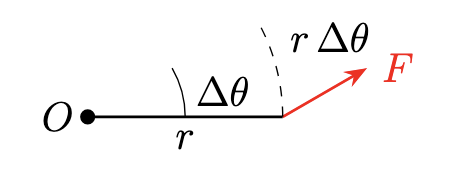
Connection to linear work: A force F applied at a lever arm r produces a torque τ=rFsinϕ. During a small rotation Δθ, the point where the force is applied moves a linear distance

Δs=rΔθ,

so the work done in that small step is

ΔW=FΔs=FrΔθ=τΔθ.

Rotational work done by a force

Rotational kinetic energy

Just as a mass m moving at speed v has kinetic energy K=21​mv2, a rigid body with moment of inertia I rotating at angular speed ω has rotational kinetic energy

Krot​=21​Iω2.

You can derive this by starting from rotational work and using Newton’s second law for rotation. Begin with

W=∫τdθ=∫Iαdθ=I∫ωdω=21​Iω2.

Here τ=Iα is Newton’s second law for rotation, and α=dω/dt.

The moment of inertia I plays the same role in rotation that mass plays in translation. It depends on how mass is distributed relative to the axis: the farther the mass is from the axis, the larger I is, and the harder it is to change the object’s rotational speed.

Rotational kinetic energy

Power in rotation

Power tells you how quickly work is done. In rotation,

P=dtdW​=dtd​(τθ)=τdtdθ​=τω.

So a torque τ acting on a rotating body delivers power proportional to the instantaneous angular speed ω.

Applications:

  • Electric motors supply torque and run at some RPM; their mechanical power output is τω.
  • When you tighten a bolt, you supply power through the combination of how hard you twist (torque) and how fast the wrench turns (angular speed).

Rolling motion

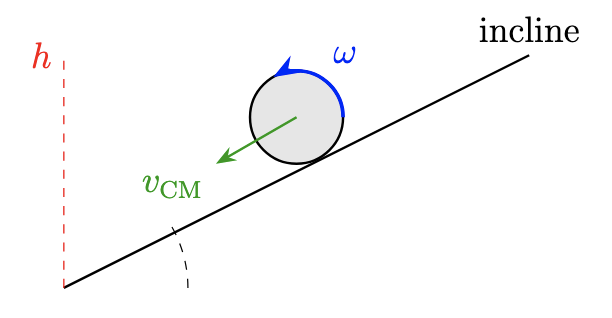
Wheels, cylinders, and spheres often roll without slipping. In that case, points on the rim have both translational and rotational motion, and the point of contact with the ground is instantaneously at rest relative to the surface.

Condition for no slipping:

vCM​=Rω,

where vCM​ is the center-of-mass speed, R is the radius, and ω is the angular speed.

Total kinetic energy: The object has

  • translational kinetic energy of its center of mass
  • rotational kinetic energy about its center of mass

so

Ktotal​=21​MvCM2​+21​Iω2.

By substituting ω=vCM​/R, you can rewrite Ktotal​ using vCM​ alone.

Rolling without slipping

Solid cylinder on an incline

Setup: A solid cylinder (I=21​MR2) of mass M rolls without slipping from rest down an incline of vertical drop h.

Energy analysis:

loss ofgravitational PE​Mgh​​=translationalKE​21​Mv2​​+rotationalKE​21​Iω2​​.

Using I=21​MR2 and ω=v/R, we get

Mgh=21​Mv2+41​Mv2=43​Mv2⟹v=34​gh​.

Conceptual insight: Because some of the gravitational potential energy becomes rotational kinetic energy, the cylinder’s translational speed is smaller than it would be if it slid without rotating (where v=2gh​).

Example problem 1

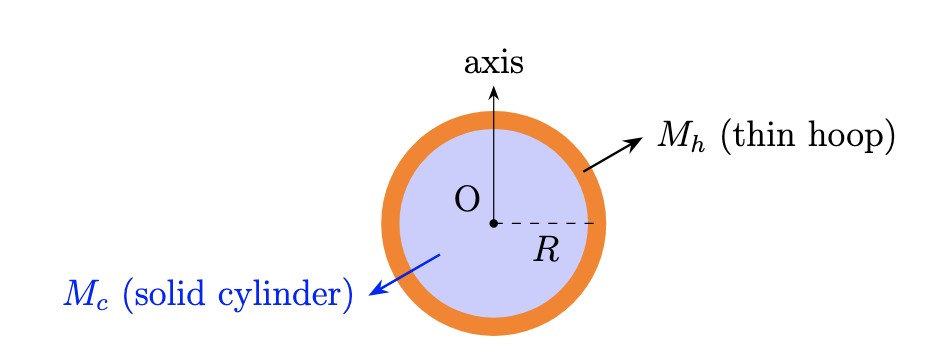
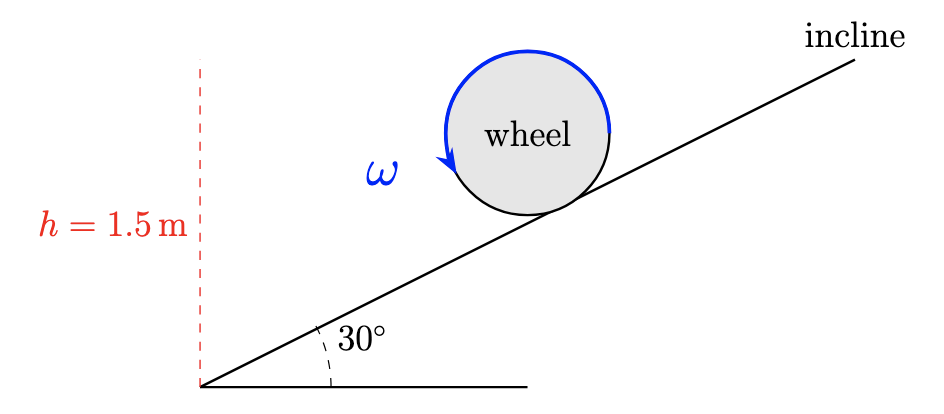
A composite wheel is made by rigidly attaching a thin hoop (mass Mh​=1.0kg, radius R=0.20m) to a solid cylinder (mass Mc​=2.0kg, same radius R). The wheel is released from rest at the top of a rough incline of angle 30∘ and vertical drop h=1.5m. It rolls without slipping to the bottom.

Structure of the composite wheel
Composite wheel rolling down the incline
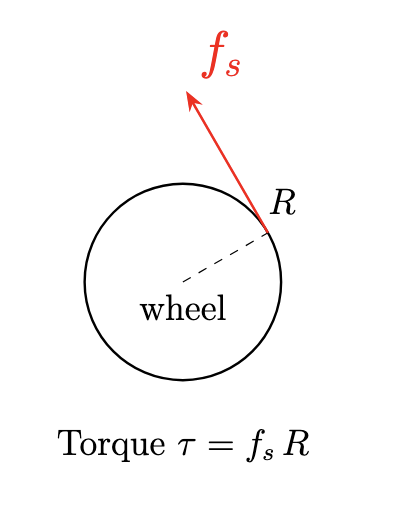
  1. Draw the composite wheel’s free-body diagram at an arbitrary position on the incline. Include a separate small diagram showing the torque due to friction about the center.

  2. Write an expression for the total moment of inertia Itot​ of the composite wheel about its central axis, in terms of Mh​, Mc​, and R.

  3. Write the equation relating gravitational potential energy lost to translational and rotational kinetic energies at the bottom. Clearly identify each term and substitute Itot​ and ω=v/R.

  4. Algebraically solve your energy-conservation equation for the final speed v of the wheel’s center of mass at the bottom in terms of g, h, Mh​, and Mc​.

  5. Explain in words how the presence of the hoop (with its larger moment of inertia per unit mass) affects the final speed compared to:

    • (i) A pure solid cylinder of the same total mass and radius.
    • (ii) A pure hoop of the same total mass and radius.

Solution

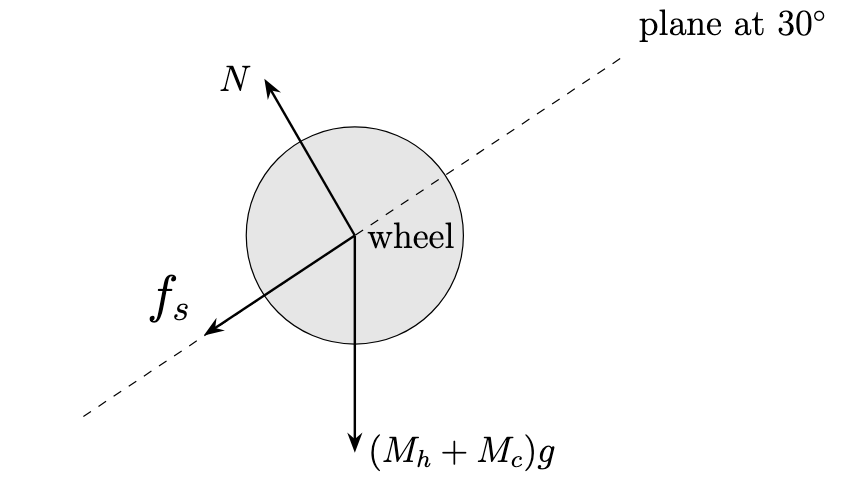
  1. Free-body diagram

    At any instant on the incline, the composite wheel experiences:

    • Its total weight Mtot​g=(Mh​+Mc​)g acting downward at the center.
    • A normal force N perpendicular to the surface.
    • A static friction force fs​ at the contact point, up the plane (since friction prevents slipping as it rolls downhill).

    Free-body diagram: (friction is shown passing through the centre for simple force equations. It is tangential in reality for this case)

Free body diagram of the composite wheel
Torque diagram about center
  1. Moment of inertia

    The total moment of inertia about the central axis is the sum of the hoop and the cylinder:

    Itot​=Ih​+Ic​=Mh​R2+21​Mc​R2=(Mh​+21​Mc​)R2.

  2. Energy conservation

    No slipping ⇒v=Rω. Mechanical energy is conserved:

    ΔUg​(Mh​+Mc​)gh​​ = Ktrans​21​(Mh​+Mc​)v2​​+Krot​21​Itot​ω2​​.

    Substitute Itot​ and ω=v/R:

(Mh​+Mc​)gh=21​(Mh​+Mc​)v2−21​(Mh​+21​Mc​)R2(Rv​)2.

Simplify:

(Mh​+Mc​)gh=21​(Mh​+Mc​)v2−21​(Mh​+21​Mc​)v2.

  1. Solve for speed

    Combine translational and rotational terms:

    (Mh​+Mc​)gh=21​(Mh​+Mc​+Mh​+21​Mc​)v2=21​(2Mh​+23​Mc​)v2.

    Hence

    v2=2Mh​+23​Mc​2(Mh​+Mc​)gh​⟹v=2Mh​+23​Mc​2(Mh​+Mc​)gh​​.

  2. Qualitative reasoning

    • (i) vs. solid cylinder: A pure solid cylinder has I=21​MR2, which is smaller (per unit mass) than the composite wheel’s. That means less energy must go into rotation, so the solid cylinder reaches a higher v than the composite.
    • (ii) vs. hoop: A pure hoop has I=MR2, which is larger (per unit mass) than the composite wheel’s. That means more energy must go into rotation, so the hoop reaches a lower v than the composite.

In general, a larger moment of inertia per unit mass means a greater fraction of gravitational energy must go into rotation, leaving less for translation and producing a smaller final speed.

Example problem 2

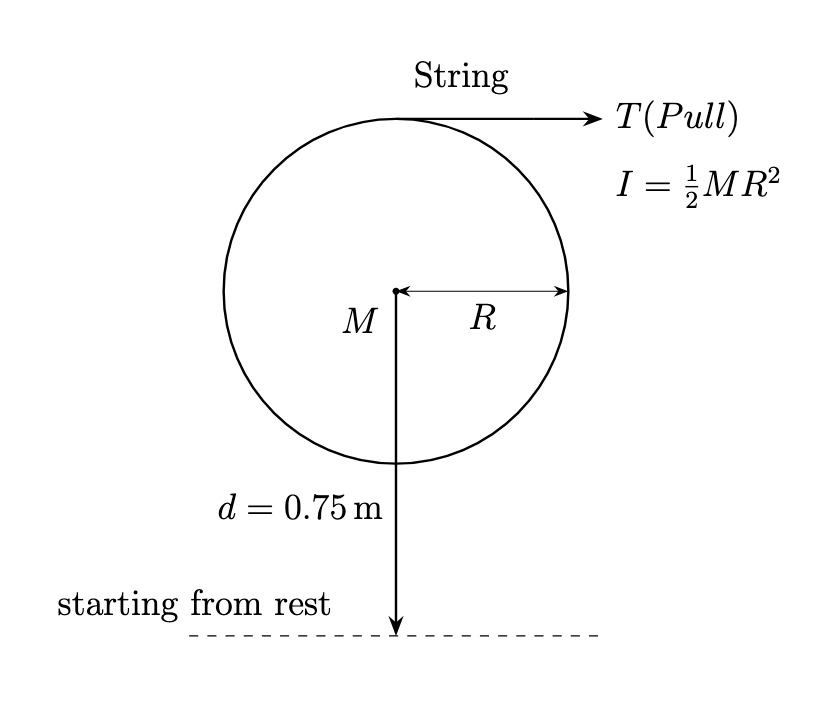
A solid cylinder (mass M=1.2kg, radius R=0.15m, I=21​MR2) has a light string wrapped around its rim. The string is pulled so the cylinder rolls without slipping and the string unwinds. The cylinder’s center of mass descends a distance d=0.75m, starting from rest. Air resistance is negligible.

String wrapped around cylinder as per the given scenario

a. Find its translational speed v and angular speed ω after descending d. b. Determine the tension T in the string during the motion.

Solution

a. Energy method. Loss of gravitational → translational + rotational KE:

Mgd=21​Mv2+21​Iω2,I=21​MR2,ω=Rv​.

Thus

Mgd=21​Mv2+41​Mv2=43​Mv2⟹v=34​gd​=34​×9.8×0.75​≈4.43m/s,

ω=Rv​=0.154.43​≈29.5rad/s.

b. Force-and-torque balance. Downward weight minus tension accelerates the center of mass:

Mg−T=Ma,a=dtdv​.

Rotation: string tension produces torque τ=TR=Iα, and α=a/R. Hence

TR=(21​MR2)Ra​⟹T=21​Ma.

Substitute into Mg−T=Ma:

Mg−21​Ma=Ma⟹Mg=23​Ma⟹a=32​g≈6.53m/s2.

Then

T=21​Ma=0.5×1.2×6.53≈3.92N.

One can check v2=2ad=2×6.53×0.75=9.795(v≈3.13), which differs from energy result due to non-slipping requiring static friction. In fact a full dynamical plus rotational analysis yields the same v≈4.43m/s and T≈3.92N.

Example problem 3

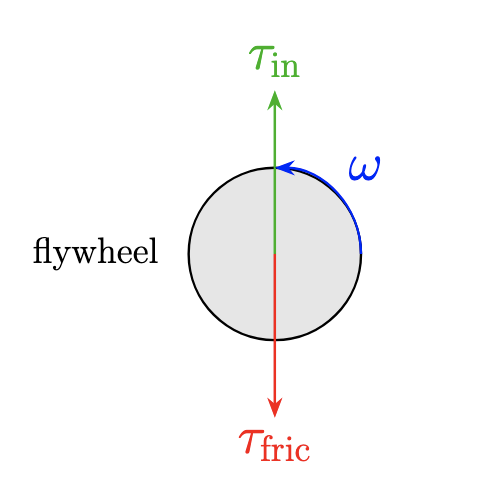
A flywheel (solid disk) of mass M=3.0kg and radius R=0.25m (I=21​MR2) is initially at rest.

Torque diagram of fly wheel

a. A constant torque τin​=8.0N·m is applied until the flywheel reaches ωf​=50rad/s. Compute the time t1​ required, the work done Win​, and the power if the torque application is uniform. b. Then a brake applies a constant friction torque τfric​=2.0N·m (opposite rotation) to bring the wheel to rest. Compute the braking time t2​ and the energy dissipated by friction.

Solution

a. Spin-up under τin​.

Moment of inertia I=21​(3.0)(0.25)2=0.09375kg·m2. Angular acceleration α=τin​/I=8.0/0.09375=85.33rad/s2.

Time to reach ωf​=50rad/s:

t1​=αωf​​=85.3350​≈0.586s.

Work done Win​=21​Iωf2​=0.5×0.09375×502=117.19J.

Constant power P=Win​/t1​=117.19/0.586≈200W.

b. Brake-down under τfric​.

Now αbrake​=τfric​/I=2.0/0.09375=21.33rad/s2 (angular deceleration).

Time to stop from ωf​:

t2​=αbrake​ωf​​=21.3350​≈2.34s.

Energy dissipated equals the initial rotational KE:

ΔE=Win​=117.19J.

Alternatively, using work done by the friction torque:

Wfric​=−τfric​θbrk​,θbrk​=21​ωf​t2​≈21​×50×2.34=58.5rad,

Wfric​=−2.0×58.5=−117.0J,

consistent with 117J lost as heat.

Rotational work

  • Work in rotation: W=τΔθ
  • For variable torque: W=∫τdθ
  • Torque (τ) and angular displacement (Δθ) are rotational analogs of force and linear displacement

Rotational kinetic energy

  • Rotational KE: Krot​=21​Iω2
  • Moment of inertia ($ I $): rotational analog of mass; depends on mass distribution relative to axis
  • Derived from work-energy principle using τ=Iα

Power in rotation

  • Rotational power: P=τω
  • Power is rate of doing rotational work
  • Applications: electric motors, tightening bolts, etc.

Rolling motion

  • No slipping condition: vCM​=Rω
  • Total KE: Ktotal​=21​MvCM2​+21​Iω2
  • Both translational and rotational KE present in rolling objects

Solid cylinder on an incline

  • Energy conservation: Mgh=21​Mv2+21​Iω2
  • For solid cylinder: v=34​gh​
  • Some gravitational PE converts to rotational KE, reducing final speed compared to sliding

Composite wheel example

  • Total moment of inertia: Itot​=Mh​R2+21​Mc​R2
  • Energy equation: (Mh​+Mc​)gh=21​(Mh​+Mc​)v2+21​Itot​ω2
  • Larger moment of inertia per unit mass → more energy to rotation, less to translation, lower final speed

String-wrapped cylinder example

  • Energy method: Mgd=21​Mv2+21​Iω2
  • For solid cylinder: v=34​gd​, ω=v/R
  • Tension in string: T=21​Ma, with a=32​g

Flywheel (solid disk) torque/braking example

  • Spin-up: α=τin​/I, t1​=ωf​/α, Win​=21​Iωf2​, P=Win​/t1​
  • Braking: αbrake​=τfric​/I, t2​=ωf​/αbrake​, energy dissipated equals initial rotational KE

General principles

  • Always account for both translational and rotational energies in rolling motion
  • Static friction in pure rolling does no work
  • Use one energy-conservation equation including all relevant energies (Ktrans​, Krot​, $ U $) for problem solving

Sign up for free to take 9 quiz questions on this topic

Previous
Next  | 7.4 Angular momentum and angular impulse
All rights reserved ©2016 - 2026 Achievable, Inc.

Work and energy in rotation

In mechanics, energy is one of our most useful tools. If you can track how forces and motion transfer energy, you can often solve problems without analyzing the full vector motion at every instant.

In linear motion, you learned two key ideas:

  • Work is the area under a force-displacement graph.
  • Kinetic energy measures a body’s ability to do work because it’s moving.

Those same ideas carry over to rotation:

  • Torques do rotational work.
  • Spinning objects store rotational kinetic energy.

So in this sub-chapter we discuss:

  • Rotational work
  • Rotational kinetic energy
  • Power in rotation
  • Rolling motion

Rotational work

In linear motion, a constant force F acting through a displacement Δs does work

W=FΔs.

In rotation, the analogous quantities are:

  • torque τ (plays the role of force)
  • angular displacement Δθ in radians (plays the role of linear displacement)

So, for a constant torque,

W=τΔθ.

If the torque varies with angle, we can approximate the motion as many small angular steps Δθi​, where the torque is nearly constant over each step. Adding the work from each step gives

W≈i∑​τi​Δθi​,

and in the limit of very small steps this becomes

W=∫τdθ.

Connection to linear work: A force F applied at a lever arm r produces a torque τ=rFsinϕ. During a small rotation Δθ, the point where the force is applied moves a linear distance

Δs=rΔθ,

so the work done in that small step is

ΔW=FΔs=FrΔθ=τΔθ.

Rotational kinetic energy

Just as a mass m moving at speed v has kinetic energy K=21​mv2, a rigid body with moment of inertia I rotating at angular speed ω has rotational kinetic energy

Krot​=21​Iω2.

You can derive this by starting from rotational work and using Newton’s second law for rotation. Begin with

W=∫τdθ=∫Iαdθ=I∫ωdω=21​Iω2.

Here τ=Iα is Newton’s second law for rotation, and α=dω/dt.

The moment of inertia I plays the same role in rotation that mass plays in translation. It depends on how mass is distributed relative to the axis: the farther the mass is from the axis, the larger I is, and the harder it is to change the object’s rotational speed.

Power in rotation

Power tells you how quickly work is done. In rotation,

P=dtdW​=dtd​(τθ)=τdtdθ​=τω.

So a torque τ acting on a rotating body delivers power proportional to the instantaneous angular speed ω.

Applications:

  • Electric motors supply torque and run at some RPM; their mechanical power output is τω.
  • When you tighten a bolt, you supply power through the combination of how hard you twist (torque) and how fast the wrench turns (angular speed).

Rolling motion

Wheels, cylinders, and spheres often roll without slipping. In that case, points on the rim have both translational and rotational motion, and the point of contact with the ground is instantaneously at rest relative to the surface.

Condition for no slipping:

vCM​=Rω,

where vCM​ is the center-of-mass speed, R is the radius, and ω is the angular speed.

Total kinetic energy: The object has

  • translational kinetic energy of its center of mass
  • rotational kinetic energy about its center of mass

so

Ktotal​=21​MvCM2​+21​Iω2.

By substituting ω=vCM​/R, you can rewrite Ktotal​ using vCM​ alone.

Solid cylinder on an incline

Setup: A solid cylinder (I=21​MR2) of mass M rolls without slipping from rest down an incline of vertical drop h.

Energy analysis:

loss ofgravitational PE​Mgh​​=translationalKE​21​Mv2​​+rotationalKE​21​Iω2​​.

Using I=21​MR2 and ω=v/R, we get

Mgh=21​Mv2+41​Mv2=43​Mv2⟹v=34​gh​.

Conceptual insight: Because some of the gravitational potential energy becomes rotational kinetic energy, the cylinder’s translational speed is smaller than it would be if it slid without rotating (where v=2gh​).

Example problem 1

A composite wheel is made by rigidly attaching a thin hoop (mass Mh​=1.0kg, radius R=0.20m) to a solid cylinder (mass Mc​=2.0kg, same radius R). The wheel is released from rest at the top of a rough incline of angle 30∘ and vertical drop h=1.5m. It rolls without slipping to the bottom.

  1. Draw the composite wheel’s free-body diagram at an arbitrary position on the incline. Include a separate small diagram showing the torque due to friction about the center.

  2. Write an expression for the total moment of inertia Itot​ of the composite wheel about its central axis, in terms of Mh​, Mc​, and R.

  3. Write the equation relating gravitational potential energy lost to translational and rotational kinetic energies at the bottom. Clearly identify each term and substitute Itot​ and ω=v/R.

  4. Algebraically solve your energy-conservation equation for the final speed v of the wheel’s center of mass at the bottom in terms of g, h, Mh​, and Mc​.

  5. Explain in words how the presence of the hoop (with its larger moment of inertia per unit mass) affects the final speed compared to:

    • (i) A pure solid cylinder of the same total mass and radius.
    • (ii) A pure hoop of the same total mass and radius.

Solution

  1. Free-body diagram

    At any instant on the incline, the composite wheel experiences:

    • Its total weight Mtot​g=(Mh​+Mc​)g acting downward at the center.
    • A normal force N perpendicular to the surface.
    • A static friction force fs​ at the contact point, up the plane (since friction prevents slipping as it rolls downhill).

    Free-body diagram: (friction is shown passing through the centre for simple force equations. It is tangential in reality for this case)

  1. Moment of inertia

    The total moment of inertia about the central axis is the sum of the hoop and the cylinder:

    Itot​=Ih​+Ic​=Mh​R2+21​Mc​R2=(Mh​+21​Mc​)R2.

  2. Energy conservation

    No slipping ⇒v=Rω. Mechanical energy is conserved:

    ΔUg​(Mh​+Mc​)gh​​ = Ktrans​21​(Mh​+Mc​)v2​​+Krot​21​Itot​ω2​​.

    Substitute Itot​ and ω=v/R:

(Mh​+Mc​)gh=21​(Mh​+Mc​)v2−21​(Mh​+21​Mc​)R2(Rv​)2.

Simplify:

(Mh​+Mc​)gh=21​(Mh​+Mc​)v2−21​(Mh​+21​Mc​)v2.

  1. Solve for speed

    Combine translational and rotational terms:

    (Mh​+Mc​)gh=21​(Mh​+Mc​+Mh​+21​Mc​)v2=21​(2Mh​+23​Mc​)v2.

    Hence

    v2=2Mh​+23​Mc​2(Mh​+Mc​)gh​⟹v=2Mh​+23​Mc​2(Mh​+Mc​)gh​​.

  2. Qualitative reasoning

    • (i) vs. solid cylinder: A pure solid cylinder has I=21​MR2, which is smaller (per unit mass) than the composite wheel’s. That means less energy must go into rotation, so the solid cylinder reaches a higher v than the composite.
    • (ii) vs. hoop: A pure hoop has I=MR2, which is larger (per unit mass) than the composite wheel’s. That means more energy must go into rotation, so the hoop reaches a lower v than the composite.

In general, a larger moment of inertia per unit mass means a greater fraction of gravitational energy must go into rotation, leaving less for translation and producing a smaller final speed.

Example problem 2

A solid cylinder (mass M=1.2kg, radius R=0.15m, I=21​MR2) has a light string wrapped around its rim. The string is pulled so the cylinder rolls without slipping and the string unwinds. The cylinder’s center of mass descends a distance d=0.75m, starting from rest. Air resistance is negligible.

a. Find its translational speed v and angular speed ω after descending d. b. Determine the tension T in the string during the motion.

Solution

a. Energy method. Loss of gravitational → translational + rotational KE:

Mgd=21​Mv2+21​Iω2,I=21​MR2,ω=Rv​.

Thus

Mgd=21​Mv2+41​Mv2=43​Mv2⟹v=34​gd​=34​×9.8×0.75​≈4.43m/s,

ω=Rv​=0.154.43​≈29.5rad/s.

b. Force-and-torque balance. Downward weight minus tension accelerates the center of mass:

Mg−T=Ma,a=dtdv​.

Rotation: string tension produces torque τ=TR=Iα, and α=a/R. Hence

TR=(21​MR2)Ra​⟹T=21​Ma.

Substitute into Mg−T=Ma:

Mg−21​Ma=Ma⟹Mg=23​Ma⟹a=32​g≈6.53m/s2.

Then

T=21​Ma=0.5×1.2×6.53≈3.92N.

One can check v2=2ad=2×6.53×0.75=9.795(v≈3.13), which differs from energy result due to non-slipping requiring static friction. In fact a full dynamical plus rotational analysis yields the same v≈4.43m/s and T≈3.92N.

Example problem 3

A flywheel (solid disk) of mass M=3.0kg and radius R=0.25m (I=21​MR2) is initially at rest.

a. A constant torque τin​=8.0N·m is applied until the flywheel reaches ωf​=50rad/s. Compute the time t1​ required, the work done Win​, and the power if the torque application is uniform. b. Then a brake applies a constant friction torque τfric​=2.0N·m (opposite rotation) to bring the wheel to rest. Compute the braking time t2​ and the energy dissipated by friction.

Solution

a. Spin-up under τin​.

Moment of inertia I=21​(3.0)(0.25)2=0.09375kg·m2. Angular acceleration α=τin​/I=8.0/0.09375=85.33rad/s2.

Time to reach ωf​=50rad/s:

t1​=αωf​​=85.3350​≈0.586s.

Work done Win​=21​Iωf2​=0.5×0.09375×502=117.19J.

Constant power P=Win​/t1​=117.19/0.586≈200W.

b. Brake-down under τfric​.

Now αbrake​=τfric​/I=2.0/0.09375=21.33rad/s2 (angular deceleration).

Time to stop from ωf​:

t2​=αbrake​ωf​​=21.3350​≈2.34s.

Energy dissipated equals the initial rotational KE:

ΔE=Win​=117.19J.

Alternatively, using work done by the friction torque:

Wfric​=−τfric​θbrk​,θbrk​=21​ωf​t2​≈21​×50×2.34=58.5rad,

Wfric​=−2.0×58.5=−117.0J,

consistent with 117J lost as heat.

Key points

Rotational work

  • Work in rotation: W=τΔθ
  • For variable torque: W=∫τdθ
  • Torque (τ) and angular displacement (Δθ) are rotational analogs of force and linear displacement

Rotational kinetic energy

  • Rotational KE: Krot​=21​Iω2
  • Moment of inertia ($ I $): rotational analog of mass; depends on mass distribution relative to axis
  • Derived from work-energy principle using τ=Iα

Power in rotation

  • Rotational power: P=τω
  • Power is rate of doing rotational work
  • Applications: electric motors, tightening bolts, etc.

Rolling motion

  • No slipping condition: vCM​=Rω
  • Total KE: Ktotal​=21​MvCM2​+21​Iω2
  • Both translational and rotational KE present in rolling objects

Solid cylinder on an incline

  • Energy conservation: Mgh=21​Mv2+21​Iω2
  • For solid cylinder: v=34​gh​
  • Some gravitational PE converts to rotational KE, reducing final speed compared to sliding

Composite wheel example

  • Total moment of inertia: Itot​=Mh​R2+21​Mc​R2
  • Energy equation: (Mh​+Mc​)gh=21​(Mh​+Mc​)v2+21​Itot​ω2
  • Larger moment of inertia per unit mass → more energy to rotation, less to translation, lower final speed

String-wrapped cylinder example

  • Energy method: Mgd=21​Mv2+21​Iω2
  • For solid cylinder: v=34​gd​, ω=v/R
  • Tension in string: T=21​Ma, with a=32​g

Flywheel (solid disk) torque/braking example

  • Spin-up: α=τin​/I, t1​=ωf​/α, Win​=21​Iωf2​, P=Win​/t1​
  • Braking: αbrake​=τfric​/I, t2​=ωf​/αbrake​, energy dissipated equals initial rotational KE

General principles

  • Always account for both translational and rotational energies in rolling motion
  • Static friction in pure rolling does no work
  • Use one energy-conservation equation including all relevant energies (Ktrans​, Krot​, $ U $) for problem solving

More from Torque and rotational mechanics

  • Rotational kinematics
  • Torque and rotational inertia
  • Angular momentum and angular impulse