



Ricardian trade
After reading the works of Adam Smith in the late 18th Century, David Ricardo built upon those foundations of economics as a modern field. His works are considered foundational for classical economics, the main branch of economics until the early 20th century. We will define more specifically what the AP exam requires for understanding economic schools of thought later on.
For now we will discuss the theory of international trade that Ricardo built up. The PPC gives us a base to build up a simplified example of international trade. We have two countries, who each produce the same two goods following its own production possibilities curve. Goods here is shorthand for any type of production, it could be a good or a service it is just makes the presentation easier.
All trade between the countries is costless, instant, and voluntary. So there are no issues with travel costs, the timing of receiving goods, or any other details.
Our jumping off point is two definitions of how to compare production across countries.
Absolute and comparative advantage, combined with some simple mathematical calculations and comparisons allow us to determine the benefits of trade. The benefits will solely come from comparative advantage and the ability of countries to specialize in production. For AP Macroeconomics, this is exclusively done using production tables or PPC graphs. There are other methods, but they are only used in AP Microeconomics.
Absolute advantage
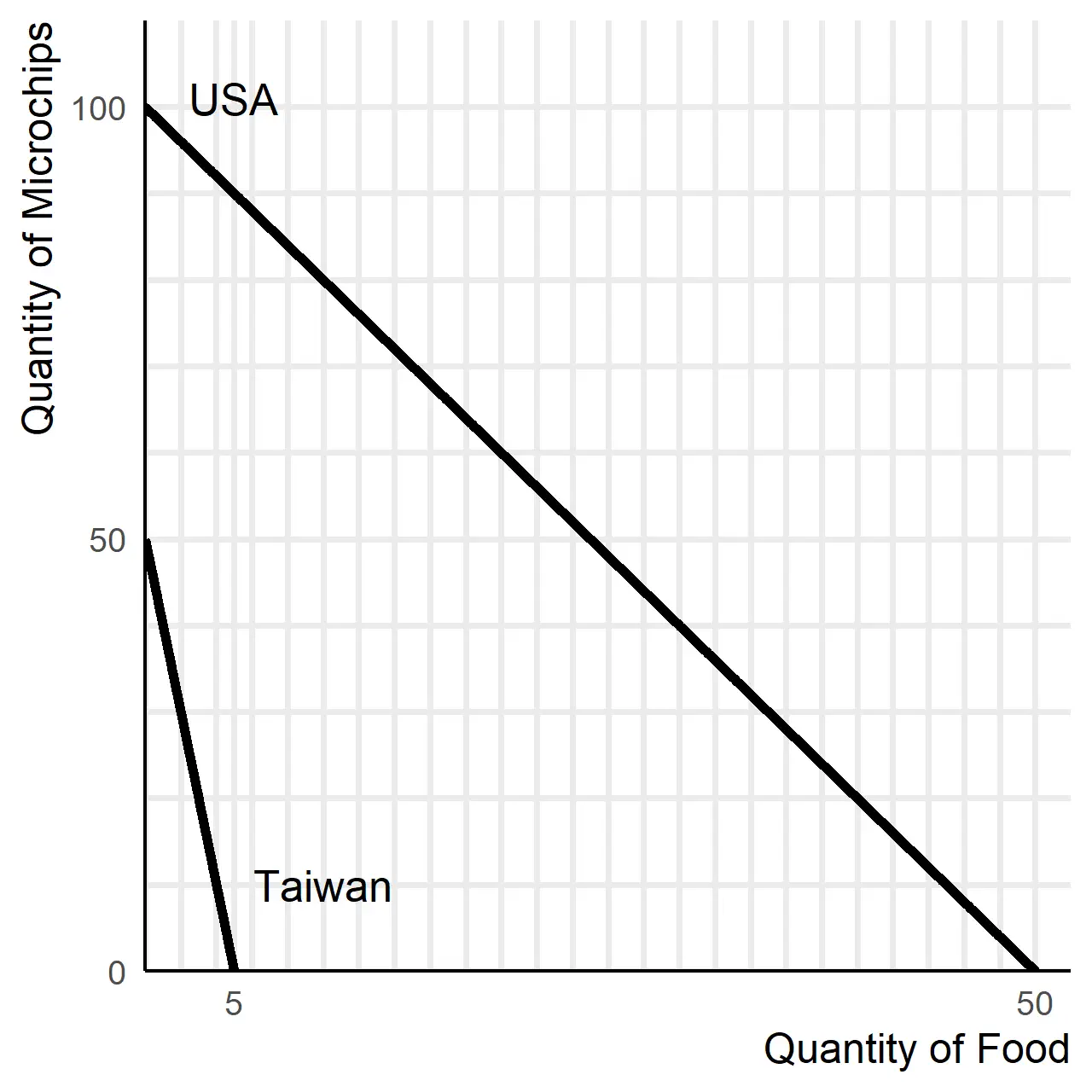
For our example, we take the PPC for the United States from the previous subchapter. So when the US specializes, they can produce 20 units of food or 100 units of microchips. Now we add a second country, Taiwan, who can produce 5 units of food or 50 units of microchips. These numbers are summarized in the table below.
| Food | Microchips | |
|---|---|---|
| USA | 20 | 100 |
| Taiwan | 5 | 50 |
Absolute advantage can be easily determined when the PPCs are presented as a table. The United States of America has an absolute advantage in food, because their possible production is higher than Taiwan’s. That is 20 > 5. Similarly, the United States of America has an absolute advantage in microchips because they can produce more, 100 > 50.
There is no issue with this result. One country can have an absolute advantage in both goods, or it can be split with one for each country. These are the only possibilities.
Comparative advantage
To find comparative advantage, we need to know how to calculate the opportunity cost of production. Because our PPFs are always linear, this is straightforward and clear. The general rule is given by
When given a chart, for a FRQ it is simplest to use the good on the x-axis as the focus good. For multiple choice questions, pay extra close attention to what is being asked. For this example, both ways will be shown. This is mainly to illustrate that if you interpret the numbers correctly, either method is fine.
We start with the opportunity cost of food. For the USA, . The negative of this is the slope of the PPC, since food is on the x-axis. For Taiwan . The negative of this is the slope of Taiwan’s PPC.
Comparative advantage is determined by seeing which OC is lowest. We have that the USA’s is smaller than Taiwan’s , . This means that the United States should specialize in food. From this we might guess that Taiwan should specialize in microchips. Let’s verify that.
For the USA, . For Taiwan, . Comparing these results, for microchips Taiwan has a smaller than the USA, . So the guess that Taiwan should specialize in microchips was correct.
Unlike absolute advantage, comparative advantage must be split. In this example, that means that the US having comparative advantage in food automatically means that Taiwan should have comparative advantage in microchips. Once we check one good, we know what is true for the other. If the OC of each country is the same, then we say there is no comparative advantage.
Graphically, if we can tell which PPC has the steepest slope, that is the country that has comparative advantage in the x-axis good. Conversely, the country with the flattest slope of its PPC has a comparative advantage in the y-axis good. This method can fail if the OCs are close, but may be useful if there are large differences.
Gains from trade
Our final topic is the gains from trade. For this we need one additional definition.
For our example and focusing on food, results in gains from trade. For example gives the USA more microchips per unit of food than producing themselves. On the other hand, Taiwan pays less than their own OC to get food by trading microchips. In this setup gains from trade result purely from comparative advantage allowing specialization.
As long as the Terms of Trade falls between the two opportunity costs, voluntary trade is mutually beneficial. This means that there is only one situation where trade is not mutually beneficial, when the opportunity costs are equal. Trade leads to no benefits only in that exact situation. Any time the opportunity costs are different, not only are there guaranteed to be gains from trade, but each country receives some benefit.
Light thoughts beyond Ricardo
This is clearly just a model, but the result is important. Trade is beneficial, because it allows a country to produce what it is best at making and trade for goods that other countries are better at making. This is a positive statement.
There are normative judgements for not purely trading and producing based on comparative advantage. One that is not uncommon is for national security. This is a case where even if goods are available, not every country will sell to you and producing yourself is the surest way to ensure supply. This applies to military equipment and potentially to key production inputs for industries that are considered economically significant.
Microchips were chosen for our example because they are an example of such a good. In recent years Taiwan has been the major source of semiconductors, the majority from a single company. The United States has incentivized that company to invest in production in the United States for exactly the type of reasons outlined here.
Another important hidden factor at this level of Ricardian modeling is productivity. Productivity is the efficiency of production of goods. At its most basic level, it can be measured as output per unit of resources. Since we have avoided discussing how production takes place, specifics of technology or use of resources, we can say nothing about productivity. Productivity will come up again when we talk about economic growth.