



Slope fields
A slope field is a diagram of short line segments. Each segment shows the slope of a solution curve at a particular point on the coordinate plane. By looking at all the segments together, you can see the general shape of the curves that satisfy the differential equation.
Sketching slope fields
On the AP exam, you may be given a small grid (typically extending about 2 units in each direction from the origin) and asked to sketch a basic slope field. To do this:
-
At each point , calculate the slope by plugging the values into the given .
-
Draw a short line segment at that point with the corresponding slope.
Examples
- Sketch a slope field of the differential equation:
This equation tells you that at any point on the solution curve, the slope of the tangent line is the value of . Calculating the slopes at a few points:
- At , the slope is
So we draw a short horizontal segment at the point .
- At , the slope is
Draw a short segment with slope at .
It may help to construct a table with a few points and their corresponding slopes:
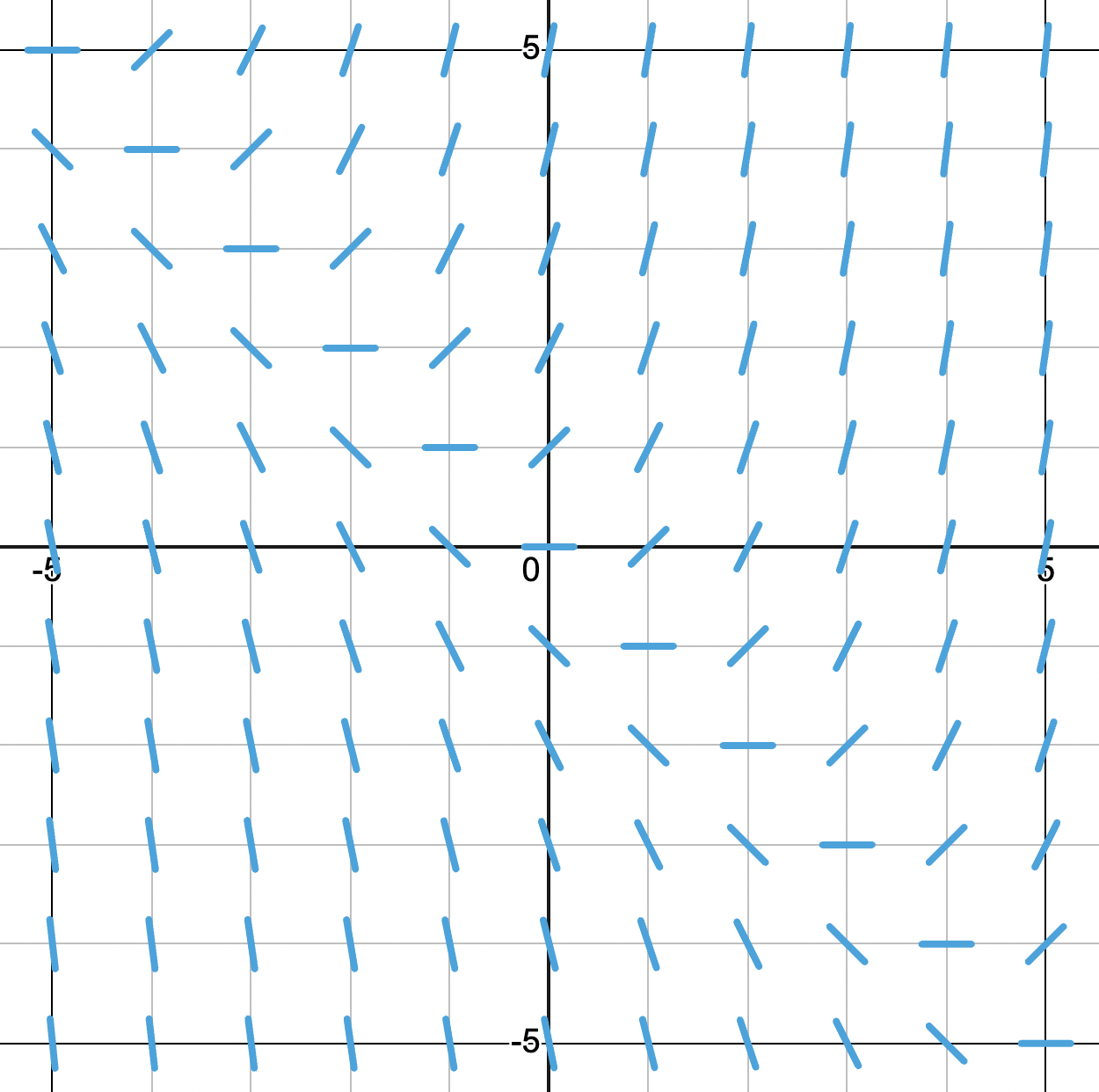
Here’s the slope field. The segment at each point has the slope calculated from the differential equation.
- Sketch a slope field of the differential equation:
Solution
Since the differential equation depends only on , every point with the same -coordinate has the same slope.
- At , the slopes are
Draw line segments with slope at each point on the vertical line .
Let’s construct a table to organize a few of the values:
| -value | |
|---|---|
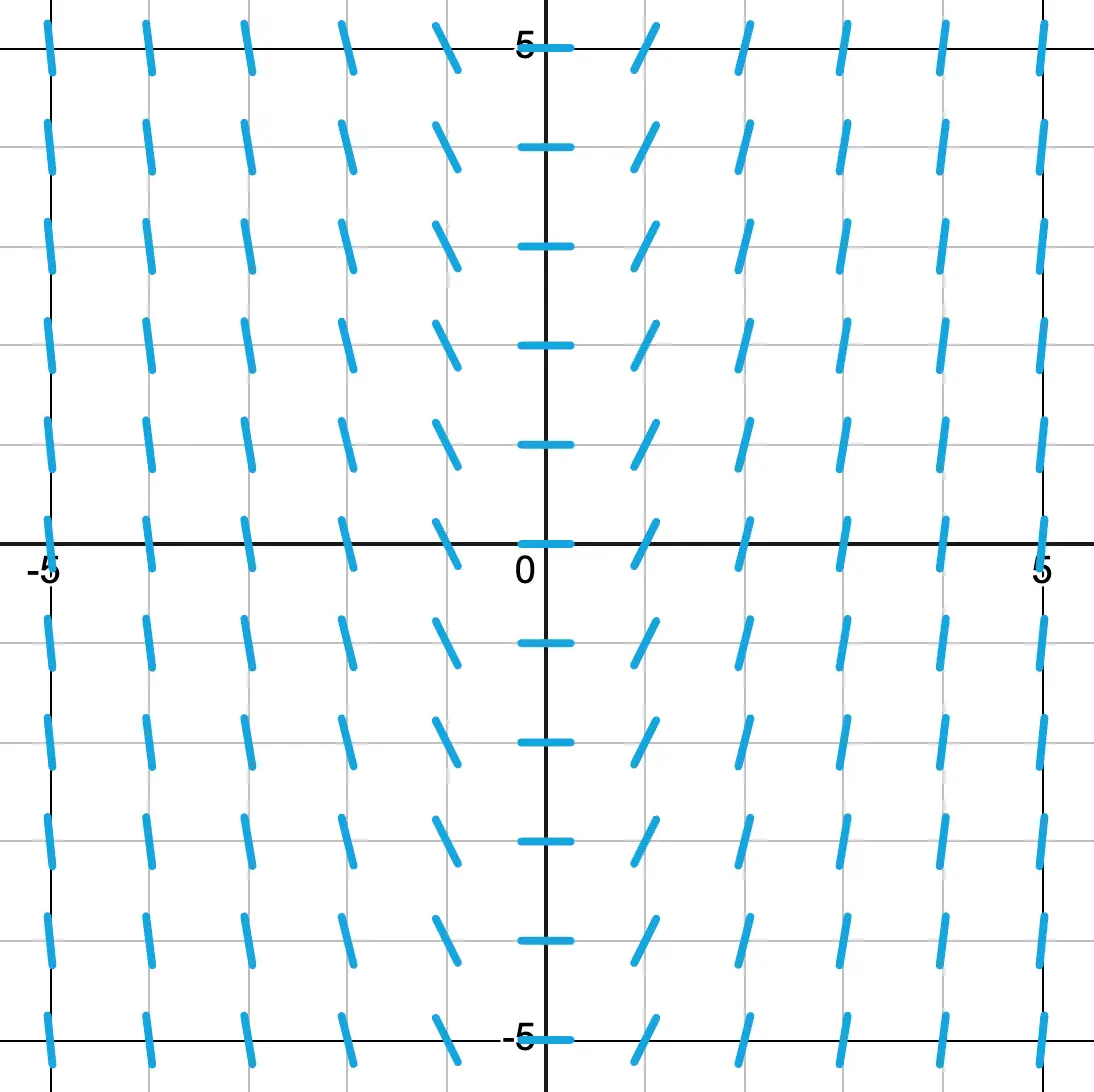
Below is the slope field for the differential equation:
Notice that the solution curves in the slope field follow a shape similar to a parabola. For differential equations that depend only on , the solution curves are essentially the family of antiderivatives. In this example, the solutions to form the family of antiderivatives
with different values of corresponding to vertically shifted curves. This illustrates the purpose of slope fields: they let you visualize all possible solutions at once, even for equations that cannot be solved explicitly.
Try sketching the slope fields for the following differential equations and check them on this slope field plotter in Desmos by changing the differential equation .
Particular solutions and initial conditions
A slope field shows all possible solution curves for a differential equation. Given an initial condition, one specific curve is selected - the particular solution.
For example, the initial condition means the solution curve must pass through the point .
To sketch the particular solution:
-
Locate the point that corresponds to the initial condition e.g. means .
-
Sketch a curve that is tangent to the slope segments as you move through the slope field. The curve should follow the “tilt” of the segments.
-
This curve represents the unique solution to the differential equation that passes through the given point and helps you visualize how the solution behaves.
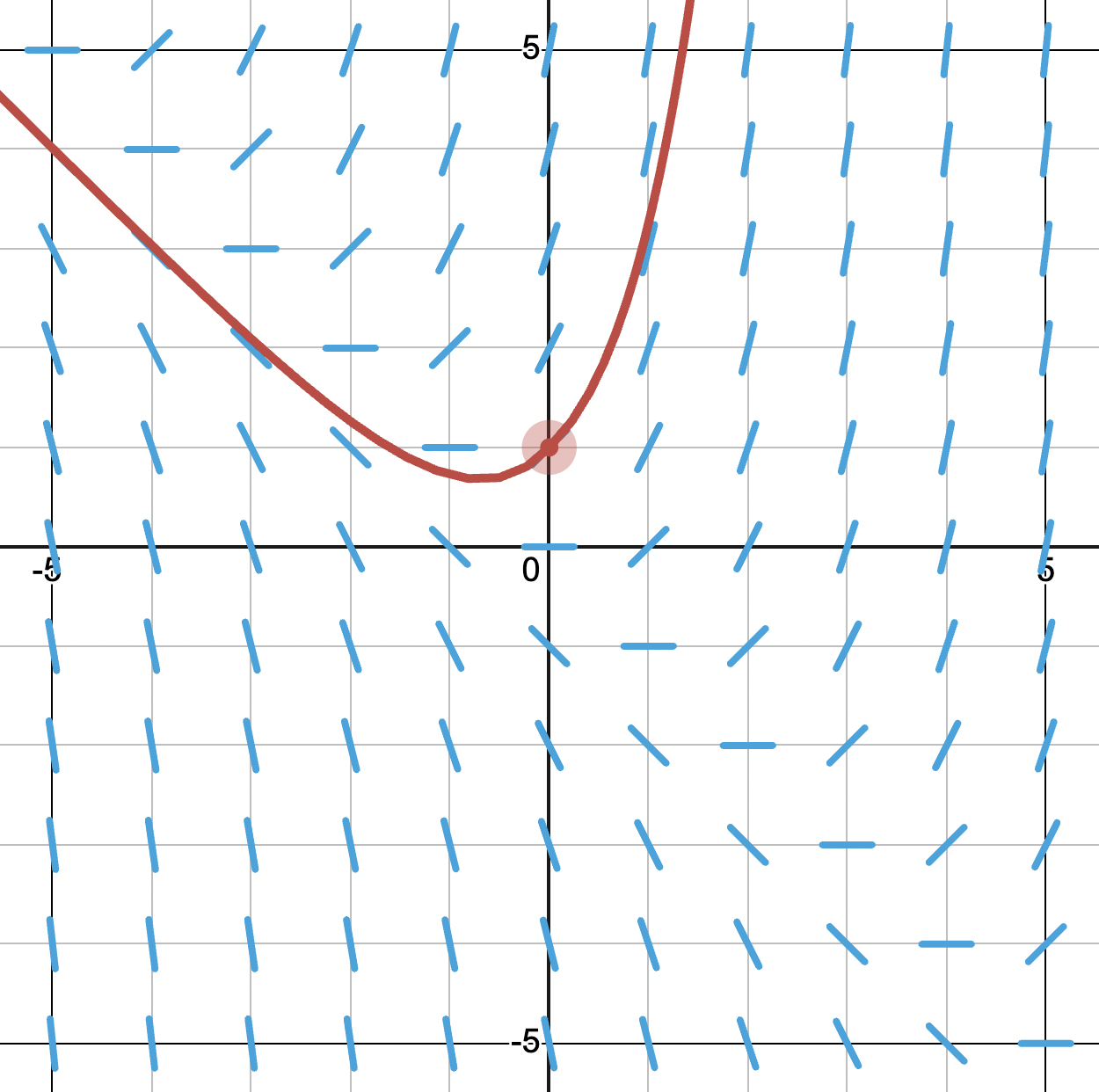
Using the slope field for , shown below is the solution curve that passes through :
Reasoning with slope fields
Sometimes you’ll be given a slope field and asked to identify the matching equation. The answer choices could be either differential equations or specific solutions.
If the choices are differential equations, look for the following patterns on the slope field and confirm with test points:
1. Horizontal slopes (slope ) or vertical slopes (empty regions)
-
Horizontal lines occur where .
-
Test points with any flat segments by plugging them into the differential equation to confirm the slope is .
-
If there are vertical line segments or certain regions in the field are empty, the derivative is undefined at those points. Check the DE for division by zero or other restrictions.
2. Check slope signs
-
Pick test points in different quadrants that show positive or negative slopes.
-
Plug each point into the differential equations to confirm the signs. Use this to eliminate any slope-field options that don’t match.
-
Example: Given
- Quadrant slopes are positive
- Quadrant slopes are negative
- Quadrant slopes are positive
- Quadrant slopes are negative
3. Horizontal patterns
- If slopes remain the same when moving left to right across the graph, it means the -value does not affect the slope, so depends only on .
4. Vertical patterns
- Similarly, if slopes remain the same when moving up and down along vertical columns, then depends only on .
Examples
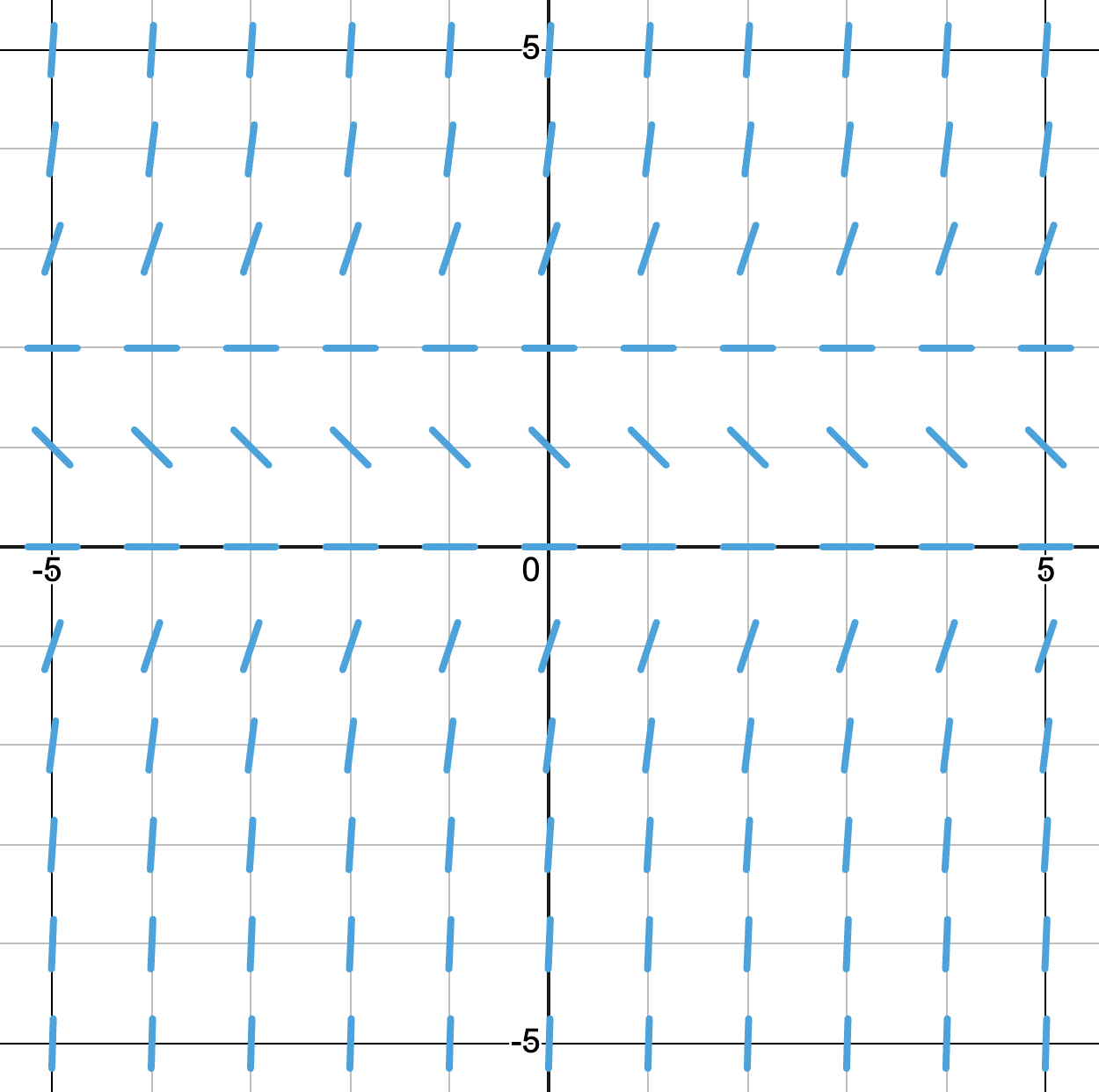
Shown below is the slope field for which of the following differential equations?
Solution
Let’s check the patterns:
1. Horizontal or vertical slopes
Horizontal line segments appear along the lines and , indicating that whenever or .
Therefore, these choices can be eliminated:
- It equals only when and cannot produce horizontal segments at .
- Additionally, the slope field for this choice would show vertical line segments at .
- It equals only when .
2. Check slope signs
Observing the slope field:
-
All points below and above have positive slopes
-
All points along the line have negative slopes
-
To confirm, we can test specific points in the remaining answer choices:
-
At , the slope is , which is indeed negative.
-
At , the slope is , which is indeed positive.
- At results in , which does not match the negative slope shown on the graph.
Therefore, the differential equation that matches the slope field is answer choice
Additional confirmation: the differential equation depends only on , and all slopes when moving left to right across the graph remain the same.
MCQs may also give answer choices that are specific solutions of the form . The slope field should resemble the family of curves . If it’s not clear which curve fits, differentiate each candidate to get , then compare those slopes to the slope field.
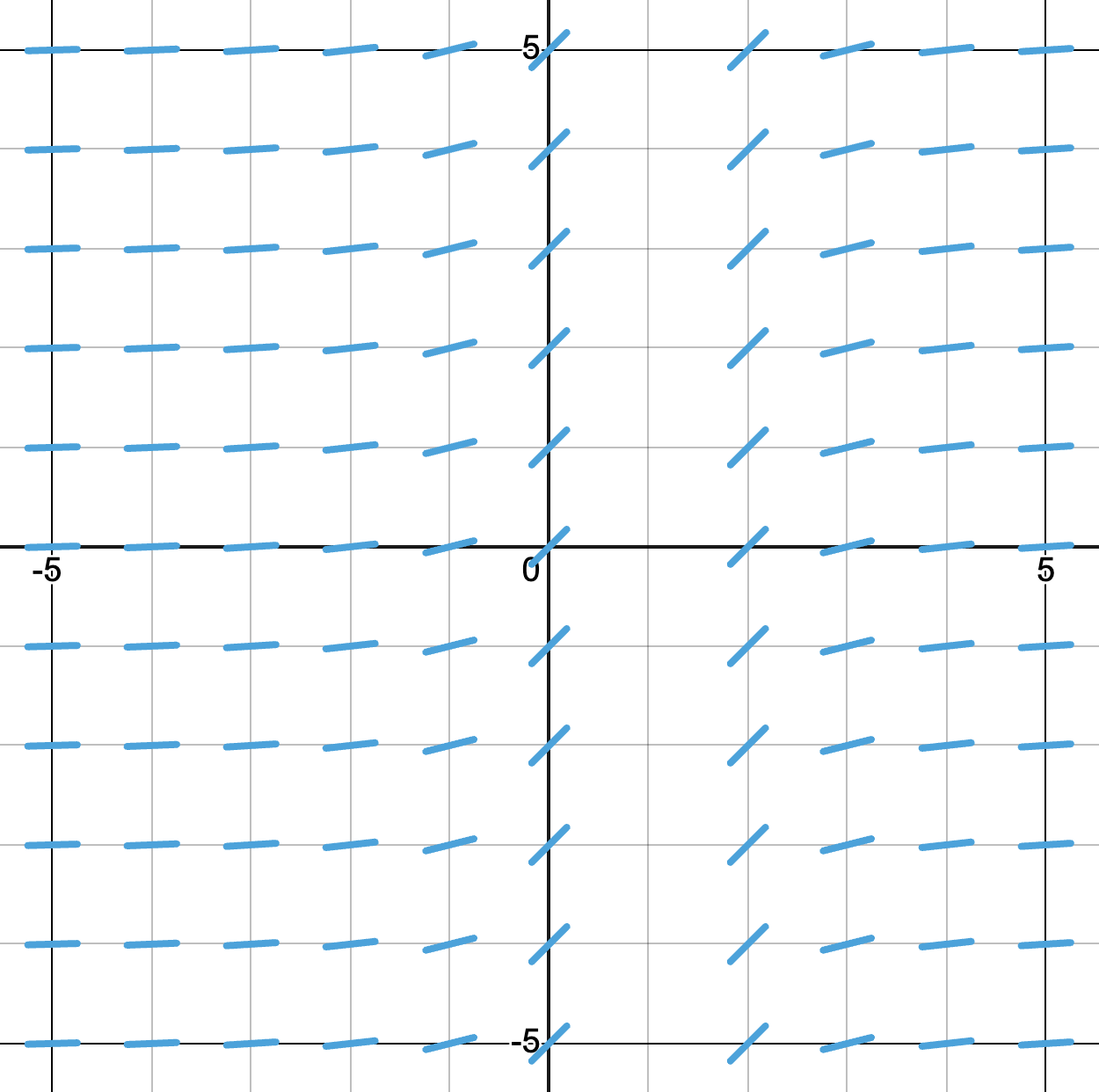
Which of the following could be a specific solution to the differential equation whose slope field is shown below?
Solution
The key feature of this slope field is the empty region along , suggesting the slope is undefined at .
All of the answer choices are undefined at except for
which is a polynomial. So we can rule out this answer choice.
Differentiate each remaining answer choice to compare slopes:
We can check the signs of the slopes in a few regions.
-
Along , the slopes shown are positive. Then we can eliminate choice , which gives a negative slope when .
-
Along , the slopes shown are also positive. Then we can eliminate choice because plugging in results in a negative value.
Therefore the solution curve that matches the given slope field is the remaining answer choice