




Probability
A probability tells you how likely an event is to occur. Probabilities can be written as decimals from to or as percentages from to .
- If the event will never occur, the probability is , i.e. a chance.
- If the event will always occur, the probability is , i.e. a chance.
- If the event will occur 7 out of 10 times, the probability is , i.e. a chance.
For any event, there are only two possibilities: it happens or it doesn’t. That means the probability of the event plus the probability of “not the event” will always add up to (or ).
For example, suppose you pick a marble from a bag and there’s a chance it will be blue. Then the probability it won’t be blue is .
A probability can often be found using this basic idea:
- Probability = (number of desired outcomes) / (total number of possible outcomes)
For example, suppose you and your brother are in a raffle with total participants. You’d be happy if either of you wins, so there are desired winners out of possible winners. The probability is , or .
Example: The question below is from 2017 AMC 10A
Chloe chooses a real number uniformly at random from the interval . Independently, Laurent chooses a real number uniformly at random from the interval . What is the probability that Laurent’s number is greater than Chloe’s number?
A.
B.
C.
D.
E.
Answer:
Any number Laurent picks from to is automatically greater than any number Chloe could pick from . That accounts for half of Laurent’s interval.
For the other half (when Laurent picks from ), Laurent and Chloe are choosing uniformly from the same interval, so Laurent has a chance of being greater than Chloe.
So the total probability is
- probability(Laurent in upper half) 1
- plus probability(Laurent in lower half)
This gives .
There are two rules that are especially useful in probability: the AND rule and the OR rule.
AND means multiply the probabilities
Consider this question:
What is the chance of winning a coin flip twice in a row?
A fair coin has a chance of landing the way you want on one flip, which is in decimal form. Winning twice in a row means winning the first flip and the second flip, so we multiply.
The probability of winning twice in a row is .
Let’s try another example.
You are tasked with randomly selecting criminals from a police lineup. There are two accomplices in the crime. What is the chance you overlook both criminals when randomly selecting two from a lineup that includes 7 suspects? Express the probability in terms of a fraction.
Try to solve it yourself, then check below!
Answer: This question asks for the probability of selecting a non-criminal and then selecting a second non-criminal, so we multiply the probabilities.
There are criminals out of suspects, so there are non-criminals.
- Probability the first pick is a non-criminal:
- After that pick, there are non-criminals left out of remaining suspects, so probability the second pick is a non-criminal:
OR means add the probabilities
Now consider this question:
What is the chance of randomly selecting a consonant or the letter A from the alphabet twice in a row?
There are 21 consonants and 1 letter A. On a single draw, “consonant” and “A” can’t happen at the same time, so we add their probabilities.
- Probability of a consonant:
- Probability of A:
So the probability of selecting a consonant or A on one draw is
Because the question asks for this to happen twice in a row, we multiply by itself:
Example: The question below is from 2016 AMC 12B
Tom, Dick, and Harry are playing a game. Starting at the same time, each of them flips a fair coin repeatedly until he gets his first head, at which point he stops. What is the probability that all three flip their coins the same number of times?
A.
B.
C.
D.
E.
Answer: B.
All three flip the same number of times if they all get their first head on flip 1, or all get their first head on flip 2, or all get their first head on flip 3, and so on.
- All stop after 1 flip: probability
- All stop after 2 flips: they must all get tails first and then heads, so probability
- All stop after 3 flips: probability
So we add these possibilities:
and so on.
This is a geometric series.
Mutually exclusive and independent events
If two events are mutually exclusive, they cannot occur at the same time. For example, if it is snowing outside, it cannot be 100 degrees F. These events are mutually exclusive because snow requires temperatures below freezing.
If two events are independent, one event does not affect the other. For example, whether it’s raining does not affect whether a random moment falls on a weekend. The probability that a random moment is on the weekend is always , whether it’s raining or not.
A useful guideline is:
- Mutually exclusive events often lead to adding probabilities.
- Independent events often lead to multiplying probabilities.
This isn’t a universal rule, but it matches many common contest problems.
Example: The question below is from 2017 AMC 10A
Amelia has a coin that lands heads with probability , and Blaine has a coin that lands on heads with probability . Amelia and Blaine alternately toss their coins until someone gets a head; the first one to get a head wins. All coin tosses are independent. Amelia goes first. The probability that Amelia wins is , where and are relatively prime positive integers. What is ?
A.
B.
C.
D.
E.
Answer: D.
Probability notation
You may see probability written using notation like . Here:
- means “probability.”
- The letter in parentheses names the event.
So means there is a chance that event occurs.
For mutually exclusive events, refers to the sum of and . For independent events, refers to the product of and .
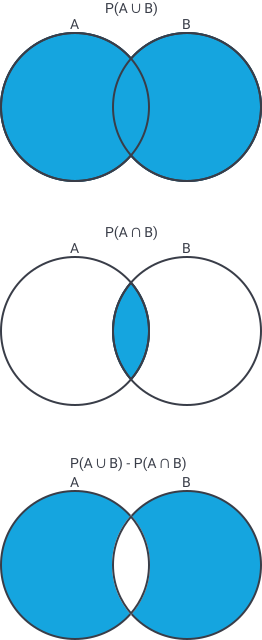
Union and intersection notation also appears in probability.
- The union of two events means “ or ” (one or both can occur).
- The intersection of two events means “ and ” (both occur).
The notation for the union and intersection of probabilities and a visual representation for each are shown below.
Geometric probability
In geometric probability, we use areas or volumes to count outcomes.
For example, suppose a bullseye is a circle with radius inside a target circle with radius . If you are equally likely to land anywhere on the target, then
- desired area = area of the bullseye
- total area = area of the whole target
So the probability of hitting the bullseye is
or .
Geometric probability doesn’t have to come from a literal real-world situation. The key idea is that “desired outcomes” and “total outcomes” are represented by geometric measures.
Example: The question below is from 2021 AMC 10B
A square with side length is colored white except for blue isosceles right triangular regions with legs of length in each corner of the square and a blue diamond with side length in the center of the square, as shown in the diagram. A circular coin with diameter is dropped onto the square and lands in a random location where the coin is completely contained within the square. The probability that the coin will cover part of the blue region of the square can be written as , where and are positive integers. What is ?
A.
B.
C.
D.
E.
Answer: C.
Consider that the circle’s center must be placed in one of these five green shapes for it to be touching a blue area. Divide their total areas by the area of the whole square to find the probability (do not simplify the fraction) and compare that fraction to to find .

Expected value
An expected value is the long-run average result of a probability game if you repeat it many times.
For example, suppose a coin flip results in heads or tails, where heads gives a value of and tails gives a value of . Over many flips, the average value tends toward . That’s the expected value of this game.
To find an expected value:
- Multiply each outcome by its probability.
- Add those products.
- Make sure the probabilities add up to .
Example: The question below is from 2006 AMC 10A
A player pays to play a game. A die is rolled. If the number on the die is odd, the game is lost. If the number on the die is even, the die is rolled again. In this case the player wins if the second number matches the first and loses otherwise. How much should the player win if the game is fair? (In a fair game the probability of winning times the amount won is what the player should pay.)
A.
B.
C.
D.
E.
Answer: D.
For the game to be fair, the expected value must equal the cost to play.
.