




Permutations and combinations
Permutations and combinations are tools for counting selections from a set.
- Permutations count arrangements where order matters.
- Combinations count selections where order doesn’t matter.
Permutations
Use permutations when the order of elements matters, like counting the number of ways people can stand in a line.
Variables:
- is the total number of options available
- is the number of times you have to choose
This formula counts the number of ordered sequences of length you can make from distinct options.
Let’s solve the following question using this equation.
Five kindergarteners are lining up for recess. How many ways could they line up?
Which values match and ? Use them to set up and evaluate the permutations expression.
There are 5 kindergarteners total, so there are options. A complete line uses all 5 kids, so .
Here’s the full math equation:
Example: The question below is from 2022 AMC 10A
A rectangle is partitioned into regions as shown. Each region is to be painted a solid color - red, orange, yellow, blue, or green - so that regions that touch are painted different colors, and colors can be used more than once. How many different colorings are possible?
A.
B.
C.
D.
E.
Answer: D.
In this problem, the basic permutation formula is a useful starting point, but you also have to account for the “touching regions must be different” constraint.
Start by counting the colorings where all five regions use different colors. That gives .
Next, consider colorings where exactly two regions share a color (and the rest are different). This corresponds to using 4 distinct colors, which can be arranged in ways. There are three ways to choose a pair of nonadjacent regions that are allowed to match in color, so this contributes .
Finally, consider the case where there are two matching pairs (so only 3 distinct colors are used). This can happen when diagonal corner regions match. Treating each matching pair as a single “choice” gives .
Adding the cases gives .
Combinations
Use combinations when the order of elements does not matter, like counting the number of ways to pick marbles from a jar.
Variables: - is the total number of options available
- is the number of times you have to choose
This formula counts the number of groups of size you can form from distinct options.
Let’s solve the following question using this equation. Which values match and ? Use them to set up and evaluate the combinations expression.
How many pairs of news anchors could be picked from six news anchor applicants?
There are applicants total, so . A pair is a group of , so .
Here’s the full math equation:
Notice what happened in the simplification: the in the denominator cancels with the same factor in the numerator. This kind of cancellation is common in permutation and combination expressions, so it’s often worth looking for shared factors before multiplying everything out.
Example: The question below is from 2001 AMC 8
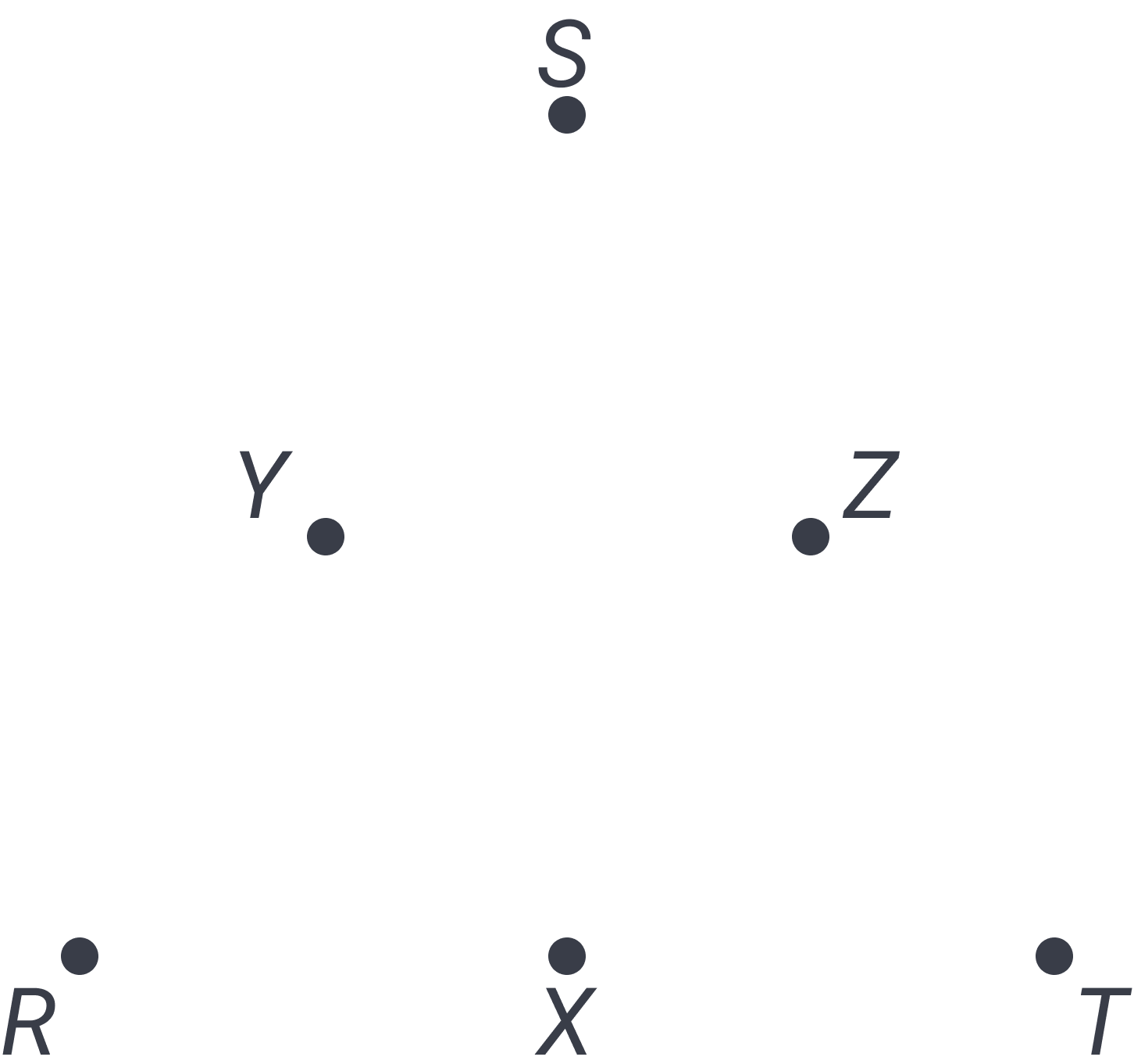
Points , and are vertices of an equilateral triangle, and points , and are midpoints of its sides. How many noncongruent triangles can be drawn using any three of these six points as vertices?
A.
B.
C.
D.
E.
Answer: D.
A natural first step is to count all ways to choose 3 points from 6, regardless of triangle type:
- Total combinations:
From there, you eliminate choices that don’t produce a triangle or that produce triangles congruent to others.
For example:
- There are small equilateral triangles, so you would subtract of those to leave one representative.
- There are collinear triples that aren’t triangles at all: , , and .
After removing the other repeated isosceles and right triangles, the remaining count is .
n choose k notation (nCk)
You may also see combinations written in a compact notation that looks like a fraction without a dividing line. This is read as “ choose ,” and it represents the same value as the combinations formula.
This notation becomes more useful later when working with combinatorial identities.
The notation means “5C3” or “5 choose 3”: the number of ways to choose a group of from distinct options. The and have the same meanings as in the sections above.
Which answer choice matches the situation below?
How many groups of four coins can be pulled from a coin purse that contains nine unique coins from all around the world?
A.
B.
C.
D.
E.
Answer: B