



Quadratics
A quadratic equation is an equation in which the highest power of the variable is . It has the general form shown below.
The letters and are the coefficients of the first two terms, is the variable, and is the constant term. When you graph a quadratic, you get a parabola - a symmetric curve that looks like an upward-opening or downward-opening bowl.
Here is an example of the quadratic shown graphically.
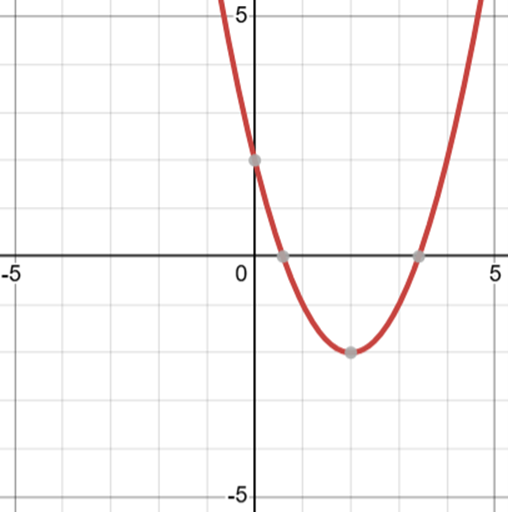
We call them quadratics because they often can be factored (sometimes called “reverse FOIL”) into a product of two binomials. Multiplying two binomials creates an term, which is where the “quadratic” structure comes from.
Here’s an example.
Writing the quadratic in factored form makes the solutions (also called roots) easy to find. A product equals only if at least one factor equals , so we set each parenthesis equal to :
So the two roots are and .
Quadratic formula
A more formal (and most well-known) method for finding the roots of a quadratic is the quadratic formula. You identify the values of , , and in the quadratic, then substitute them into the formula. The symbol means you compute two values: one using and one using .
The expression under the square root, , is called the discriminant. Its sign tells you how many real roots the quadratic has:
- If , there are two real roots.
- If , there is one real root (a repeated root).
- If , there are no real roots.
In that last case, the parabola doesn’t cross the -axis. For an upward-opening parabola, its lowest point (the vertex) lies above the -axis.
Example: The question below is from 2009 AMC 8
On the last day of school, Mrs. Wonderful gave jelly beans to her class. She gave each boy as many jelly beans as there were boys in the class. She gave each girl as many jelly beans as there were girls in the class. She brought jelly beans, and when she finished, she had six jelly beans left. There were two more boys than girls in her class. How many students were in her class?
A.
B.
C.
D.
E.
Answer: B.
Vieta’s formula for quadratics
Vieta’s formulas connect the coefficients of a quadratic to the sum and product of its roots. If the roots are and , then:
- The sum of the roots is the second coefficient divided by the first coefficient, multiplied by .
- The product of the roots is the constant term divided by the first coefficient.
Example: The question below is from 2006 AMC 10B
Let and be the roots of the equation . Suppose that and are the roots of the equation . What is ?
A.
B.
C.
D.
E.
Answer: D.