



This browser is too old to run Achievable.

Update it, or open this page in a current version of Chrome, Safari, Firefox or Edge. On an iPhone or iPad, update iOS: every browser there runs on the version of Safari that comes with it.

Achievable logoAchievable logo
ACCA Financial Accounting
Sign in
Sign up
Purchase
Textbook
Practice exams
Support
How it works
Resources
Exam catalog
Mountain with a flag at the peak
Textbook
Introduction
1. The context and purpose of financial reporting
2. Accounting principles, concepts and qualitative characteristics
3. Double-entry bookkeeping and accounting systems
3.1 Source document
3.2 Books of prime entry
3.3 The general ledger and double-entry bookkeeping
3.4 The Accounting equation
3.5 Accounting systems
4. Recording transactions and events
5. Reconciliations
6. Preparing trial balance
7. Preparing financial statements
8. Preparing basic consolidated financial statements
9. Interpretation of financial statements
Wrapping up
Achievable logoAchievable logo
3.3 The general ledger and double-entry bookkeeping
Achievable ACCA Financial Accounting
3. Double-entry bookkeeping and accounting systems
Our ACCA course is currently in development and is a work-in-progress.

The general ledger and double-entry bookkeeping

12 min read
Font
Discuss
Share
Feedback

Earlier, we noted that financial statement transactions originate from source documents and are first recorded in the books of prime entry (day books). These transactions are then posted to general ledger accounts through journal entries using double-entry bookkeeping. This chapter looks at the main types of ledger accounts and how to record transactions in them using journal entries.

Learning objectives

By the end of this lesson, you should be able to:

  • Describe the main types of general ledger accounts, including their nature and function.
  • Describe how financial data is initially recorded in the accounting system.
  • Explain the use of journal entries and how journal entries are processed to general ledger accounts.
  • Identify correct journal entries from a given narrative.
  • Illustrate how to balance and close the general ledger accounts at the year-end.

The general ledger

Definitions
General ledger
Also called the nominal ledger, it is the central record (manual or computerised) that contains all ledger accounts. It organises transactions by categories, each corresponding to elements of the financial statements.
Ledger account
A ledger account is a specific record within the general ledger that summarises all transactions for a particular item, such as an asset, liability, equity, income, or expense.

For example, credit sales from the sales daybook are posted to both the sales ledger account and the receivables ledger account within the general ledger.

Every ledger account has two sides:

  • Debit (Dr)
  • Credit (Cr)

In a manual accounting system, ledger accounts are usually presented in a T-form (a T-account) as shown below.

T-account chart showing debits on the left side and credits on the right side.
T-account chart
Achievable
  • The left-hand side represents debits, while the right-hand side represents credits.
  • An entry on the debit side means the account is debited, and an entry on the credit side means it is credited.
  • The date column records when the transaction occurred, while the description column briefly states the corresponding ledger account.

Every financial transaction follows the duality concept - each transaction has two equal and opposite effects. One account is debited, and another is credited, following the rules of double-entry bookkeeping. Below are examples of some general ledger accounts and the related elements of the financial statements.

Ledger account Related element of the financial statement
Sales Income
Trade receivables Asset
Purchases Expense
Trade payables Liability
Cash and bank balance Asset
Bank overdraft Liability
Rent Expense
Office building Asset
Long-term loans Liability
Ordinary shares Equity
Inventories Asset

The narratives below use payables, the general name for amounts a business owes its suppliers. Amounts owed to suppliers of goods bought for resale are its trade payables.

Double-entry bookkeeping

Double-entry bookkeeping states that every transaction affects at least two ledger accounts: one debit and one credit, always with equal amounts. Each ledger account belongs to one of the five financial statement elements: assets, liabilities, equity, expenses, or income.

This principle is the foundation for all postings in the general ledger. It’s summarised in the table below.

Assets & expenses related ledger Income, liability and equity related ledger
A debit entry Increases the balance Decreases the balance
A credit entry Decreases the balance Increases the balance

Because a debit entry increases the balance of assets and expenses, these accounts are said to have a debit balance. In contrast, income, liability, and equity accounts are said to have a credit balance. These debit and credit rules are what keep the accounting equation in balance, as you’ll see in the next chapter, The accounting equation.

Passing journal entries

Passing journal entries means recording a transaction by debiting one ledger account and crediting another, following the double-entry principle. Routine transactions - such as credit sales or cash receipts - are posted straight from the day books. The journal itself is used for non-routine entries, like year-end adjustments, corrections of errors, and credit purchases of non-current assets. Exam questions commonly show any double entry in journal format (Dr account / Cr account), since it makes clear at a glance which accounts are debited and credited.

Format of a general journal is shown below

Date Description Debit ($) Credit ($)
GL account to be debited xxx
GL account to be credited xxx

Step-by-step illustration

Use the steps below to turn a narrative into a journal entry.

Steps

  1. Identify all the ledger accounts involved in the narrative - this ensures the duality principle.
  2. Determine the effect on each ledger account - will it increase, decrease, or will one increase while the other decreases?
  3. Relate each ledger account to a financial statement element (asset, liability, equity, income, or expense).
  4. Apply the debit/credit rules from the table above.

Let’s demonstrate these guidelines using these narratives.

Narrative 1: Kofi sold goods worth $ 5,000 for cash.

  • The two ledger accounts from the narratives are sales and cash.
  • We have sold goods, so sales (i.e., revenue) will increase and since we are receiving cash it will also increase.
  • Sales is an income and cash is an asset.
  • Since cash (asset item) is increasing, we debit the cash general ledger account.
  • Also because sales (i.e., income item) is increasing, we credit the sales general ledger account.

We make a journal entry for the transaction as depicted below.

Ledger accounts Debit ($) Credit ($)
Cash 5,000
Sales 5,000
Being sales of goods for cash

You can also show the same transaction using T-accounts. When you use a T-account, you record the entry on the debit or credit side and use the description to reference the corresponding account. This makes the duality concept visible: each entry points to the other account affected by the same transaction.

T-account showing a cash sale recorded as a debit on the left and a credit on the right.
Cash sale ledger account chart
Achievable

Try the next example on your own.

Narrative 2: Kofi bought office furniture costing $10,000 on credit.

  • What are the two ledger accounts involved?
  • What is the effect on each account?
  • What financial statement elements do the ledger accounts relate to?
  • What is the journal entry?
(spoiler)
  • The two ledger accounts are office furniture and payables.
  • Kofi acquired office furniture, so office furniture increases. He bought it on credit, so payables (what he owes) also increase.
  • Office furniture is an asset, and payables are a liability.
  • Since office furniture (an asset) is increasing, we debit the office furniture ledger account. Since payables (a liability) are increasing, we credit the payables ledger account.
Ledger accounts Debit ($) Credit ($)
Office furniture 10,000
Payables 10,000
Being purchase of office furniture on credit

The T-account is shown below:

T-accounts: office furniture debited with payables of 10,000; payables credited with office furniture of 10,000.
Office furniture and payables ledger accounts
Achievable

Try this example on your own.

Narrative 3: Kofi paid $3,000 cash to the furniture supplier.

  • What are the two ledger accounts involved?
  • What is the effect on each account?
  • What financial statement elements do the ledger accounts relate to?
  • What is the journal entry?
(spoiler)
  • The two ledger accounts are cash and payables.
  • Kofi paid cash to the furniture supplier, so cash decreases and payables also decrease.
  • Cash is an asset, and payables are a liability.
  • Since cash (an asset) is decreasing, we credit the cash ledger account. Since payables (a liability) are decreasing, we debit the payables ledger account.
Ledger accounts Debit ($) Credit ($)
Payables 3,000
Cash 3,000
Being cash payment to the furniture supplier

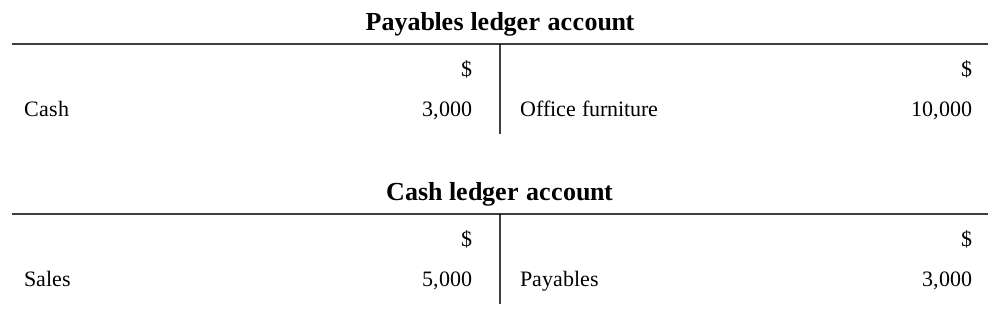
The T-accounts, continued from the earlier narratives, are shown below:

T-accounts: payables debited with cash of 3,000 and credited with office furniture of 10,000; cash debited with sales of 5,000 and credited with payables of 3,000.
Payables and cash ledger accounts
Achievable

Balancing a ledger account

In practice, many transactions occur, and many journal entries are posted. Periodically (daily, weekly, monthly, etc.), the accountant determines the net amount on each ledger account. This process is called balancing the account. Follow these steps when you want to balance any account.

Steps

  1. Draw total lines beneath the last debit and credit entries, leaving one line space.
  2. Add all debit entries and all credit entries separately.
  3. Enter the higher of the two totals on both sides of the account.
  4. Find the difference between the two sides.
  5. Record this difference as the Balance c/d on the side with the lower total, then bring it down as Balance b/d on the opposite side.

Demonstration of balancing an account

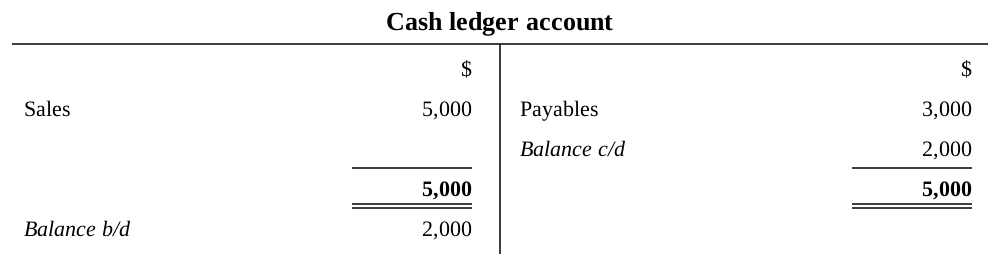
Let’s balance the ledger accounts we earlier created. Let’s demonstrate with the cash ledger account.

  • Total debit balance is $5,000 as against a $ 3,000 total credit balance.
  • We enter $ 5,000 as the total on both the debit and credit sides of the general ledger account.
  • The shortfall of $ 2,000 (i.e., $ 5,000 minus $3,000) on the credit side becomes balance carried down (c/d).
  • The shortfall is then carried to the opposite (i.e., debit) side as the balance brought down (b/d).

This is shown below.

Cash ledger account balanced: sales of 5,000 on the debit side; payables of 3,000 and balance c/d of 2,000 on the credit side; totals of 5,000; balance b/d of 2,000.
Balancing the cash ledger account
Achievable

The balances brought down for each ledger account are summarised on the trial balance (to be treated later in this course).

Closing of ledger accounts

Closing a ledger account is similar to balancing off, but it occurs specifically at the end of the accounting year. The closing balances are used in preparing the financial statements.

  • Income and expense related accounts are closed into the statement of profit or loss.
  • Asset, liability, and equity related accounts are both carried forward to the next period as well as reported in the current year’s statement of financial position.

Rules for closing-off:

  • Income accounts: debit the income ledger, credit the statement of profit or loss.
  • Expense accounts: credit the expense ledger, debit the statement of profit or loss.

Example: closing Kofi’s sales account

At the year end, Kofi’s sales account (from Narrative 1) has a credit balance of $5,000. Being income, it’s closed to the statement of profit or loss: debit sales $5,000, credit statement of profit or loss $5,000, leaving the sales account with a nil balance ready for the new year. An expense account closes the same way but in the opposite direction - debit the statement of profit or loss, credit the expense ledger.

Cash, however, is an asset, so it isn’t closed. Its $2,000 debit balance from the balancing example above is simply carried down (b/d) and reported in the statement of financial position.

General ledger and ledger accounts

  • General ledger (nominal ledger): central record of all ledger accounts, organised by financial statement categories
  • Ledger account: summarises transactions for one item (asset, liability, equity, income, expense)
  • Each account has two sides: debit (Dr, left) and credit (Cr, right), shown as a T-account

Double-entry bookkeeping

  • Duality concept: every transaction has two equal, opposite effects (one debit, one credit)
  • Debit increases assets & expenses; decreases income, liabilities, equity
  • Credit increases income, liabilities, equity; decreases assets & expenses
  • Assets/expenses normally carry a debit balance; income/liabilities/equity normally carry a credit balance

Journal entries

  • Journal entries record transactions as Dr one account / Cr another, following double-entry rules
  • Routine transactions post directly from day books; journal used for non-routine items (year-end adjustments, error corrections, credit purchases of non-current assets)
  • Steps to derive a journal entry from a narrative:
    • Identify the two ledger accounts involved
    • Determine whether each increases or decreases
    • Classify each as asset, liability, equity, income, or expense
    • Apply debit/credit rules accordingly
  • Example logic: cash sale → debit cash (asset increase), credit sales (income increase); credit purchase of furniture → debit office furniture (asset increase), credit payables (liability increase); payment to supplier → debit payables (liability decrease), credit cash (asset decrease)

Balancing a ledger account

  • Done periodically to find the net balance of an account
  • Steps: total both sides, enter the higher total on each side, record the shortfall as balance c/d on the lower side, bring it down as balance b/d on the opposite side
  • Balances b/d from all accounts feed into the trial balance

Closing ledger accounts at year-end

  • Income and expense accounts are closed into the statement of profit or loss:
    • Income: debit income account, credit statement of profit or loss
    • Expense: credit expense account, debit statement of profit or loss
  • Asset, liability, and equity accounts are not closed — balances carried forward (b/d) and reported in the statement of financial position

Sign up for free to take 13 quiz questions on this topic

Previous
Next  | 3.4 The Accounting equation
All rights reserved ©2016 - 2026 Achievable, Inc.

The general ledger and double-entry bookkeeping

Earlier, we noted that financial statement transactions originate from source documents and are first recorded in the books of prime entry (day books). These transactions are then posted to general ledger accounts through journal entries using double-entry bookkeeping. This chapter looks at the main types of ledger accounts and how to record transactions in them using journal entries.

Learning objectives

By the end of this lesson, you should be able to:

  • Describe the main types of general ledger accounts, including their nature and function.
  • Describe how financial data is initially recorded in the accounting system.
  • Explain the use of journal entries and how journal entries are processed to general ledger accounts.
  • Identify correct journal entries from a given narrative.
  • Illustrate how to balance and close the general ledger accounts at the year-end.

The general ledger

Definitions
General ledger
Also called the nominal ledger, it is the central record (manual or computerised) that contains all ledger accounts. It organises transactions by categories, each corresponding to elements of the financial statements.
Ledger account
A ledger account is a specific record within the general ledger that summarises all transactions for a particular item, such as an asset, liability, equity, income, or expense.

For example, credit sales from the sales daybook are posted to both the sales ledger account and the receivables ledger account within the general ledger.

Every ledger account has two sides:

  • Debit (Dr)
  • Credit (Cr)

In a manual accounting system, ledger accounts are usually presented in a T-form (a T-account) as shown below.

  • The left-hand side represents debits, while the right-hand side represents credits.
  • An entry on the debit side means the account is debited, and an entry on the credit side means it is credited.
  • The date column records when the transaction occurred, while the description column briefly states the corresponding ledger account.

Every financial transaction follows the duality concept - each transaction has two equal and opposite effects. One account is debited, and another is credited, following the rules of double-entry bookkeeping. Below are examples of some general ledger accounts and the related elements of the financial statements.

Ledger account Related element of the financial statement
Sales Income
Trade receivables Asset
Purchases Expense
Trade payables Liability
Cash and bank balance Asset
Bank overdraft Liability
Rent Expense
Office building Asset
Long-term loans Liability
Ordinary shares Equity
Inventories Asset

The narratives below use payables, the general name for amounts a business owes its suppliers. Amounts owed to suppliers of goods bought for resale are its trade payables.

Double-entry bookkeeping

Double-entry bookkeeping states that every transaction affects at least two ledger accounts: one debit and one credit, always with equal amounts. Each ledger account belongs to one of the five financial statement elements: assets, liabilities, equity, expenses, or income.

This principle is the foundation for all postings in the general ledger. It’s summarised in the table below.

Assets & expenses related ledger Income, liability and equity related ledger
A debit entry Increases the balance Decreases the balance
A credit entry Decreases the balance Increases the balance

Because a debit entry increases the balance of assets and expenses, these accounts are said to have a debit balance. In contrast, income, liability, and equity accounts are said to have a credit balance. These debit and credit rules are what keep the accounting equation in balance, as you’ll see in the next chapter, The accounting equation.

Passing journal entries

Passing journal entries means recording a transaction by debiting one ledger account and crediting another, following the double-entry principle. Routine transactions - such as credit sales or cash receipts - are posted straight from the day books. The journal itself is used for non-routine entries, like year-end adjustments, corrections of errors, and credit purchases of non-current assets. Exam questions commonly show any double entry in journal format (Dr account / Cr account), since it makes clear at a glance which accounts are debited and credited.

Format of a general journal is shown below

Date Description Debit ($) Credit ($)
GL account to be debited xxx
GL account to be credited xxx

Step-by-step illustration

Use the steps below to turn a narrative into a journal entry.

Steps

  1. Identify all the ledger accounts involved in the narrative - this ensures the duality principle.
  2. Determine the effect on each ledger account - will it increase, decrease, or will one increase while the other decreases?
  3. Relate each ledger account to a financial statement element (asset, liability, equity, income, or expense).
  4. Apply the debit/credit rules from the table above.

Let’s demonstrate these guidelines using these narratives.

Narrative 1: Kofi sold goods worth $ 5,000 for cash.

  • The two ledger accounts from the narratives are sales and cash.
  • We have sold goods, so sales (i.e., revenue) will increase and since we are receiving cash it will also increase.
  • Sales is an income and cash is an asset.
  • Since cash (asset item) is increasing, we debit the cash general ledger account.
  • Also because sales (i.e., income item) is increasing, we credit the sales general ledger account.

We make a journal entry for the transaction as depicted below.

Ledger accounts Debit ($) Credit ($)
Cash 5,000
Sales 5,000
Being sales of goods for cash

You can also show the same transaction using T-accounts. When you use a T-account, you record the entry on the debit or credit side and use the description to reference the corresponding account. This makes the duality concept visible: each entry points to the other account affected by the same transaction.

Try the next example on your own.

Narrative 2: Kofi bought office furniture costing $10,000 on credit.

  • What are the two ledger accounts involved?
  • What is the effect on each account?
  • What financial statement elements do the ledger accounts relate to?
  • What is the journal entry?
(spoiler)
  • The two ledger accounts are office furniture and payables.
  • Kofi acquired office furniture, so office furniture increases. He bought it on credit, so payables (what he owes) also increase.
  • Office furniture is an asset, and payables are a liability.
  • Since office furniture (an asset) is increasing, we debit the office furniture ledger account. Since payables (a liability) are increasing, we credit the payables ledger account.
Ledger accounts Debit ($) Credit ($)
Office furniture 10,000
Payables 10,000
Being purchase of office furniture on credit

The T-account is shown below:

Try this example on your own.

Narrative 3: Kofi paid $3,000 cash to the furniture supplier.

  • What are the two ledger accounts involved?
  • What is the effect on each account?
  • What financial statement elements do the ledger accounts relate to?
  • What is the journal entry?
(spoiler)
  • The two ledger accounts are cash and payables.
  • Kofi paid cash to the furniture supplier, so cash decreases and payables also decrease.
  • Cash is an asset, and payables are a liability.
  • Since cash (an asset) is decreasing, we credit the cash ledger account. Since payables (a liability) are decreasing, we debit the payables ledger account.
Ledger accounts Debit ($) Credit ($)
Payables 3,000
Cash 3,000
Being cash payment to the furniture supplier

The T-accounts, continued from the earlier narratives, are shown below:

Balancing a ledger account

In practice, many transactions occur, and many journal entries are posted. Periodically (daily, weekly, monthly, etc.), the accountant determines the net amount on each ledger account. This process is called balancing the account. Follow these steps when you want to balance any account.

Steps

  1. Draw total lines beneath the last debit and credit entries, leaving one line space.
  2. Add all debit entries and all credit entries separately.
  3. Enter the higher of the two totals on both sides of the account.
  4. Find the difference between the two sides.
  5. Record this difference as the Balance c/d on the side with the lower total, then bring it down as Balance b/d on the opposite side.

Demonstration of balancing an account

Let’s balance the ledger accounts we earlier created. Let’s demonstrate with the cash ledger account.

  • Total debit balance is $5,000 as against a $ 3,000 total credit balance.
  • We enter $ 5,000 as the total on both the debit and credit sides of the general ledger account.
  • The shortfall of $ 2,000 (i.e., $ 5,000 minus $3,000) on the credit side becomes balance carried down (c/d).
  • The shortfall is then carried to the opposite (i.e., debit) side as the balance brought down (b/d).

This is shown below.

The balances brought down for each ledger account are summarised on the trial balance (to be treated later in this course).

Closing of ledger accounts

Closing a ledger account is similar to balancing off, but it occurs specifically at the end of the accounting year. The closing balances are used in preparing the financial statements.

  • Income and expense related accounts are closed into the statement of profit or loss.
  • Asset, liability, and equity related accounts are both carried forward to the next period as well as reported in the current year’s statement of financial position.

Rules for closing-off:

  • Income accounts: debit the income ledger, credit the statement of profit or loss.
  • Expense accounts: credit the expense ledger, debit the statement of profit or loss.

Example: closing Kofi’s sales account

At the year end, Kofi’s sales account (from Narrative 1) has a credit balance of $5,000. Being income, it’s closed to the statement of profit or loss: debit sales $5,000, credit statement of profit or loss $5,000, leaving the sales account with a nil balance ready for the new year. An expense account closes the same way but in the opposite direction - debit the statement of profit or loss, credit the expense ledger.

Cash, however, is an asset, so it isn’t closed. Its $2,000 debit balance from the balancing example above is simply carried down (b/d) and reported in the statement of financial position.

Key points

General ledger and ledger accounts

  • General ledger (nominal ledger): central record of all ledger accounts, organised by financial statement categories
  • Ledger account: summarises transactions for one item (asset, liability, equity, income, expense)
  • Each account has two sides: debit (Dr, left) and credit (Cr, right), shown as a T-account

Double-entry bookkeeping

  • Duality concept: every transaction has two equal, opposite effects (one debit, one credit)
  • Debit increases assets & expenses; decreases income, liabilities, equity
  • Credit increases income, liabilities, equity; decreases assets & expenses
  • Assets/expenses normally carry a debit balance; income/liabilities/equity normally carry a credit balance

Journal entries

  • Journal entries record transactions as Dr one account / Cr another, following double-entry rules
  • Routine transactions post directly from day books; journal used for non-routine items (year-end adjustments, error corrections, credit purchases of non-current assets)
  • Steps to derive a journal entry from a narrative:
    • Identify the two ledger accounts involved
    • Determine whether each increases or decreases
    • Classify each as asset, liability, equity, income, or expense
    • Apply debit/credit rules accordingly
  • Example logic: cash sale → debit cash (asset increase), credit sales (income increase); credit purchase of furniture → debit office furniture (asset increase), credit payables (liability increase); payment to supplier → debit payables (liability decrease), credit cash (asset decrease)

Balancing a ledger account

  • Done periodically to find the net balance of an account
  • Steps: total both sides, enter the higher total on each side, record the shortfall as balance c/d on the lower side, bring it down as balance b/d on the opposite side
  • Balances b/d from all accounts feed into the trial balance

Closing ledger accounts at year-end

  • Income and expense accounts are closed into the statement of profit or loss:
    • Income: debit income account, credit statement of profit or loss
    • Expense: credit expense account, debit statement of profit or loss
  • Asset, liability, and equity accounts are not closed — balances carried forward (b/d) and reported in the statement of financial position

More from Double-entry bookkeeping and accounting systems

  • Source document
  • Books of prime entry
  • The Accounting equation
  • Accounting systems