


This browser is too old to run Achievable.

Update it, or open this page in a current version of Chrome, Safari, Firefox or Edge. On an iPhone or iPad, update iOS: every browser there runs on the version of Safari that comes with it.

Achievable logoAchievable logo
ACCA Financial Accounting
Sign in
Sign up
Purchase
Textbook
Practice exams
Support
How it works
Resources
Exam catalog
Mountain with a flag at the peak
Textbook
Introduction
1. The context and purpose of financial reporting
2. Accounting principles, concepts and qualitative characteristics
3. Double-entry bookkeeping and accounting systems
4. Recording transactions and events
5. Reconciliations
5.1 Bank reconciliation statement
5.2 Payables account reconciliation
6. Preparing trial balance
7. Preparing financial statements
8. Preparing basic consolidated financial statements
9. Interpretation of financial statements
Wrapping up
Achievable logoAchievable logo
5.1 Bank reconciliation statement
Achievable ACCA Financial Accounting
5. Reconciliations
Our ACCA course is currently in development and is a work-in-progress.

Bank reconciliation statement

11 min read
Font
Discuss
Share
Feedback

Bank reconciliation makes sure the bank general ledger (cash book) and the bank statement agree. It does this by identifying timing differences, omissions, and errors. In this chapter, you’ll see why differences occur, how to update the cash book, and how to prepare a reconciliation statement so you can report the correct bank balance in the financial statements.

Learning objectives

By the end of this chapter, you should be able to:

  • Explain the purpose of bank reconciliations.
  • Identify the main reasons for differences between the bank general ledger account and the bank statement/ internet banking records.
  • Identify and correct errors and/ or omissions in the bank general ledger account.
  • Prepare the reconciliation of the bank general ledger account to the bank statement/ internet banking records.
  • Derive bank statements and bank general ledger account balances from given information.
  • Identify the bank balance to be reported in the financial statements.

Cashbook and bank statement

Many entities make payments and receive money through a bank rather than using physical cash. These transactions are recorded in the cash book (the bank general ledger account). Periodically (usually monthly), the bank issues a statement showing the opening balance, deposits (credits), withdrawals (debits), and the closing balance.

Because both the entity and the bank are recording the same bank-account activity, the closing balance in the cash book should match the closing balance on the bank statement. In practice, the two balances often differ.

The bank records your deposit as money it owes you, so a positive balance appears as a credit on the bank statement but as a debit (an asset) in your cash book. An overdraft reverses this: it’s a debit on the bank statement and a credit in the cash book. When the account is overdrawn, each reconciling item works the other way round; the rule is set out after the BRS format below. An overdrawn adjusted cash-book balance is reported as a current liability, not netted against other assets.

Purpose of bank reconciliation

A bank reconciliation compares the cash book balance with the bank statement balance.

If the two balances don’t agree, you prepare a bank reconciliation statement to explain the difference. The reconciliation helps you:

  • identify transactions that are missing from the cash book or the bank statement
  • find and correct errors
  • make sure deposits, withdrawals, and bank charges are recorded correctly for financial reporting

Reasons for balance discrepancies

Factors that cause a difference between the cashbook and the bank statement balances fall into three categories:

  1. Unrecorded items and omissions by the entity
  2. Timing differences
  3. Errors

Omissions or unrecorded items

This happens when transactions appear on the bank statement but have not yet been entered in the entity’s bank ledger account (cash book). These are often items initiated by the bank or by third parties, so the entity may only become aware of them when the bank statement is received.

The following are some specific items that an entity may not have included in the bank general ledger account:

  • Bank fees or charges: These are service charges, transaction fees, or maintenance costs deducted directly by the bank.
  • Interest earned: This is interest income credited by the bank to the account.
  • Direct credits: These are deposits made directly into the account by third parties, which the business may not be immediately aware of until viewing the bank statement.
  • Direct debits: These are payments collected from the account by the payee (for example, a supplier) under the business’s prior authorisation. Amounts and dates may vary, and the business doesn’t control the amount collected.
  • Standing orders: These are fixed-amount payments made by the bank based on the instructions of the business to a vendor on predetermined dates.
  • Dishonoured cheques: These are cheques deposited that were subsequently returned due to insufficient funds.

Timing differences

Timing differences arise when the entity and the bank record the same transaction on different dates.

The entity usually records receipts and payments in the cash book as soon as they occur. The bank may process (clear) those transactions later. Until both sides have recorded the transaction, the balances won’t match.

The following are some specific items that may cause timing differences:

  • Outstanding or unpresented cheques: Cheques issued by the entity and recorded in the cash book but not yet cleared by the bank as at the end of the period. This reduces the cash book balance, but the bank statement balance remains higher until the recipient presents and clears the cheque.
  • Deposits in transit or uncredited cheques: Cash or cheques deposited by the entity near month-end but processed by the bank in the following period. The cash book records the deposit immediately (increasing its balance), but it doesn’t appear on the current bank statement until processed.

Errors

Errors occur when mistakes are made either by the entity in recording transactions in the bank ledger account or by the bank in the bank statement.

For example, the entity may record a wrong figure (e.g., $540 instead of $450), duplicate an entry, or make errors when totalling the cash book. If this was a receipt, the cash book is overstated by $90, so you credit the cash book with $90 in the adjusted cash book; if it was a payment, you debit the cash book with $90. Cash-book errors are corrected in the cash book itself, while bank errors are corrected only in the BRS, not in the cash book. On the bank’s side, errors may include posting transactions to the wrong account, incorrect debits or credits, or transposition errors in amounts. These mistakes create discrepancies until they are identified and corrected through the reconciliation process.

Preparation of the BRS

Generally, the preparation of the BRS follows two stages.

First, adjust the bank general ledger account (cash book) for any errors or omissions in the entity’s records.

Second, reconcile the adjusted bank ledger account with the bank statement balance.

Stage 1: Adjust the cash book

  1. Gather the period’s bank statement (or internet-banking records) and the company’s bank general-ledger/cash-book entries (all receipts and payments).
  2. Confirm the previous period’s closing balance equals the current period’s opening balance on both the bank statement and the cash book.
  3. Match each cash-book item to the bank statement; mark matched items. Unmarked items in the cash book are usually timing differences (or cash-book errors); unmarked items on the bank statement are usually omissions from the cash book (or bank errors).
  4. Record the unposted transactions and correct ledger errors using proper journal entries so the cash book reflects all bank activity.

Stage 2: Prepare the BRS

  1. Reconcile the adjusted cash-book balance to the bank statement closing balance by listing timing differences and bank errors (the unmarked items identified earlier).

Note: Steps 1-4 produce the adjusted bank ledger (cashbook) balance that appears on the statement of financial position. Step 5 (the BRS) explains why that adjusted balance may differ from the bank statement closing balance.

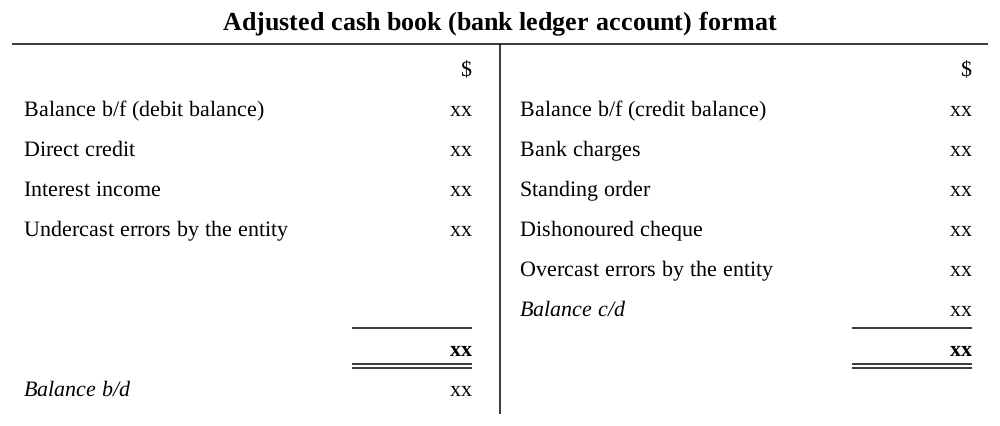
Adjusted cash book format: balance b/f (debit balance), direct credit, interest income and undercast errors by the entity on the debit side; balance b/f (credit balance), bank charges, standing order, dishonoured cheque, overcast errors by the entity and balance c/d on the credit side; balance b/d below the totals.
Adjusted cash book format
Achievable
Bank reconciliation statement (BRS) format
Balance as per bank statement xxx
Add: uncredited cheques xxx
Less: unpresented cheques xxx
Add or less bank errors xxx
Adjusted/corrected bank ledger balance xxx

When the account is overdrawn: treat the overdraft as a negative figure and make the usual adjustments: add uncredited deposits and deduct unpresented cheques. For example, a bank statement overdraft of $300 with $200 of unpresented cheques gives (300) - 200 = (500), an adjusted cash-book overdraft of $500. If you show the overdraft as a positive figure instead, the signs reverse: deduct uncredited deposits and add unpresented cheques.

Illustration 1: Adjusted cashbook

Ataasa Ltd’s bank ledger account shows a debit balance of $10,400 on 31 July. The bank statement for the same date, on the other hand, shows a credit balance of $9,500. Investigation reveals:

  1. Cheques issued but not yet presented: $1,200
  2. Deposit made on 31 July, credited by bank on 1 August: $2,000
  3. Bank charges debited by the bank, not yet in the cash book: $100
  4. Standing order (rent) paid by bank, not in cash book: $500
  5. Customer’s cheque deposited but later dishonoured (bank debited), not in cash book: $400
  6. A customer made an Electronic Funds Transfer (EFT) directly to the bank, not in the cash book: $600
  7. Bank error: $300, which belonged to another customer, was wrongly credited to Ataasa Ltd’s account.

Required: (i) Identify the items that affect the cashbook and why?

Do you know the answer?

(spoiler)

Items 3, 4, 5, and 6 affect the cash book because they are unrecorded items/omissions.

  • Bank charges ($100): Deducted by the bank but not yet recorded in the cash book.
  • Standing order ($500): Automatic payment made by the bank, not yet entered in the cash book.
  • Dishonoured cheque ($400): Previously recorded deposit reversed by the bank and must be adjusted.
  • EFT ($600): Direct deposit by a customer that needs to be added to the cash book

Items that do not affect the cash book:

  • Unpresented cheques of $1,200 - Timing difference (already recorded in cash book).
  • Deposit in transit of $2,000 - Timing difference (already recorded in cash book)
  • Bank error of $300 - Bank error (does not affect the entity’s records; the bank must correct this)

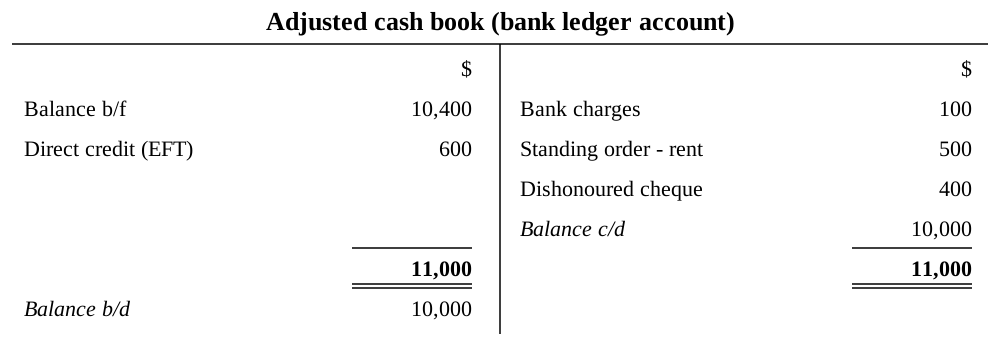
(ii) Prepare the Adjusted cash book (to get the adjusted bank balance)

(spoiler)
Adjusted cash book: balance b/f of 10,400 and direct credit (EFT) of 600 on the debit side; bank charges of 100, standing order for rent of 500, dishonoured cheque of 400 and balance c/d of 10,000 on the credit side; totals of 11,000; balance b/d of 10,000.
Adjusted cash book example
Achievable

(iii) Prepare the Bank reconciliation statement (BRS) as at 31 July.

(spoiler)
Bank reconciliation statement as at 31 July
$
Bank statement balance 9,500
Uncredited cheque 2,000
Unpresented cheque (1,200)
Bank error: wrong credit (300)
Balance as per adjusted cash book 10,000

Illustration 2: Determining the bank statement balance

On 31 March, the cashbook (bank ledger account) of Nkunim Ltd showed a debit balance of $12,600. Cheques issued but not yet presented total $2,800, while a deposit of $1,500 made on 31 March has not yet been credited by the bank. Bank charges of $200 and a standing order of $400 have not been recorded in the cash book.

Required: Based on this information, determine the Bank statement balance as at 31 March.

Do you know the answer?

(spoiler)
Bank reconciliation statement as at 31 March
$
Bank ledger account balance (DR) 12,600
Bank charges (200)
Standing order (400)
Adjusted cashbook balance (bank ledger) 12,000
Uncredited cheque (1,500)
Unpresented cheque 2,800
Balance as per bank statement 13,300

Notes for clarity: The solution combined the determination of the adjusted cashbook balance in the BRS. Because the BRS started with the adjusted cashbook balance, the unpresented cheque was added and the uncredited cheque subtracted. This is the direct opposite of the illustration one format.

Purpose & basics of bank reconciliation

  • Compares cash book (bank ledger) balance with bank statement balance to explain differences
  • Differences arise from: omissions/unrecorded items, timing differences, errors
  • Helps identify missing transactions, correct errors, ensure accurate reporting

Debit/credit conventions & overdrafts

  • Positive cash balance: credit on bank statement, debit (asset) in cash book
  • Overdraft: debit on bank statement, credit in cash book
  • Overdraft treatment: treat as negative figure — add uncredited deposits, deduct unpresented cheques
    • If overdraft shown as positive, reverse signs: deduct uncredited deposits, add unpresented cheques
  • Adjusted overdrawn cash book balance reported as a current liability, not netted against assets

Causes of discrepancies

  • Omissions/unrecorded items: bank-initiated items entity hasn’t recorded yet — bank fees, interest earned, direct credits/debits, standing orders, dishonoured cheques
  • Timing differences: same transaction recorded on different dates
    • Unpresented/outstanding cheques: recorded in cash book, not yet cleared by bank
    • Deposits in transit/uncredited cheques: recorded in cash book, not yet processed by bank
  • Errors: entity errors (wrong figures, duplicates, totalling mistakes) corrected in the cash book; bank errors corrected only in the BRS, not the cash book

Two-stage BRS preparation process

  • Stage 1 – Adjust the cash book:
    • Match bank statement items to cash book entries; confirm opening balances agree
    • Record unposted transactions/omissions and correct cash-book errors via journal entries
    • Produces the adjusted cash book balance reported in financial statements
  • Stage 2 – Prepare the BRS:
    • Reconcile adjusted cash book balance to bank statement closing balance using remaining timing differences and bank errors
  • BRS format: start with bank statement balance; add uncredited cheques; less unpresented cheques; adjust for bank errors → adjusted/corrected bank ledger balance
    • Note: if BRS starts from adjusted cash book balance instead, treatment of uncredited/unpresented cheques reverses (add unpresented, deduct uncredited)

Key distinctions to remember

  • Omissions/errors by entity → adjust the cash book itself
  • Timing differences and bank errors → adjust via the BRS only, not the cash book
  • Final adjusted cash book balance = figure reported in financial statements

Sign up for free to take 14 quiz questions on this topic

Previous
Next  | 5.2 Payables account reconciliation
All rights reserved ©2016 - 2026 Achievable, Inc.

Bank reconciliation statement

Bank reconciliation makes sure the bank general ledger (cash book) and the bank statement agree. It does this by identifying timing differences, omissions, and errors. In this chapter, you’ll see why differences occur, how to update the cash book, and how to prepare a reconciliation statement so you can report the correct bank balance in the financial statements.

Learning objectives

By the end of this chapter, you should be able to:

  • Explain the purpose of bank reconciliations.
  • Identify the main reasons for differences between the bank general ledger account and the bank statement/ internet banking records.
  • Identify and correct errors and/ or omissions in the bank general ledger account.
  • Prepare the reconciliation of the bank general ledger account to the bank statement/ internet banking records.
  • Derive bank statements and bank general ledger account balances from given information.
  • Identify the bank balance to be reported in the financial statements.

Cashbook and bank statement

Many entities make payments and receive money through a bank rather than using physical cash. These transactions are recorded in the cash book (the bank general ledger account). Periodically (usually monthly), the bank issues a statement showing the opening balance, deposits (credits), withdrawals (debits), and the closing balance.

Because both the entity and the bank are recording the same bank-account activity, the closing balance in the cash book should match the closing balance on the bank statement. In practice, the two balances often differ.

The bank records your deposit as money it owes you, so a positive balance appears as a credit on the bank statement but as a debit (an asset) in your cash book. An overdraft reverses this: it’s a debit on the bank statement and a credit in the cash book. When the account is overdrawn, each reconciling item works the other way round; the rule is set out after the BRS format below. An overdrawn adjusted cash-book balance is reported as a current liability, not netted against other assets.

Purpose of bank reconciliation

A bank reconciliation compares the cash book balance with the bank statement balance.

If the two balances don’t agree, you prepare a bank reconciliation statement to explain the difference. The reconciliation helps you:

  • identify transactions that are missing from the cash book or the bank statement
  • find and correct errors
  • make sure deposits, withdrawals, and bank charges are recorded correctly for financial reporting

Reasons for balance discrepancies

Factors that cause a difference between the cashbook and the bank statement balances fall into three categories:

  1. Unrecorded items and omissions by the entity
  2. Timing differences
  3. Errors

Omissions or unrecorded items

This happens when transactions appear on the bank statement but have not yet been entered in the entity’s bank ledger account (cash book). These are often items initiated by the bank or by third parties, so the entity may only become aware of them when the bank statement is received.

The following are some specific items that an entity may not have included in the bank general ledger account:

  • Bank fees or charges: These are service charges, transaction fees, or maintenance costs deducted directly by the bank.
  • Interest earned: This is interest income credited by the bank to the account.
  • Direct credits: These are deposits made directly into the account by third parties, which the business may not be immediately aware of until viewing the bank statement.
  • Direct debits: These are payments collected from the account by the payee (for example, a supplier) under the business’s prior authorisation. Amounts and dates may vary, and the business doesn’t control the amount collected.
  • Standing orders: These are fixed-amount payments made by the bank based on the instructions of the business to a vendor on predetermined dates.
  • Dishonoured cheques: These are cheques deposited that were subsequently returned due to insufficient funds.

Timing differences

Timing differences arise when the entity and the bank record the same transaction on different dates.

The entity usually records receipts and payments in the cash book as soon as they occur. The bank may process (clear) those transactions later. Until both sides have recorded the transaction, the balances won’t match.

The following are some specific items that may cause timing differences:

  • Outstanding or unpresented cheques: Cheques issued by the entity and recorded in the cash book but not yet cleared by the bank as at the end of the period. This reduces the cash book balance, but the bank statement balance remains higher until the recipient presents and clears the cheque.
  • Deposits in transit or uncredited cheques: Cash or cheques deposited by the entity near month-end but processed by the bank in the following period. The cash book records the deposit immediately (increasing its balance), but it doesn’t appear on the current bank statement until processed.

Errors

Errors occur when mistakes are made either by the entity in recording transactions in the bank ledger account or by the bank in the bank statement.

For example, the entity may record a wrong figure (e.g., $540 instead of $450), duplicate an entry, or make errors when totalling the cash book. If this was a receipt, the cash book is overstated by $90, so you credit the cash book with $90 in the adjusted cash book; if it was a payment, you debit the cash book with $90. Cash-book errors are corrected in the cash book itself, while bank errors are corrected only in the BRS, not in the cash book. On the bank’s side, errors may include posting transactions to the wrong account, incorrect debits or credits, or transposition errors in amounts. These mistakes create discrepancies until they are identified and corrected through the reconciliation process.

Preparation of the BRS

Generally, the preparation of the BRS follows two stages.

First, adjust the bank general ledger account (cash book) for any errors or omissions in the entity’s records.

Second, reconcile the adjusted bank ledger account with the bank statement balance.

Stage 1: Adjust the cash book

  1. Gather the period’s bank statement (or internet-banking records) and the company’s bank general-ledger/cash-book entries (all receipts and payments).
  2. Confirm the previous period’s closing balance equals the current period’s opening balance on both the bank statement and the cash book.
  3. Match each cash-book item to the bank statement; mark matched items. Unmarked items in the cash book are usually timing differences (or cash-book errors); unmarked items on the bank statement are usually omissions from the cash book (or bank errors).
  4. Record the unposted transactions and correct ledger errors using proper journal entries so the cash book reflects all bank activity.

Stage 2: Prepare the BRS

  1. Reconcile the adjusted cash-book balance to the bank statement closing balance by listing timing differences and bank errors (the unmarked items identified earlier).

Note: Steps 1-4 produce the adjusted bank ledger (cashbook) balance that appears on the statement of financial position. Step 5 (the BRS) explains why that adjusted balance may differ from the bank statement closing balance.

Bank reconciliation statement (BRS) format
Balance as per bank statement xxx
Add: uncredited cheques xxx
Less: unpresented cheques xxx
Add or less bank errors xxx
Adjusted/corrected bank ledger balance xxx

When the account is overdrawn: treat the overdraft as a negative figure and make the usual adjustments: add uncredited deposits and deduct unpresented cheques. For example, a bank statement overdraft of $300 with $200 of unpresented cheques gives (300) - 200 = (500), an adjusted cash-book overdraft of $500. If you show the overdraft as a positive figure instead, the signs reverse: deduct uncredited deposits and add unpresented cheques.

Illustration 1: Adjusted cashbook

Ataasa Ltd’s bank ledger account shows a debit balance of $10,400 on 31 July. The bank statement for the same date, on the other hand, shows a credit balance of $9,500. Investigation reveals:

  1. Cheques issued but not yet presented: $1,200
  2. Deposit made on 31 July, credited by bank on 1 August: $2,000
  3. Bank charges debited by the bank, not yet in the cash book: $100
  4. Standing order (rent) paid by bank, not in cash book: $500
  5. Customer’s cheque deposited but later dishonoured (bank debited), not in cash book: $400
  6. A customer made an Electronic Funds Transfer (EFT) directly to the bank, not in the cash book: $600
  7. Bank error: $300, which belonged to another customer, was wrongly credited to Ataasa Ltd’s account.

Required: (i) Identify the items that affect the cashbook and why?

Do you know the answer?

(spoiler)

Items 3, 4, 5, and 6 affect the cash book because they are unrecorded items/omissions.

  • Bank charges ($100): Deducted by the bank but not yet recorded in the cash book.
  • Standing order ($500): Automatic payment made by the bank, not yet entered in the cash book.
  • Dishonoured cheque ($400): Previously recorded deposit reversed by the bank and must be adjusted.
  • EFT ($600): Direct deposit by a customer that needs to be added to the cash book

Items that do not affect the cash book:

  • Unpresented cheques of $1,200 - Timing difference (already recorded in cash book).
  • Deposit in transit of $2,000 - Timing difference (already recorded in cash book)
  • Bank error of $300 - Bank error (does not affect the entity’s records; the bank must correct this)

(ii) Prepare the Adjusted cash book (to get the adjusted bank balance)

(spoiler)

(iii) Prepare the Bank reconciliation statement (BRS) as at 31 July.

(spoiler)
Bank reconciliation statement as at 31 July
$
Bank statement balance 9,500
Uncredited cheque 2,000
Unpresented cheque (1,200)
Bank error: wrong credit (300)
Balance as per adjusted cash book 10,000

Illustration 2: Determining the bank statement balance

On 31 March, the cashbook (bank ledger account) of Nkunim Ltd showed a debit balance of $12,600. Cheques issued but not yet presented total $2,800, while a deposit of $1,500 made on 31 March has not yet been credited by the bank. Bank charges of $200 and a standing order of $400 have not been recorded in the cash book.

Required: Based on this information, determine the Bank statement balance as at 31 March.

Do you know the answer?

(spoiler)
Bank reconciliation statement as at 31 March
$
Bank ledger account balance (DR) 12,600
Bank charges (200)
Standing order (400)
Adjusted cashbook balance (bank ledger) 12,000
Uncredited cheque (1,500)
Unpresented cheque 2,800
Balance as per bank statement 13,300

Notes for clarity: The solution combined the determination of the adjusted cashbook balance in the BRS. Because the BRS started with the adjusted cashbook balance, the unpresented cheque was added and the uncredited cheque subtracted. This is the direct opposite of the illustration one format.

Key points

Purpose & basics of bank reconciliation

  • Compares cash book (bank ledger) balance with bank statement balance to explain differences
  • Differences arise from: omissions/unrecorded items, timing differences, errors
  • Helps identify missing transactions, correct errors, ensure accurate reporting

Debit/credit conventions & overdrafts

  • Positive cash balance: credit on bank statement, debit (asset) in cash book
  • Overdraft: debit on bank statement, credit in cash book
  • Overdraft treatment: treat as negative figure — add uncredited deposits, deduct unpresented cheques
    • If overdraft shown as positive, reverse signs: deduct uncredited deposits, add unpresented cheques
  • Adjusted overdrawn cash book balance reported as a current liability, not netted against assets

Causes of discrepancies

  • Omissions/unrecorded items: bank-initiated items entity hasn’t recorded yet — bank fees, interest earned, direct credits/debits, standing orders, dishonoured cheques
  • Timing differences: same transaction recorded on different dates
    • Unpresented/outstanding cheques: recorded in cash book, not yet cleared by bank
    • Deposits in transit/uncredited cheques: recorded in cash book, not yet processed by bank
  • Errors: entity errors (wrong figures, duplicates, totalling mistakes) corrected in the cash book; bank errors corrected only in the BRS, not the cash book

Two-stage BRS preparation process

  • Stage 1 – Adjust the cash book:
    • Match bank statement items to cash book entries; confirm opening balances agree
    • Record unposted transactions/omissions and correct cash-book errors via journal entries
    • Produces the adjusted cash book balance reported in financial statements
  • Stage 2 – Prepare the BRS:
    • Reconcile adjusted cash book balance to bank statement closing balance using remaining timing differences and bank errors
  • BRS format: start with bank statement balance; add uncredited cheques; less unpresented cheques; adjust for bank errors → adjusted/corrected bank ledger balance
    • Note: if BRS starts from adjusted cash book balance instead, treatment of uncredited/unpresented cheques reverses (add unpresented, deduct uncredited)

Key distinctions to remember

  • Omissions/errors by entity → adjust the cash book itself
  • Timing differences and bank errors → adjust via the BRS only, not the cash book
  • Final adjusted cash book balance = figure reported in financial statements

More from Reconciliations

  • Payables account reconciliation