
Achievable logoAchievable logo
SIE
Sign in
Sign up
Purchase
Textbook
Practice exams
Support
How it works
Resources
Exam catalog
Mountain with a flag at the peak
Textbook
Introduction
1. Common stock
2. Preferred stock
3. Debt securities
3.1 Basic characteristics
3.2 Issuance & underwriting
3.3 Trading
3.4 Features
3.5 Yield
3.6 Suitability
4. Corporate debt
5. Municipal debt
6. US government debt
7. Investment companies
8. Alternative pooled investments
9. Options
10. Taxes
11. The primary market
12. The secondary market
13. Brokerage accounts
14. Retirement & education plans
15. Rules & ethics
Wrapping up
Achievable logoAchievable logo
3.5 Yield
Achievable SIE
3. Debt securities

Yield

13 min read
Font
Discuss
Share
Feedback

We first discussed the concept of yield in the preferred stock chapter. The idea is the same for bonds: yield measures the overall return of an investment. For bonds, yield is influenced by several factors, including:

  • The interest rate (coupon)
  • The purchase price
  • The length of time until maturity

A bond’s interest rate (coupon) and its yield sound similar, but they aren’t the same thing (except for nominal yield, discussed below). The interest rate is the annual interest the issuer pays based on par value. Yield is the bond’s overall rate of return, which depends on both the coupon and the price you pay. If a bond is purchased at a discount or a premium, its yield will differ from its coupon.

Reading bond prices in points

The examples in this chapter state prices in dollars, but bond prices are usually quoted as a percentage of par instead. Each whole percentage point of that quote is called a bond point.

Definitions
Bond point
A unit of price equal to 1% of par. On a $1,000 par bond, one bond point equals $10.

So a bond quoted at 106 is trading at 106% of $1,000 par, or $1,060. A bond quoted at 87 is trading at 87% of par, or $870.

Premiums and discounts can be described the same way:

  • A 7 point premium means the bond is trading at 107% of par: $1,070, or $70 above par.
  • A 13 point discount means the bond is trading at 87% of par: $870, or $130 below par.

Don’t confuse a bond point with a basis point. A bond point measures price and equals 1% of par ($10 on a $1,000 par bond). A basis point measures yield and equals 0.01%. So a 7 point premium means the bond is $70 above par - not 7 basis points.

You’ll see the full set of bond quote conventions later, in the corporate debt chapter’s coverage of the bond market and quotes. For now, all you need is this conversion: a bond quote is a percentage of par, and each point is worth $10 on a $1,000 par bond.

We’ll discuss the following yields in this chapter:

  • Nominal yield
  • Current yield
  • Yield to maturity (YTM)
  • Yield to call (YTC)

Nominal yield

The nominal yield is another name for the bond’s interest rate (coupon). You’ll rarely calculate nominal yield in practice, but you may be asked to identify the formula.

For example:

A $1,000 par, 4% bond

Nominal yield=ParAnnual income​

Nominal yield=$1,000$40​

Nominal yield=4%

This calculation simply confirms the stated 4% coupon. Nominal yield depends on two values that don’t change:

  • Par value ($1,000)
  • Annual interest paid ($40)

No matter what happens to the bond’s market price, the issuer still pays $40 per year, and the bond still matures at $1,000. That’s why nominal yield stays fixed over the bond’s life. Unlike the other yields in this chapter, market price is not part of the nominal yield calculation.

Current yield

A bond’s current yield is a quick (but incomplete) way to estimate return. It uses annual income and the bond’s current market price, but it ignores time. Time matters for bonds because it affects:

  • How long you receive interest payments
  • When you receive the principal repayment

Because of that, current yield is often used as a fast approximation, but it can be misleading if treated as a full measure of return.

Let’s add market price to the example.

A $1,000 par, 4% bond bought for $800

If this bond is bought at $800 (a discount), the investor’s overall return will be higher than the 4% coupon. That’s because the investor earns return from two sources:

Coupon

  • Pays the investor $40 annually

Discount

  • Investor earns $200 over the life of the bond

The investor receives 4% of par ($1,000) each year, and also benefits from the bond moving from the purchase price ($800) up to par ($1,000) at maturity. That extra $200 increases the overall return.

Current yield is calculated by dividing annual income by the bond’s market price.

A $1,000 par, 4% bond bought for $800. What’s the current yield?

Can you figure it out?

(spoiler)

Current yield=Market priceAnnual income​

Current yield=$800$40​

Current yield=5%

Because the bond is purchased at a discount, the current yield (5%) is higher than the coupon (4%). So you can assume:

  • For discount bonds, current yield > coupon

Now compare that to a premium bond. Premium bonds trade above par.

A $1,000 par, 4% bond bought for $1,100

The investor still receives $40 per year in interest. But because the bond matures at par, paying $1,100 for a bond that will be worth $1,000 at maturity creates a $100 loss over time. That pushes the overall return below the coupon.

A $1,000 par, 4% bond bought for $1,100. What is the current yield?

Can you figure it out?

(spoiler)

Current yield=Market priceAnnual income​

Current yield=$1,100$40​

Current yield=3.6%

Here, the current yield (3.6%) is lower than the coupon (4%). So you can assume:

  • For premium bonds, current yield < coupon

Here’s a video breakdown of a practice question on current yield:

Yield to maturity (YTM)

Yield to maturity and yield to call formulas are difficult to memorize and typically are not tested. Exam questions are more likely to focus on the relationships of the yields, which is best depicted on the bond see-saw (discussed at the end of this chapter). Additionally, a test question may focus on the components of these yield formulas. Don’t spend much time focusing on the math related to these yields.

Unlike current yield, yield to maturity (YTM) (also called a bond’s basis) includes time. It assumes the investor buys the bond and holds it until maturity, making it a more complete measure of overall return.

A 10 year, $1,000 par, 4% bond is trading at $800. What is the yield to maturity (YTM)?

ytmytmytmytm​=2F+P​C+nF−P​​=21000+800​40+101000−800​​=90040+20​=6.7%​ where:CFPn​=coupon interest payment=face value (par)=price=years to maturity​

Here’s what each part represents:

  • Annual income is $40 (4% of $1,000 par).
  • The total discount is $200 ($1,000 − $800). Spread over 10 years, that’s $20 per year.
  • The denominator uses the average of price and par: ($800 + $1,000) / 2 = $900.

The YTM (6.7%) is higher than the coupon (4%). That matches the general pattern: discount bonds have yields above the coupon because the discount adds to return.

Now compare a premium bond.

A 10 year, $1,000 par, 4% bond is trading at $1,100. What is the yield to maturity (YTM)?

ytmytmytmytm​=2F+P​C−nP−F​​=21,000+1,100​40−101,100−1,000​​=105040−10​=2.9%​ where:CFPn​=coupon interest payment=face value (par)=price=years to maturity​

  • Annual income is still $40.
  • The total premium is $100 ($1,100 − $1,000). Spread over 10 years, that’s $10 per year.
  • We subtract the annualized premium because it reduces return.
  • The average of price and par is ($1,100 + $1,000) / 2 = $1,050.

The YTM (2.9%) is lower than the coupon (4%), which is the typical premium-bond relationship.

Yield to call (YTC)

Remember the advice above - the math behind the yield to call formula is unimportant.

Yield to call (YTC) applies only to callable bonds. If a bond isn’t callable, there is no YTC.

YTC is the bond’s overall rate of return assuming it’s called at the first call date. Like YTM, it includes time. The formula is similar to YTM, but it uses:

  • The call price instead of par at maturity
  • The years to call instead of years to maturity

A 10 year, $1,000 par, 4% bond is trading at $800. The bond is callable at par after 5 years. What is the yield to call (YTC)?

ytcytcytcytc​=2CP+MP​C+tCP−MP​​=21000+800​40+51000−800​​=90040+40​=8.9%​ where:CCPMPt​=coupon interest payment=call price=market price=years to call​

The YTC (8.9%) is higher than the coupon (4%), and it’s also higher than the YTM (6.7%). The reason is timing: the investor earns the $200 discount sooner.

  • Held to maturity: the $200 discount is realized over 10 years.
  • Called in 5 years: the same $200 is realized in 5 years, increasing the annualized return.

Now look at a premium bond.

A 10 year, $1,000 par, 4% bond is trading at $1,100. The bond is callable at par after 5 years. What is the yield to call (YTC)?

ytcytcytcytc​=2CP+MP​C−tMP−CP​​=21,000+1,100​40−51,100−1,000​​=105040−20​=1.9%​ where:CCPMPt​=coupon interest payment=call price=market price=years to call​

The YTC (1.9%) is lower than the coupon (4%), and it’s also lower than the YTM (2.9%). Again, timing explains it:

  • Held to maturity: the $100 premium is lost over 10 years.
  • Called in 5 years: the same $100 loss happens in 5 years, reducing the annualized return.

Discount bond yield relationships

Let’s summarize the discount bond example from the previous sections.

A 10 year, $1,000 par, 4% bond is trading at $800. The bond is callable at par after 5 years.

  • Coupon = 4.0% (lowest)

  • Current yield = 5.0%

  • YTM = 6.7%

  • YTC = 8.9% (highest)

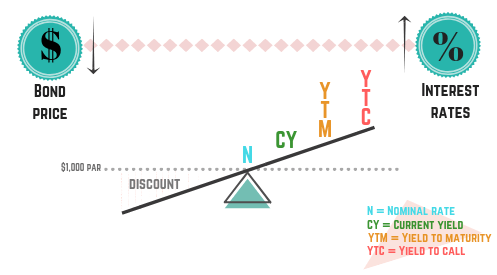
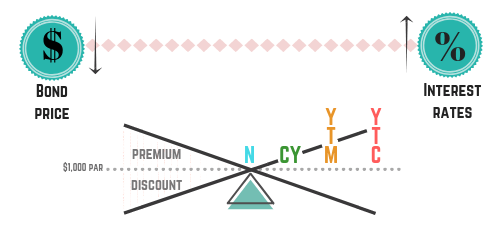
Every discount bond follows this order, so you don’t need to calculate the yields to rank them. The bond see-saw shows the same order at a glance:

Discount bond see-saw
Achievable
/
"Discount bond see-saw"

The price side of the see-saw sits below par (a discount), so the yield side rises. Many people memorize the see-saw and rewrite it on scratch paper at the start of the exam.

FINRA is more focused on whether you understand which yield is higher or lower than on whether you can compute every yield. You may still need to calculate current yield, but yield relationships are tested frequently. Knowing the order also helps you eliminate incorrect answer choices.

Premium bond yield relationships

Let’s continue using the premium bond example from the previous sections.

A 10 year, $1,000 par, 4% bond is trading at $1,100. The bond is callable at par after 5 years.

  • Coupon = 4.0% (highest)

  • Current yield = 3.6%

  • YTM = 2.9%

  • YTC = 1.9% (lowest)

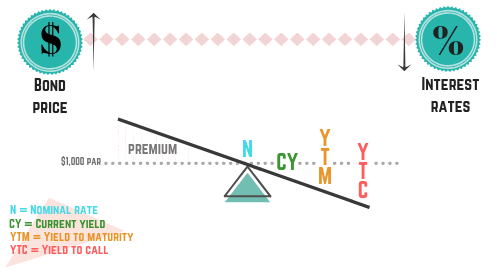
The yields come in the same order as for a discount bond, but each one is now lower than the one before it. Every premium bond follows this pattern, and the see-saw shows it:

Premium bond see-saw
Achievable
/
"Premium bond see-saw"

For premium bonds, the price side points upward because the bond trades above par. The yield side points downward, reflecting that yields are below the coupon.

Yield for par bonds

We’ve seen how discounts and premiums affect yield. What if a bond is purchased at par ($1,000)? This case is straightforward.

When a bond is purchased at par:

  • The bond is bought at $1,000 and matures at $1,000.
  • There is no gain or loss from price movement back to par.
  • The only return is the coupon.

So, all yields equal the coupon. Using the same bond as the rest of this chapter:

A 10 year, $1,000 par, 4% bond bought for $1,000. The bond is callable at par after 5 years.

  • Coupon = 4.0% ($40 / $1,000 par)
  • Current yield = 4.0% ($40 / $1,000 price)
  • YTM = 4.0% (no discount to earn and no premium to lose, so the $40 a year is the whole return)
  • YTC = 4.0% (called at $1,000, the same price the investor paid)

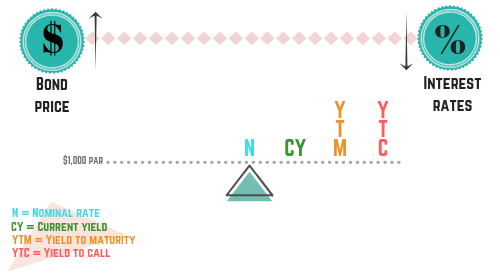
For a bond purchased at par, the see-saw looks like this:

Par bond see-saw
Achievable
/
"Par bond see-saw"

Coupon, current yield, YTM, and YTC all line up at the same level. If you see a question about par bond yields, keep it simple: they’re all the same.

The bond see-saw

Yield is a major SIE topic, and the bond see-saw helps you visualize the relationship between bond prices, interest rate changes, and yields. Here are the discount, premium, and par versions together:

Bond see-saw
Achievable
/
"Bond see-saw"

If you use a “dump sheet,” this is a common item to include. A dump sheet is a set of key visuals or facts you write on scratch paper after the exam begins, so you can reference them during questions.

Some test-takers also use acronyms like this:

CYM Call

  • CY = Current Yield

  • M = yield to Maturity

  • Call = yield to Call

Use any memory aid that helps you keep the yield terms and their order straight.

Bond yield basics

  • Yield = overall return; influenced by coupon, purchase price, time to maturity
  • Coupon and yield differ unless bond trades at par
  • Bond point = 1% of par ($10 on $1,000 bond); different from basis point (0.01%, measures yield)

Reading bond prices

  • Prices quoted as % of par, not dollars
  • Premium/discount described in points (e.g., 7-point premium = 107% of par)
  • Four yields covered: nominal, current, YTM, YTC

Nominal yield

  • Same as stated coupon rate
  • Also known as: coupon, interest rate, stated rate
  • Formula: Nominal yield=ParAnnual income​
  • Fixed for life of bond; market price not a factor

Current yield

  • Quick estimate of return; ignores time
  • Formula: Current yield=Market priceAnnual income​
  • Discount bonds: current yield > coupon
  • Premium bonds: current yield < coupon

Yield to maturity (YTM)

  • Also called bond’s “basis”; assumes held to maturity; accounts for time
  • Formula concept: annual income ± annualized discount/premium, divided by average of price and par
  • Discount bonds: YTM > coupon
  • Premium bonds: YTM < coupon
  • Exact math rarely tested; focus on relationships

Yield to call (YTC)

  • Applies only to callable bonds; assumes called at first call date
  • Uses call price and years to call instead of par/maturity
  • Discount bonds: YTC > YTM > current yield > coupon (gain realized sooner)
  • Premium bonds: YTC < YTM < current yield < coupon (loss realized sooner)

Discount bond yield relationships

  • Order (low to high): Coupon < Current yield < YTM < YTC
  • Bond see-saw: price below par (discount) → yields rise

Premium bond yield relationships

  • Order (high to low): Coupon > Current yield > YTM > YTC
  • Bond see-saw: price above par (premium) → yields fall

Yield for par bonds

  • Bond bought and matures at par → no gain/loss from price
  • All yields equal the coupon: Coupon = Current yield = YTM = YTC
  • See-saw is balanced/level at par

The bond see-saw

  • Visual tool linking price and yield relationships across discount, premium, and par bonds
  • Useful as a “dump sheet” item to memorize before exam
  • Mnemonic: CYM Call = Current Yield, Maturity, Call (yield order)

Sign up for free to take 27 quiz questions on this topic

Previous
Next  | 3.6 Suitability
All rights reserved ©2016 - 2026 Achievable, Inc.

Yield

We first discussed the concept of yield in the preferred stock chapter. The idea is the same for bonds: yield measures the overall return of an investment. For bonds, yield is influenced by several factors, including:

  • The interest rate (coupon)
  • The purchase price
  • The length of time until maturity

A bond’s interest rate (coupon) and its yield sound similar, but they aren’t the same thing (except for nominal yield, discussed below). The interest rate is the annual interest the issuer pays based on par value. Yield is the bond’s overall rate of return, which depends on both the coupon and the price you pay. If a bond is purchased at a discount or a premium, its yield will differ from its coupon.

Reading bond prices in points

The examples in this chapter state prices in dollars, but bond prices are usually quoted as a percentage of par instead. Each whole percentage point of that quote is called a bond point.

Definitions
Bond point
A unit of price equal to 1% of par. On a $1,000 par bond, one bond point equals $10.

So a bond quoted at 106 is trading at 106% of $1,000 par, or $1,060. A bond quoted at 87 is trading at 87% of par, or $870.

Premiums and discounts can be described the same way:

  • A 7 point premium means the bond is trading at 107% of par: $1,070, or $70 above par.
  • A 13 point discount means the bond is trading at 87% of par: $870, or $130 below par.

Don’t confuse a bond point with a basis point. A bond point measures price and equals 1% of par ($10 on a $1,000 par bond). A basis point measures yield and equals 0.01%. So a 7 point premium means the bond is $70 above par - not 7 basis points.

You’ll see the full set of bond quote conventions later, in the corporate debt chapter’s coverage of the bond market and quotes. For now, all you need is this conversion: a bond quote is a percentage of par, and each point is worth $10 on a $1,000 par bond.

We’ll discuss the following yields in this chapter:

  • Nominal yield
  • Current yield
  • Yield to maturity (YTM)
  • Yield to call (YTC)

Nominal yield

The nominal yield is another name for the bond’s interest rate (coupon). You’ll rarely calculate nominal yield in practice, but you may be asked to identify the formula.

For example:

A $1,000 par, 4% bond

Nominal yield=ParAnnual income​

Nominal yield=$1,000$40​

Nominal yield=4%

This calculation simply confirms the stated 4% coupon. Nominal yield depends on two values that don’t change:

  • Par value ($1,000)
  • Annual interest paid ($40)

No matter what happens to the bond’s market price, the issuer still pays $40 per year, and the bond still matures at $1,000. That’s why nominal yield stays fixed over the bond’s life. Unlike the other yields in this chapter, market price is not part of the nominal yield calculation.

Current yield

A bond’s current yield is a quick (but incomplete) way to estimate return. It uses annual income and the bond’s current market price, but it ignores time. Time matters for bonds because it affects:

  • How long you receive interest payments
  • When you receive the principal repayment

Because of that, current yield is often used as a fast approximation, but it can be misleading if treated as a full measure of return.

Let’s add market price to the example.

A $1,000 par, 4% bond bought for $800

If this bond is bought at $800 (a discount), the investor’s overall return will be higher than the 4% coupon. That’s because the investor earns return from two sources:

Coupon

  • Pays the investor $40 annually

Discount

  • Investor earns $200 over the life of the bond

The investor receives 4% of par ($1,000) each year, and also benefits from the bond moving from the purchase price ($800) up to par ($1,000) at maturity. That extra $200 increases the overall return.

Current yield is calculated by dividing annual income by the bond’s market price.

A $1,000 par, 4% bond bought for $800. What’s the current yield?

Can you figure it out?

(spoiler)

Current yield=Market priceAnnual income​

Current yield=$800$40​

Current yield=5%

Because the bond is purchased at a discount, the current yield (5%) is higher than the coupon (4%). So you can assume:

  • For discount bonds, current yield > coupon

Now compare that to a premium bond. Premium bonds trade above par.

A $1,000 par, 4% bond bought for $1,100

The investor still receives $40 per year in interest. But because the bond matures at par, paying $1,100 for a bond that will be worth $1,000 at maturity creates a $100 loss over time. That pushes the overall return below the coupon.

A $1,000 par, 4% bond bought for $1,100. What is the current yield?

Can you figure it out?

(spoiler)

Current yield=Market priceAnnual income​

Current yield=$1,100$40​

Current yield=3.6%

Here, the current yield (3.6%) is lower than the coupon (4%). So you can assume:

  • For premium bonds, current yield < coupon

Here’s a video breakdown of a practice question on current yield:

Yield to maturity (YTM)

Yield to maturity and yield to call formulas are difficult to memorize and typically are not tested. Exam questions are more likely to focus on the relationships of the yields, which is best depicted on the bond see-saw (discussed at the end of this chapter). Additionally, a test question may focus on the components of these yield formulas. Don’t spend much time focusing on the math related to these yields.

Unlike current yield, yield to maturity (YTM) (also called a bond’s basis) includes time. It assumes the investor buys the bond and holds it until maturity, making it a more complete measure of overall return.

A 10 year, $1,000 par, 4% bond is trading at $800. What is the yield to maturity (YTM)?

ytmytmytmytm​=2F+P​C+nF−P​​=21000+800​40+101000−800​​=90040+20​=6.7%​ where:CFPn​=coupon interest payment=face value (par)=price=years to maturity​

Here’s what each part represents:

  • Annual income is $40 (4% of $1,000 par).
  • The total discount is $200 ($1,000 − $800). Spread over 10 years, that’s $20 per year.
  • The denominator uses the average of price and par: ($800 + $1,000) / 2 = $900.

The YTM (6.7%) is higher than the coupon (4%). That matches the general pattern: discount bonds have yields above the coupon because the discount adds to return.

Now compare a premium bond.

A 10 year, $1,000 par, 4% bond is trading at $1,100. What is the yield to maturity (YTM)?

ytmytmytmytm​=2F+P​C−nP−F​​=21,000+1,100​40−101,100−1,000​​=105040−10​=2.9%​ where:CFPn​=coupon interest payment=face value (par)=price=years to maturity​

  • Annual income is still $40.
  • The total premium is $100 ($1,100 − $1,000). Spread over 10 years, that’s $10 per year.
  • We subtract the annualized premium because it reduces return.
  • The average of price and par is ($1,100 + $1,000) / 2 = $1,050.

The YTM (2.9%) is lower than the coupon (4%), which is the typical premium-bond relationship.

Yield to call (YTC)

Remember the advice above - the math behind the yield to call formula is unimportant.

Yield to call (YTC) applies only to callable bonds. If a bond isn’t callable, there is no YTC.

YTC is the bond’s overall rate of return assuming it’s called at the first call date. Like YTM, it includes time. The formula is similar to YTM, but it uses:

  • The call price instead of par at maturity
  • The years to call instead of years to maturity

A 10 year, $1,000 par, 4% bond is trading at $800. The bond is callable at par after 5 years. What is the yield to call (YTC)?

ytcytcytcytc​=2CP+MP​C+tCP−MP​​=21000+800​40+51000−800​​=90040+40​=8.9%​ where:CCPMPt​=coupon interest payment=call price=market price=years to call​

The YTC (8.9%) is higher than the coupon (4%), and it’s also higher than the YTM (6.7%). The reason is timing: the investor earns the $200 discount sooner.

  • Held to maturity: the $200 discount is realized over 10 years.
  • Called in 5 years: the same $200 is realized in 5 years, increasing the annualized return.

Now look at a premium bond.

A 10 year, $1,000 par, 4% bond is trading at $1,100. The bond is callable at par after 5 years. What is the yield to call (YTC)?

ytcytcytcytc​=2CP+MP​C−tMP−CP​​=21,000+1,100​40−51,100−1,000​​=105040−20​=1.9%​ where:CCPMPt​=coupon interest payment=call price=market price=years to call​

The YTC (1.9%) is lower than the coupon (4%), and it’s also lower than the YTM (2.9%). Again, timing explains it:

  • Held to maturity: the $100 premium is lost over 10 years.
  • Called in 5 years: the same $100 loss happens in 5 years, reducing the annualized return.

Discount bond yield relationships

Let’s summarize the discount bond example from the previous sections.

A 10 year, $1,000 par, 4% bond is trading at $800. The bond is callable at par after 5 years.

  • Coupon = 4.0% (lowest)

  • Current yield = 5.0%

  • YTM = 6.7%

  • YTC = 8.9% (highest)

Every discount bond follows this order, so you don’t need to calculate the yields to rank them. The bond see-saw shows the same order at a glance:

The price side of the see-saw sits below par (a discount), so the yield side rises. Many people memorize the see-saw and rewrite it on scratch paper at the start of the exam.

FINRA is more focused on whether you understand which yield is higher or lower than on whether you can compute every yield. You may still need to calculate current yield, but yield relationships are tested frequently. Knowing the order also helps you eliminate incorrect answer choices.

Premium bond yield relationships

Let’s continue using the premium bond example from the previous sections.

A 10 year, $1,000 par, 4% bond is trading at $1,100. The bond is callable at par after 5 years.

  • Coupon = 4.0% (highest)

  • Current yield = 3.6%

  • YTM = 2.9%

  • YTC = 1.9% (lowest)

The yields come in the same order as for a discount bond, but each one is now lower than the one before it. Every premium bond follows this pattern, and the see-saw shows it:

For premium bonds, the price side points upward because the bond trades above par. The yield side points downward, reflecting that yields are below the coupon.

Yield for par bonds

We’ve seen how discounts and premiums affect yield. What if a bond is purchased at par ($1,000)? This case is straightforward.

When a bond is purchased at par:

  • The bond is bought at $1,000 and matures at $1,000.
  • There is no gain or loss from price movement back to par.
  • The only return is the coupon.

So, all yields equal the coupon. Using the same bond as the rest of this chapter:

A 10 year, $1,000 par, 4% bond bought for $1,000. The bond is callable at par after 5 years.

  • Coupon = 4.0% ($40 / $1,000 par)
  • Current yield = 4.0% ($40 / $1,000 price)
  • YTM = 4.0% (no discount to earn and no premium to lose, so the $40 a year is the whole return)
  • YTC = 4.0% (called at $1,000, the same price the investor paid)

For a bond purchased at par, the see-saw looks like this:

Coupon, current yield, YTM, and YTC all line up at the same level. If you see a question about par bond yields, keep it simple: they’re all the same.

The bond see-saw

Yield is a major SIE topic, and the bond see-saw helps you visualize the relationship between bond prices, interest rate changes, and yields. Here are the discount, premium, and par versions together:

If you use a “dump sheet,” this is a common item to include. A dump sheet is a set of key visuals or facts you write on scratch paper after the exam begins, so you can reference them during questions.

Some test-takers also use acronyms like this:

CYM Call

  • CY = Current Yield

  • M = yield to Maturity

  • Call = yield to Call

Use any memory aid that helps you keep the yield terms and their order straight.

Key points

Bond yield basics

  • Yield = overall return; influenced by coupon, purchase price, time to maturity
  • Coupon and yield differ unless bond trades at par
  • Bond point = 1% of par ($10 on $1,000 bond); different from basis point (0.01%, measures yield)

Reading bond prices

  • Prices quoted as % of par, not dollars
  • Premium/discount described in points (e.g., 7-point premium = 107% of par)
  • Four yields covered: nominal, current, YTM, YTC

Nominal yield

  • Same as stated coupon rate
  • Also known as: coupon, interest rate, stated rate
  • Formula: Nominal yield=ParAnnual income​
  • Fixed for life of bond; market price not a factor

Current yield

  • Quick estimate of return; ignores time
  • Formula: Current yield=Market priceAnnual income​
  • Discount bonds: current yield > coupon
  • Premium bonds: current yield < coupon

Yield to maturity (YTM)

  • Also called bond’s “basis”; assumes held to maturity; accounts for time
  • Formula concept: annual income ± annualized discount/premium, divided by average of price and par
  • Discount bonds: YTM > coupon
  • Premium bonds: YTM < coupon
  • Exact math rarely tested; focus on relationships

Yield to call (YTC)

  • Applies only to callable bonds; assumes called at first call date
  • Uses call price and years to call instead of par/maturity
  • Discount bonds: YTC > YTM > current yield > coupon (gain realized sooner)
  • Premium bonds: YTC < YTM < current yield < coupon (loss realized sooner)

Discount bond yield relationships

  • Order (low to high): Coupon < Current yield < YTM < YTC
  • Bond see-saw: price below par (discount) → yields rise

Premium bond yield relationships

  • Order (high to low): Coupon > Current yield > YTM > YTC
  • Bond see-saw: price above par (premium) → yields fall

Yield for par bonds

  • Bond bought and matures at par → no gain/loss from price
  • All yields equal the coupon: Coupon = Current yield = YTM = YTC
  • See-saw is balanced/level at par

The bond see-saw

  • Visual tool linking price and yield relationships across discount, premium, and par bonds
  • Useful as a “dump sheet” item to memorize before exam
  • Mnemonic: CYM Call = Current Yield, Maturity, Call (yield order)

More from Debt securities

  • Basic characteristics
  • Issuance & underwriting
  • Trading
  • Features
  • Suitability