



The New York Stock Exchange
Functioning in some form since 1792, the New York Stock Exchange (NYSE) is the world’s largest stock exchange. The NYSE operates as an auction market, where a designated market maker (DMM) facilitates trading for a stock. Like an auctioneer, the DMM helps bring buyers and sellers together, and it also trades with the public out of its own inventory. The DMM always acts in a principal capacity, trading for its own account. It doesn’t act in an agency capacity: the exchange’s system matches public buy and sell orders with each other automatically.
Before 2008, this role belonged to the NYSE specialist, who could act in either capacity: as an agent matching public orders, or as a principal trading from inventory. When the NYSE replaced specialists with DMMs in 2008, the agency role was eliminated. You may still see the DMM referred to as the “specialist.”
In practice, a DMM is both a person on the NYSE floor and a sophisticated electronic trading system. Modern markets move too quickly for a human to manually execute every trade. Most market making is handled by algorithms that react almost instantly to changing prices and order flow. People still oversee these systems, make sure they operate correctly, and can step in to trade manually when needed.
Private companies are hired by the NYSE to operate as DMMs, and each company assigns an employee to work at the DMM post on the floor. If you want a closer look, here’s a NYSE YouTube video describing the role of DMMs.
There are several DMMs on the NYSE, but each listed stock is assigned to one DMM. For example, all trades of Coca-Cola stock (listed on the NYSE) are facilitated by one specific DMM. The DMM’s primary goal is to “maintain fair and orderly markets” and reduce liquidity problems. In plain terms, the DMM helps ensure investors can trade at accurate market prices during normal trading hours.
There are several ways the NYSE supports this process. One key tool is its order-routing system, traditionally called the Super Display Book. When financial firms submit customer orders to the NYSE, most orders go through this system, which matches and executes them automatically. In 2012, the Super Display Book was updated to the modern Universal Trading Platform, but FINRA still refers to the Super Display Book as the NYSE’s system.
If it’s a limit order that’s currently “away from the market,” it rests on the NYSE’s order book, known as the DMM’s book. To see what that means, here’s a simple example of what a DMM’s book might look like:
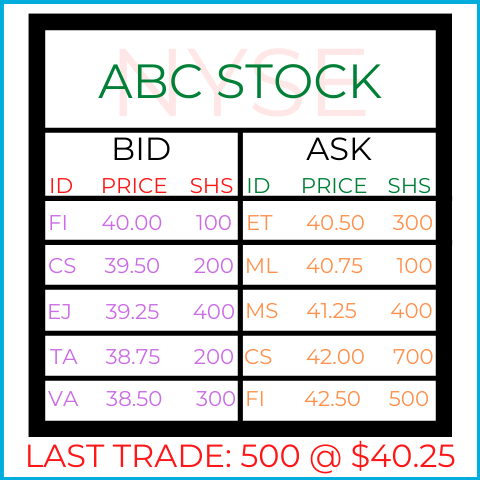
When a DMM reviews market dynamics, they’ll typically see a screen like this: a bid-and-ask display.
- The left side shows buy limit orders submitted by financial firms on behalf of customers (the IDs are the submitting firms; you don’t need to memorize specific firm IDs).
- The right side shows sell limit orders.
All of these orders are “away from the market,” meaning they can’t be filled at the current market price. The last completed trade was 500 shares at $40.25, which sits between the highest bid and the lowest ask.
The best buy order is 100 shares at $40.00, and the best sell order is 300 shares at $40.50. This is the inside market, meaning the best available prices currently on the DMM’s book. Therefore, the inside market is:
40.00 x 40.50
1 x 3
Market orders are often matched against limit orders on the book. A market order requests a trade at the next available price. For example, if a market order to buy 300 shares enters the system, it could be matched against the limit order to sell 300 shares at $40.50. In that case, the exchange’s system matches:
- the buyer (the market order to buy), with
- the seller (the $40.50 limit order to sell).
The DMM isn’t part of that trade; it doesn’t act as an agent for public orders.
If the DMM believes the $0.50 spread (between the highest bid and lowest ask) is too wide, it can narrow the spread by offering shares from its own inventory at a better price than $40.50. Suppose the DMM offers 300 shares at $40.40. The market order to buy 300 shares would then buy from the DMM at $40.40, a $0.10 per share price improvement compared with the $40.50 sell limit order. This is how DMMs act in a principal capacity: they buy into or sell from their own inventory.
When trading as principal, the DMM follows the same price priority as everyone else: the best price trades first. In this example, to trade ahead of the public orders on the book, the DMM has to improve on them:
- to sell ahead of them, it must offer below $40.50, and
- to buy ahead of them, it must bid above $40.00.
At the same price as a public order, the DMM’s order trades alongside the public orders (called parity) rather than ahead of them. At a worse price, it waits behind them. Before 2008, the specialist had to let public orders at the same price trade first.
These examples show how the DMM supports a fair, orderly, and liquid market:
- When there’s plenty of trading activity, public orders mostly trade with each other through the exchange’s system.
- When trading is thin or spreads are wide, the DMM trades directly with the public from its own inventory (principal).
Here’s a video that goes deeper into the DMM’s role in bid-ask spreads and how to approach test questions on the topic:
DMMs are also authorized to stop stock, meaning they freeze the price of a security for a short period of time. This is most often done for floor brokers, who also work on the NYSE floor. Floor brokers represent financial firms that send trades to the NYSE.
For example, Charles Schwab could send a representative to the NYSE floor to help facilitate large customer trades (small trades are routinely handled by the system with no human involvement). If Charles Schwab receives a large order in an NYSE-listed stock, it may route the order to a floor broker. The floor broker then communicates with the DMM and other floor brokers to seek the best possible price.
If the DMM chooses, it can quote a price to the floor broker and “lock it in” by stopping the stock for a short time. During that time window, the floor broker tries to find a better price from other brokers. If no better price is found before the time expires, the floor broker can return to the DMM and accept the quoted price. DMMs may only stop stock for public orders; they can’t do it for themselves or for a financial firm’s trading account.
The NYSE trades only stocks that are “listed” on the exchange. To be listed, issuers must meet certain standards, such as market capitalization and minimum numbers of shareholders. You don’t need to memorize the listing requirements, but you should know that the NYSE generally lists large companies with actively traded stocks.
One of the NYSE’s goals is to maintain fair and orderly markets. After Black Monday in 1987, the NYSE introduced circuit breakers to help prevent a market “death spiral.” Sometimes called trading curbs, circuit breakers pause trading for short periods when there’s a large, rapid market decline. For circuit breaker purposes, “the market” is measured by the S&P 500. The rules are enforced daily:
7% decline before 3:25pm ET
- 15-minute trading halt
13% decline before 3:25pm ET
- 15-minute trading halt
20% decline at any time
- Market shuts down for the day
Circuit breakers don’t eliminate market declines, but they can temporarily slow downward momentum. Although the NYSE created the system, all major exchanges enforce these rules today. Circuit breakers are uncommon, but they were triggered during the 2010 Flash Crash (a 9% drop in minutes) and four times during the COVID-19 volatility in March 2020.
The NYSE is open every business day from 9:30am to 4:00pm ET. DMMs often arrive early (commonly around 7am ET) to analyze market data for price discovery. Even when the market is closed, financial firms can still submit orders into the system. If many buy orders accumulate overnight, the DMM may open the stock at a higher price than the prior day’s close (and vice versa). Setting the opening price based on pre-market supply and demand is called price discovery.
The NYSE isn’t the only exchange with this structure. A few other exchanges are modeled similarly, including the American Stock Exchange, referred to as NYSE-MKT. There are also regional exchanges, such as the Philadelphia Stock Exchange. A stock can trade on the NYSE and another exchange (often a regional exchange). These are called dual-listed stocks.
Any trade that takes place on the NYSE is a first market trade. As a reminder, a first market trade is a trade of a listed stock on an exchange. Listed securities can also trade outside their primary exchange in the OTC markets, which is called the third market.
When the same security trades in multiple markets, it can be harder to identify the best available price. The Consolidated Quotation System (CQS) helps by providing the consolidated tape, which reports quotes across multiple markets for securities listed on exchanges like the NYSE and NASDAQ. The consolidated tape combines first and third market quotes, but it does not include the second market (the non-NASDAQ OTC markets).