



Bids & offers
Investors can buy and sell securities in the secondary market largely because of market makers. A market maker is a firm that makes a business out of trading securities with the public. Like a car dealership that buys cars and resells them, a market maker buys securities from investors and sells those securities to other investors.
This chapter explains how market makers use bid and ask spreads and how this works in two major markets.
Bid & ask spreads
Bid & ask (offer) spreads are maintained by market makers in the secondary market*.
- The bid and ask are the prices the market maker is willing to trade at.
- The difference between them (the spread) is a key source of the market maker’s profit.
*Securities are originally sold in the primary market by issuers, then are traded in the secondary market by investors.
The bid is the price the firm is willing to buy a security at.
- The term bid is from the market maker’s perspective: the firm is “bidding” for someone to sell to them.
- Along with the bid price, the market maker also states how many shares it’s willing to buy at that price. We’ll use this in the example below.
The ask (also called the offer) is the price the firm is willing to sell a security at.
- The term ask is also from the market maker’s perspective: the firm is “asking” a price in hopes that someone will buy.
- Along with the ask price, the market maker states how many shares it’s willing to sell at that price.
Here’s an example of a bid/ask:
GM stock
$40 bid / $41 ask
4x7
In this example, a market maker is quoting GM stock.
- The $40 bid means the market maker is willing to buy GM at $40.
- The $41 ask means the market maker is willing to sell GM at $41.
The 4x7 shows the quote size in round lots.
- 4 on the bid side means the market maker will buy 4 round lots (400 shares) at $40.
- 7 on the ask side means the market maker will sell 7 round lots (700 shares) at $41.
The market maker’s profit comes from the difference between the buy price and the sell price.
- Here, the spread is $41 − $40 = $1.
- A $1 spread can add up quickly when a market maker executes thousands of trades per day.
A $1 spread is not typical for actively traded stocks. Most popular stocks have spreads measured in pennies. Even with small spreads, firms can earn substantial profits if trading volume is high.
An efficient market is one with active trading and small spreads. In an efficient market, market makers can rely on many small spreads adding up over the day.
There are always two sides to a trade. So far, we’ve described bid and ask from the market maker’s perspective. A customer takes the opposite side.
Bid
- Market maker buys
- Customer sells
Ask
- Market maker sells
- Customer buys
NYSE
Operating in some form since 1792, the New York Stock Exchange (NYSE) is the world’s largest stock exchange. The NYSE is an auction market. For each listed stock, a designated market maker (DMM) (sometimes called a specialist) facilitates trading.
Like an auctioneer, the DMM:
- helps bring buyers and sellers together, and
- trades with the public from the DMM’s own inventory.
The DMM always acts in a principal capacity*, trading for its own account. It doesn’t act in an agency capacity: the exchange’s system matches public buy and sell orders with each other automatically.
*These trade capacities are discussed in detail later in this unit. For now, assume an agency capacity involves matching buyers and sellers, while a principal transaction involves a professional trading directly with their clients.
Before 2008, this role belonged to the NYSE specialist, who could act in either capacity: as an agent matching public orders, or as a principal trading from inventory. When the NYSE replaced specialists with DMMs in 2008, the agency role was eliminated.
In practice, the DMM function is a mix of people and technology.
- Markets move too quickly for a person to manually execute all trades.
- Most market making is handled by computerized systems and algorithms that respond almost instantly to changes in supply and demand.
- People still oversee these systems, handle exceptions, and may step in when needed.
Private companies are hired by the NYSE to operate as DMMs, and they assign an employee to the DMM post on the exchange floor. If you want a deeper look, here’s a NYSE YouTube video describing the role of DMMs.
There are several DMMs on the NYSE, but each listed stock is assigned to one DMM. For example, all trades of Coca-Cola stock (listed on the NYSE) are facilitated by one specific DMM.
The DMM’s main goal is to maintain fair and orderly markets and reduce liquidity problems. In plain terms, the DMM helps ensure investors can trade at accurate market prices during normal trading hours.
One way the NYSE supports this is through its order-routing system, traditionally called the Super Display Book.
- When firms submit customer orders to the NYSE, most orders go through this system.
- The system matches and executes orders automatically.
In 2012, the Super Display Book was updated to the modern Universal Trading Platform, but FINRA still refers to the Super Display Book as the NYSE’s system.
Limit orders that are currently “away from the market” are placed on the NYSE’s order book, known as the DMM’s book.
*Limit orders involve placing a “limit” on a transaction price. For example, a limit order to buy stock at $40 would not allow a transaction to go through unless the stock was $40 or lower. If the market price was above $40, the order would be “away from the market” and remain unfilled until the market price fell below $40. You’ll learn more about these order types later in this unit.
To see how this works, here’s a simplified example of what the DMM’s book might look like:
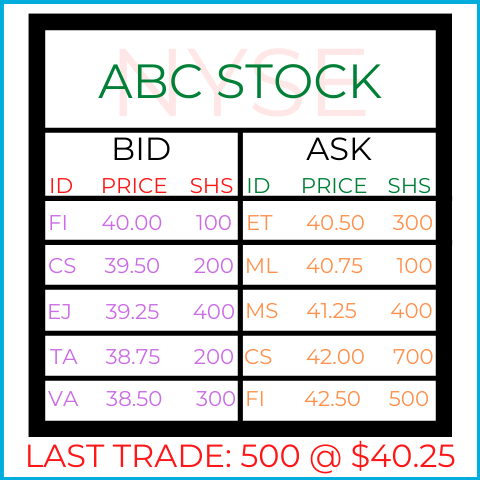
This screen shows the current limit orders on the book.
- The left side shows buy limit orders submitted by firms on behalf of customers.
- The right side shows sell limit orders.
- These orders are “away from the market,” meaning they can’t be filled at the current market price.
The last completed trade was 500 shares at $40.25, which sits between the highest bid and the lowest ask.
- The best buy order is 100 shares at $40.00.
- The best sell order is 300 shares at $40.50.
These best prices form the inside market, meaning the best available bid and best available ask on the DMM’s book.
Therefore, the inside market is:
40.00 x 40.50
1 x 3
Market orders are often matched against the limit orders on the book. A market order requests execution at the next available price.
- If a market order to buy 300 shares enters the system, it can be matched with the 300-share sell limit order at $40.50.
- In that case, the exchange’s system matches a buyer (the market order) with a seller (the limit order). The DMM isn’t part of that trade; it doesn’t act as an agent for public orders.
If the DMM believes the $0.50 spread (between the highest bid and lowest ask) is too wide, the DMM may narrow it by offering shares from its own inventory at a better price.
- Suppose the DMM offers 300 shares from inventory at $40.40.
- The market order would then buy from the DMM at $40.40, a $0.10 per share price improvement compared with buying at $40.50.
This is how DMMs act in a principal capacity: they trade directly from their own inventory.
When doing this, the DMM follows the same price priority as everyone else: the best price trades first. To trade ahead of (or “in front of”) the public orders already on the book:
- the DMM must sell at a price below $40.50, or
- the DMM must buy at a price above $40.00.
At the same price as a public order, the DMM’s order trades alongside the public orders (called parity) rather than ahead of them. At a worse price, it waits behind them. Before 2008, the specialist had to let public orders at the same price trade first.
Putting it together:
- When trading is active and spreads are tight, public orders mostly trade with each other through the exchange’s system.
- When trading is thin or spreads are wide, the DMM trades directly with the public to add liquidity (principal).
Here’s a video that goes deeper into the DMM’s role with bid and ask spreads and how to approach test questions on the topic:
DMMs are also authorized to stop stock, meaning they can temporarily freeze (guarantee) a price for a short period of time. This is most often done for floor brokers, who work on the NYSE floor.
Floor brokers represent financial firms that send orders to the NYSE.
For example, Charles Schwab could send a representative to the NYSE floor to help execute large customer trades (small trades are typically handled electronically). If Schwab receives a large order in an NYSE-listed stock, it may route that order to a floor broker.
From there:
- The floor broker communicates with the DMM and other floor brokers to seek the best available price.
- The DMM may quote a price to the floor broker and “lock it in” by stopping the stock for a short time.
- During that time, the floor broker tries to find a better price elsewhere on the floor.
- If no better price is found before time expires, the broker can return to the DMM and accept the stopped price.
DMMs can only stop stock for public orders. They can’t stop stock for themselves or for a firm’s proprietary trading account.
The NYSE trades only stocks that are listed on the exchange. To be listed, issuers must meet certain standards (such as market capitalization and minimum numbers of shareholders). You don’t need to memorize the listing requirements, but you should know that the NYSE generally lists large, actively traded companies.
The NYSE isn’t the only exchange with this structure. Other exchanges are modeled similarly, including the American Stock Exchange, referred to as NYSE-MKT. There are also regional exchanges with similar features, such as the Philadelphia Stock Exchange.
A stock may trade on the NYSE and another exchange (often a regional exchange). These are called dual-listed stocks.