



NASDAQ
NASDAQ
Originally started in the 1970s as an association of dealers, NASDAQ grew into one of the largest exchanges in the world. Unlike the NYSE, which operates as an auction market, NASDAQ is considered a negotiated market. Stocks traded on the NYSE are handled by a centralized DMM; each individual stock’s trades are handled by one DMM.
NASDAQ is an over-the-counter market (no physical trading floor) made up of dozens of market makers who trade with the public. Market makers compete with each other, and the firms showing the best prices tend to attract the most orders. An OTC trade is one that does not take place at a physical exchange.
Even though NASDAQ is an OTC market, it’s still considered to have “exchange status,” and its stocks are treated as exchange-listed. Like the NYSE, NASDAQ has high standards for companies that want to list on its platform.
Market makers must be willing to provide a continuous quote on the securities they trade. There are legitimate reasons for a temporary or permanent withdrawal (e.g., closing the business, sick employees, unforeseen events, etc.). In practice, market makers typically provide consistent, ongoing quotes that look like this:
| Bid | Ask | |
|---|---|---|
| Price | $50.25 | $50.50 |
| Size | 7 | 3 |
This quote works the same way as the other bid and ask quotes we’ve discussed in this chapter:
- The market maker is willing to buy up to 700 shares at $50.25.
- The market maker is willing to sell 300 shares at $50.50.
- The spread is $0.25.
NASDAQ includes dozens of market makers displaying quotes like this. Here’s what it looks like when all market maker quotes are aggregated:
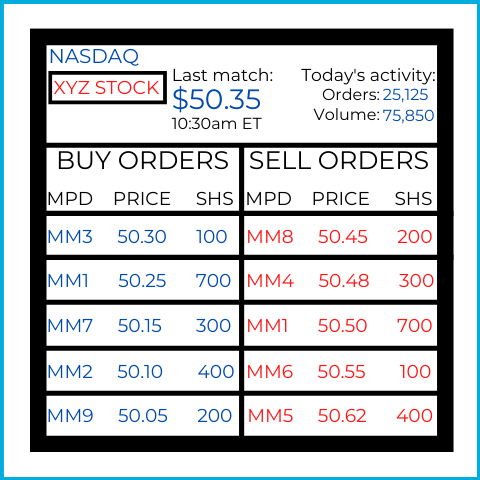
*MPD = Market maker ID
First, let’s test your knowledge. What’s the inside market?
Answer = $50.30 x $50.45 / 1 x 2
The inside market is the price and number of shares available at the highest bid (buy order) and lowest ask (sell order).
On NASDAQ, the inside market is shown as a level 1 quote. When investors initially pull up a quote on a NASDAQ security, they’re typically shown a level 1 quote with the best prices currently available.
The visual above showing several market maker quotes is a level 2 quote. A level 2 quote goes beyond the inside market and shows additional quotes in the market. Investors can access NASDAQ’s level 2 quote system through their broker-dealers by special request.
Sometimes, a level 2 quote can provide insight into market activity. For example, if there’s a large interest to buy just below the highest bid or to sell just above the lowest ask, that information can influence expectations about where the market may move.
A level 3 quote looks like a level 2 quote, but it’s interactive. Participating market makers are the only ones with access to level 3 quotes. They use this system to place new quotes, adjust current quotes, or remove old quotes.
NASDAQ uses its own execution system for routing trades, known as the NASDAQ Market Center Execution System. Market makers using this system can enter quotes for up to 999,999 shares (just short of 1 million).
NASDAQ is open daily from 9:30am-4:00pm ET for normal operating hours, the same as the NYSE. NASDAQ also offers pre-market and post-market trading, which allows investors to trade outside normal hours.
NASDAQ after-hours
- Pre-market: 4:00am - 9:30am ET
- Post-market: 4:00pm - 8:00pm ET
Pre-market and post-market trading increase trading opportunities, but they also add risk. Fewer investors trade during these sessions, which can increase volatility. Most broker-dealers require customers to review a risk disclosure before trading in the pre- and post-markets. Investors should understand that these markets often involve wider spreads, lower trading volume, and higher volatility.
The NYSE and NASDAQ used to regulate their own markets as self-regulatory organizations (SROs). SROs are granted regulatory power and oversee the participants in their markets. In 2007, the NYSE’s and NASDAQ’s regulatory arms combined into FINRA, the SRO that now supervises both markets. Although FINRA is not a governmental entity, it has the power to control who operates in the financial markets and how financial firms interact with the investing public.