



Budgeting standards
Budgeting standards play a crucial role in ensuring consistency and efficiency in cost control. Standards are predefined benchmarks for costs and operational efficiency, which guide the preparation of budgets and help in performance evaluation.
By setting these standards, organizations can better control costs, measure efficiency, and maintain consistency across their operations. However, standards based solely on historical data can lock in past inefficiencies - if a process was slow or wasteful last year, using that performance as this year’s standard just carries the inefficiency forward instead of challenging the organization to improve.
Standard costs are used to create budgets by estimating how much it should cost to produce goods or deliver services under normal operating conditions. Managers then compare actual costs against these standards, and the difference is classified as one of two variances (the mechanics of calculating these variances are covered in calculating and interpreting variances):
- Favorable variance: Occurs when actual costs are lower than the standard costs, indicating better-than-expected performance or cost savings.
- Unfavorable variance: Occurs when actual costs exceed the standard costs, suggesting inefficiencies, higher-than-expected expenses, or other operational issues.
These labels are stated here for costs - a favorable cost variance means actual cost came in below standard. Note that this orientation reverses for revenues, where a favorable variance means actual revenue exceeded the standard; the sales variance chapters cover this in detail.
Ideal (theoretical) vs. currently attainable (practical) standards
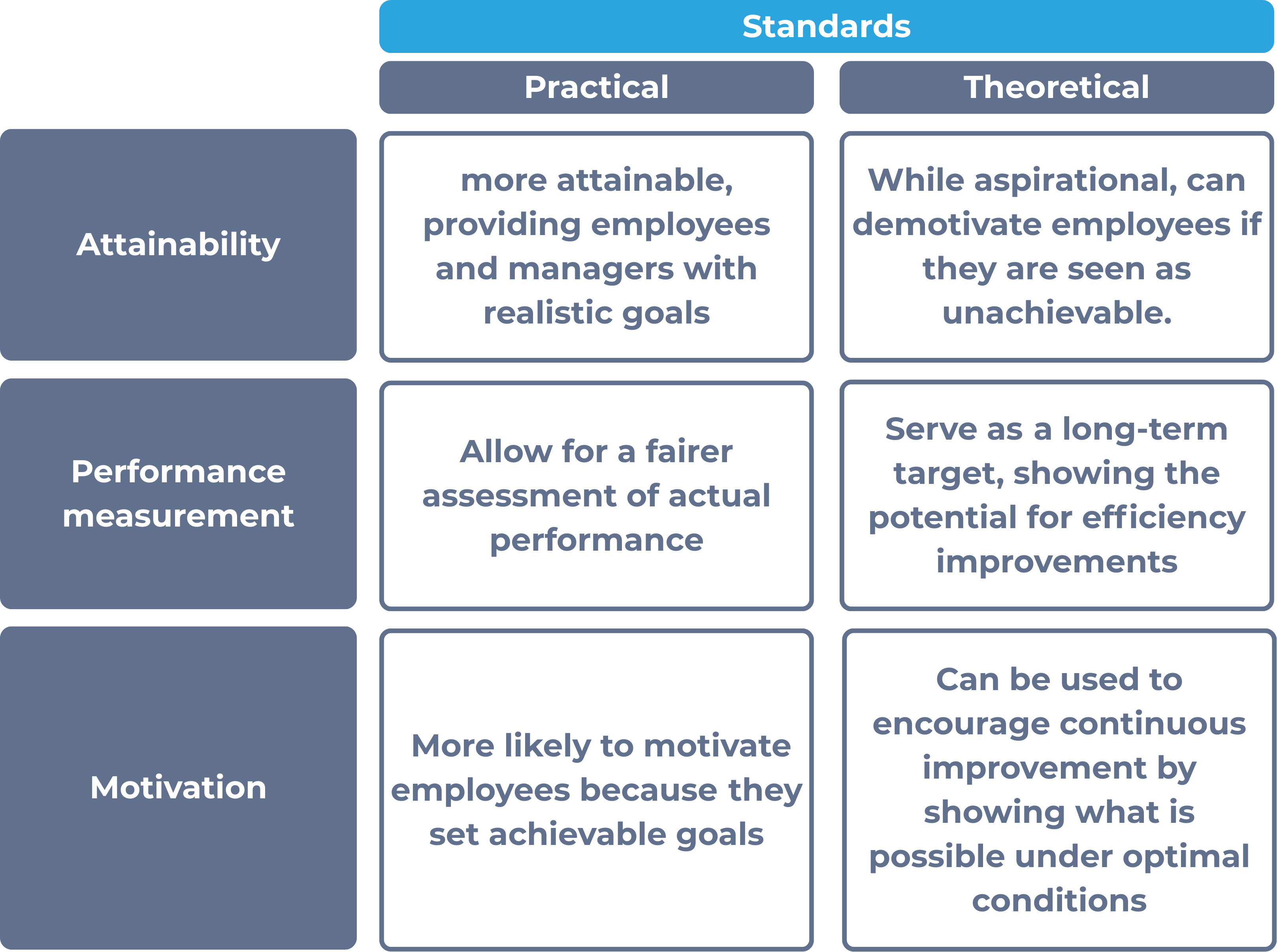
Ideal (theoretical) standards are cost standards that assume perfect efficiency, no downtime, and no waste. These standards represent the best possible performance under ideal operating conditions. While ideal standards are often unattainable in real-world scenarios, they serve as a valuable benchmark for organizations to measure the highest level of operational efficiency they could potentially achieve.
On the other hand, currently attainable (practical) standards reflect real-world conditions, accounting for typical inefficiencies such as machine downtime, material waste, and normal employee performance variability. These standards are more realistic and provide a better basis for performance evaluation since they reflect what can reasonably be achieved under normal operating conditions.
For example, a production line held to an ideal standard of zero downtime can leave workers feeling the target is unreachable no matter how well they perform, which saps motivation. A practical standard that builds in a small, expected allowance for routine maintenance gives that same team a target they can realistically hit - and feel good about hitting.
In conclusion, practical standards are generally better for day-to-day performance evaluation since they are attainable and motivate teams to meet achievable targets. However, it is useful to know theoretical or ideal standards to provide a benchmark for long-term improvement and to push the organization towards higher efficiency.
Authoritative vs. participative standards
Authoritative standards are set by managers or experts without direct input from employees who are responsible for meeting those standards. The main advantage of authoritative standards is that they are typically faster and more efficient to implement. Since the decision-making process is centralized, it allows quicker formulation and alignment of standards with the organization’s broader strategic objectives. Managers and experts can ensure that the standards are ambitious and consistent with the company’s overall goals, particularly when specialized knowledge or a high-level view of the company is needed.
However, a key disadvantage of authoritative standards is the potential for lack of buy-in from employees. When employees are not involved in setting the standards, they may feel disconnected from the process, leading to lower motivation and commitment to achieving the targets. Furthermore, the standards may not fully reflect operational realities, as managers may lack detailed insights into the day-to-day challenges faced by employees. This could result in standards that are either too strict or impractical, which may negatively impact performance and morale.
Participative standards, on the other hand, involve employees in the process of setting performance benchmarks. One of the main advantages of this approach is that it fosters a sense of ownership and engagement among employees. When employees contribute to setting the standards, they are more likely to view the targets as realistic and attainable, leading to greater commitment and motivation to achieve them. Additionally, participative standards are often more grounded in operational practicalities because employees provide insights based on their experience with day-to-day tasks. This makes the standards more achievable and encourages collaboration between different levels of the organization.
However, the participative approach has some disadvantages, primarily the time and resources required to gather input from multiple stakeholders. Reaching consensus can be a lengthy process, and disagreements may arise between employees and management, leading to delays or compromises that weaken the standards.