



Developing standards and budgetary control
Developing standards for direct materials and direct labor
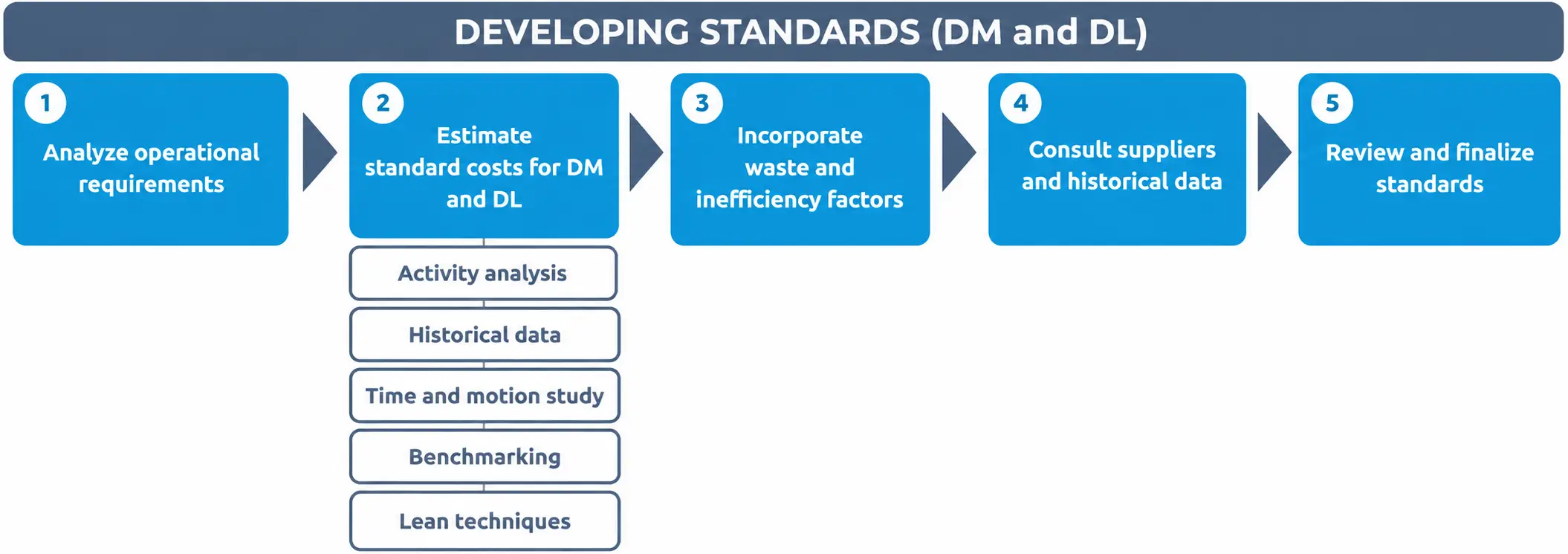
The process of developing standards for direct materials (DM) and direct labor (DL) involves several steps. These standards provide benchmarks for budgeting and performance evaluation, ensuring that the organization operates efficiently. The following is a general step-by-step process for developing DM and DL standards:
This process allows organizations to establish reliable standards that can serve as benchmarks for efficient production, helping to control costs and measure performance.
Step 1. Analyze operational requirements
Begin by identifying the specific materials and labor required to complete a production process. This includes determining the types and quantities of materials needed for each unit of production and the types of labor (skilled, unskilled) necessary to complete each task.
Step 2. Estimate standard costs for DM and DL
Estimate the standard costs for direct materials (DM) and direct labor (DL). This involves determining:
- The standard quantity of DM needed per unit of output and the expected cost per unit of material.
- The standard time of DL required to complete each task and the expected labor rate per hour.
Two commonly used techniques for developing these cost standards are:
- Activity analysis: This involves analyzing the specific activities that contribute to the production process and identifying where efficiencies or inefficiencies occur in order to develop standard costs.
- Time and motion study: A time and motion study involves analyzing a process or task by observing the time taken for each step and the specific movements involved. This data helps pinpoint areas for optimization and allows for the development of more precise standards.
Other approaches, such as benchmarking against industry standards and lean manufacturing techniques, can also help set standards that are competitive and efficient.
Step 3. Incorporate waste and inefficiency factors
Adjust the standard quantities and times to account for normal levels of waste, downtime, and inefficiency. This ensures that the standards reflect real-world conditions and are not overly optimistic.
Step 4. Consult suppliers and historical data
For direct materials, consult suppliers to get up-to-date pricing and evaluate historical purchase data to refine material cost estimates. For direct labor, review historical payroll data and consider expected wage increases or adjustments.
Step 5. Review and finalize standards
Collaborate with relevant department managers and employees to review the proposed standards. Ensure that they are realistic, achievable, and aligned with operational goals before finalizing them for budgeting and performance evaluation.
Budget flexibility and revisions
A successful budgeting process should include a policy that allows for budget revisions to accommodate significant changes in assumptions. Economic conditions, market shifts, and operational changes may require adjustments to the original budget. A budget process should allow for these revisions, ensuring that the organization can respond to new circumstances without losing sight of its objectives. By regularly revisiting the assumptions behind the budget, management can make timely adjustments and avoid disruptions that could impact financial performance or strategic initiatives.
Therefore, while it is essential to have a policy for budget revisions to account for significant changes, it is equally important to ensure that revisions are not abused to maintain the integrity of the budgeting process.
Monitoring and controlling expenditures
Budgets serve as a powerful tool for monitoring and controlling expenditures by:
1. Setting financial targets
Budgets establish expected spending levels for each department or project, serving as a benchmark against which actual expenditures are compared.
2. Variance analysis
Regular comparison of actual spending to the budget allows for the identification of variances (differences between budgeted and actual costs), highlighting areas where costs are exceeding expectations.
3. Accountability
By assigning specific budgetary responsibilities to department managers, budgets help ensure that individuals are accountable for managing their resources effectively.
4. Cost control
Budgets encourage managers to monitor their spending closely and make adjustments when actual costs begin to exceed budgeted amounts, helping to avoid unnecessary expenses.
5. Resource allocation
Budgets provide a framework for deciding how to allocate financial resources, ensuring that funds are directed toward priority areas that align with the organization’s strategic goals.
Budgetary slack and goal congruence
Budgetary slack undermines goal congruence, which is the alignment of individual managers’ goals with the overall objectives of the organization. If managers prioritize their departmental interests over the organization’s strategic goals, it can distort the budgeting process and hinder the company’s ability to achieve its long-term objectives.
Conclusion
Developing reliable standards for direct materials and direct labor requires a structured process - from analyzing operational requirements through finalizing standards with input from managers and employees. Techniques like activity analysis and time and motion studies help ground these standards in realistic, achievable benchmarks.
Budgets need enough flexibility to adapt to changing conditions, but frequent revisions can undermine accountability and financial discipline. Beyond setting targets, budgets are a tool for monitoring expenditures, analyzing variances, and holding managers accountable for their resources.
Finally, guarding against budgetary slack keeps individual managers’ goals aligned with the organization’s overall objectives, supporting a budgeting process that’s both flexible and disciplined.