



Initial recognition and subsequent measurement
The topic for intangible assets that is covered in the CMA Part 1 exams is limited to the impairment. However, in order to discuss this, we need to also cover the different types of intangible assets since the impairment methods would differ for each type.
Just like property, plant and equipment, the general accounting for intangible assets can be broken down into:
- Initial recognition
- Subsequent measurement, which includes:
- Periodic amortization, if applicable
- Impairment
Goodwill is discussed separately from other types of intangibles because, despite being an intangible asset itself, the requirements for accounting for goodwill are covered by a different Codification.
Initial recognition of intangible assets
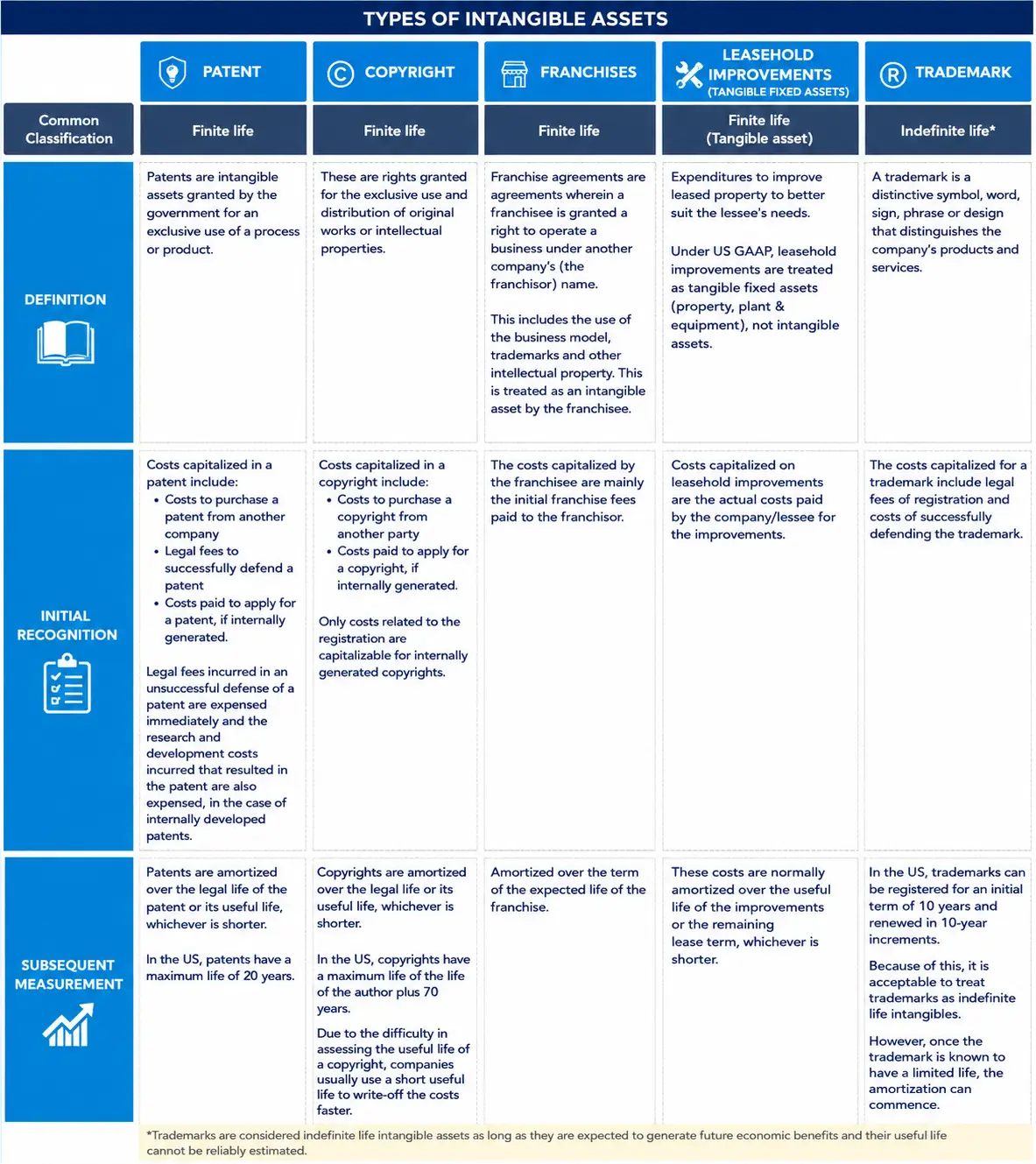
The initial recognition of intangible assets mirrors that of property, plant and equipment discussed in the previous section. They are initially recorded at acquisition cost plus incidental costs necessary to make the asset ready for use. This may vary depending on the type of asset being accounted for so initial recognition accounting is best discussed per type of intangible asset. This discussion is combined in the table presented in the next section.
Subsequent measurement of intangible assets
The subsequent measurement of intangible assets depends on whether the asset has a definite life or an indefinite life.
-
Definite-life intangible assets are carried at cost less accumulated amortization and impairment.
-
Indefinite-life intangible assets are carried at cost less impairment only, since they are not amortized until their useful life becomes finite.
An intangible asset is considered to have an indefinite life when there are no legal, regulatory, contractual, competitive, or economic factors that limit its continued use. However, indefinite does not mean infinite. If circumstances change such that the useful life can be determined, the company must begin amortizing the asset accordingly.
In practice, amortization methods may vary depending on the type of intangible asset, but the accounting treatment is conceptually the same as depreciation: the expense is systematically allocated and recorded through a journal entry that mirrors depreciation charges.
Example: Reassessing useful life
A trademark’s carrying value is reassessed from an indefinite life to a definite 5-year life.
Answer: Amortize prospectively: per year; prior periods aren’t restated.
Cost, useful life and amortization
The table below summarizes common intangible asset types, their capitalized costs, useful life, and amortization treatment.
| Intangible asset | Costs capitalized | Useful life | Amortization |
| Patent | Purchase price and legal fees to obtain it; R&D to develop it is expensed | Definite - lesser of legal life (20 yrs) or useful life | Straight-line over useful life |
| Trademark / trade name | Purchase price or registration fees | Often indefinite - renewable indefinitely | Not amortized; impairment-tested |
Journal entry
This entry reduces the asset’s carrying value over time while recognizing the expense in the income statement.
| Account | Debit | Credit | Financial statement element |
| Amortization expense | XXX | Expense | |
| Accumulated amortization - intangible asset | XXX | Contra-asset | |
| To record amortization of intangible asset | |||
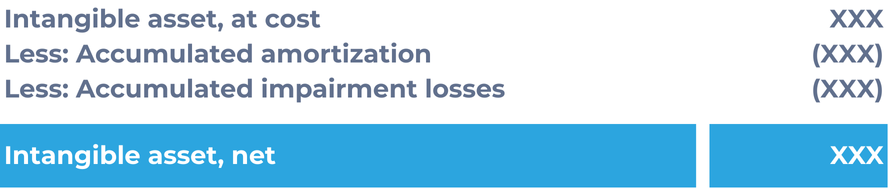
The journal entry typically is credited to the contra-asset account because we need to track the cost of the intangible asset. Effectively, the presentation in the balance sheet is as follows: