


Achievable logoAchievable logo
CMA Part 1
Sign in
Sign up
Purchase
Textbook
Practice exams
Support
How it works
Exam catalog
Mountain with a flag at the peak
Textbook
1. External financial reporting decisions
2. Planning, budgeting, and forecasting
3. Performance management
4. Cost management
5. Internal control
6. Technology and analytics
Achievable logoAchievable logo
1.2.5.3 Impairment of intangible assets
Achievable CMA Part 1
1. External financial reporting decisions
1.2. Financial transactions
1.2.5. Intangible assets
Our CMA Part 1 course is currently in development and is a work-in-progress.

Impairment of intangible assets

7 min read
Font
Discuss
Share
Feedback

Intangible assets are tested for impairment differently depending on their useful life. Finite-life (amortizable) intangible assets are tested only when events or changes in circumstances indicate that the carrying amount may not be recoverable - there’s no requirement to test them on a fixed schedule. Indefinite-life intangible assets, including goodwill, must be tested for impairment at least annually, and more often if impairment indicators arise.

Impairment testing is a general process to test whether an asset’s fair value is lower than its book value. If the fair value is lower, it means the expected future benefits from the asset are now lower than its value in the accounting records. The impairment process ensures that intangible assets are not overstated on the balance sheet.

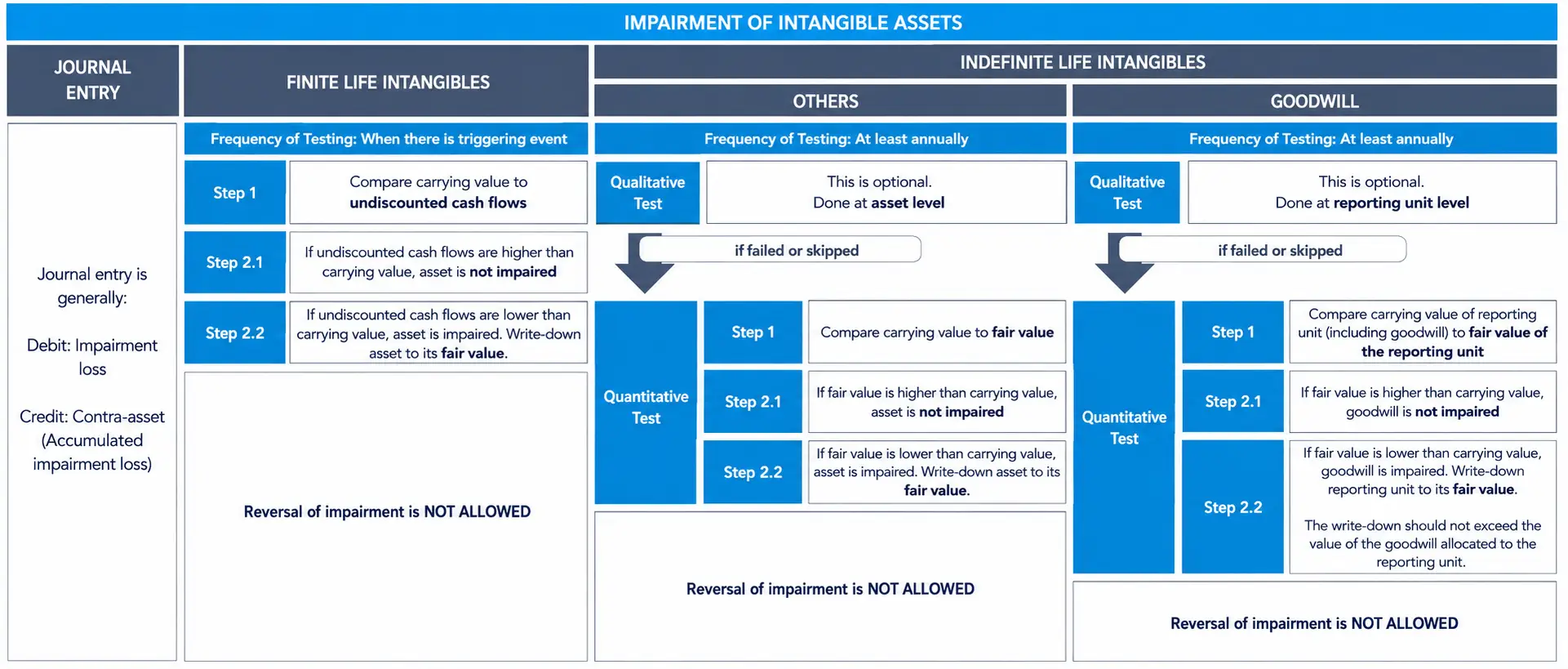
The processes are summarized in the following concept map:

Comparing impairment testing steps for finite life intangibles, indefinite life intangibles, and goodwill.
Intangible Impairment Summary

The map also outlines the goodwill impairment test, which the next chapter, Goodwill, covers in detail.

If an impairment is identified, the following journal entry is booked:

Account Debit Credit Financial statement element
Impairment loss - intangible asset XXX Loss
Accumulated impairment - intangible asset XXX Contra-asset
To record impairment of intangible asset

The journal entry typically is credited to the contra-asset account because we need to track the cost of the intangible asset.

Watch out: under US GAAP, once an intangible asset is written down for impairment, the reduced carrying amount becomes its new cost basis. The impairment loss may not be reversed even if the asset’s fair value recovers later - this differs from IFRS, which permits reversals for assets other than goodwill.

Impairment of finite life intangible assets

The impairment evaluation for an intangible asset with a finite life is only performed when events or changes in circumstances indicate that the carrying amount may not be recoverable - for example, a significant drop in expected cash flows or a change in how the asset is used. When triggered, it’s a two step process:

  1. Compare the carrying value (CV) of the asset to undiscounted future cash flows expected from the use and disposal of the asset
  2. If applicable, write the asset down to its fair value.

The process above to determine impairment for finite life intangibles is the same as the process of impairment of tangible assets held for use, such as PPE.

Step 1: Compare carrying value (CV) to undiscounted cash flows

Compare the carrying value (CV) of the asset to undiscounted future cash flows expected from the use and disposal of the asset.

If CV>Undiscounted future cash flows, this means that the asset is impaired because the carrying value is currently overstated. Proceed to Step 2.

If CV<Undiscounted future cash flows, this means that the asset is not impaired because the future benefits are still estimated to be higher than the carrying amount in the books. In this case, there is nothing to do and the process ends here.

Step 2: If applicable, write-down the asset to its fair value

If the carrying value of the intangible asset is higher than the undiscounted cashflows from the asset, we need to write-down the asset to its fair value. It should be noted that the fair value used in step 2 is not the same as the undiscounted future cash flows. Computation of the fair value will not be tested in the CMA exams but it will be provided so you can determine the impairment loss.

Definitions
Fair value
This is defined as the price that would be received to sell an asset or paid to transfer a liability in an orderly transaction between market participants at the measurement date (an exit price).

The difference between the carrying amount and the fair value is booked as an impairment loss.

Example: Impairment of a finite-life intangible asset

A company’s patent has a carrying value of $300,000. Management estimates the patent will generate $250,000 in undiscounted future cash flows over its remaining life, and its fair value is $220,000.

  • Step 1: Compare the carrying value to the undiscounted cash flows: $300,000>$250,000, so the patent is impaired. Move to Step 2.
  • Step 2: Write the asset down to its fair value. The impairment loss is $300,000−$220,000=$80,000.

Answer: The company records an impairment loss of $80,000, and the patent’s new carrying value is $220,000.

Impairment of indefinite life intangible assets other than goodwill

Intangible assets with an indefinite useful life (excluding goodwill) must be assessed for impairment at least once a year, or more frequently if events or circumstances suggest that the asset’s value may have declined. There are two approaches available when conducting this assessment:

  1. Qualitative test (optional): A preliminary evaluation of whether it is more likely than not that the asset is impaired, based on relevant events and conditions.
  2. Quantitative test: A detailed comparison of the asset’s carrying amount with its fair value to determine whether an impairment loss should be recognized.

The qualitative test

The qualitative test is the first step in assessing impairment for indefinite-life intangible assets. This step is optional, which means that if it is skipped, the company proceeds directly to the quantitative test. The purpose of the qualitative test is to evaluate whether a quantitative test is necessary.

Under ASC 350, companies are guided to consider factors that influence the significant assumptions used in estimating the asset’s fair value. These factors may include:

  • Rising costs of raw materials, labor, or other inputs
  • Negative financial performance or declining revenues (actual or projected)
  • Adverse legal, regulatory, contractual, or political developments
  • Deterioration in industry, market, or broader macroeconomic conditions

(See ASC 350-30-35-18B for the detailed list of considerations.)

If, after weighing these factors, management concludes that it is more likely than not (greater than 50% probability) that the asset’s fair value is below its carrying amount, the company must proceed to the quantitative test to calculate the impairment loss. If not, the process ends at this stage, and no further testing is required.

The quantitative test

The quantitative test is required in either of the following situations:

  • The company chooses not to perform the qualitative test; or
  • The qualitative test indicates that it is more likely than not that the asset’s fair value is below its carrying amount.

This test compares the carrying value (CV) of the asset directly to its fair value, using the same fair value definition given earlier.

If CV>Fair value, the asset is impaired: it is written down to fair value, and the excess of carrying value over fair value is recognized as an impairment loss.

If CV≤Fair value, the asset is not impaired, and no further action is needed.

In the CMA exam, you will not be required to compute fair value directly since this figure will be provided. Your task will be to use the given fair value to determine and record the impairment loss.

Impairment of Intangible Assets

  • All intangible assets must be regularly tested for impairment
  • Impairment: fair value < book value (carrying value)
  • Ensures assets are not overstated on the balance sheet

Impairment Journal Entry

  • Debit: Impairment loss – intangible asset (Loss)
  • Credit: Accumulated Impairment – Intangible Asset (Contra-asset)
  • Tracks reduction in asset value

Impairment of Finite Life Intangible Assets

  • Two-step process:
    • Step 1: Compare carrying value (CV) to undiscounted future cash flows
      • If CV > undiscounted cash flows → asset is impaired
      • If CV < undiscounted cash flows → no impairment
    • Step 2: Write-down asset to fair value if impaired
      • Impairment loss = CV – fair value
  • Same process as impairment of tangible assets (e.g., PPE)

Impairment of Indefinite Life Intangible Assets (excluding goodwill)

  • Must assess for impairment at least annually, or if circumstances indicate
  • Two approaches:
    • Qualitative test (optional): evaluate likelihood of impairment based on relevant events/factors
      • If more likely than not (probability >50%) that fair value < CV, proceed to quantitative test
    • Quantitative test: required if qualitative test skipped or indicates possible impairment

Qualitative Test for Indefinite Life Intangibles

  • Consider factors affecting fair value estimates:
    • Rising costs, negative financial performance, adverse legal/regulatory changes, industry decline
  • If not more likely than not impaired, no further testing required

Quantitative Test for Indefinite Life Intangibles

  • Step 1: Compare CV to fair value
    • If CV > fair value → asset is impaired
    • If CV < fair value → no impairment
  • Step 2: Write-down asset to fair value if impaired
    • Impairment loss = CV – fair value
    • Fair value = exit price in orderly transaction

Key Definitions

  • Fair value: price to sell an asset or transfer a liability in an orderly transaction between market participants at measurement date (exit price)

Sign up for free to take 10 quiz questions on this topic

Previous
Next  | 1.2.5.4 Goodwill
All rights reserved ©2016 - 2026 Achievable, Inc.

Impairment of intangible assets

Intangible assets are tested for impairment differently depending on their useful life. Finite-life (amortizable) intangible assets are tested only when events or changes in circumstances indicate that the carrying amount may not be recoverable - there’s no requirement to test them on a fixed schedule. Indefinite-life intangible assets, including goodwill, must be tested for impairment at least annually, and more often if impairment indicators arise.

Impairment testing is a general process to test whether an asset’s fair value is lower than its book value. If the fair value is lower, it means the expected future benefits from the asset are now lower than its value in the accounting records. The impairment process ensures that intangible assets are not overstated on the balance sheet.

The processes are summarized in the following concept map:

The map also outlines the goodwill impairment test, which the next chapter, Goodwill, covers in detail.

If an impairment is identified, the following journal entry is booked:

Account Debit Credit Financial statement element
Impairment loss - intangible asset XXX Loss
Accumulated impairment - intangible asset XXX Contra-asset
To record impairment of intangible asset

The journal entry typically is credited to the contra-asset account because we need to track the cost of the intangible asset.

Watch out: under US GAAP, once an intangible asset is written down for impairment, the reduced carrying amount becomes its new cost basis. The impairment loss may not be reversed even if the asset’s fair value recovers later - this differs from IFRS, which permits reversals for assets other than goodwill.

Impairment of finite life intangible assets

The impairment evaluation for an intangible asset with a finite life is only performed when events or changes in circumstances indicate that the carrying amount may not be recoverable - for example, a significant drop in expected cash flows or a change in how the asset is used. When triggered, it’s a two step process:

  1. Compare the carrying value (CV) of the asset to undiscounted future cash flows expected from the use and disposal of the asset
  2. If applicable, write the asset down to its fair value.

The process above to determine impairment for finite life intangibles is the same as the process of impairment of tangible assets held for use, such as PPE.

Step 1: Compare carrying value (CV) to undiscounted cash flows

Compare the carrying value (CV) of the asset to undiscounted future cash flows expected from the use and disposal of the asset.

If CV>Undiscounted future cash flows, this means that the asset is impaired because the carrying value is currently overstated. Proceed to Step 2.

If CV<Undiscounted future cash flows, this means that the asset is not impaired because the future benefits are still estimated to be higher than the carrying amount in the books. In this case, there is nothing to do and the process ends here.

Step 2: If applicable, write-down the asset to its fair value

If the carrying value of the intangible asset is higher than the undiscounted cashflows from the asset, we need to write-down the asset to its fair value. It should be noted that the fair value used in step 2 is not the same as the undiscounted future cash flows. Computation of the fair value will not be tested in the CMA exams but it will be provided so you can determine the impairment loss.

Definitions
Fair value
This is defined as the price that would be received to sell an asset or paid to transfer a liability in an orderly transaction between market participants at the measurement date (an exit price).

The difference between the carrying amount and the fair value is booked as an impairment loss.

Example: Impairment of a finite-life intangible asset

A company’s patent has a carrying value of $300,000. Management estimates the patent will generate $250,000 in undiscounted future cash flows over its remaining life, and its fair value is $220,000.

  • Step 1: Compare the carrying value to the undiscounted cash flows: $300,000>$250,000, so the patent is impaired. Move to Step 2.
  • Step 2: Write the asset down to its fair value. The impairment loss is $300,000−$220,000=$80,000.

Answer: The company records an impairment loss of $80,000, and the patent’s new carrying value is $220,000.

Impairment of indefinite life intangible assets other than goodwill

Intangible assets with an indefinite useful life (excluding goodwill) must be assessed for impairment at least once a year, or more frequently if events or circumstances suggest that the asset’s value may have declined. There are two approaches available when conducting this assessment:

  1. Qualitative test (optional): A preliminary evaluation of whether it is more likely than not that the asset is impaired, based on relevant events and conditions.
  2. Quantitative test: A detailed comparison of the asset’s carrying amount with its fair value to determine whether an impairment loss should be recognized.

The qualitative test

The qualitative test is the first step in assessing impairment for indefinite-life intangible assets. This step is optional, which means that if it is skipped, the company proceeds directly to the quantitative test. The purpose of the qualitative test is to evaluate whether a quantitative test is necessary.

Under ASC 350, companies are guided to consider factors that influence the significant assumptions used in estimating the asset’s fair value. These factors may include:

  • Rising costs of raw materials, labor, or other inputs
  • Negative financial performance or declining revenues (actual or projected)
  • Adverse legal, regulatory, contractual, or political developments
  • Deterioration in industry, market, or broader macroeconomic conditions

(See ASC 350-30-35-18B for the detailed list of considerations.)

If, after weighing these factors, management concludes that it is more likely than not (greater than 50% probability) that the asset’s fair value is below its carrying amount, the company must proceed to the quantitative test to calculate the impairment loss. If not, the process ends at this stage, and no further testing is required.

The quantitative test

The quantitative test is required in either of the following situations:

  • The company chooses not to perform the qualitative test; or
  • The qualitative test indicates that it is more likely than not that the asset’s fair value is below its carrying amount.

This test compares the carrying value (CV) of the asset directly to its fair value, using the same fair value definition given earlier.

If CV>Fair value, the asset is impaired: it is written down to fair value, and the excess of carrying value over fair value is recognized as an impairment loss.

If CV≤Fair value, the asset is not impaired, and no further action is needed.

In the CMA exam, you will not be required to compute fair value directly since this figure will be provided. Your task will be to use the given fair value to determine and record the impairment loss.

Key points

Impairment of Intangible Assets

  • All intangible assets must be regularly tested for impairment
  • Impairment: fair value < book value (carrying value)
  • Ensures assets are not overstated on the balance sheet

Impairment Journal Entry

  • Debit: Impairment loss – intangible asset (Loss)
  • Credit: Accumulated Impairment – Intangible Asset (Contra-asset)
  • Tracks reduction in asset value

Impairment of Finite Life Intangible Assets

  • Two-step process:
    • Step 1: Compare carrying value (CV) to undiscounted future cash flows
      • If CV > undiscounted cash flows → asset is impaired
      • If CV < undiscounted cash flows → no impairment
    • Step 2: Write-down asset to fair value if impaired
      • Impairment loss = CV – fair value
  • Same process as impairment of tangible assets (e.g., PPE)

Impairment of Indefinite Life Intangible Assets (excluding goodwill)

  • Must assess for impairment at least annually, or if circumstances indicate
  • Two approaches:
    • Qualitative test (optional): evaluate likelihood of impairment based on relevant events/factors
      • If more likely than not (probability >50%) that fair value < CV, proceed to quantitative test
    • Quantitative test: required if qualitative test skipped or indicates possible impairment

Qualitative Test for Indefinite Life Intangibles

  • Consider factors affecting fair value estimates:
    • Rising costs, negative financial performance, adverse legal/regulatory changes, industry decline
  • If not more likely than not impaired, no further testing required

Quantitative Test for Indefinite Life Intangibles

  • Step 1: Compare CV to fair value
    • If CV > fair value → asset is impaired
    • If CV < fair value → no impairment
  • Step 2: Write-down asset to fair value if impaired
    • Impairment loss = CV – fair value
    • Fair value = exit price in orderly transaction

Key Definitions

  • Fair value: price to sell an asset or transfer a liability in an orderly transaction between market participants at measurement date (exit price)

More from Intangible assets

  • Learning outcomes
  • Initial recognition and subsequent measurement
  • Goodwill