


Achievable logoAchievable logo
CMA Part 1
Sign in
Sign up
Purchase
Textbook
Practice exams
Support
How it works
Exam catalog
Mountain with a flag at the peak
Textbook
1. External financial reporting decisions
2. Planning, budgeting, and forecasting
3. Performance management
4. Cost management
5. Internal control
6. Technology and analytics
Achievable logoAchievable logo
1.2.10.4 Transactions affecting retained earnings
Achievable CMA Part 1
1. External financial reporting decisions
1.2. Financial transactions
1.2.10. Equity transactions
Our CMA Part 1 course is currently in development and is a work-in-progress.

Transactions affecting retained earnings

12 min read
Font
Discuss
Share
Feedback

At the end of the accounting cycle, the temporary accounts in the trial balance (i.e., revenue, expenses, gains and losses) are closed to the retained earnings account.

The retained earnings account holds all the historical results of operations of the company and is generally the amount being considered if the company is able to distribute dividends. Accordingly, before accounting for any other transactions, a net credit amount of retained earnings means that the company has been historically earning net income. However, it is good to note that having a credit in retained earnings is not an assurance of future dividend distributions but only a good indicator of a company’s capacity.

Transactions affecting the company’s retained earnings can be split into two:

  1. appropriations
  2. dividend distributions.

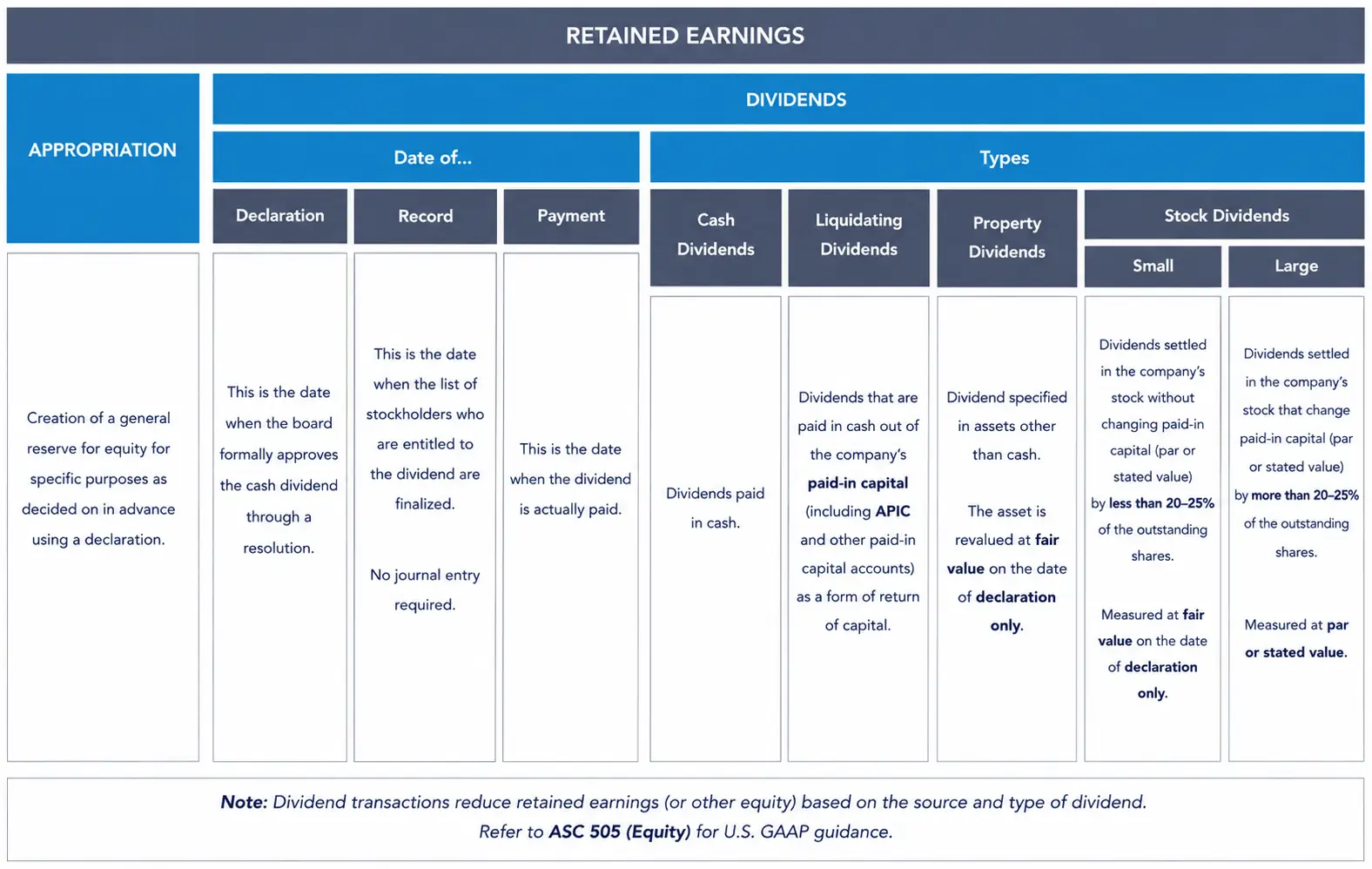
The following concept map can be helpful in understanding this section about transactions affecting retained earnings:

Retained earnings showing appropriation and dividend types by declaration, record, and payment dates.
Retained Earnings Transactions

Appropriation of retained earnings

As mentioned above, retained earnings are the portion of equity that are available for distribution to the shareholders. However, when for any reason the company wants to restrict a portion of the assets to not be distributable, the company can appropriate retained earnings to separate it from the distributable equity.

Appropriation of retained earnings to restrict it to be distributed creates a general reserve that the company can use for specific purposes such as capital expenditures or research and development. This means that a general portion of the assets is allocated for these purposes, but not a specific asset account (i.e., specific cash or asset item).

The journal entry to appropriate retained earnings once it is approved is a simple reclassification from the unappropriated retained earnings to the appropriated retained earnings account.

Account Debit Credit Financial statement element
Retained earnings XXX Equity
Retained earnings - appropriated XXX Equity
To record appropriation of retained earnings

In contrast when the appropriation has already served its purpose or if it’s no longer needed, we just need to book a reversal of the above entry:

Account Debit Credit Financial statement element
Retained earnings - appropriated XXX Equity
Retained earnings XXX Equity
To record release of appropriated retained earnings

Cash dividends

Dividends are distributions of profits to shareholders and can be in many different forms. It has the impact of reducing the company’s equity through the distribution of an asset or recognition of a liability. The most common form of dividend is in the form of cash. This is when a company commits to distribute cash to its shareholders and there is enough retained earnings to cover the distribution.

There are three relevant dates in the accounting for dividends:

  1. date of declaration
  2. date of record
  3. date of payment.

Cash dividends: date of declaration

This is the date when the company formally commits to pay the dividend through a resolution. This is also the date when the date of record and date of payment are announced.

During this time, the company already incurs a liability which is estimated based on the expected shareholders at the date of record. The journal entry is as follows:

Account Debit Credit Financial statement element
Retained earnings XXX Equity
Dividends payable XXX Liability
To record dividends at the date of declaration

For cash dividends, the resulting dividends payable is typically presented as a current liability.

Cash dividends: date of record

This is the date when the final list of shareholders who are entitled to the dividend are finalized. No journal entry is normally required on this date but the company can adjust the dividends payable in case it is materially different from the amount recorded on the date of declaration.

Cash dividends: date of payment

This is the date when the dividend is actually paid. The journal entry is as follows:

Account Debit Credit Financial statement element
Dividends payable XXX Liability
Cash XXX Asset
To record the payment of cash dividend

Liquidating dividends

These are dividends that are not paid out of retained earnings. Typically they are paid out of the company’s APIC as a form of return of capital to the shareholders especially when the retained earnings are not enough for the dividends.

They can be taken out of the common stock if the company is completely liquidating.

Liquidating dividends: date of declaration

At the date of declaration, the company records the following:

Account Debit Credit Financial statement element
Common stock - APIC XXX Equity
Retained earnings XXX Equity
Dividends payable XXX Liability
To record dividends at the date of declaration with a partial liquidating dividend

A dividend can be partly liquidating just like in this example above.

Liquidating dividends: date of record

This is the date when the final list of shareholders who are entitled to the liquidating dividend are finalized. Just as in the previous example, no entry is required during the date of record.

Liquidating dividends: date of payment

This is the date when the dividend is actually paid. The journal entry is identical to the cash dividend payment entry shown above - a debit to dividends payable and a credit to cash - because the effect on retained earnings and APIC was already recorded at the date of declaration.

Property dividends

This is a type of dividend wherein assets, other than cash, are being distributed to the shareholders.

Property dividends can be in many forms such as distributions to shareholders of inventories or shares in another company, to name a few. The general rule is that the property dividend is measured at the fair value of the asset being distributed at the date of declaration - the asset is remeasured to fair value at that date, with any gain or loss recognized in income, and the dividends payable and retained earnings are recorded at that same fair value.

If the property dividend payable remains unpaid at the end of the reporting period, the company remeasures the asset (and the related payable) to fair value again at that date.

Property dividends: date of declaration

At the date of declaration, the company records the two journal entries:

  1. to revalue the asset
  2. to record the dividends payable against the retained earnings.
Account Debit Credit Financial statement element
Inventories XXX Asset
Gain on disposal of asset XXX Gain
To revalue the inventories to be distributed as dividends at fair value
Account Debit Credit Financial statement element
Retained earnings XXX Equity
Dividends payable XXX Liability
To record property dividends payable at the date of declaration at fair value

The amount of dividends payable in the second journal entry should be equal to the fair value of the inventories in the previous journal entry

If the property to be distributed is a non-current asset, then the resulting dividends payable is classified as a non-current liability, otherwise it is classified as a current liability in the balance sheet.

Property dividends: date of record

Just as in the previous example, no entry is required during the date of record.

Property dividends: date of payment

The journal entry to record the settlement of the dividends payable

Account Debit Credit Financial statement element
Dividends payable XXX Liability
Inventories XXX Asset
Gain on disposal of assets XXX Gain
To record the settlement of property dividends

The asset should be distributed at fair value and any differences from the value recorded as a liability on the date of declaration is recorded as a gain on disposal.

It should be noted that despite the recording of gains/losses on disposal of the asset distributed as a property dividend, the net reduction in shareholders’ equity from this transaction equals the fair value of the asset at the date of declaration - the remeasurement gain increases retained earnings through net income, but retained earnings is then debited for that same fair value when the dividend is declared.

Stocks dividends

Definitions
Stock dividends
These are types of dividends wherein the company distributes its own stocks to the shareholders.

It has the impact of increasing the shareholdings of the investors while not affecting the overall shareholder’s equity since effectively there is only a reclassification from retained earnings to the paid-in capital accounts.

There are two types of stock dividends:

  1. small stock dividend
  2. large stock dividend

Exam tip: The small-vs-large distinction turns on both the size of the dividend and the measurement basis. A stock dividend below roughly 20-25% of outstanding shares is a small stock dividend, measured at fair value. One at or above that threshold is a large stock dividend, measured at par value instead.

Small stock dividends

These are stock dividends that are typically less than 20-25% of the existing shares. There is no definite guidance as to the exact % of stock dividends that is considered as “small” but a small stock dividend is generally assessed as a dividend paid in the reporting entity’s own shares that is not large enough to materially influence the unit market price of the stock. This varies between entities and under different market conditions but a distribution of 20-25% of the previous outstanding shares has been identified by the Codification as an initial basis.

Small stock dividends are recorded at the fair value of the shares.

Example: Small stock dividend

AZH Co. issues a 10% stock dividend on their 1,000,000 issued and outstanding shares that has a par value of $1.00. The fair value of the shares of AZH Co. is $1.5 per share. The journal entry to be recorded is as follows:

Account Debit Credit Financial statement element
Retained earnings 150,000 Equity
Common stock 100,000 Equity
APIC - common stock 50,000 Equity
To record small stock dividend

Large stock dividends

Large stock dividends are those that are typically greater than 20-25% of the existing shares. These are recorded at the par value of the issued shares.

Account Debit Credit Financial statement element
Retained earnings XXX Equity
Common stock XXX Equity
To record large stock dividend

There is no impact on APIC of a large stock dividend.

Retained Earnings Overview

  • Temporary accounts closed to retained earnings at period end
  • Retained earnings = cumulative net income less dividends
  • Credit balance indicates historical profitability, but not guaranteed dividends

Appropriation of Retained Earnings

  • Used to restrict portion of retained earnings (not distributable)
  • Creates “appropriated retained earnings” (general reserve) for specific purposes
  • Journal entry: reclassify from unappropriated to appropriated retained earnings
    • Reverse entry when appropriation is no longer needed

Cash Dividends

  • Most common dividend form; reduces equity and increases liability
  • Three key dates:
    • Declaration: liability recognized (Retained earnings ↓, Dividends payable ↑)
    • Record: determines eligible shareholders; usually no entry
    • Payment: liability settled (Dividends payable ↓, Cash ↓)

Liquidating Dividends

  • Paid from APIC or common stock, not retained earnings
  • Represents return of capital, not profit distribution
  • Declaration: reduce APIC and/or retained earnings, increase dividends payable
  • Payment: same entry as cash dividends (Dividends payable ↓, Cash ↓)

Property Dividends

  • Non-cash asset distribution (e.g., inventory, shares in another company)
  • Recorded at fair value at declaration and payment dates
  • Declaration:
    • Revalue asset to fair value (record gain/loss)
    • Recognize dividends payable (Retained earnings ↓, Dividends payable ↑)
  • Payment: settle dividends payable, remove asset, recognize gain/loss if value changed

Stock Dividends

  • Company issues own shares to shareholders; no change in total equity

  • Reclassifies retained earnings to paid-in capital

    Small Stock Dividends

    • Less than 20-25% of outstanding shares
    • Recorded at fair value (Retained earnings ↓, Common stock & APIC ↑)

    Large Stock Dividends

    • Greater than 20-25% of outstanding shares
    • Recorded at par value only (Retained earnings ↓, Common stock ↑)
    • No impact on APIC

Sign up for free to take 12 quiz questions on this topic

Previous
Next  | 1.2.11.1.1 Learning outcomes
All rights reserved ©2016 - 2026 Achievable, Inc.

Transactions affecting retained earnings

At the end of the accounting cycle, the temporary accounts in the trial balance (i.e., revenue, expenses, gains and losses) are closed to the retained earnings account.

The retained earnings account holds all the historical results of operations of the company and is generally the amount being considered if the company is able to distribute dividends. Accordingly, before accounting for any other transactions, a net credit amount of retained earnings means that the company has been historically earning net income. However, it is good to note that having a credit in retained earnings is not an assurance of future dividend distributions but only a good indicator of a company’s capacity.

Transactions affecting the company’s retained earnings can be split into two:

  1. appropriations
  2. dividend distributions.

The following concept map can be helpful in understanding this section about transactions affecting retained earnings:

Appropriation of retained earnings

As mentioned above, retained earnings are the portion of equity that are available for distribution to the shareholders. However, when for any reason the company wants to restrict a portion of the assets to not be distributable, the company can appropriate retained earnings to separate it from the distributable equity.

Appropriation of retained earnings to restrict it to be distributed creates a general reserve that the company can use for specific purposes such as capital expenditures or research and development. This means that a general portion of the assets is allocated for these purposes, but not a specific asset account (i.e., specific cash or asset item).

The journal entry to appropriate retained earnings once it is approved is a simple reclassification from the unappropriated retained earnings to the appropriated retained earnings account.

Account Debit Credit Financial statement element
Retained earnings XXX Equity
Retained earnings - appropriated XXX Equity
To record appropriation of retained earnings

In contrast when the appropriation has already served its purpose or if it’s no longer needed, we just need to book a reversal of the above entry:

Account Debit Credit Financial statement element
Retained earnings - appropriated XXX Equity
Retained earnings XXX Equity
To record release of appropriated retained earnings

Cash dividends

Dividends are distributions of profits to shareholders and can be in many different forms. It has the impact of reducing the company’s equity through the distribution of an asset or recognition of a liability. The most common form of dividend is in the form of cash. This is when a company commits to distribute cash to its shareholders and there is enough retained earnings to cover the distribution.

There are three relevant dates in the accounting for dividends:

  1. date of declaration
  2. date of record
  3. date of payment.

Cash dividends: date of declaration

This is the date when the company formally commits to pay the dividend through a resolution. This is also the date when the date of record and date of payment are announced.

During this time, the company already incurs a liability which is estimated based on the expected shareholders at the date of record. The journal entry is as follows:

Account Debit Credit Financial statement element
Retained earnings XXX Equity
Dividends payable XXX Liability
To record dividends at the date of declaration

For cash dividends, the resulting dividends payable is typically presented as a current liability.

Cash dividends: date of record

This is the date when the final list of shareholders who are entitled to the dividend are finalized. No journal entry is normally required on this date but the company can adjust the dividends payable in case it is materially different from the amount recorded on the date of declaration.

Cash dividends: date of payment

This is the date when the dividend is actually paid. The journal entry is as follows:

Account Debit Credit Financial statement element
Dividends payable XXX Liability
Cash XXX Asset
To record the payment of cash dividend

Liquidating dividends

These are dividends that are not paid out of retained earnings. Typically they are paid out of the company’s APIC as a form of return of capital to the shareholders especially when the retained earnings are not enough for the dividends.

They can be taken out of the common stock if the company is completely liquidating.

Liquidating dividends: date of declaration

At the date of declaration, the company records the following:

Account Debit Credit Financial statement element
Common stock - APIC XXX Equity
Retained earnings XXX Equity
Dividends payable XXX Liability
To record dividends at the date of declaration with a partial liquidating dividend

A dividend can be partly liquidating just like in this example above.

Liquidating dividends: date of record

This is the date when the final list of shareholders who are entitled to the liquidating dividend are finalized. Just as in the previous example, no entry is required during the date of record.

Liquidating dividends: date of payment

This is the date when the dividend is actually paid. The journal entry is identical to the cash dividend payment entry shown above - a debit to dividends payable and a credit to cash - because the effect on retained earnings and APIC was already recorded at the date of declaration.

Property dividends

This is a type of dividend wherein assets, other than cash, are being distributed to the shareholders.

Property dividends can be in many forms such as distributions to shareholders of inventories or shares in another company, to name a few. The general rule is that the property dividend is measured at the fair value of the asset being distributed at the date of declaration - the asset is remeasured to fair value at that date, with any gain or loss recognized in income, and the dividends payable and retained earnings are recorded at that same fair value.

If the property dividend payable remains unpaid at the end of the reporting period, the company remeasures the asset (and the related payable) to fair value again at that date.

Property dividends: date of declaration

At the date of declaration, the company records the two journal entries:

  1. to revalue the asset
  2. to record the dividends payable against the retained earnings.
Account Debit Credit Financial statement element
Inventories XXX Asset
Gain on disposal of asset XXX Gain
To revalue the inventories to be distributed as dividends at fair value
Account Debit Credit Financial statement element
Retained earnings XXX Equity
Dividends payable XXX Liability
To record property dividends payable at the date of declaration at fair value

The amount of dividends payable in the second journal entry should be equal to the fair value of the inventories in the previous journal entry

If the property to be distributed is a non-current asset, then the resulting dividends payable is classified as a non-current liability, otherwise it is classified as a current liability in the balance sheet.

Property dividends: date of record

Just as in the previous example, no entry is required during the date of record.

Property dividends: date of payment

The journal entry to record the settlement of the dividends payable

Account Debit Credit Financial statement element
Dividends payable XXX Liability
Inventories XXX Asset
Gain on disposal of assets XXX Gain
To record the settlement of property dividends

The asset should be distributed at fair value and any differences from the value recorded as a liability on the date of declaration is recorded as a gain on disposal.

It should be noted that despite the recording of gains/losses on disposal of the asset distributed as a property dividend, the net reduction in shareholders’ equity from this transaction equals the fair value of the asset at the date of declaration - the remeasurement gain increases retained earnings through net income, but retained earnings is then debited for that same fair value when the dividend is declared.

Stocks dividends

Definitions
Stock dividends
These are types of dividends wherein the company distributes its own stocks to the shareholders.

It has the impact of increasing the shareholdings of the investors while not affecting the overall shareholder’s equity since effectively there is only a reclassification from retained earnings to the paid-in capital accounts.

There are two types of stock dividends:

  1. small stock dividend
  2. large stock dividend

Exam tip: The small-vs-large distinction turns on both the size of the dividend and the measurement basis. A stock dividend below roughly 20-25% of outstanding shares is a small stock dividend, measured at fair value. One at or above that threshold is a large stock dividend, measured at par value instead.

Small stock dividends

These are stock dividends that are typically less than 20-25% of the existing shares. There is no definite guidance as to the exact % of stock dividends that is considered as “small” but a small stock dividend is generally assessed as a dividend paid in the reporting entity’s own shares that is not large enough to materially influence the unit market price of the stock. This varies between entities and under different market conditions but a distribution of 20-25% of the previous outstanding shares has been identified by the Codification as an initial basis.

Small stock dividends are recorded at the fair value of the shares.

Example: Small stock dividend

AZH Co. issues a 10% stock dividend on their 1,000,000 issued and outstanding shares that has a par value of $1.00. The fair value of the shares of AZH Co. is $1.5 per share. The journal entry to be recorded is as follows:

Account Debit Credit Financial statement element
Retained earnings 150,000 Equity
Common stock 100,000 Equity
APIC - common stock 50,000 Equity
To record small stock dividend

Large stock dividends

Large stock dividends are those that are typically greater than 20-25% of the existing shares. These are recorded at the par value of the issued shares.

Account Debit Credit Financial statement element
Retained earnings XXX Equity
Common stock XXX Equity
To record large stock dividend

There is no impact on APIC of a large stock dividend.

Key points

Retained Earnings Overview

  • Temporary accounts closed to retained earnings at period end
  • Retained earnings = cumulative net income less dividends
  • Credit balance indicates historical profitability, but not guaranteed dividends

Appropriation of Retained Earnings

  • Used to restrict portion of retained earnings (not distributable)
  • Creates “appropriated retained earnings” (general reserve) for specific purposes
  • Journal entry: reclassify from unappropriated to appropriated retained earnings
    • Reverse entry when appropriation is no longer needed

Cash Dividends

  • Most common dividend form; reduces equity and increases liability
  • Three key dates:
    • Declaration: liability recognized (Retained earnings ↓, Dividends payable ↑)
    • Record: determines eligible shareholders; usually no entry
    • Payment: liability settled (Dividends payable ↓, Cash ↓)

Liquidating Dividends

  • Paid from APIC or common stock, not retained earnings
  • Represents return of capital, not profit distribution
  • Declaration: reduce APIC and/or retained earnings, increase dividends payable
  • Payment: same entry as cash dividends (Dividends payable ↓, Cash ↓)

Property Dividends

  • Non-cash asset distribution (e.g., inventory, shares in another company)
  • Recorded at fair value at declaration and payment dates
  • Declaration:
    • Revalue asset to fair value (record gain/loss)
    • Recognize dividends payable (Retained earnings ↓, Dividends payable ↑)
  • Payment: settle dividends payable, remove asset, recognize gain/loss if value changed

Stock Dividends

  • Company issues own shares to shareholders; no change in total equity

  • Reclassifies retained earnings to paid-in capital

    Small Stock Dividends

    • Less than 20-25% of outstanding shares
    • Recorded at fair value (Retained earnings ↓, Common stock & APIC ↑)

    Large Stock Dividends

    • Greater than 20-25% of outstanding shares
    • Recorded at par value only (Retained earnings ↓, Common stock ↑)
    • No impact on APIC

More from Equity transactions

  • Learning outcomes
  • Definitions
  • Transactions affecting paid-in capital