



Transactions affecting paid-in capital
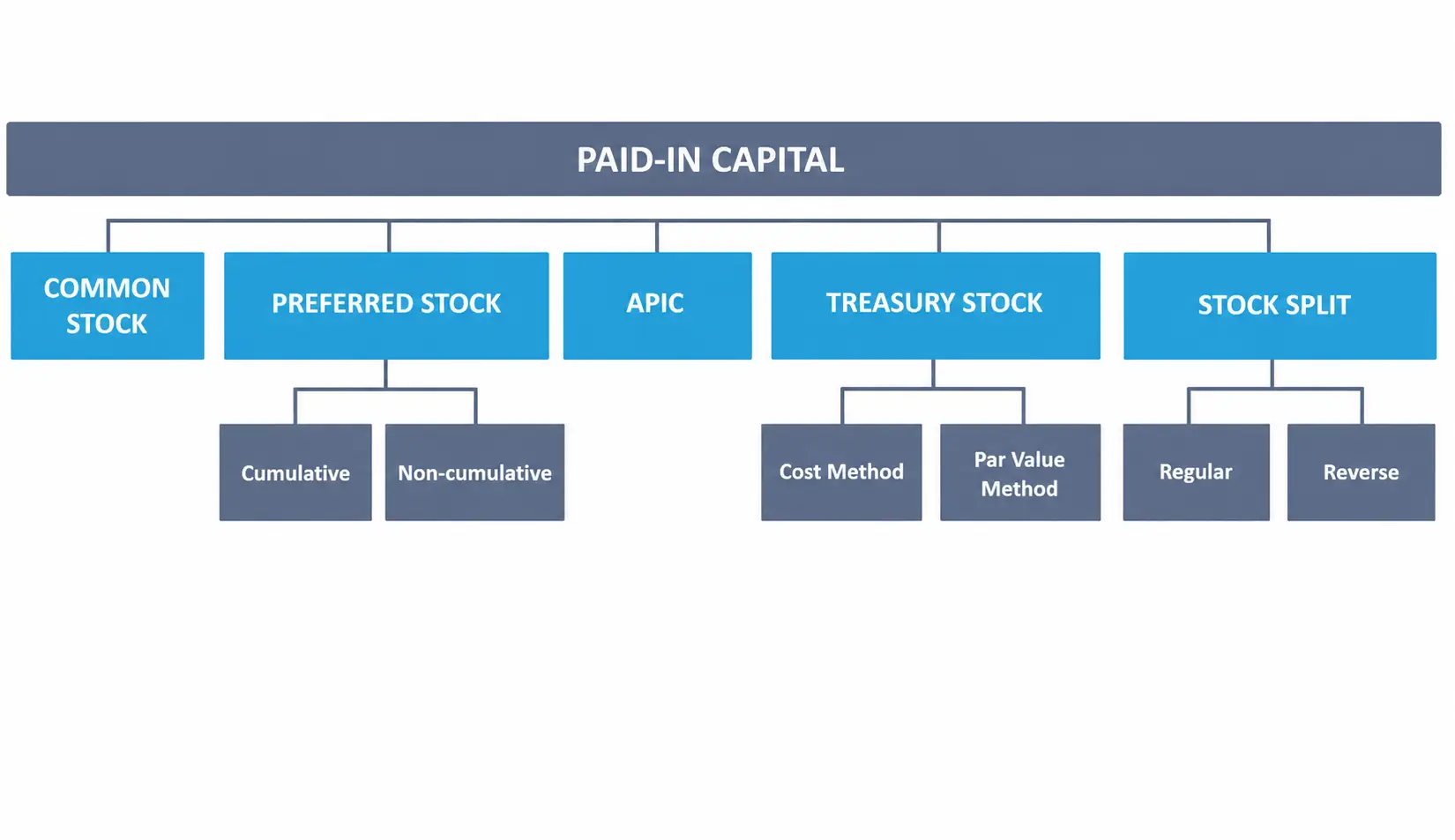
The following are the main topics to understand for paid-in capital:
Common stock
A company can have more than one class of common stock. It is the unit of ownership that grants a shareholder a right to vote in major corporate events. Normally common stock is registered with a stated par value, which when aggregated for all issued common stock, represents the legal capital of the company.
When a common stock is issued, companies do not normally receive an amount exactly equal to the par value of the stock. In this case, any excess is credited to the additional paid-in capital (APIC). A sample journal entry to record the issuance of a common stock above par is shown below:
| Account | Debit | Credit | Financial statement element |
| Cash | XXX | Asset | |
| Common stock | XXX | Equity | |
| APIC - common stock | XXX | Equity | |
| To record issuance of common stock above par | |||
The credit to common stock represents the par value of the stock issued. Any excess is credited to APIC. In the case of no-par value common stock, the entire proceeds are credited to the common stock account. No-par value common stocks are stocks that are registered without a par value.
Example: issuing common stock above par
A company issues 10,000 shares of $1 par common stock for cash of $12 per share.
- Total cash received: 10,000 shares × $12 = $120,000
- Common stock (par value): 10,000 shares × $1 = $10,000
- APIC - common stock (the excess over par): $120,000 - $10,000 = $110,000
Answer: Debit cash $120,000; credit common stock $10,000; credit APIC - common stock $110,000
Preferred stock
The most significant distinction of a preferred stock versus a common stock is the absence of a right to vote. However, despite this lack of capacity to participate in voting, a preferred stock has certain advantages:
- Preference in liquidation - preferred stock are not subordinate to common stock. Hence, in the event of a liquidation, preferred stockholders will receive its share in the assets before common stockholders.
- Preference in dividend distributions - preferred stockholders receive dividends before common stockholders. The amount of dividends depends on the type of preferred stock they are holding (cumulative or non-cumulative).
The journal entry for the issuance of a preferred stock is generally the same as the common stock:
| Account | Debit | Credit | Financial statement element |
| Cash | XXX | Asset | |
| Preferred stock | XXX | Equity | |
| APIC - preferred stock | XXX | Equity | |
| To record issuance of preferred stock above par | |||
The credit to preferred stock represents the par value of the stock issued. Any excess is credited to APIC. There are two types of preferred stock with regards to its rights to dividends in arrears:
- Cumulative preferred stock, and
- Non-cumulative preferred stock.
Cumulative preferred stock
When a preferred stock is cumulative, it means that each year, preferred stockholders earn the right to be paid preferred dividends in the future, regardless if they have been declared or not. Any undeclared dividends for cumulative preferred stock of prior periods are referred to as dividends in arrears and must be disclosed in the financial statements to provide users of financial statements information about the dividend-paying capacity of the company since these arrears should be settled first before paying dividends to common stockholders.
If the dividends are undeclared, a journal entry does not have to be booked to record dividends in arrears.
Only when a dividend is declared should the company record a dividend payable for all dividends in arrears up to that point. Journal entries for declared dividends to preference shareholders are the same for common stock and will be discussed under “retained earnings”.
Non-cumulative preferred stock
When a preferred stock is non-cumulative, it means that preferred stockholders lose the right to be paid a dividend when it is not declared during the year. Journal entries for declared dividends to preference shareholders are the same for common stock and will be discussed under “retained earnings”.
Additional paid-in capital (APIC)
APIC represents the value of shares above the par or stated value. Transactions affecting APIC are generally discussed with the related equity accounts that generated the APIC:
- APIC - common stock - arising from the issue of common stock above par value as discussed in the previous section.
- APIC - preferred stock - arising from the issue of preferred stock above par value as discussed in the previous section.
- APIC - treasury stock - arising from treasury share transactions which will be discussed next.
Another type of APIC can be from detachable warrants from compound instruments such as bonds and preferred stocks issued with warrants. However, this is beyond the scope of the CMA Exams.
Treasury stock
These are stocks that have been issued but were subsequently reacquired by the company, making them shares that are issued but not outstanding since the current owners of the shares are the company itself.
When a company has treasury stock, it generally has two options:
- the company can re-sell the shares to external shareholders, in which case it becomes an “outstanding” stock again, or
- the company can retire the shares, in which case the share ceases to be classified as an “issued” stock.
There can be several economic reasons why a repurchase of shares to become treasury shares is necessary such as when the company wants to:
- consolidate ownership by removing smaller shareholders
- improve certain ratios that use issued and outstanding shares as an input, or
- reduce the cost of capital.
Treasury stocks are contra-equity accounts, hence they are expected to reduce a company’s equity.
Treasury stock is a debit-balance contra-equity account: it sits alongside common stock and APIC - common stock and reduces total stockholders’ equity until the shares are reissued or retired.
The most common method for accounting of treasury stock is the cost method under US GAAP. This method debits the treasury stock account with the total cost of the treasury stock regardless of its original issue price.
When treasury shares are later reissued, the difference between the reissue price and their cost is recorded in APIC - treasury stock: reissuing above cost credits APIC - treasury stock, while reissuing below cost debits APIC - treasury stock (and then retained earnings, if APIC - treasury stock isn’t large enough to absorb the difference).
Stock splits
A stock split has an effect of altering the components of what makes up the company’s share capital in USD (i.e., the number of shares and par value) while retaining its total balance in USD.
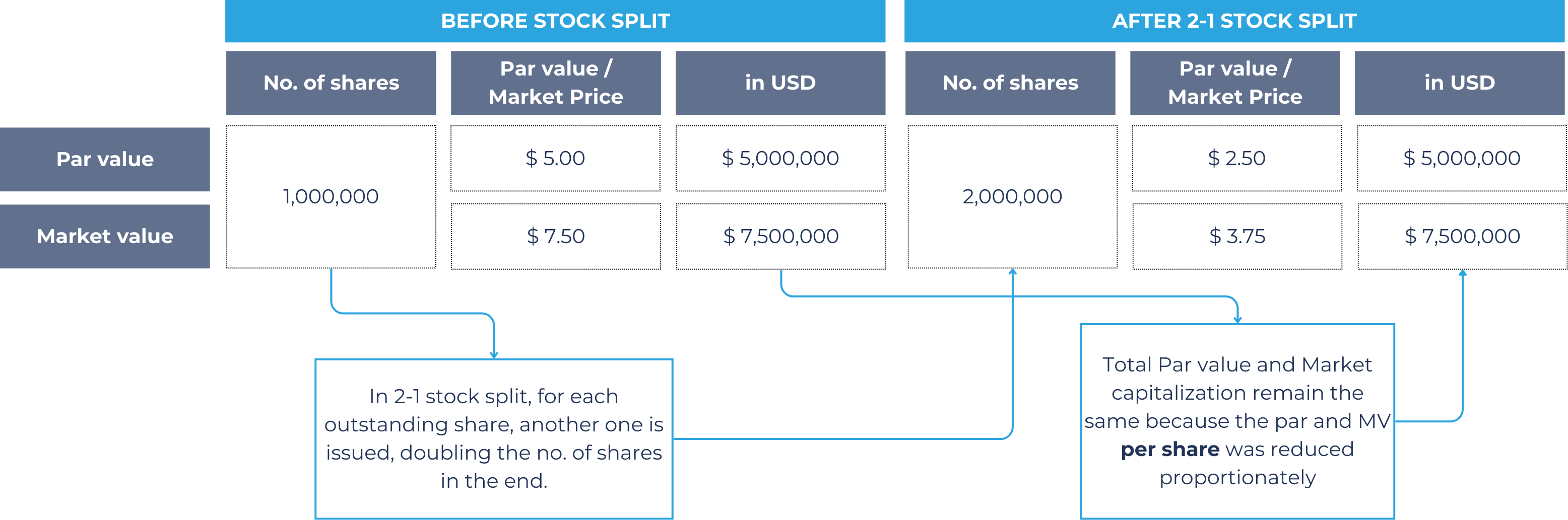
Below is a simple illustration of a company’s share capital before and after a 2-for-1 stock split and its effect on its market price per share.
A two-for-one (i.e., 2-for-1) stock split means that for each original share, two new shares will be issued while also splitting the par value in half. One of the most common benefits of a stock split is that it makes the share more accessible to new investors, thus improving liquidity, because it also proportionally reduces the market price per share while maintaining the market capitalization.
In the case of above, each share now costs $3.75 to external shareholders instead of $7.50 per share before the stock split while maintaining the same market capitalization.
Since there is no impact to the company’s common stock in dollar amounts, the recording of a stock split will depend on the record keeping policies of the company but typically a memorandum entry would suffice where the company should note that the previous common stock with the old par value has been canceled and then replaced by the new common stock with the new par value.
For example a 1-for-2 reverse stock split makes an investor who owns 2 shares end up with 1 share while doubling its market value which helps when the company has a danger of delisting for when the market value falls below a certain minimum.
It also has no impact on the total par value in USD and market capitalization, just like a regular stock split.