



Achievable logoAchievable logo
CMA Part 1
Sign in
Sign up
Purchase
Textbook
Practice exams
Support
How it works
Exam catalog
Mountain with a flag at the peak
Textbook
1. External financial reporting decisions
2. Planning, budgeting, and forecasting
3. Performance management
4. Cost management
4.1 Measurement concepts
4.2 Costing systems
4.3 Overhead costs
4.4 Supply chain management
4.5 Business process improvement
4.5.1 Value chain analysis
4.5.2 Value-added concepts
4.5.3 Process analysis, redesign, and standardization
4.5.4 Continuous improvement, benchmarking, and best practices
4.5.5 Cost of quality analysis
5. Internal control
6. Technology and analytics
Achievable logoAchievable logo
4.5.1 Value chain analysis
Achievable CMA Part 1
4. Cost management
4.5. Business process improvement
Our CMA Part 1 course is currently in development and is a work-in-progress.

Value chain analysis

8 min read
Font
Discuss
Share
Feedback

Learning outcome statements

The learning outcome statements relevant for this section are:

  1. define value chain analysis
  2. identify the steps in value chain analysis
  3. explain how value chain analysis is used to better understand a company’s competitive advantage

Introduction

In today’s highly competitive business environment, understanding where and how value is created within an organization is essential to achieving sustainable profitability and long-term strategic success. This is where value chain analysis becomes a powerful management tool. It allows organizations to dissect their internal operations into distinct activities and examine how each contributes to delivering value to customers.

Value chain analysis is not only about cost reduction or operational efficiency, it also plays a critical role in identifying how a firm can differentiate itself from competitors by enhancing customer satisfaction, improving quality, or innovating service delivery. By analyzing individual processes across the organization, managers can pinpoint value-creating opportunities, eliminate wasteful practices, and strengthen the firm’s position within the industry.

This analytical framework forms a foundational component of strategic planning, cost management, and performance evaluation. It helps managers make informed decisions about resource allocation, outsourcing, technology investments, and pricing strategies.

In this section, we will define value chain analysis, identify its main components and steps, and explore how it can be leveraged to gain a competitive advantage through either cost leadership or differentiation.

Definitions
Value chain analysis
Value chain analysis is the process of identifying and evaluating the discrete internal activities of a business to determine how they contribute to the organization’s overall value proposition and competitive position.

It involves identifying, categorizing, and evaluating all the activities that take place from the acquisition of raw materials to the delivery of the final product or service, with the goal of enhancing efficiency, reducing costs, and maximizing customer satisfaction.

The concept was introduced by Michael Porter in his landmark book Competitive Advantage (1985). According to Porter, every firm is a collection of activities performed to design, produce, market, deliver, and support its product or service. These activities collectively form what is known as the value chain.

Value chain analysis differs from a simple cost analysis in that it emphasizes the value delivered to the customer, not just the cost incurred. The focus is on understanding how each activity either adds value to the final offering or consumes resources without creating sufficient return.

Although the terms are sometimes used interchangeably, value chain and supply chain refer to distinct concepts:

  • The supply chain focuses on the external flow of goods and services, from suppliers to manufacturers to customers. It emphasizes logistics, procurement, and operational coordination across organizations.

  • The value chain, in contrast, focuses internally on the activities within the organization that contribute to value creation. It considers how internal processes, from product development to after-sales service, generate value for the end user.

Understanding this distinction helps managers decide where to focus optimization efforts: externally (supply efficiency) or internally (value enhancement).

Limitations of the value chain analysis:

While value chain analysis is a powerful strategic tool, it is not without challenges. Its effectiveness depends on the quality of data, clarity of internal processes, and the ability of management to interpret and act on insights. The following limitations should be considered:

  • Complexity and time-intensiveness
    Mapping all activities and their interactions requires significant effort, particularly in large or diversified organizations with complex operations.

  • Difficulty in quantifying value
    Not all value is financial. Intangible benefits, such as customer loyalty, employee satisfaction, or brand equity, are harder to measure but play a critical role in value creation.

  • Internal focus
    Value chain analysis emphasizes internal processes and may overlook external factors such as market trends, supplier dynamics, or consumer behavior unless combined with other tools like PESTEL or SWOT analysis.

  • Benchmarking challenges
    Obtaining accurate and comparable data from competitors for benchmarking purposes can be difficult, especially in industries where proprietary processes and cost structures are closely guarded.

  • Risk of oversimplification
    Reducing operations to discrete activities might obscure cross-functional collaboration or the strategic importance of certain capabilities that span multiple functions.

Despite these limitations, when used appropriately, value chain analysis remains an essential component of strategic planning and performance management.

Primary and support activities

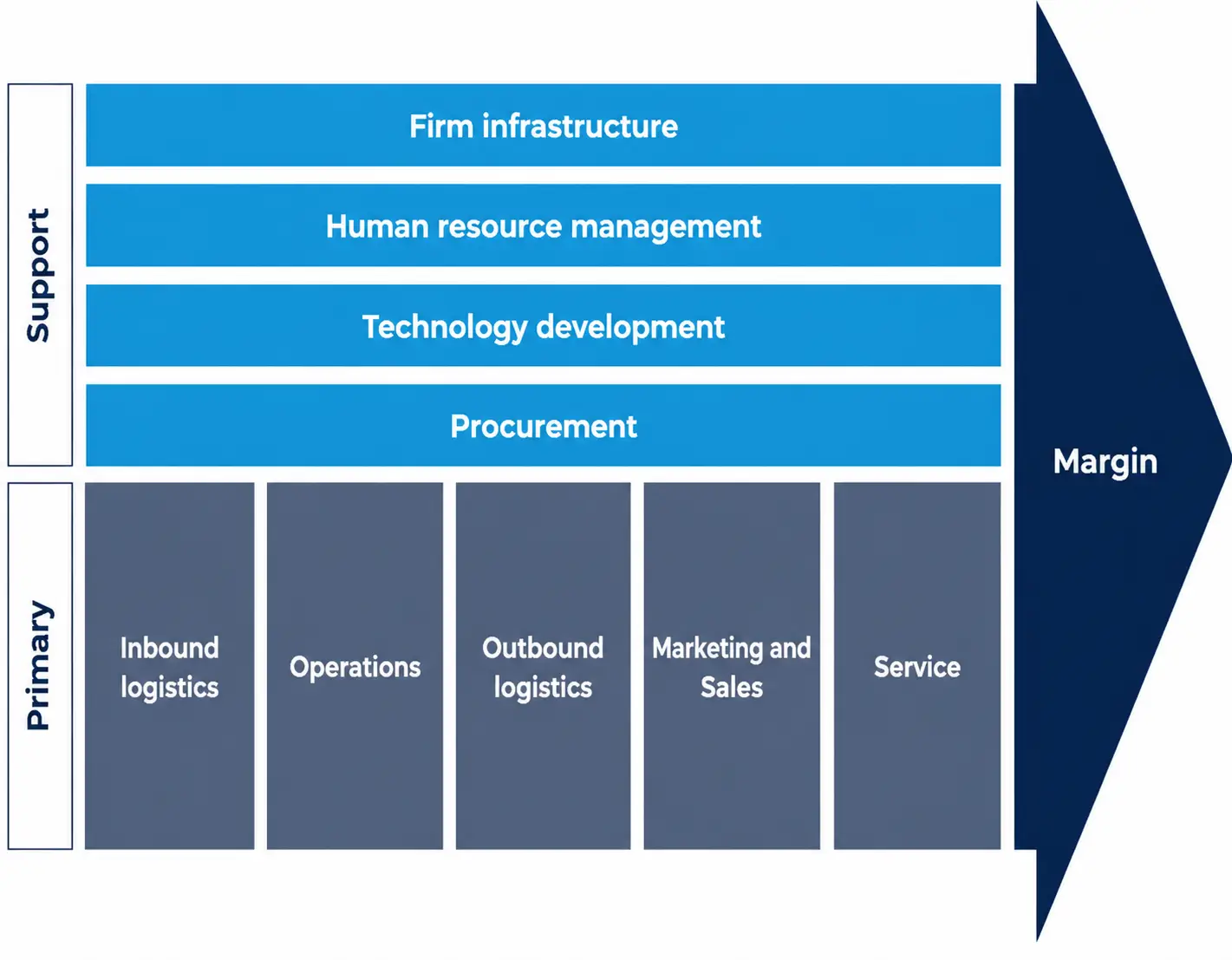
In Michael Porter’s value chain model, internal activities are categorized into two broad groups: primary activities and support activities. Together, these form the sequence of value-creating steps within the organization. Understanding this classification enables firms to examine where value is added and identify areas for improvement or competitive advantage.

Porter value chain diagram with support activities on top and primary activities below, leading to margin.
Porter Value Chain

Primary activities

These are the core business functions that are directly involved in the creation, sale, and service of a product or service. They typically occur in a sequential order and contribute directly to the customer experience.

  1. Inbound logistics
    Activities related to receiving, storing, and distributing raw materials or components.
    Example: A manufacturer’s warehousing and materials handling processes.

  2. Operations
    Processes that transform inputs into finished products or services.
    Example: Assembly lines, packaging, and equipment maintenance.

  3. Outbound logistics
    Activities involved in distributing finished goods to customers.
    Example: Warehousing, delivery scheduling, and order fulfillment systems.

  4. Marketing and sales
    Efforts to promote and sell the product, including advertising, pricing strategies, and salesforce management.
    Example: A retailer’s seasonal promotions or a B2B sales team’s client targeting.

  5. Service
    Post-sale support that maintains or enhances product value.
    Example: Customer support hotlines, warranty repairs, and installation services.

Support activities

Support activities provide the infrastructure necessary for the effectiveness and efficiency of primary activities. Although they do not directly contribute to the production or sale of goods, they enable the primary functions to perform optimally.

  1. Firm infrastructure
    Includes general management, planning, finance, legal, and quality control.
    Example: Strategic planning, compliance systems, and internal audit functions.

  2. Human Resource management
    Recruiting, hiring, training, and retaining employees across all levels.
    Example: Staff development programs and performance appraisal systems.

  3. Technology development
    Research and development, IT infrastructure, and innovation initiatives that support product and process improvements.
    Example: Software development in a tech firm or automation improvements in a factory.

  4. Procurement
    Sourcing and purchasing of inputs required by the firm, including raw materials, machines, and services.
    Example: Vendor selection and contract negotiation for raw materials.

Each activity, whether primary or support, can either contribute to or detract from the organization’s overall value offering. The goal of value chain analysis is to identify opportunities to reduce cost or enhance differentiation across any part of the chain.

For example, a company might streamline its inbound logistics through just-in-time (JIT) inventory systems to reduce warehousing costs, or it might enhance customer loyalty by investing in superior after-sales service. Both strategies increase value, either by lowering cost or improving customer satisfaction.

Steps in conducting a value chain analysis

Conducting a value chain analysis involves a systematic evaluation of an organization’s internal processes to determine how each contributes to value creation and competitive positioning. This step-by-step approach enables firms to understand cost structures, pinpoint inefficiencies, and identify opportunities for differentiation or cost leadership.

There is no universally prescribed method for performing value chain analysis; however, most approaches follow a logical progression centered around the following steps:

Value chain analysis
  1. Step 1: Identify value-creating activities
    List all primary and support activities performed by the organization.
  2. Step 2: Evaluate cost and value
    Assess the cost and value contribution of each activity to detect inefficiencies or strengths.
  3. Step 3: Benchmark performance
    Compare activities with competitors or industry best practices to spot performance gaps.
  4. Step 4: Identify improvement areas
    Use the insights to determine where the company can reduce cost, enhance differentiation, automate tasks, or consider outsourcing. These adjustments strengthen the company’s ability to achieve cost leadership or product/service differentiation.

Value chain analysis: definition and purpose

  • Identifies and evaluates internal business activities
  • Focuses on value creation, not just cost reduction
  • Supports strategic planning, cost management, and competitive positioning

Value chain vs. supply chain

  • Value chain: internal activities adding value for customers
  • Supply chain: external flow of goods/services among organizations

Limitations of value chain analysis

  • Complex and time-consuming, especially for large firms
  • Difficult to quantify intangible value (e.g., brand, loyalty)
  • Internal focus may overlook external market factors

Porter’s value chain model: activity categories

  • Primary activities: directly create, sell, and service products
    • Inbound logistics, Operations, Outbound logistics, Marketing & sales, Service
  • Support activities: enable primary activities’ effectiveness
    • Firm infrastructure, Human resource management, Technology development, Procurement

Steps in conducting value chain analysis

  • Identify all primary and support activities
  • Evaluate cost and value contribution of each activity
  • Benchmark against competitors or best practices
  • Identify areas for cost reduction or differentiation

Sign up for free to take 10 quiz questions on this topic

Previous
Next  | 4.5.2 Value-added concepts
All rights reserved ©2016 - 2026 Achievable, Inc.

Value chain analysis

Learning outcome statements

The learning outcome statements relevant for this section are:

  1. define value chain analysis
  2. identify the steps in value chain analysis
  3. explain how value chain analysis is used to better understand a company’s competitive advantage

Introduction

In today’s highly competitive business environment, understanding where and how value is created within an organization is essential to achieving sustainable profitability and long-term strategic success. This is where value chain analysis becomes a powerful management tool. It allows organizations to dissect their internal operations into distinct activities and examine how each contributes to delivering value to customers.

Value chain analysis is not only about cost reduction or operational efficiency, it also plays a critical role in identifying how a firm can differentiate itself from competitors by enhancing customer satisfaction, improving quality, or innovating service delivery. By analyzing individual processes across the organization, managers can pinpoint value-creating opportunities, eliminate wasteful practices, and strengthen the firm’s position within the industry.

This analytical framework forms a foundational component of strategic planning, cost management, and performance evaluation. It helps managers make informed decisions about resource allocation, outsourcing, technology investments, and pricing strategies.

In this section, we will define value chain analysis, identify its main components and steps, and explore how it can be leveraged to gain a competitive advantage through either cost leadership or differentiation.

Definitions
Value chain analysis
Value chain analysis is the process of identifying and evaluating the discrete internal activities of a business to determine how they contribute to the organization’s overall value proposition and competitive position.

It involves identifying, categorizing, and evaluating all the activities that take place from the acquisition of raw materials to the delivery of the final product or service, with the goal of enhancing efficiency, reducing costs, and maximizing customer satisfaction.

The concept was introduced by Michael Porter in his landmark book Competitive Advantage (1985). According to Porter, every firm is a collection of activities performed to design, produce, market, deliver, and support its product or service. These activities collectively form what is known as the value chain.

Value chain analysis differs from a simple cost analysis in that it emphasizes the value delivered to the customer, not just the cost incurred. The focus is on understanding how each activity either adds value to the final offering or consumes resources without creating sufficient return.

Although the terms are sometimes used interchangeably, value chain and supply chain refer to distinct concepts:

  • The supply chain focuses on the external flow of goods and services, from suppliers to manufacturers to customers. It emphasizes logistics, procurement, and operational coordination across organizations.

  • The value chain, in contrast, focuses internally on the activities within the organization that contribute to value creation. It considers how internal processes, from product development to after-sales service, generate value for the end user.

Understanding this distinction helps managers decide where to focus optimization efforts: externally (supply efficiency) or internally (value enhancement).

Limitations of the value chain analysis:

While value chain analysis is a powerful strategic tool, it is not without challenges. Its effectiveness depends on the quality of data, clarity of internal processes, and the ability of management to interpret and act on insights. The following limitations should be considered:

  • Complexity and time-intensiveness
    Mapping all activities and their interactions requires significant effort, particularly in large or diversified organizations with complex operations.

  • Difficulty in quantifying value
    Not all value is financial. Intangible benefits, such as customer loyalty, employee satisfaction, or brand equity, are harder to measure but play a critical role in value creation.

  • Internal focus
    Value chain analysis emphasizes internal processes and may overlook external factors such as market trends, supplier dynamics, or consumer behavior unless combined with other tools like PESTEL or SWOT analysis.

  • Benchmarking challenges
    Obtaining accurate and comparable data from competitors for benchmarking purposes can be difficult, especially in industries where proprietary processes and cost structures are closely guarded.

  • Risk of oversimplification
    Reducing operations to discrete activities might obscure cross-functional collaboration or the strategic importance of certain capabilities that span multiple functions.

Despite these limitations, when used appropriately, value chain analysis remains an essential component of strategic planning and performance management.

Primary and support activities

In Michael Porter’s value chain model, internal activities are categorized into two broad groups: primary activities and support activities. Together, these form the sequence of value-creating steps within the organization. Understanding this classification enables firms to examine where value is added and identify areas for improvement or competitive advantage.

Primary activities

These are the core business functions that are directly involved in the creation, sale, and service of a product or service. They typically occur in a sequential order and contribute directly to the customer experience.

  1. Inbound logistics
    Activities related to receiving, storing, and distributing raw materials or components.
    Example: A manufacturer’s warehousing and materials handling processes.

  2. Operations
    Processes that transform inputs into finished products or services.
    Example: Assembly lines, packaging, and equipment maintenance.

  3. Outbound logistics
    Activities involved in distributing finished goods to customers.
    Example: Warehousing, delivery scheduling, and order fulfillment systems.

  4. Marketing and sales
    Efforts to promote and sell the product, including advertising, pricing strategies, and salesforce management.
    Example: A retailer’s seasonal promotions or a B2B sales team’s client targeting.

  5. Service
    Post-sale support that maintains or enhances product value.
    Example: Customer support hotlines, warranty repairs, and installation services.

Support activities

Support activities provide the infrastructure necessary for the effectiveness and efficiency of primary activities. Although they do not directly contribute to the production or sale of goods, they enable the primary functions to perform optimally.

  1. Firm infrastructure
    Includes general management, planning, finance, legal, and quality control.
    Example: Strategic planning, compliance systems, and internal audit functions.

  2. Human Resource management
    Recruiting, hiring, training, and retaining employees across all levels.
    Example: Staff development programs and performance appraisal systems.

  3. Technology development
    Research and development, IT infrastructure, and innovation initiatives that support product and process improvements.
    Example: Software development in a tech firm or automation improvements in a factory.

  4. Procurement
    Sourcing and purchasing of inputs required by the firm, including raw materials, machines, and services.
    Example: Vendor selection and contract negotiation for raw materials.

Each activity, whether primary or support, can either contribute to or detract from the organization’s overall value offering. The goal of value chain analysis is to identify opportunities to reduce cost or enhance differentiation across any part of the chain.

For example, a company might streamline its inbound logistics through just-in-time (JIT) inventory systems to reduce warehousing costs, or it might enhance customer loyalty by investing in superior after-sales service. Both strategies increase value, either by lowering cost or improving customer satisfaction.

Steps in conducting a value chain analysis

Conducting a value chain analysis involves a systematic evaluation of an organization’s internal processes to determine how each contributes to value creation and competitive positioning. This step-by-step approach enables firms to understand cost structures, pinpoint inefficiencies, and identify opportunities for differentiation or cost leadership.

There is no universally prescribed method for performing value chain analysis; however, most approaches follow a logical progression centered around the following steps:

  1. Step 1: Identify value-creating activities
    List all primary and support activities performed by the organization.
  2. Step 2: Evaluate cost and value
    Assess the cost and value contribution of each activity to detect inefficiencies or strengths.
  3. Step 3: Benchmark performance
    Compare activities with competitors or industry best practices to spot performance gaps.
  4. Step 4: Identify improvement areas
    Use the insights to determine where the company can reduce cost, enhance differentiation, automate tasks, or consider outsourcing. These adjustments strengthen the company’s ability to achieve cost leadership or product/service differentiation.
Key points

Value chain analysis: definition and purpose

  • Identifies and evaluates internal business activities
  • Focuses on value creation, not just cost reduction
  • Supports strategic planning, cost management, and competitive positioning

Value chain vs. supply chain

  • Value chain: internal activities adding value for customers
  • Supply chain: external flow of goods/services among organizations

Limitations of value chain analysis

  • Complex and time-consuming, especially for large firms
  • Difficult to quantify intangible value (e.g., brand, loyalty)
  • Internal focus may overlook external market factors

Porter’s value chain model: activity categories

  • Primary activities: directly create, sell, and service products
    • Inbound logistics, Operations, Outbound logistics, Marketing & sales, Service
  • Support activities: enable primary activities’ effectiveness
    • Firm infrastructure, Human resource management, Technology development, Procurement

Steps in conducting value chain analysis

  • Identify all primary and support activities
  • Evaluate cost and value contribution of each activity
  • Benchmark against competitors or best practices
  • Identify areas for cost reduction or differentiation

More from Business process improvement

  • Value-added concepts
  • Process analysis, redesign, and standardization
  • Continuous improvement, benchmarking, and best practices
  • Cost of quality analysis