



Cost of quality analysis
Learning outcome statements
The learning outcome statements relevant for this section are:
- identify and describe the components of the costs of quality, commonly referred to as prevention costs, appraisal costs, internal failure costs, and external failure costs
- calculate the financial impact of implementing the above-mentioned processes
Introduction
In any organization, the pursuit of quality is not only a strategic objective but also a financial consideration. While high product or service quality leads to customer satisfaction and long-term loyalty, achieving that quality requires investment in prevention, detection, and correction. These investments are captured under the concept of the costs of quality (COQ), a framework that helps organizations measure and manage the financial impact of quality-related activities.
The costs of quality do not refer solely to the cost of achieving high quality, but rather to the total cost associated with both achieving and failing to achieve quality. This includes money spent on avoiding defects, inspecting products, fixing problems, and dealing with customer complaints or returns.
Organizations that fail to manage quality effectively often suffer from high internal costs (e.g., scrap and rework) or even greater external costs (e.g., warranty claims, lost customers). On the other hand, organizations that invest in quality improvement programs can often reduce their total cost of quality over time by focusing on preventive and appraisal activities.
This section introduces the four main categories of quality costs and explores how they can be measured, analyzed, and optimized to improve organizational performance and reduce waste.
Categories of the costs of quality
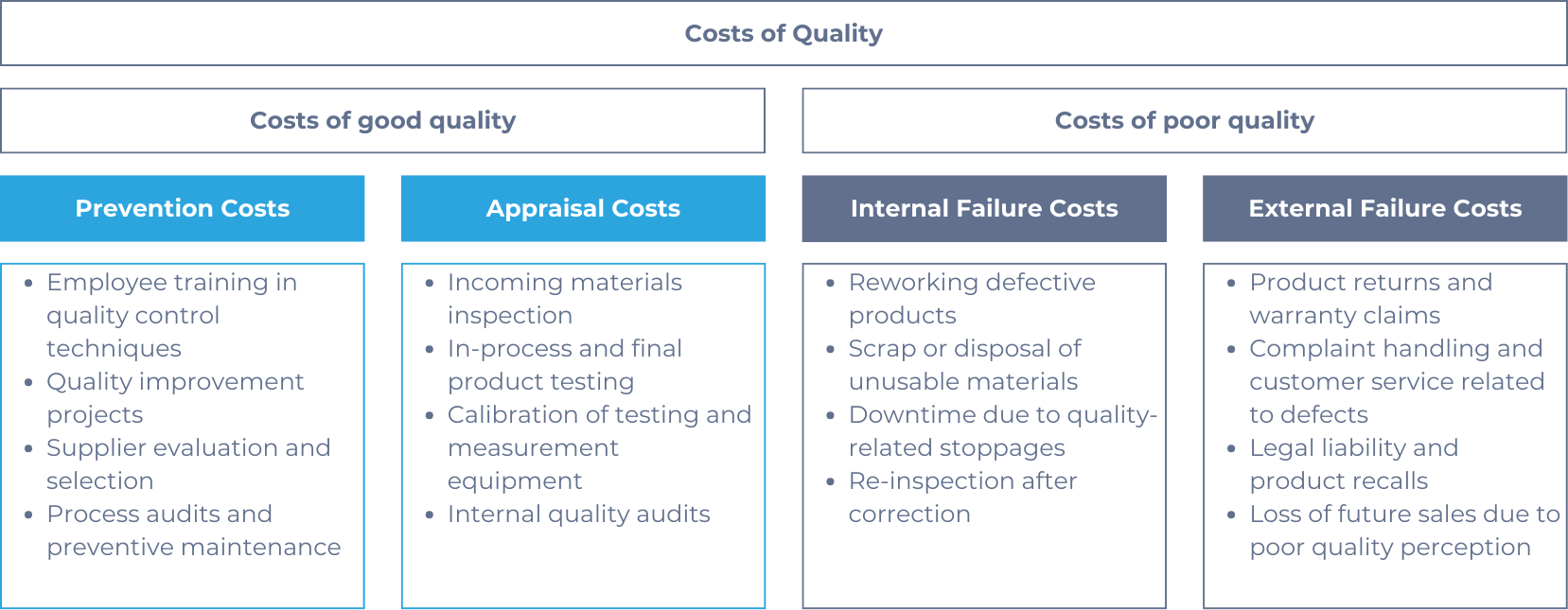
The Costs of Quality (COQ) framework breaks down all quality-related expenditures into four main categories. These categories help organizations understand where their quality dollars are going and how to shift resources to maximize quality while minimizing total cost.
The four categories of quality costs can be broadly grouped into two overarching types:
By increasing investments in good quality (prevention and appraisal), organizations can significantly reduce the more damaging and costly effects of poor quality over time.
1. Prevention costs
These are the costs incurred to prevent defects before they occur. Prevention focuses on process design, training, and quality planning to ensure products and services are right the first time. Examples of prevention costs:
- Employee training in quality control techniques
- Quality improvement projects (e.g., Six Sigma initiatives)
- Supplier evaluation and selection
- Process audits and preventive maintenance
2. Appraisal costs
These costs are related to measuring, inspecting, and monitoring to detect defects before the product reaches the customer. Appraisal ensures quality compliance during production. Examples of appraisal costs:
- Incoming materials inspection
- In-process and final product testing
- Calibration of testing and measurement equipment
- Internal quality audits
3. Internal failure costs
These are the costs of defects found before the product or service is delivered to the customer. They include expenses for rework, scrap, and delays due to quality issues. Examples of internal failure costs:
- Reworking defective products
- Scrap or disposal of unusable materials
- Downtime due to quality-related stoppages
- Re-inspection after correction
4. External failure costs
These are the costs of defects discovered after the product or service has been delivered to the customer. These failures can result in reputational damage and customer dissatisfaction. Examples of external failure costs:
- Product returns and warranty claims
- Complaint handling and customer service related to defects
- Legal liability and product recalls
- Loss of future sales due to poor quality perception
| Category | Purpose | Example activities |
| Prevention costs | Avoid defects before they occur | Training, quality planning, supplier assessment |
| Appraisal costs | Detect defects before customer delivery | Inspections, product testing, audits |
| Internal failure costs | Fix defects before delivery | Rework, scrap, re-inspection |
| External failure costs | Address defects after delivery | Returns, warranties, customer complaints |