



The medical assistant's role in examination and diagnostic procedures for immune conditions
The medical assistant’s role in examination, diagnostic procedures, and treatments
As a medical assistant, you may be involved in assisting with examination, diagnostic procedures, and treatments. Having an understanding of what is required of you during those processes will help you provide the best possible care for your patients and become the best assistant for your provider. The following sections describe the medical assistant’s role.
Assisting with the examination, procedures & treatment
When working with patients who have infectious diseases, it is important to protect yourself and other patients in the healthcare facility. A patient who has made an appointment to be seen for a cough or other respiratory issue may be asked to put on a mask when checking in for the appointment. This will help to protect the other patients in the reception area. Hand sanitizer is often available in the reception area so that patients can use it after they have sneezed, coughed, or wiped their noses.
Many healthcare facilities will also have the medical assistant wear a mask when working with patients with potentially infectious diseases, especially respiratory infections. A simple explanation that you are wearing the mask as a precaution will help to make the patient feel more comfortable with the situation.
Preparing a patient for an infectious disease examination includes having the patient disrobe appropriately, depending on which body system is involved. For allergy testing, the patient usually must disrobe to the waist, and the gown is open in the back.
An important part of any examination is taking a health history. When working with a patient who has a potential infectious disease, the medical assistant should gather the history of the present illness (HPI) information and review the past medical history (PMH).
When working with a patient with potential allergies, it is important to ask what the reaction to the allergen was. The reaction can indicate whether the patient has an allergy or a sensitivity. With a true allergy, there is an immune system response that can affect many organs in the body (e.g., difficulty breathing or hives). Allergies can be severe or even life threatening. With a sensitivity, there is no immune system response, but there is an exaggeration of a normal side effect. This could range from digestive issues to neurologic issues.
Assisting with diagnostic procedures
The medical assistant is often involved in assisting with diagnostic procedures of the immune system. It is important to remain professional during these interactions. The following sections describe the medical assistant’s role in assisting with those diagnostic procedures.
Testing for allergies
Skin testing to detect allergies requires a percutaneous application or intradermal injection of a small amount of antigen (or groups of antigens) and later examination of the test sites for a visible reaction. The larger the localized skin reaction, the more profound the patient’s allergic response to the tested allergen.
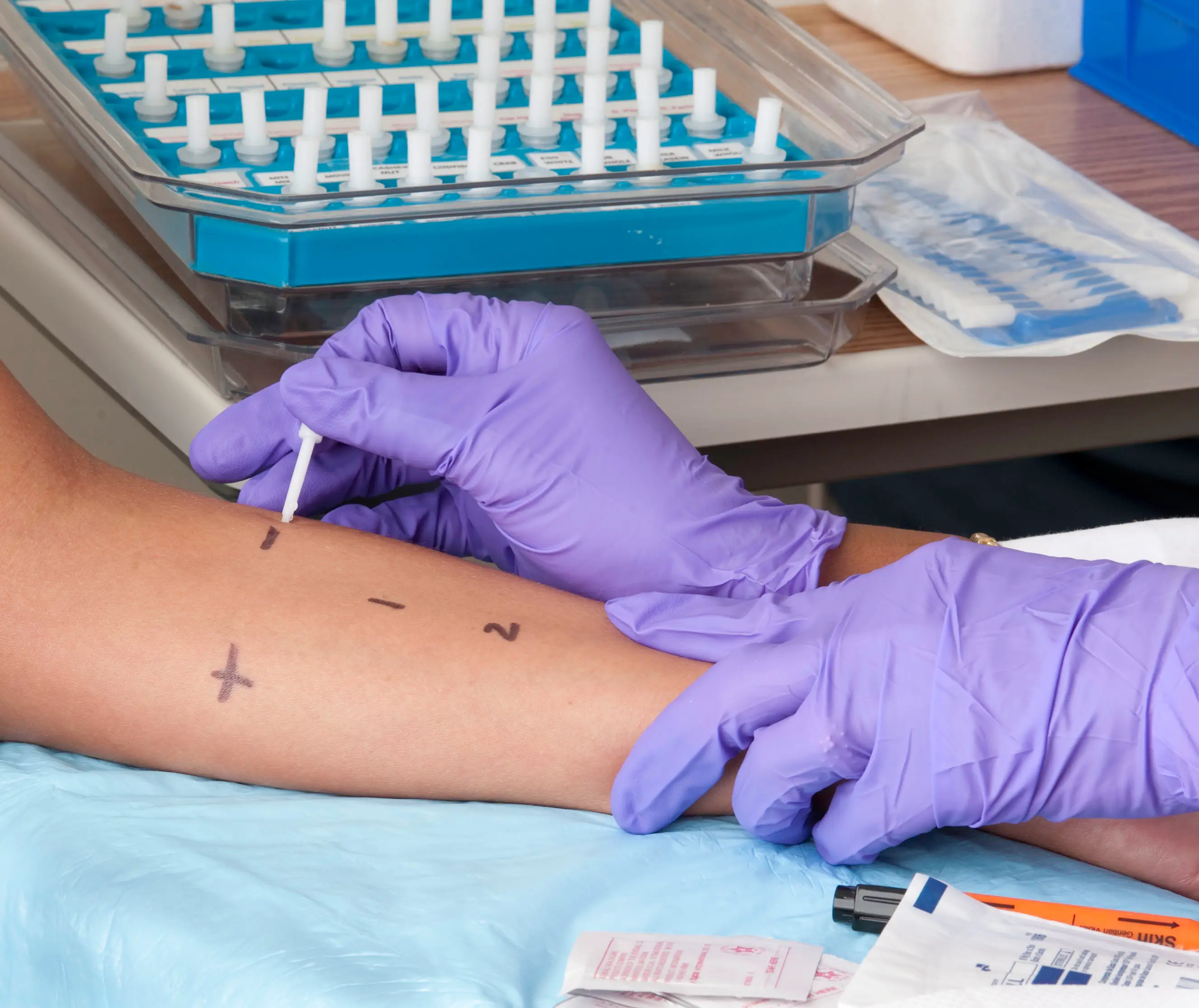
A percutaneous, or scratch, test may be performed on the forearm, upper arm, or back. The back is favored in young children because of the large area of skin available. It also is easier to immobilize the child in this position. The skin surface is labeled or numbered in rows 1½ to 2 inches apart, and a small amount of allergen is placed on the skin, which is then scratched or pricked to place the allergen just under the skin surface. Many allergists use a plastic device that is dipped into the designated allergens and lightly pressed into the skin so that the prick and allergen deposition occur at the same time. Seventy or more tests may be done at one time. It is essential to follow a pattern so that the site of each allergen can be easily identified. The first step should be to number all of the sites before applying the allergen. This type of allergy testing is used for allergic rhinitis, asthma, and detection of food allergies.
Common medication, environmental, and food allergens
| Medication | Environmental | Food |
| Penicillin | Dust mites | Eggs |
| Sulfonamides | Pollen | Peanuts |
| Anticonvulsants | Pet dander | Tree nuts |
| NSAIDS | Mold | Wheat |
| Chemotherapy drugs | Cigarette smoke | Shellfish |
A reaction usually occurs within 10 to 30 minutes of exposure to the allergen. If the reaction is positive, a wheal (hive) forms at the site of the scratch (see the skin allergy testing image above). Interpretation of the test result should always be based on a comparison of this reaction with that of the control, which is a scratch with a plain fluid free of any allergy-producing extract.
After 15 minutes, the medical assistant measures the erythema (redness) and the wheal at each site. If a strong reaction occurs, the allergen extract should be carefully wiped off to prevent any further exposure. Frequently, large or significant reactions are accompanied by local itching. Patients should remain in the office for at least 30 minutes after completion of the test in case a delayed systemic allergic response occurs.
A patch test uses an allergen that is applied to a patch that is placed on the skin. Patch testing helps detect delayed allergic reactions associated with contact dermatitis. The patches are placed on the arms or back and must remain in place for 48 hours. The patient needs to avoid bathing and activities that cause heavy sweating. The patches are removed at a subsequent office visit. Skin irritation at the patch site indicates an allergy to that particular substance.
Five guidelines for allergen skin testing
- Whether a medical assistant may perform allergen skin testing, intradermal injections, or PPD administration is delegated by the supervising provider and governed by state law and medical board regulations - this authority is not uniform nationally, and some states prohibit medical assistants from performing these procedures.
- The patient should stop antihistamines and certain other medications (prescription and over-the-counter antihistamines, tricyclic antidepressants, and certain heartburn medications) 3 to 10 days before testing, as directed by their provider, to prevent false-negative results.
- Recommended sites for injection or application of the allergen are the anterior forearm, the upper arm, and the back.
- Allergen sites must be specifically labeled and spaced approximately 1½ to 2 inches apart.
- If the patient shows signs of anaphylaxis, notify the provider immediately and prepare emergency supplies. Allergy testing should be performed only when the provider is onsite.
- Skin testing may cause a mild systemic allergic response, resulting in rhinitis, wheezing, and sneezing. The patient should contact the provider if a more severe reaction occurs.
The intradermal test is more sensitive than the percutaneous test and usually is used to diagnose allergies to penicillin and insect venom, such as from bee stings. Extracts are injected into the intradermal layer of the skin in doses of 0.1 to 0.2 mL. This method also is used for the tuberculin (purified protein derivative [PPD]) test and the Valley Fever coccidioidomycosis test. When intradermal injections are used for allergy testing, 10 to 15 allergens may be tested at one time on each arm. The reaction time is identical to that of the scratch test; however, the antigen is more dilute.
The radioallergosorbent test (RAST) measures the level of antibodies created when a sample of the patient’s blood is mixed with allergens in the laboratory. The RAST is easier to perform than skin testing because it requires a single venipuncture. Although skin testing remains the preferred method of diagnosing hypersensitivity, the RAST may be indicated when the patient cannot stop antihistamine medications, when a skin disorder makes accurate interpretation of skin test results difficult, or when skin test results are negative, but the patient’s signs and symptoms support further investigation. RAST blood tests are primarily used to identify food allergies.