



Specific immunity, allergies, and lifespan changes
Humoral immunity
Humoral immunity, also known as antibody-mediated immunity, involves the production of antibodies. B cells are formed from stem cells in the bone marrow. They then migrate to lymph organs (e.g., lymph nodes, spleen), where they multiply and live. B cells are the most important cell in humoral immunity, but T cells and macrophages are also involved in the process. When an antibody combines with an antigen, an antibody-antigen complex is formed.
Antibodies are protein molecules that specifically attach to antigens. They can neutralize toxins or destroy viruses directly. They can combine with larger antigens (e.g., bacteria) to form antibody-antigen complexes. These complexes signal phagocytes, such as neutrophils and macrophages, to come and destroy them. The phagocytes engulf the complexes and destroy the antigen.
Antibodies can protect the body in many ways. They circulate in the plasma and are present in secretions (i.e., tears, saliva, colostrum), ready to attach to unsuspecting antigens. However, there is one thing antibodies are unable to do - they cannot enter a cell. That can be a problem because sometimes antigens go inside host cells. When that happens, antibodies cannot destroy the antigen. This is when cell-mediated immunity takes over.
Cell-mediated immunity
T cells are formed from stem cells in bone marrow. They then migrate to the thymus, where they mature and learn their role in the immune system. They are the most important cell in cell-mediated immunity. T cells do not produce antibodies, but they can help antibodies do their job. T cells are very effective against intracellular pathogens (antigens). When an antigen enters a cell, the infected cell displays fragments of that antigen on its surface. Cytotoxic T cells recognize this displayed antigen and destroy the infected cell directly, killing the pathogen along with it rather than relying on antibodies, which cannot reach inside the cell. There are different types of T cells that have different roles in cell-mediated immunity.
Different types of T cells
Four main types of T cells work in specific immunity. Look at the following list and see how important T cells are to immunity in general.
- T helper cells (TH), also known as CD4+ T cells. They help in B-cell activation and activation of cytotoxic T cells.
- Cytotoxic T cells (TC), also known as CD8+ cells. They destroy virus-infected cells and tumor cells. They also can cause damage to or rejection of organ transplants. In addition, they can cause autoimmune diseases.
- Memory T cells rapidly proliferate if the body is reexposed to the antigen.
- Regulatory T cells (Treg), also known as suppressor T cells. They help shut down the immune response when the antigen has been destroyed.
Cell-mediated immunity is particularly well suited to destroying viruses. Viruses must be inside a host cell to reproduce. Cytotoxic T cells destroy a virus once it gets inside a cell. Cell-mediated immunity helps stop the spread of viral infections within the body. Another job of cell-mediated immunity is to recognize and destroy cancer cells or tumor cells. Even though these cells are part of a person’s body, they are not normal. They have changed and are now harming the body. Cell-mediated immunity recognizes malignant changes in cells. It works to destroy them before they cause disease (cancer) or tumors.
Types of acquired immunity
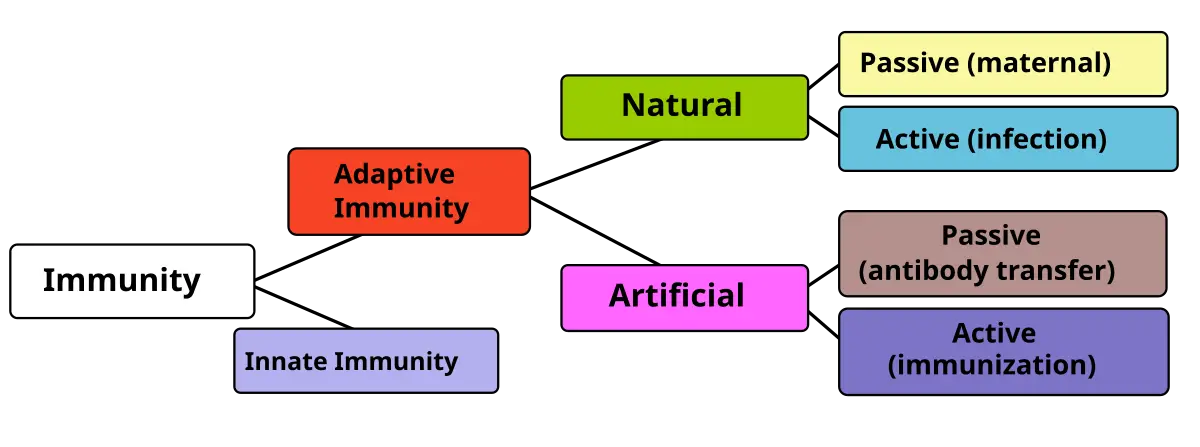
Immunity is one way our body protects us from infectious diseases. Acquired immunity is classified as active or passive. Active immunity requires the body to respond to an antigen and produce antibodies for protection. Passive immunity does not require the body to do anything. In passive immunity, premade antibodies are given to a person. This occurs through transmission from the mother to the fetus or infant or through an injection of immune globulin. The immune system is not required to make anything.
Active immunity and passive immunity are each categorized as natural immunity or artificial immunity. All four types of acquired immunity describe ways the body has acquired antibodies to specific diseases.
Allergies
The immune system is quite remarkable. When it works well, it keeps our bodies from harm. When it doesn’t work properly, the immune system can harm the body. Allergies are an example of the immune system overreacting. Allergies are also known as hypersensitivity reactions.
Hypersensitivity is defined as an immune response that causes tissue damage in the host. It is an excessive response to a stimulus or foreign agent. A hypersensitivity reaction does not occur the first time an antigen is encountered. It is when the person encounters the antigen for a second or subsequent exposure that the reaction develops.
An allergic reaction is a type I hypersensitivity reaction. It is the body responding to an allergic trigger called an allergen. Allergens are harmless environmental substances, but in an allergic reaction, the body overreacts to their presence.
When the body responds to an allergen, immune cells release histamines, kinins, and other inflammatory substances. This causes the characteristic allergy symptoms: runny nose, watery eyes, and possibly a rash or hives. Sometimes drugs called antihistamines are used to alleviate allergy symptoms.
If an allergic reaction is severe, it can cause a dangerous condition called anaphylactic shock. This can be a life-threatening condition. People who know they are highly allergic to a substance should carry an EpiPen to treat an anaphylactic reaction.
Life span changes
As we age, there are changes that can occur with both the immune system and the lymphatic system. Some of those changes are discussed in the following sections.
Changes in children
Some antibodies are passed from mother to baby, which provides some protection when they are born. More antibodies are passed to the baby through colostrum and breast milk. These passively acquired antibodies will protect for a short time. It will take some time for the immune and lymphatic systems to fully develop. Babies produce their own antibodies when they are exposed to a pathogen, whether by having the disease or getting a vaccination.
Childhood disorders of the lymphatic and immune systems include the following:
- Hypersensitivities or allergies to foods, pollen, or pet dander
- Childhood leukemias or lymphomas
- The development of autoimmune disease in late adolescence
Changes in adults
As we age, there is a reduction in the production of the B and T cells in the bone marrow and thymus. There is also a diminished function of the mature lymphocytes in the lymph tissue. This results in a lesser response to challenges to the immune system than when we were younger.
Unlike children, adults and seniors will have a host of diagnoses from this chapter in their health records. Autoimmune diseases are most common in young adulthood to middle age. Cancers of these systems also appear in significant numbers. Non-Hodgkin’s lymphoma and acute myelogenous leukemia (AML) account for thousands of hospitalizations every year. Multiple myeloma is most frequently diagnosed after age 60.