



Infectious pathogens
Many microorganisms are nonpathogenic, which means they do not cause disease. They can be found in our body, maintaining homeostasis. For example, Staphylococcus epidermidis is normal, nonpathogenic flora on the skin, while Staphylococcus aureus can act as an opportunistic pathogen, causing infection when it enters the body through a break in the skin or when the immune system is weakened. Other microorganisms are pathogenic, which means disease-causing. These pathogens enter our bodies through direct contact, indirect contact, or by vectors.
Methods of disease transmission
Direct contact
A susceptible person comes in contact with an infected person, and the pathogen is spread via contact with blood, body fluids, and excretions (e.g., stool, urine, and saliva).
Methods of direct contact include the following:
- Person to person: Spread from sneezing, touching, and coughing. Influenza and strep throat are spread this way.
- Animal to person: Spread from being bitten, scratched, or handling animal waste. Rabies is spread through this method.
- Mother to unborn child: Varicella, herpes simplex viruses, and toxoplasmosis are just some of the diseases that are spread from an infected mother to the unborn child.
Indirect contact
The pathogen is spread from contact with a contaminated object (e.g., water, food, drinking glass) or through airborne transmission, in which droplet nuclei carrying the pathogen remain suspended in the air and are inhaled by another person. Escherichia coli and Salmonella are spread through contaminated food and water, while tuberculosis is spread through the air via droplet nuclei.
Vectors
Most blood-sucking insects consume the disease-causing microorganism from one host and transmit it during a “meal” to another host.
- Mosquitoes are vectors for yellow fever, malaria, West Nile fever, and Zika virus.
- Ticks are vectors of Lyme disease, tick-borne encephalitis, and rickettsial diseases.
- Fleas are vectors for plague.
Disease process
When a pathogen enters our body and starts to multiply, an infection occurs. Changes occur in our bodies, yet we do not feel any different. This is the incubation period. It starts at the time of exposure and ends when the signs and symptoms appear.
The incubation period is different for each disease. For instance, strep throat has an incubation period of 2 to 5 days, whereas varicella (chickenpox) has an incubation period of 14 to 16 days. As our body tissues become damaged from the infection, we start to see the signs and symptoms. This is when the disease occurs.
Common pathogens
| Pathogen | Description | Related diseases |
|---|---|---|
| Fungi | Yeast and molds | Tinea corporis (ringworm) |
| Viruses | Smallest organisms | Common cold, influenza, measles, mumps |
| Bacteria | Single-celled organisms | Tuberculosis, E. coli infection, strep throat |
| Helminths | Multicellular parasites | Tapeworms, flatworms |
| Ectoparasite | Parasite on body | Lice, scabies |
Some diseases are noncommunicable. They cannot be transmitted from one person to another. For instance, a person with tetanus cannot spread the disease to another person.
Other diseases are communicable. These diseases are transmitted from one person to another. If a communicable disease is known to be easily transmitted, it is called a contagious disease. Strep throat, coronavirus disease (COVID-19), and influenza are examples of contagious diseases.
For instance, people with strep throat are contagious from the start of the fever until they have been on the appropriate antibiotics for 24 hours. The period during which a disease can spread to another is called the contagious period.
It is important for people in healthcare to understand the ways diseases are spread. Taking required precautions will minimize your risk of “catching something” from your patients.
Inflammatory processes
The inflammatory response is the body’s efficient way of protecting itself. Inflammation occurs when the tissues are injured. The injury could be the result of bacteria, trauma, heat, toxins, or other causes.
The damaged cells release the chemicals histamine, prostaglandins, and bradykinin. These chemicals cause the following responses:
- Blood vessels at the site dilate, causing more local blood flow. With the increase in blood flow, erythema (redness) and warmth occur in that area.
- Blood vessel walls allow more white blood cells and plasma to move out of the vessel into the surrounding tissues. The white blood cells work to protect the cells and clean up the dead tissue. The extra fluid from the blood causes edema (swelling), pain, and loss of movement. For instance, if an injury occurs in your finger joint area, the edema may be so great that it prevents you from moving your finger.
Even though the inflammatory process can be efficient, it can also be the cause of disease. Autoinflammatory diseases (e.g., familial Mediterranean fever) differ from autoimmune diseases, which will be described later in the chapter.
Autoinflammatory diseases result from a genetic mutation that causes the inflammatory process to activate without a reason. The person may experience brief recurring attacks of pain and fevers, and blood work indicates systemic inflammation.
Immunity
Our immune system protects our bodies against potentially harmful substances. Our immune system “remembers” the antigens from diseases and responds with specific antibodies. The antibodies destroy or attempt to destroy the harmful substances.
As with the autoinflammatory conditions, at times, the immune response can work against us. These malfunctions are classified as follows:
-
Allergies: Reactions occur if a person is exposed to a food (e.g., milk, tree nuts, peanuts, eggs, soy, and wheat), pollen, dust mites, latex, mold, pet dander, inhalants, or other substances.
-
Autoimmunity: The immune system does not recognize the body’s own antigens and starts attacking itself. Rheumatoid arthritis, lupus, and psoriasis are examples of autoimmune disorders.
-
Immunodeficiency: This is caused by a deficiency in one or more of the immune system’s key players (e.g., white blood cells, such as the B cells and T cells). A person with immunodeficiency has impaired resistance to infections.
Nutritional imbalance
Nutritional imbalances include too little or too much of a nutrient. Nutritional imbalances can affect growth, disease, and death.
Causes of nutritional imbalances include the following:
-
Vitamin and mineral deficiencies: Some of these deficiencies can be caused by alcoholism, disease, dietary deficiencies (and poverty), weight loss surgery, and metabolic disorders.
-
Vitamin and mineral excesses: Vitamin excesses can occur when a person takes too much of a vitamin. The water-soluble vitamins (vitamins B and C) pass through the body fairly quickly. The fat-soluble vitamins (vitamins A, D, E, and K) can accumulate in the body. This can lead to toxic conditions. Mineral excess can be caused by diet, medication, or a metabolic error.
-
Obesity: This is caused by eating too many calories, getting too little exercise, or having an endocrine or metabolic condition. Obesity can increase a person’s risk for other diseases, including heart disease, diabetes, hypertension (high blood pressure), and stroke.
-
Starvation: Eating too little food can result from disease or poverty.
Trauma and environmental agents
Trauma from auto accidents, violence, falls, and other events can cause disease. Common traumatic injuries include fractures, lacerated and ruptured organs, bleeding, neck and spinal injuries, and head injuries. Psychological trauma can also cause disorders.
Environmental changes, such as severe hot or cold temperatures and extremes of atmospheric pressure, can affect health. Poisonings, insect and animal bites, burns, electric shock, and near drownings can also cause diseases.
Neoplasms
When cells grow more quickly than normal or do not die as fast as they should, an abnormal mass is created. This mass is called a neoplasm or tumor. Tumors can be benign (noncancerous) or malignant (cancerous).
As the malignant cells grow, they can break through the basement membrane. This delicate membrane separates the epithelial cells from connective tissues. Once this occurs, the cancerous cells can invade blood and lymph vessels.
The circulating fluid (blood, lymph fluid) can then carry the cancerous cells to another location in the body. Thus, cancerous cells from the primary tumor (original site) can metastasize to another location in the body, creating a secondary tumor.
If a provider suspects a patient may have cancer, a number of blood tests and imaging tests will be ordered. A biopsy may be performed. The surgeon may also take a biopsy of nearby lymph nodes so the tissue can be checked for malignant cells. Based on the diagnostic results, the oncologist or pathologist will grade and stage the cancer.
Classifications of cancer
There are more than 100 different types of cancer. Cancers are classified based on the type of tissue from which they originate.
The six major classifications are as follows:
Carcinoma
A cancer of epithelial origin or cancer of the internal or external lining of the body. Carcinoma can originate from many areas of the body, including the skin, lungs, breast, colon, and prostate. Carcinomas make up about 80% to 90% of all cancer cases.
Two major subtypes of carcinomas are these:
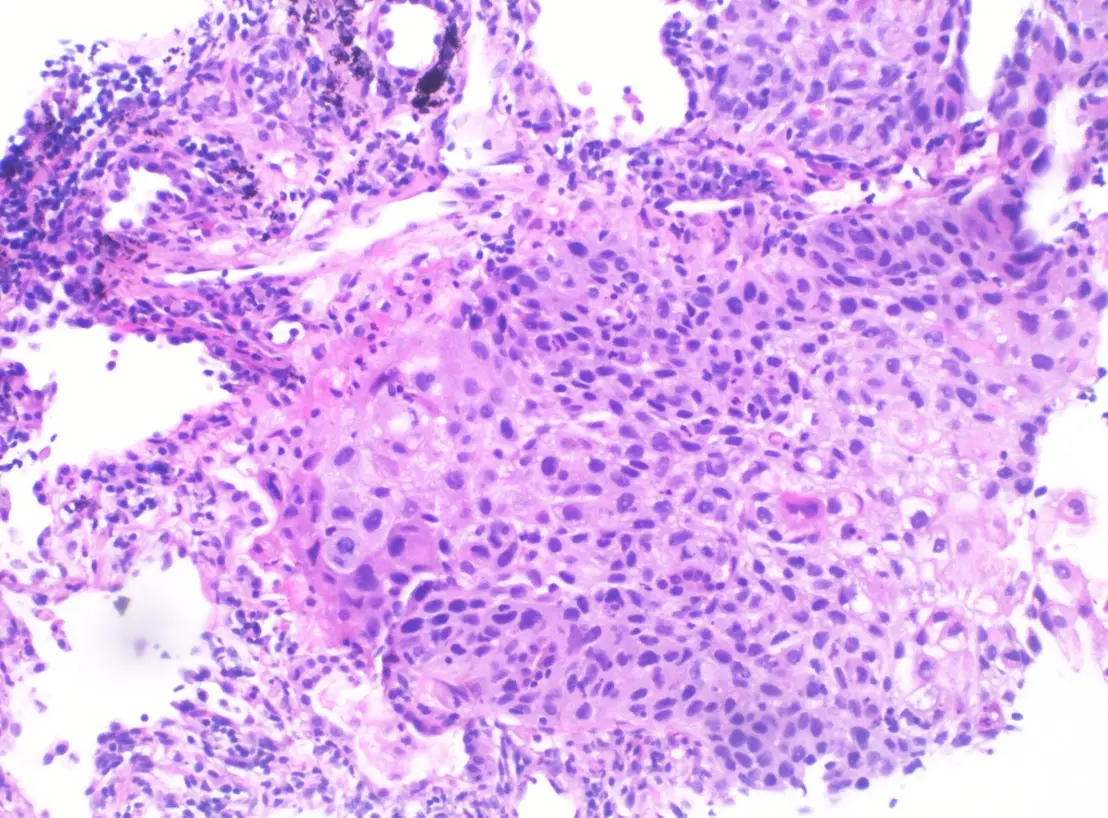
- Squamous cell carcinoma: A cancer that originated from the squamous epithelium. One example is squamous cell carcinoma of the lung.
- Adenocarcinoma: A cancer that starts in an organ or a gland. One example is gastric adenocarcinoma.
Other cancer classifications
-
Sarcoma: A cancer that starts in supportive and connective tissues (e.g., bones, tendons, cartilage, fat, and muscle). Examples include osteosarcoma, chondrosarcoma, and liposarcoma.
-
Myeloma: A cancer that originated in the plasma cells (a type of white blood cells) in the bone marrow. An example is multiple myeloma.
-
Leukemia: A cancer of the bone marrow. An example is acute myelocytic leukemia.
-
Lymphoma: A cancer that originated in the lymphatic system. There are two types of lymphomas:
- Hodgkin lymphoma: Diagnosed by the detection of Reed-Sternberg cells, a cell specific only to this disease.
- Non-Hodgkin lymphoma: All lymphomas other than Hodgkin lymphoma.
-
Mixed types: Cancer that has a combination of cells from within one classification or between two cancer classifications. One example is teratocarcinoma.
Grade
Grade refers to how abnormal the malignant cells look.
If the malignant cells and tissues closely resemble normal cells and tissue, the tumor is called well-differentiated. These are more slow-growing tumors.
If the malignant cells and tissues do not look like normal cells and tissues, they are called undifferentiated or poorly differentiated.
The microscopic look of the cell is graded using 1, 2, 3, or 4 to indicate the appearance.
- Grade 1: Well-differentiated; the cells and organization of the malignant tissue look close to that of normal tissue.
- Grade 2: Moderately differentiated; the tissue does not look like normal tissue. The cells are also growing at a faster rate than normal.
- Grades 3 and 4: Do not look like normal tissue and tend to spread quickly.
Stage
Stage refers to the extent of the cancer, including its size and whether it has spread. A cancer is referred to by this stage.
Several staging systems are used, and various factors must be taken into consideration with staging systems:
- Location of the tumor
- Type of cell
- Size of the tumor
- Whether it has spread to nearby lymph nodes
- Whether it has spread to other locations in the body
- Tumor grade, or how abnormal the cells look compared with normal sizes and how quickly it grows and spreads