


Achievable logoAchievable logo
CCMA
Sign in
Sign up
Purchase
Textbook
Practice exams
Support
How it works
Exam catalog
Mountain with a flag at the peak
Textbook
1. Medical assistant
2. Electronic records
3. Medical terminology and anatomy
4. The fundamentals of infection control
4.1 The cycle of infection
4.2 The body’s defense mechanisms and types of infection
5. Introduction to vital signs
6. The patient interview and history
7. The physical examination
8. Appointment scheduling
9. Insurance billing
10. Diagnostic coding and the ICD-10-CM System
11. Procedural coding
12. Medical billing and reimbursement essentials
13. Assisting with medical specialties
14. Assisting with the musculoskeletal system
15. Assisting with the cardiovascular system
16. Assisting with the respiratory system
17. Assisting with the nervous system
18. Anatomy and physiology of the urinary system
19. Assisting in obstetrics and gynecology
20. Assisting in endocrinology
21. Assisting in ophthalmology & otolaryngology
22. Assisting in gastroenterology
23. Assisting in the immune & lymphatic systems
24. Assisting in pediatrics: the developmental stages and care
25. The medical assistant’s role in caring for the older patient
26. The role of the medical assistant in physical therapy examination and assessment
27. Preparing for minor surgery: room, solutions, and supplies
28. Introduction to the clinical laboratory
29. Urinalysis
30. Blood collection
31. Analysis of blood
32. Electrocardiography and heart structure
33. The principles of pharmacology
34. Essential calculations and measurement systems
35. Solid, liquid, & solutions medication doses
36. Administering medications
37. Metabolism and core nutrient roles
38. Medical emergencies in the healthcare setting
Achievable logoAchievable logo
4.1 The cycle of infection
Achievable CCMA
4. The fundamentals of infection control
Our CCMA course is currently in development and is a work-in-progress.

The cycle of infection

7 min read
Font
Discuss
Share
Feedback

As a Medical assistant, your role in helping to create and maintain a safe and healthy environment for both patients and employees is key. This role includes understanding how infections occur and are transmitted in the population and practicing all necessary infection control precautions. To understand how infections are spread, you need to understand the cycle of infection.

The cycle of infection

Disease is defined as a specific illness with a recognizable group of signs and symptoms and a clear cause (e.g., infection, environment). We recognize and categorize many types of diseases: hereditary (genetic), drug induced, autoimmune, degenerative, communicable, and infectious, to name only a few. Sometimes a specific disease may fit two or more categories.

Any disease caused by the growth of pathogenic microorganisms in the body falls into the category of infectious diseases. The entrance of a living microbe into the body is not a disease until the infected cell or individual shows harmful changes in structure, function, or biochemistry. In fact, a pathogen may be ingested, injected, or inhaled and never cause disease. However, an unaffected person can still transmit the infection to another person. In this case, we call the unaffected person a carrier.

Microorganisms are almost everywhere. We carry them on our skin, in our bodies, and on our clothing. They can be in ice, boiling water, the soil, and the air. The only places free of microorganisms are certain internal body organs and tissues and sterilized medical equipment and supplies. In the normal state, organs and tissues that do not connect with the outside by means of mucus-lined membranes are free of all living microorganisms.

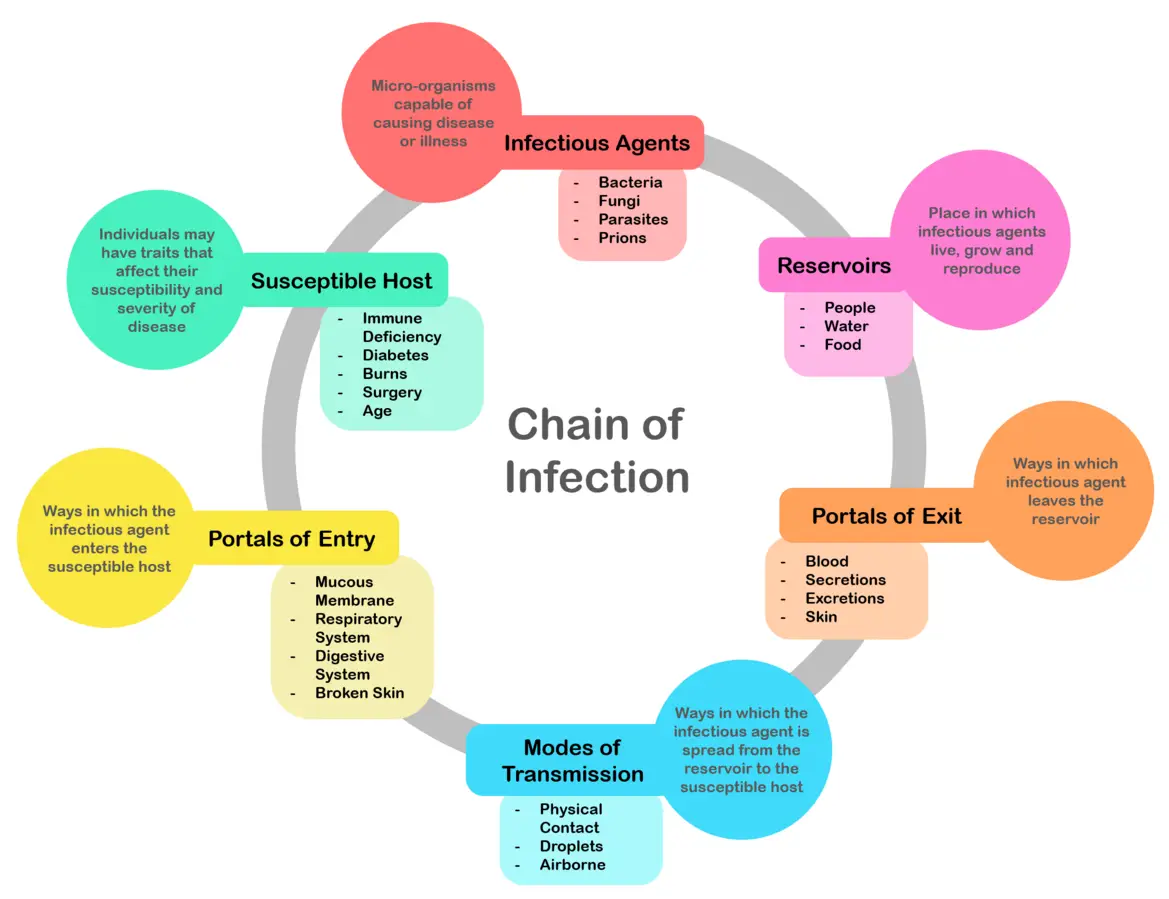
Certain factors are required for an infectious disease to spread. These factors, or links, make up the chain of infection. Break the chain, and you break the infection process.

Breaking any link in the chain of infection can help prevent the spread of disease.

The chain of infection starts with the infectious agent. Infection cannot occur without the presence of an infectious microorganism. The best way for healthcare workers to prevent the spread of disease is to use infection control procedures, such as the following:

  • Consistent hand washing
  • Proper use of antiseptics
  • Effective disinfection and sterilization methods
Six links in the chain of infection labeled
Chain of infection
Wikimedia Commons
/
CC BY-SA 4.0

Five elements make up the cycle of infection. These five parts all must be present for infection to occur:

  • Reservoir Host
  • Means of Exit
  • Means of Transmission
  • Means of Entrance
  • Susceptible Host

Reservoir host

The second link in the chain of infection is the reservoir. The most common reservoirs are people, insects, animals, water, food, and contaminated instruments and equipment. Most pathogens must gain entrance into a host, or else they die. The reservoir host supplies all of the conditions needed for microbial growth, allowing the microbes to multiply. The pathogen either causes infection in the host or, in the case of vector-borne diseases, exits the host in great enough numbers to cause disease in another host.

Sanitization, disinfection, and sterilization are key to breaking the chain of infection at the reservoir link. Pest control can also help with the insect and animal components.

Sidenote
Breaking the reservoir link

Sanitization, disinfection, sterilization, and pest control help reduce or eliminate reservoirs where pathogens can survive and multiply.

Means of exit

The chain of infection continues with the means, or portal, of exit—that is, how the pathogen escapes the reservoir host through the mouth, eyes, intestines, reproductive tract, nose, ears, urinary tract or open wounds.

The use of Standard Precautions (e.g., gloves, masks, proper wound care, correct disposal of contaminated products, and handwashing) helps control the ability of infectious material to spread from one host to another.

It is important to use proper hand hygiene and personal protective equipment to break the chain of infection at the portal of exit link. Taking measures to control the splatter of body fluids, whether it be a cough or sneeze or during a procedure, is another important way to break this link.

Means of transmission

After exiting the reservoir host, the organism needs a mode of transmission.

Direct transmission occurs from contact with an infected person, with discharges from an infected person (e.g., feces or urine), or with infected soil.

Direct transmission includes droplet transmission. This refers to the droplets that come from sneezing, coughing, or even talking. Those droplets land on the next potential host.

Indirect transmission refers to the transfer of microorganisms by suspended particles in the air, inanimate objects, or animals and insects. When microorganisms are suspended particles, this is considered airborne transmission. Transmission occurs through inhalation of the microorganisms.

Vectors are animals or insects that harbor pathogens and can transmit them. Transmission can also occur through contaminated food or drink or contact with contaminated objects (called fomites).

Proper sanitation of water and food; the use of sanitization, disinfection, and sterilization procedures; and the use of germicides (e.g., Wavicide and Cidex) all help to control the transmission of pathogens.

Hand hygiene, personal protective equipment, and proper cleaning and disinfection procedures are essential for breaking the chain of infection during transmission.

To break the chain of infection at the mode of transmission link, hand hygiene and personal protective equipment are, again, important factors, along with food safety, sanitization, disinfection, and sterilization.

Means of entry

The next link in the chain of infection is the means, or portal, of entry. This is how the transmitted pathogen enters a new host through the mouth, eyes, intestines, reproductive tract, nose, ears, urinary tract, or open wounds.

As with the portal of exit, the use of Standard Precautions helps to prevent the infectious agent from entering the body.

It is important to use proper hand hygiene and personal protective equipment to break the chain of infection at the portal of entry link. Providing proper first aid and personal hygiene play a role in breaking this link.

Susceptible host

The final link in the chain of infection is exposure of the pathogen to a susceptible host. If the host is susceptible (i.e., capable of supporting the growth of the infecting organism), the organism multiplies.

Various factors contribute to a host’s susceptibility:

  • Genetic factors
  • Quantity of organisms
  • State of the individual’s physical health
  • Stress
  • Poor health
  • Poor nutrition
  • Poor hygiene or crowded living conditions

If conditions are right, the organism reaches infectious levels, and the susceptible host can start the chain of infection all over again.

Immunizations and patient education play an important role in reducing susceptibility and helping to break the chain of infection.

Immunizations and patient education play an important role in reducing that susceptibility to break the chain of infection at the susceptible host link.

Cycle of infection

  • Five essential elements: reservoir host, means of exit, means of transmission, means of entrance, susceptible host
  • Breaking any link prevents infection spread
  • Key infection control: hand washing, antiseptics, disinfection, sterilization

Reservoir host

  • Common reservoirs: people, animals, insects, water, food, contaminated equipment
  • Reservoir supplies conditions for microbial growth and multiplication
  • Control methods: sanitization, disinfection, sterilization, pest control

Means of exit

  • Pathogens exit via mouth, eyes, intestines, reproductive tract, nose, ears, urinary tract, open wounds
  • Standard Precautions: gloves, masks, wound care, disposal, hand hygiene
  • Control splatter of body fluids to prevent spread

Means of transmission

  • Direct transmission: contact with infected person, discharges, droplet transmission
  • Indirect transmission: airborne particles, fomites, vectors, contaminated food/water
  • Control: hand hygiene, PPE, food safety, sanitization, disinfection, sterilization, germicides

Means of entry

  • Pathogens enter via same routes as exit: mouth, eyes, intestines, reproductive tract, nose, ears, urinary tract, open wounds
  • Standard Precautions and PPE prevent entry
  • Proper first aid and personal hygiene important

Susceptible host

  • Susceptibility factors: genetics, organism quantity, physical health, stress, nutrition, hygiene, living conditions
  • Immunizations and patient education reduce susceptibility
  • Infection cycle restarts if host is susceptible and conditions are right

Sign up for free to take 14 quiz questions on this topic

Previous
Next  | 4.2 The body’s defense mechanisms and types of infection
All rights reserved ©2016 - 2026 Achievable, Inc.

The cycle of infection

As a Medical assistant, your role in helping to create and maintain a safe and healthy environment for both patients and employees is key. This role includes understanding how infections occur and are transmitted in the population and practicing all necessary infection control precautions. To understand how infections are spread, you need to understand the cycle of infection.

The cycle of infection

Disease is defined as a specific illness with a recognizable group of signs and symptoms and a clear cause (e.g., infection, environment). We recognize and categorize many types of diseases: hereditary (genetic), drug induced, autoimmune, degenerative, communicable, and infectious, to name only a few. Sometimes a specific disease may fit two or more categories.

Any disease caused by the growth of pathogenic microorganisms in the body falls into the category of infectious diseases. The entrance of a living microbe into the body is not a disease until the infected cell or individual shows harmful changes in structure, function, or biochemistry. In fact, a pathogen may be ingested, injected, or inhaled and never cause disease. However, an unaffected person can still transmit the infection to another person. In this case, we call the unaffected person a carrier.

Microorganisms are almost everywhere. We carry them on our skin, in our bodies, and on our clothing. They can be in ice, boiling water, the soil, and the air. The only places free of microorganisms are certain internal body organs and tissues and sterilized medical equipment and supplies. In the normal state, organs and tissues that do not connect with the outside by means of mucus-lined membranes are free of all living microorganisms.

Certain factors are required for an infectious disease to spread. These factors, or links, make up the chain of infection. Break the chain, and you break the infection process.

Breaking any link in the chain of infection can help prevent the spread of disease.

The chain of infection starts with the infectious agent. Infection cannot occur without the presence of an infectious microorganism. The best way for healthcare workers to prevent the spread of disease is to use infection control procedures, such as the following:

  • Consistent hand washing
  • Proper use of antiseptics
  • Effective disinfection and sterilization methods

Five elements make up the cycle of infection. These five parts all must be present for infection to occur:

  • Reservoir Host
  • Means of Exit
  • Means of Transmission
  • Means of Entrance
  • Susceptible Host

Reservoir host

The second link in the chain of infection is the reservoir. The most common reservoirs are people, insects, animals, water, food, and contaminated instruments and equipment. Most pathogens must gain entrance into a host, or else they die. The reservoir host supplies all of the conditions needed for microbial growth, allowing the microbes to multiply. The pathogen either causes infection in the host or, in the case of vector-borne diseases, exits the host in great enough numbers to cause disease in another host.

Sanitization, disinfection, and sterilization are key to breaking the chain of infection at the reservoir link. Pest control can also help with the insect and animal components.

Sidenote
Breaking the reservoir link

Sanitization, disinfection, sterilization, and pest control help reduce or eliminate reservoirs where pathogens can survive and multiply.

Means of exit

The chain of infection continues with the means, or portal, of exit—that is, how the pathogen escapes the reservoir host through the mouth, eyes, intestines, reproductive tract, nose, ears, urinary tract or open wounds.

The use of Standard Precautions (e.g., gloves, masks, proper wound care, correct disposal of contaminated products, and handwashing) helps control the ability of infectious material to spread from one host to another.

It is important to use proper hand hygiene and personal protective equipment to break the chain of infection at the portal of exit link. Taking measures to control the splatter of body fluids, whether it be a cough or sneeze or during a procedure, is another important way to break this link.

Means of transmission

After exiting the reservoir host, the organism needs a mode of transmission.

Direct transmission occurs from contact with an infected person, with discharges from an infected person (e.g., feces or urine), or with infected soil.

Direct transmission includes droplet transmission. This refers to the droplets that come from sneezing, coughing, or even talking. Those droplets land on the next potential host.

Indirect transmission refers to the transfer of microorganisms by suspended particles in the air, inanimate objects, or animals and insects. When microorganisms are suspended particles, this is considered airborne transmission. Transmission occurs through inhalation of the microorganisms.

Vectors are animals or insects that harbor pathogens and can transmit them. Transmission can also occur through contaminated food or drink or contact with contaminated objects (called fomites).

Proper sanitation of water and food; the use of sanitization, disinfection, and sterilization procedures; and the use of germicides (e.g., Wavicide and Cidex) all help to control the transmission of pathogens.

Hand hygiene, personal protective equipment, and proper cleaning and disinfection procedures are essential for breaking the chain of infection during transmission.

To break the chain of infection at the mode of transmission link, hand hygiene and personal protective equipment are, again, important factors, along with food safety, sanitization, disinfection, and sterilization.

Means of entry

The next link in the chain of infection is the means, or portal, of entry. This is how the transmitted pathogen enters a new host through the mouth, eyes, intestines, reproductive tract, nose, ears, urinary tract, or open wounds.

As with the portal of exit, the use of Standard Precautions helps to prevent the infectious agent from entering the body.

It is important to use proper hand hygiene and personal protective equipment to break the chain of infection at the portal of entry link. Providing proper first aid and personal hygiene play a role in breaking this link.

Susceptible host

The final link in the chain of infection is exposure of the pathogen to a susceptible host. If the host is susceptible (i.e., capable of supporting the growth of the infecting organism), the organism multiplies.

Various factors contribute to a host’s susceptibility:

  • Genetic factors
  • Quantity of organisms
  • State of the individual’s physical health
  • Stress
  • Poor health
  • Poor nutrition
  • Poor hygiene or crowded living conditions

If conditions are right, the organism reaches infectious levels, and the susceptible host can start the chain of infection all over again.

Immunizations and patient education play an important role in reducing susceptibility and helping to break the chain of infection.

Immunizations and patient education play an important role in reducing that susceptibility to break the chain of infection at the susceptible host link.

Key points

Cycle of infection

  • Five essential elements: reservoir host, means of exit, means of transmission, means of entrance, susceptible host
  • Breaking any link prevents infection spread
  • Key infection control: hand washing, antiseptics, disinfection, sterilization

Reservoir host

  • Common reservoirs: people, animals, insects, water, food, contaminated equipment
  • Reservoir supplies conditions for microbial growth and multiplication
  • Control methods: sanitization, disinfection, sterilization, pest control

Means of exit

  • Pathogens exit via mouth, eyes, intestines, reproductive tract, nose, ears, urinary tract, open wounds
  • Standard Precautions: gloves, masks, wound care, disposal, hand hygiene
  • Control splatter of body fluids to prevent spread

Means of transmission

  • Direct transmission: contact with infected person, discharges, droplet transmission
  • Indirect transmission: airborne particles, fomites, vectors, contaminated food/water
  • Control: hand hygiene, PPE, food safety, sanitization, disinfection, sterilization, germicides

Means of entry

  • Pathogens enter via same routes as exit: mouth, eyes, intestines, reproductive tract, nose, ears, urinary tract, open wounds
  • Standard Precautions and PPE prevent entry
  • Proper first aid and personal hygiene important

Susceptible host

  • Susceptibility factors: genetics, organism quantity, physical health, stress, nutrition, hygiene, living conditions
  • Immunizations and patient education reduce susceptibility
  • Infection cycle restarts if host is susceptible and conditions are right

More from The fundamentals of infection control

  • The body’s defense mechanisms and types of infection