


Achievable logoAchievable logo
CCMA
Sign in
Sign up
Purchase
Textbook
Practice exams
Support
How it works
Resources
Exam catalog
Mountain with a flag at the peak
Textbook
Introduction
1. Medical assistant
2. Electronic records
3. Medical terminology and anatomy
3.1 Introduction medical terminology and its anatomy
3.2 Body organization
3.3 Body system combining forms
3.4 Body balance and disease
3.5 Infectious pathogens
4. The fundamentals of infection control
5. Introduction to vital signs
6. The patient interview and history
7. The physical examination
8. Appointment scheduling
9. Insurance billing
10. Diagnostic coding and the ICD-10-CM System
11. Procedural coding
12. Medical billing and reimbursement essentials
13. Assisting with medical specialties
14. Assisting with the musculoskeletal system
15. Assisting with the cardiovascular system
16. Assisting with the respiratory system
17. Assisting with the nervous system
18. Anatomy and physiology of the urinary system
19. Assisting in obstetrics and gynecology
20. Assisting in endocrinology
21. Assisting in ophthalmology & otolaryngology
22. Assisting in gastroenterology
23. Assisting in the immune & lymphatic systems
24. Assisting in pediatrics: the developmental stages and care
25. The medical assistant’s role in caring for the older patient
26. The role of the medical assistant in physical therapy examination and assessment
27. Preparing for minor surgery: room, solutions, and supplies
28. Introduction to the clinical laboratory
29. Urinalysis
30. Blood collection
31. Analysis of blood
32. Electrocardiography and heart structure
33. The principles of pharmacology
34. Essential calculations and measurement systems
35. Solid, liquid, & solutions medication doses
36. Administering medications
37. Metabolism and core nutrient roles
38. Medical emergencies in the healthcare setting
Achievable logoAchievable logo
3.1 Introduction medical terminology and its anatomy
Achievable CCMA
3. Medical terminology and anatomy

Introduction medical terminology and its anatomy

8 min read
Font
Discuss
Share
Feedback

To many healthcare students, the vocabulary used in the medical environment may seem like learning words in a foreign language. Medical terminology relates to anatomy, diseases, diagnostic tests, procedures, etc. The vocabulary used is a combination of eponyms, abbreviations, acronyms, symbols, and medical terminology. Medical terminology often can be broken down into word parts that make the meaning concrete and easier to understand.

Eponyms

Eponyms are often used in diseases and medical instruments. Eponyms in medicine were developed to honor scientists and providers who have created an innovative device or researched a new disease. Eponyms must be memorized. The following are some examples of eponyms:

  • Parkinson Disease was named after James Parkinson.
  • Graves Disease was named after Dr. Robert James Graves.
  • The Jackson-Pratt drain, used in some surgical procedures, was named after its two inventors, Dr. Frederick Jackson and Dr. Richard Pratt.
  • The Snellen eye chart was named after its inventor, Dr. Herman Snellen.

Abbreviations, acronyms, and symbols

An abbreviation is a shortened version of a word or phrase. The abbreviation can be derived from the letters in the word or from combining the first letter of each word. The following are some examples of medical abbreviations:

  • BP: blood pressure
  • CC: chief complaint
  • Ca: cancer
  • HA: headache
  • HTN: hypertension
  • CBC: complete blood count
  • CPE: complete physical examination
  • PPE: personal protective equipment

Acronyms are also abbreviations that become pronounceable words. Examples of acronyms:

  • AIDS: acquired immunodeficiency syndrome
  • ARDS: acute respiratory distress syndrome
  • CHF: congestive heart failure
  • HIPAA: Health Insurance Portability and Accountability Act
  • RICE: rest, ice, compression, elevation
  • SIDS: sudden infant death syndrome

A symbol is a picture that represents a word or phrase. Symbols were used more often with paper health records. The use of symbols would increase the speed of documentation and reduce the amount of paper needed. The use of symbols has decreased with the use of electronic health records today. The following are some examples of symbols. Note that s, p, and a are conventionally written with a line over the letter to set them apart from ordinary letters:

  • s = without
  • p = after
  • a = before
  • ↑ = increase
  • ↓ = decrease
  • Δ = change
  • ♀ = female
  • ♂ = male

Throughout the textbook, abbreviations and acronyms are listed. It is important for you to learn them. Making and using flashcards to study these can be useful. Most healthcare facilities have a list of approved abbreviations and symbols that healthcare professionals can use. Make sure to use only approved abbreviations and symbols. Using unapproved abbreviations and symbols in messages and documentation may lead to confusion and patient care errors.

Pitfall: “do not use” abbreviations. The Joint Commission maintains a “do not use” list of error-prone abbreviations that are easily misread, including “U” for units (mistaken for a zero or a four), “QD”/“QOD” for daily/every other day (mistaken for QID, four times daily), and a trailing zero after a decimal point such as “1.0 mg” (misread as “10 mg”). Always write these out in full rather than abbreviating them.

Medical terminology

Medical terminology often can be broken down into word parts that make the meaning concrete and easy to understand. Medical terms not made up of word parts are the terms that need to be memorized.

Medical terminology comes from a combination of Greek or Latin origin. By knowing the meaning of the word parts, a person can easily create or define medical terms. Here are the four common word parts:

  • Prefix: A word part found at the beginning of the word. Prefixes modify the meaning of the word. In most textbooks, prefixes are listed with a hyphen, such as endo- and mal-.
  • Suffix: A word part found at the end of the word. Suffixes follow a hyphen, such as -itis and -ist.
  • Root: a word part that is the foundation or main meaning of the term.
  • Combining vowel: A vowel that links the root to the suffix or a root to a root. Most commonly used combining vowel is an o.

When the root is added to the combining vowel, the result is called a combining form. Combining forms can be given by stating the root word part followed by a slash and the vowel (e.g., oste/o and chol/e).

The following section discusses prefixes and suffixes. Combining forms are presented by the body systems.

Prefixes and suffixes

The prefix is added to the beginning of the word. Not all medical terms have prefixes. Some prefixes have more than one meaning. The suffix is added to the end of the term. The prefix modifies the root by describing the following elements:

  • Location or position: peri- (surrounding, around) and endo- (within, in, inner)
  • Number: bi- (two, both) and tri- (three)
  • State or problem: mal- (bad) and an- (without, no, not)
  • Size: macro- (very large) and micro- (small)
  • Speed or level: hyper- (above normal) and hypo- (below normal)
Category Prefix Meaning
Number bi- two
Position sub- under
Direction intra- within
Time brady- slow
Negation a- / an- without

Suffixes

Suffixes are grouped below by what they describe. Many pertaining-to suffixes share the same meaning: -ac, -al, -ar, -ary, -eal, -ent, -ic, -ior, -ine, -ous, and -tic all mean pertaining to.

Body structures and functions:

Suffix Meaning
-crine secretion
-dipsia thirst
-gen to produce
-is structure
-lapse to fall, slide
-partum birth
-phagia to eat, swallow
-phasia to speak
-plasm formation
-stasis to stand, place, stop, control
-tension pressure
-trophy nourishment; development
-um structure, membrane

Conditions and diseases:

Suffix Meaning
-algia pain
-ation process, condition
-cele herniation
-emia blood condition
-ia diseased or abnormal condition
-ism condition, process
-itis inflammation
-lysis loosening, breakdown, separation, destruction
-malacia softening
-megaly enlargement
-oma tumor, mass
-osis abnormal condition
-pathy disease condition
-plegia paralysis
-pnea breathing
-rrhagia excessive or abnormal flow; hemorrhage (bursting forth)
-rrhea flow, discharge
-sclerosis abnormal condition of hardening
-stenosis abnormal condition of narrowing
-thesis to put, place (state of putting or placing)
-uria urine condition
-y process of, condition

Instruments/recording:

Suffix Meaning
-graph instrument to record
-gram record or recording
-meter instrument to measure
-scope instrument to view

Noun ending:

Suffix Meaning
-icle small or tiny structure
-ole small or tiny structure
-ule small or tiny structure

Procedures:

Suffix Meaning
-cision process of cutting
-centesis surgical puncture and aspiration of fluid
-ectomy surgical removal, excision, resection
-graphy process of recording
-metry process of measuring
-opsy process of viewing
-pexy surgical fixation
-plasty surgical repair
-rrhaphy suture repair
-scopic pertaining to visual examination
-scopy process of visual examination
-section to cut
-stomy surgical creation of artificial opening
-tomy incision, cut into
-tripsy crushing

Specialty:

Suffix Meaning
-ist one who specializes
-logist one who specializes in the study of
-logy study of

Combining forms

A combining form contains both the root word part and the combining vowel. A combining form is linked to a root or a suffix.

Pitfall: keeping vs. dropping the combining vowel. Keep the combining vowel when the suffix begins with a consonant (arthr/o + -logy = arthrology). Drop the combining vowel when the suffix begins with a vowel (arthr/o + -itis = arthritis, not arthroitis). Keep the combining vowel between two roots even when the second root begins with a vowel.

Learning combining forms by body system can be helpful. The following sections describe the body systems and list the related combining forms.

Cardiovascular system

The function of the cardiovascular system is to transport materials throughout the body using the blood. The blood transports oxygen and nutrients and collects wastes through the body. Components in the blood also fight infections and form clots. The cardiovascular system includes the heart, arteries, arterioles, veins, venules, and blood. Combining terms related to the cardiovascular system include the following:

  • angi/o (vessel, blood vessel)
  • aort/o (aorta)
  • apic/o (apex)
  • arteri/o (artery)
  • cardi/o, coron/o (heart)
  • hemat/o (blood)
  • phleb/o, ven/o (vein)
  • plasm/o (plasma)
  • valv/o (valve)
  • ventricul/o (ventricle)

For example, combining cardi/o (heart) with the suffix -megaly (enlargement) forms cardiomegaly, meaning enlargement of the heart. Breaking a term down into its combining form and suffix this way lets you decode or build terms without memorizing each one individually.

Directional combining forms

Combining form Meaning
anter/o front
caud/o tail
cephal/o head
cubit/o elbow
dextr/o right
dist/o far
dors/o back
fer/o to carry
front/o front
glute/o buttocks
infer/o downward
later/o side
medi/o middle
poplit/o back of knee
poster/o back
proxim/o near
sinistr/o left
super/o upward
ventr/o belly

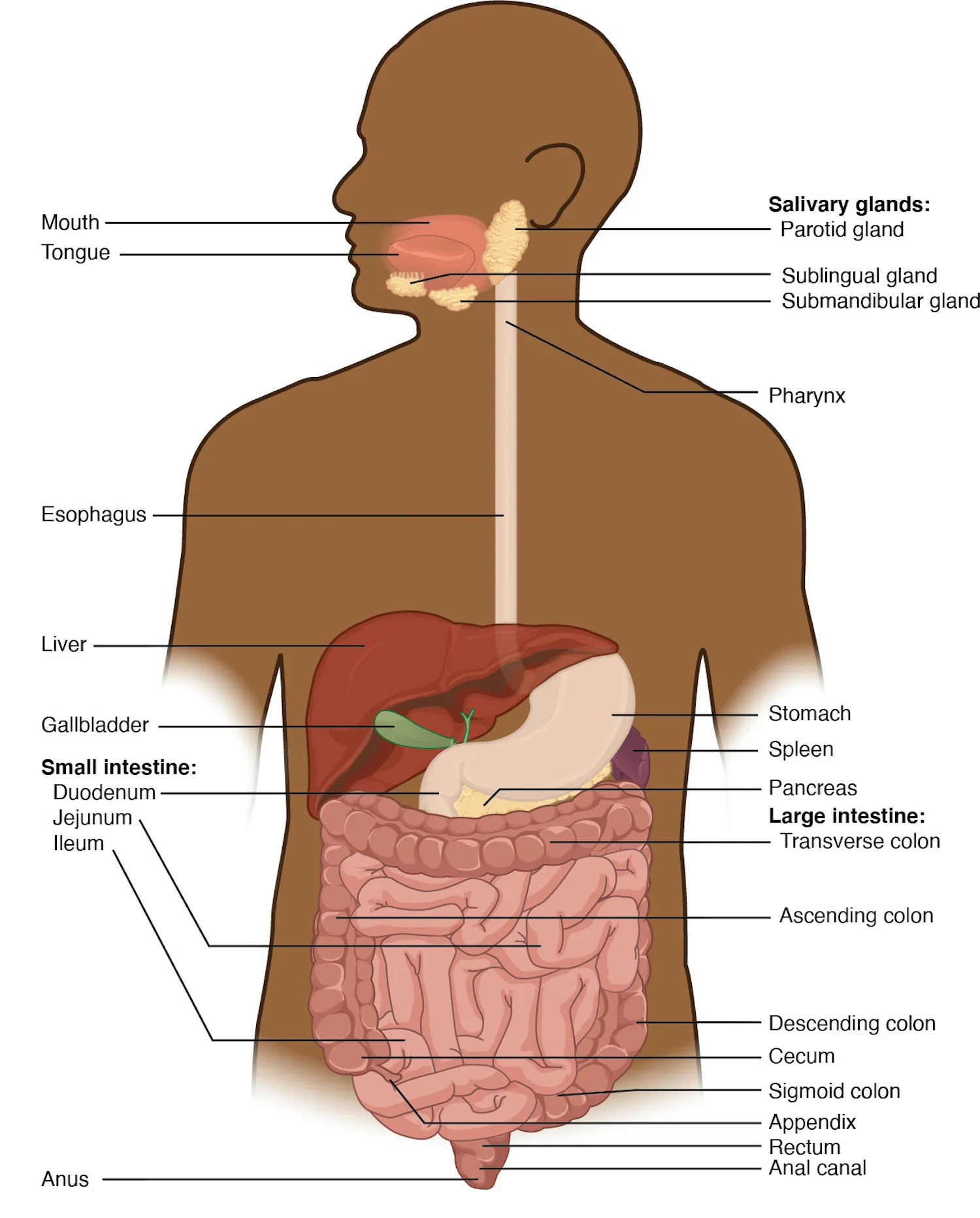
The next chapter, Body system combining forms, works through combining forms for other body systems, including the digestive system shown below.

Major organs and structures of the digestive system labeled
The digestive system
OpenStax
/
CC BY 4.0

Eponyms

  • Medical terms named after people (diseases, instruments)
  • Must be memorized, not broken into word parts
  • Examples: Parkinson Disease, Snellen chart

Abbreviations, Acronyms, and Symbols

  • Abbreviations: shortened forms (e.g., BP, CBC)
  • Acronyms: abbreviations pronounced as words (e.g., AIDS, HIPAA)
  • Symbols: pictorial representations (e.g., ↑ for increase, ♀ for female)
    • Use only approved abbreviations/symbols to avoid errors

Medical Terminology Structure

  • Terms often built from word parts: prefix, root, suffix, combining vowel
    • Prefix: beginning, modifies meaning (e.g., endo-, mal-)
    • Root: main meaning
    • Suffix: end, modifies meaning (e.g., -itis, -ist)
    • Combining vowel: links root to suffix/root (usually “o”)
  • Some terms (eponyms, abbreviations) must be memorized

Prefixes and Suffixes

  • Prefix: added to beginning, not all terms have one
    • Describes location, number, state, size, speed/level
  • Suffix: added to end, often indicates procedure, condition, disease

Combining Forms by Body System

  • Cardiovascular: angi/o (vessel), cardi/o (heart), hemat/o (blood), phleb/o (vein)
  • Gastrointestinal: abdomin/o (abdomen), gastr/o (stomach), hepat/o (liver), col/o (colon)
  • Endocrine: adren/o (adrenal gland), thyroid/o (thyroid), ovari/o (ovary)
  • Integumentary: derm/o (skin), hidr/o (sweat), onych/o (nail)
  • Lymphatic/Immune: lymph/o (lymph), splen/o (spleen), myel/o (bone marrow)
  • Musculoskeletal: oste/o (bone), my/o (muscle), arthr/o (joint), chondr/o (cartilage)
  • Nervous: cerebr/o (cerebrum), neur/o (nerve), mening/o (meninges)
  • Reproductive: oophor/o (ovary), test/o (testis), uter/o (uterus), mamm/o (breast)
  • Respiratory: bronch/o (bronchus), pulmon/o (lung), nas/o (nose), trache/o (trachea)
  • Sensory: ocul/o (eye), ot/o (ear), audi/o (hearing), retin/o (retina)
  • Urinary: nephro/o (kidney), cyst/o (bladder), urethr/o (urethra)

Directional Combining Forms

  • anter/o (front), poster/o (back), super/o (upward), infer/o (downward)
  • later/o (side), medi/o (middle), proxim/o (near), dist/o (far)
  • cephal/o (head), caud/o (tail), ventr/o (belly), dors/o (back)

Common Suffixes

  • Pertaining to: -ac, -al, -ar, -ary, -ic, -ous, -tic
  • Body structure/function: -crine (secretion), -gen (to produce), -stasis (stop/control)
  • Conditions/diseases: -algia (pain), -emia (blood condition), -itis (inflammation), -megaly (enlargement), -oma (tumor), -osis (abnormal condition), -pathy (disease)
  • Procedures: -ectomy (removal), -scopy (visual exam), -plasty (repair), -tomy (incision)
  • Instruments/recording: -graph (instrument to record), -meter (measure), -scope (view)
  • Specialty: -ist (specialist), -logist (one who studies), -logy (study of)

Building Medical Terms

  • Use combining vowel if suffix starts with consonant
  • No combining vowel if suffix starts with vowel
  • Use combining vowel between two roots
  • Do not use combining vowel between prefix and root
  • Order of roots may follow sequence of procedure

Singular and Plural Terms

  • Most plurals: add -s
  • Ends in -s, -x, -ch, -sh: add -es
  • Ends in -y after consonant: drop -y, add -ies
  • Ends in -o after consonant: add -nes
  • Irregular plurals (memorize): appendix/appendices, diagnosis/diagnoses, thorax/thoraces

Defining Medical Terms

  • Divide term into word parts
  • Label each part (prefix, root, suffix, combining form)
  • Define each part, start with suffix
  • Combine meanings for full definition

Pronouncing Medical Terms

  • Break terms into sections, pronounce separately
  • Practice out loud, focus on unusual letter combinations
  • Use similar terms as pronunciation guides

Sign up for free to take 15 quiz questions on this topic

Previous
Next  | 3.2.1 Cells, tissues, and organs
All rights reserved ©2016 - 2026 Achievable, Inc.

Introduction medical terminology and its anatomy

To many healthcare students, the vocabulary used in the medical environment may seem like learning words in a foreign language. Medical terminology relates to anatomy, diseases, diagnostic tests, procedures, etc. The vocabulary used is a combination of eponyms, abbreviations, acronyms, symbols, and medical terminology. Medical terminology often can be broken down into word parts that make the meaning concrete and easier to understand.

Eponyms

Eponyms are often used in diseases and medical instruments. Eponyms in medicine were developed to honor scientists and providers who have created an innovative device or researched a new disease. Eponyms must be memorized. The following are some examples of eponyms:

  • Parkinson Disease was named after James Parkinson.
  • Graves Disease was named after Dr. Robert James Graves.
  • The Jackson-Pratt drain, used in some surgical procedures, was named after its two inventors, Dr. Frederick Jackson and Dr. Richard Pratt.
  • The Snellen eye chart was named after its inventor, Dr. Herman Snellen.

Abbreviations, acronyms, and symbols

An abbreviation is a shortened version of a word or phrase. The abbreviation can be derived from the letters in the word or from combining the first letter of each word. The following are some examples of medical abbreviations:

  • BP: blood pressure
  • CC: chief complaint
  • Ca: cancer
  • HA: headache
  • HTN: hypertension
  • CBC: complete blood count
  • CPE: complete physical examination
  • PPE: personal protective equipment

Acronyms are also abbreviations that become pronounceable words. Examples of acronyms:

  • AIDS: acquired immunodeficiency syndrome
  • ARDS: acute respiratory distress syndrome
  • CHF: congestive heart failure
  • HIPAA: Health Insurance Portability and Accountability Act
  • RICE: rest, ice, compression, elevation
  • SIDS: sudden infant death syndrome

A symbol is a picture that represents a word or phrase. Symbols were used more often with paper health records. The use of symbols would increase the speed of documentation and reduce the amount of paper needed. The use of symbols has decreased with the use of electronic health records today. The following are some examples of symbols. Note that s, p, and a are conventionally written with a line over the letter to set them apart from ordinary letters:

  • s = without
  • p = after
  • a = before
  • ↑ = increase
  • ↓ = decrease
  • Δ = change
  • ♀ = female
  • ♂ = male

Throughout the textbook, abbreviations and acronyms are listed. It is important for you to learn them. Making and using flashcards to study these can be useful. Most healthcare facilities have a list of approved abbreviations and symbols that healthcare professionals can use. Make sure to use only approved abbreviations and symbols. Using unapproved abbreviations and symbols in messages and documentation may lead to confusion and patient care errors.

Pitfall: “do not use” abbreviations. The Joint Commission maintains a “do not use” list of error-prone abbreviations that are easily misread, including “U” for units (mistaken for a zero or a four), “QD”/“QOD” for daily/every other day (mistaken for QID, four times daily), and a trailing zero after a decimal point such as “1.0 mg” (misread as “10 mg”). Always write these out in full rather than abbreviating them.

Medical terminology

Medical terminology often can be broken down into word parts that make the meaning concrete and easy to understand. Medical terms not made up of word parts are the terms that need to be memorized.

Medical terminology comes from a combination of Greek or Latin origin. By knowing the meaning of the word parts, a person can easily create or define medical terms. Here are the four common word parts:

  • Prefix: A word part found at the beginning of the word. Prefixes modify the meaning of the word. In most textbooks, prefixes are listed with a hyphen, such as endo- and mal-.
  • Suffix: A word part found at the end of the word. Suffixes follow a hyphen, such as -itis and -ist.
  • Root: a word part that is the foundation or main meaning of the term.
  • Combining vowel: A vowel that links the root to the suffix or a root to a root. Most commonly used combining vowel is an o.

When the root is added to the combining vowel, the result is called a combining form. Combining forms can be given by stating the root word part followed by a slash and the vowel (e.g., oste/o and chol/e).

The following section discusses prefixes and suffixes. Combining forms are presented by the body systems.

Prefixes and suffixes

The prefix is added to the beginning of the word. Not all medical terms have prefixes. Some prefixes have more than one meaning. The suffix is added to the end of the term. The prefix modifies the root by describing the following elements:

  • Location or position: peri- (surrounding, around) and endo- (within, in, inner)
  • Number: bi- (two, both) and tri- (three)
  • State or problem: mal- (bad) and an- (without, no, not)
  • Size: macro- (very large) and micro- (small)
  • Speed or level: hyper- (above normal) and hypo- (below normal)
Category Prefix Meaning
Number bi- two
Position sub- under
Direction intra- within
Time brady- slow
Negation a- / an- without

Suffixes

Suffixes are grouped below by what they describe. Many pertaining-to suffixes share the same meaning: -ac, -al, -ar, -ary, -eal, -ent, -ic, -ior, -ine, -ous, and -tic all mean pertaining to.

Body structures and functions:

Suffix Meaning
-crine secretion
-dipsia thirst
-gen to produce
-is structure
-lapse to fall, slide
-partum birth
-phagia to eat, swallow
-phasia to speak
-plasm formation
-stasis to stand, place, stop, control
-tension pressure
-trophy nourishment; development
-um structure, membrane

Conditions and diseases:

Suffix Meaning
-algia pain
-ation process, condition
-cele herniation
-emia blood condition
-ia diseased or abnormal condition
-ism condition, process
-itis inflammation
-lysis loosening, breakdown, separation, destruction
-malacia softening
-megaly enlargement
-oma tumor, mass
-osis abnormal condition
-pathy disease condition
-plegia paralysis
-pnea breathing
-rrhagia excessive or abnormal flow; hemorrhage (bursting forth)
-rrhea flow, discharge
-sclerosis abnormal condition of hardening
-stenosis abnormal condition of narrowing
-thesis to put, place (state of putting or placing)
-uria urine condition
-y process of, condition

Instruments/recording:

Suffix Meaning
-graph instrument to record
-gram record or recording
-meter instrument to measure
-scope instrument to view

Noun ending:

Suffix Meaning
-icle small or tiny structure
-ole small or tiny structure
-ule small or tiny structure

Procedures:

Suffix Meaning
-cision process of cutting
-centesis surgical puncture and aspiration of fluid
-ectomy surgical removal, excision, resection
-graphy process of recording
-metry process of measuring
-opsy process of viewing
-pexy surgical fixation
-plasty surgical repair
-rrhaphy suture repair
-scopic pertaining to visual examination
-scopy process of visual examination
-section to cut
-stomy surgical creation of artificial opening
-tomy incision, cut into
-tripsy crushing

Specialty:

Suffix Meaning
-ist one who specializes
-logist one who specializes in the study of
-logy study of

Combining forms

A combining form contains both the root word part and the combining vowel. A combining form is linked to a root or a suffix.

Pitfall: keeping vs. dropping the combining vowel. Keep the combining vowel when the suffix begins with a consonant (arthr/o + -logy = arthrology). Drop the combining vowel when the suffix begins with a vowel (arthr/o + -itis = arthritis, not arthroitis). Keep the combining vowel between two roots even when the second root begins with a vowel.

Learning combining forms by body system can be helpful. The following sections describe the body systems and list the related combining forms.

Cardiovascular system

The function of the cardiovascular system is to transport materials throughout the body using the blood. The blood transports oxygen and nutrients and collects wastes through the body. Components in the blood also fight infections and form clots. The cardiovascular system includes the heart, arteries, arterioles, veins, venules, and blood. Combining terms related to the cardiovascular system include the following:

  • angi/o (vessel, blood vessel)
  • aort/o (aorta)
  • apic/o (apex)
  • arteri/o (artery)
  • cardi/o, coron/o (heart)
  • hemat/o (blood)
  • phleb/o, ven/o (vein)
  • plasm/o (plasma)
  • valv/o (valve)
  • ventricul/o (ventricle)

For example, combining cardi/o (heart) with the suffix -megaly (enlargement) forms cardiomegaly, meaning enlargement of the heart. Breaking a term down into its combining form and suffix this way lets you decode or build terms without memorizing each one individually.

Directional combining forms

Combining form Meaning
anter/o front
caud/o tail
cephal/o head
cubit/o elbow
dextr/o right
dist/o far
dors/o back
fer/o to carry
front/o front
glute/o buttocks
infer/o downward
later/o side
medi/o middle
poplit/o back of knee
poster/o back
proxim/o near
sinistr/o left
super/o upward
ventr/o belly

The next chapter, Body system combining forms, works through combining forms for other body systems, including the digestive system shown below.

Key points

Eponyms

  • Medical terms named after people (diseases, instruments)
  • Must be memorized, not broken into word parts
  • Examples: Parkinson Disease, Snellen chart

Abbreviations, Acronyms, and Symbols

  • Abbreviations: shortened forms (e.g., BP, CBC)
  • Acronyms: abbreviations pronounced as words (e.g., AIDS, HIPAA)
  • Symbols: pictorial representations (e.g., ↑ for increase, ♀ for female)
    • Use only approved abbreviations/symbols to avoid errors

Medical Terminology Structure

  • Terms often built from word parts: prefix, root, suffix, combining vowel
    • Prefix: beginning, modifies meaning (e.g., endo-, mal-)
    • Root: main meaning
    • Suffix: end, modifies meaning (e.g., -itis, -ist)
    • Combining vowel: links root to suffix/root (usually “o”)
  • Some terms (eponyms, abbreviations) must be memorized

Prefixes and Suffixes

  • Prefix: added to beginning, not all terms have one
    • Describes location, number, state, size, speed/level
  • Suffix: added to end, often indicates procedure, condition, disease

Combining Forms by Body System

  • Cardiovascular: angi/o (vessel), cardi/o (heart), hemat/o (blood), phleb/o (vein)
  • Gastrointestinal: abdomin/o (abdomen), gastr/o (stomach), hepat/o (liver), col/o (colon)
  • Endocrine: adren/o (adrenal gland), thyroid/o (thyroid), ovari/o (ovary)
  • Integumentary: derm/o (skin), hidr/o (sweat), onych/o (nail)
  • Lymphatic/Immune: lymph/o (lymph), splen/o (spleen), myel/o (bone marrow)
  • Musculoskeletal: oste/o (bone), my/o (muscle), arthr/o (joint), chondr/o (cartilage)
  • Nervous: cerebr/o (cerebrum), neur/o (nerve), mening/o (meninges)
  • Reproductive: oophor/o (ovary), test/o (testis), uter/o (uterus), mamm/o (breast)
  • Respiratory: bronch/o (bronchus), pulmon/o (lung), nas/o (nose), trache/o (trachea)
  • Sensory: ocul/o (eye), ot/o (ear), audi/o (hearing), retin/o (retina)
  • Urinary: nephro/o (kidney), cyst/o (bladder), urethr/o (urethra)

Directional Combining Forms

  • anter/o (front), poster/o (back), super/o (upward), infer/o (downward)
  • later/o (side), medi/o (middle), proxim/o (near), dist/o (far)
  • cephal/o (head), caud/o (tail), ventr/o (belly), dors/o (back)

Common Suffixes

  • Pertaining to: -ac, -al, -ar, -ary, -ic, -ous, -tic
  • Body structure/function: -crine (secretion), -gen (to produce), -stasis (stop/control)
  • Conditions/diseases: -algia (pain), -emia (blood condition), -itis (inflammation), -megaly (enlargement), -oma (tumor), -osis (abnormal condition), -pathy (disease)
  • Procedures: -ectomy (removal), -scopy (visual exam), -plasty (repair), -tomy (incision)
  • Instruments/recording: -graph (instrument to record), -meter (measure), -scope (view)
  • Specialty: -ist (specialist), -logist (one who studies), -logy (study of)

Building Medical Terms

  • Use combining vowel if suffix starts with consonant
  • No combining vowel if suffix starts with vowel
  • Use combining vowel between two roots
  • Do not use combining vowel between prefix and root
  • Order of roots may follow sequence of procedure

Singular and Plural Terms

  • Most plurals: add -s
  • Ends in -s, -x, -ch, -sh: add -es
  • Ends in -y after consonant: drop -y, add -ies
  • Ends in -o after consonant: add -nes
  • Irregular plurals (memorize): appendix/appendices, diagnosis/diagnoses, thorax/thoraces

Defining Medical Terms

  • Divide term into word parts
  • Label each part (prefix, root, suffix, combining form)
  • Define each part, start with suffix
  • Combine meanings for full definition

Pronouncing Medical Terms

  • Break terms into sections, pronounce separately
  • Practice out loud, focus on unusual letter combinations
  • Use similar terms as pronunciation guides

More from Medical terminology and anatomy

  • Body system combining forms
  • Body balance and disease
  • Infectious pathogens