


Achievable logoAchievable logo
CCMA
Sign in
Sign up
Purchase
Textbook
Practice exams
Support
How it works
Exam catalog
Mountain with a flag at the peak
Textbook
1. Medical assistant
2. Electronic records
3. Medical terminology and anatomy
4. The fundamentals of infection control
5. Introduction to vital signs
5.1 Introduction to vital signs
5.2 Pulse sites and characteristics
5.3 Fever and temperature management
5.4 Respiration and oxygen saturation
5.5 Measuring blood pressure: equipment and techniques
6. The patient interview and history
7. The physical examination
8. Appointment scheduling
9. Insurance billing
10. Diagnostic coding and the ICD-10-CM System
11. Procedural coding
12. Medical billing and reimbursement essentials
13. Assisting with medical specialties
14. Assisting with the musculoskeletal system
15. Assisting with the cardiovascular system
16. Assisting with the respiratory system
17. Assisting with the nervous system
18. Anatomy and physiology of the urinary system
19. Assisting in obstetrics and gynecology
20. Assisting in endocrinology
21. Assisting in ophthalmology & otolaryngology
22. Assisting in gastroenterology
23. Assisting in the immune & lymphatic systems
24. Assisting in pediatrics: the developmental stages and care
25. The medical assistant’s role in caring for the older patient
26. The role of the medical assistant in physical therapy examination and assessment
27. Preparing for minor surgery: room, solutions, and supplies
28. Introduction to the clinical laboratory
29. Urinalysis
30. Blood collection
31. Analysis of blood
32. Electrocardiography and heart structure
33. The principles of pharmacology
34. Essential calculations and measurement systems
35. Solid, liquid, & solutions medication doses
36. Administering medications
37. Metabolism and core nutrient roles
38. Medical emergencies in the healthcare setting
Achievable logoAchievable logo
5.3 Fever and temperature management
Achievable CCMA
5. Introduction to vital signs
Our CCMA course is currently in development and is a work-in-progress.

Fever and temperature management

9 min read
Font
Discuss
Share
Feedback

Fever

Infection, either bacterial or viral, is the most common cause of fever in both children and adults. Infants do not usually develop febrile illnesses during the first 3 months of life; if one is present, it usually is very serious. However, fever, or pyrexia, is common in young children and accounts for an estimated 30% of office visits. Fevers are classified according to the 24-hour pattern they follow. The three most common patterns are as follows:

  • Continuous fever rises and falls only slightly during a 24-hour period. The temperature consistently remains above the patient’s average normal temperature range and fluctuates less than 3 degrees.
  • Intermittent fever comes and goes, alternating between elevated and normal levels.
  • Remittent fever fluctuates considerably (i.e., by more than 3 degrees) and never returns to the normal range.

Variation in the patient’s average body temperature range may be the first warning of an illness or a change in the patient’s current condition. Patients with fever usually have the following indicators:

  • Loss of appetite (anorexia)
  • Headache
  • Thirst
  • Flushed face
  • Hot skin
  • General malaise

Some patients experience an acute onset of chills and shivering, followed by an increase in body temperature. A possible serious complication in young children with high fevers is a febrile seizure. Medication to reduce the fever, or antipyretic drugs (e.g., acetaminophen or ibuprofen), should be taken as instructed to prevent dangerous spikes in temperature. A rectal, temporal, or aural (ear) temperature over 100.4°F (38°C), an oral temperature over 100°F (37.8°C), and an axillary temperature over 99°F (37.2°C) are all considered a fever.

Sites

Average adult temperatures

Site Fahrenheit Celsius
Axillary 97.6° 36.4°
Oral 98.6° 37°
Tympanic 99.6° 37.6°
Rectal 99.6° 37.6°
Temporal artery 99.6° 37.6°

Several types of thermometers and various sites can be used to take temperature readings. A digital thermometer is placed under the tongue, in the armpit, or the rectum; a tympanic thermometer is inserted into the ear, and a temporal artery thermometer is moved across the forehead. Temperatures can be read in either Fahrenheit or Celsius. Most thermometers will convert from one scale to the other.

When an oral temperature is obtained, you do not have to indicate the site when documenting the reading in the patient’s health record. If you use an alternate site, you should document the following identifiers after recording the temperature:

  • (T) for tympanic
  • (A) for axillary
  • ® for rectal
  • (TA) for temporal artery
  • (IFR) for infrared

For example, T: 99.4°F (T) clarifies that an alternate site, tympanic, was used.

Axillary temperatures (A) and temporal artery temperatures (TA) are approximately 1°F (0.6°C) lower than oral readings because axillary readings are not taken in an enclosed body cavity. Tympanic and rectal temperatures are approximately 1°F (0.6°C) higher than oral readings. The actual reading from the thermometer should be documented with the correct abbreviation for the site.

The oral site is not typically used with young children. This site requires the patient to hold the thermometer under the tongue and keep the mouth closed, a task that can be difficult for children younger than age 3. A rectal temperature is most often used for infants. It is important to use the proper technique to avoid damaging the rectal tissue. However, most pediatricians prefer that infants’ temperatures be taken with a temporal artery thermometer because it is more comfortable for the baby, less invasive, and eliminates the possible complication of a perforated rectum.

When taken correctly, the tympanic (ear/aural)** temperature (T)** is an accurate measure because it records the temperature of the blood closest to the hypothalamus. However, research on the temporal artery (TA) thermometer indicates that this method is more accurate than tympanic measurement for identifying elevated temperatures in infants. Pediatricians, therefore, may prefer TA temperatures in infants suspected of having a fever. The TA thermometer also records accurate temperature readings in all age groups. The tympanic method is still considered a fast, accurate, and noninvasive way of recording temperatures for older children and adults.

For patients younger than 3 years and those unable to hold a thermometer properly in their mouth during the procedure, a tympanic or temporal artery thermometer can be used; if not, a less accurate axillary temperature can be obtained.

Types of thermometers and their uses

The temporal artery thermometer has become the most commonly used thermometer in healthcare, but other methods are still used. All of the thermometers are discussed in the following sections.

Temporal artery thermometer

The temporal artery thermometer uses an infrared beam to assess the temperature of the blood flowing through the temporal artery of the forehead, where the artery lies about 1 mm below the skin. Because the artery is so close to the skin, it provides good surface heat conduction, allowing the thermometer to obtain a fast, accurate, and noninvasive measurement of body temperature. To perform the procedure, place the probe in the center of the forehead, halfway between the eyebrows and the hairline. Bangs should be pushed back off the forehead (this method cannot be used if bandages cover the area). Depress the button on the scanner and gently stroke the probe across the forehead toward the hairline (at the temples), keeping the probe flat on the patient’s skin. As the scanner moves across the forehead, repeated temperature measurements are taken, and the highest measurement is recorded; keeping the button depressed, lift the scanner from the temporal area and lightly place the probe behind the earlobe. Release the button and remove the probe. Recording an accurate temperature takes about 3 seconds. Depending on the facility’s infection control procedures, disposable covers can be used on the scanner, or it can be cleaned between patients with an alcohol wipe.

Tympanic thermometer

The tympanic membrane of the ear can be used for quick, accurate, and safe assessment of a patient’s temperature. It shares the blood supply with the hypothalamus, which is the brain’s temperature regulator. The ear canal is a protected cavity. This means factors such as an open mouth, hot or cold drinks, or even a stuffy nose do not affect aural temperature.

The tympanic thermometer system consists of a handheld unit equipped with a tympanic probe, which is covered with a disposable probe cover. When the probe is placed into the ear canal, it gently seals the external opening of the canal, and the sensor detects the infrared energy produced by the tympanic membrane. This signal is digitized by the thermometer and shown on the display screen. Accurate readings are obtained in less than 2 seconds. The tympanic thermometer is popular due to the speed of obtaining the temperature and the comfort it affords the patient. This site should not be used if the patient is complaining of pain in both ears when the ear is touched. The patient may have bilateral otitis externa, making the procedure uncomfortable. In addition, if the patient has a history of or has impacted cerumen in both ears, do not use a tympanic thermometer because the reading may be inaccurate.

Insert the probe into the ear canal far enough to seal the opening without applying pressure. To expose the tympanic membrane in children younger than age 3, gently pull the earlobe down and back; for patients older than age 3, gently pull the pinna (top of the ear) up and back.

Digital thermometer

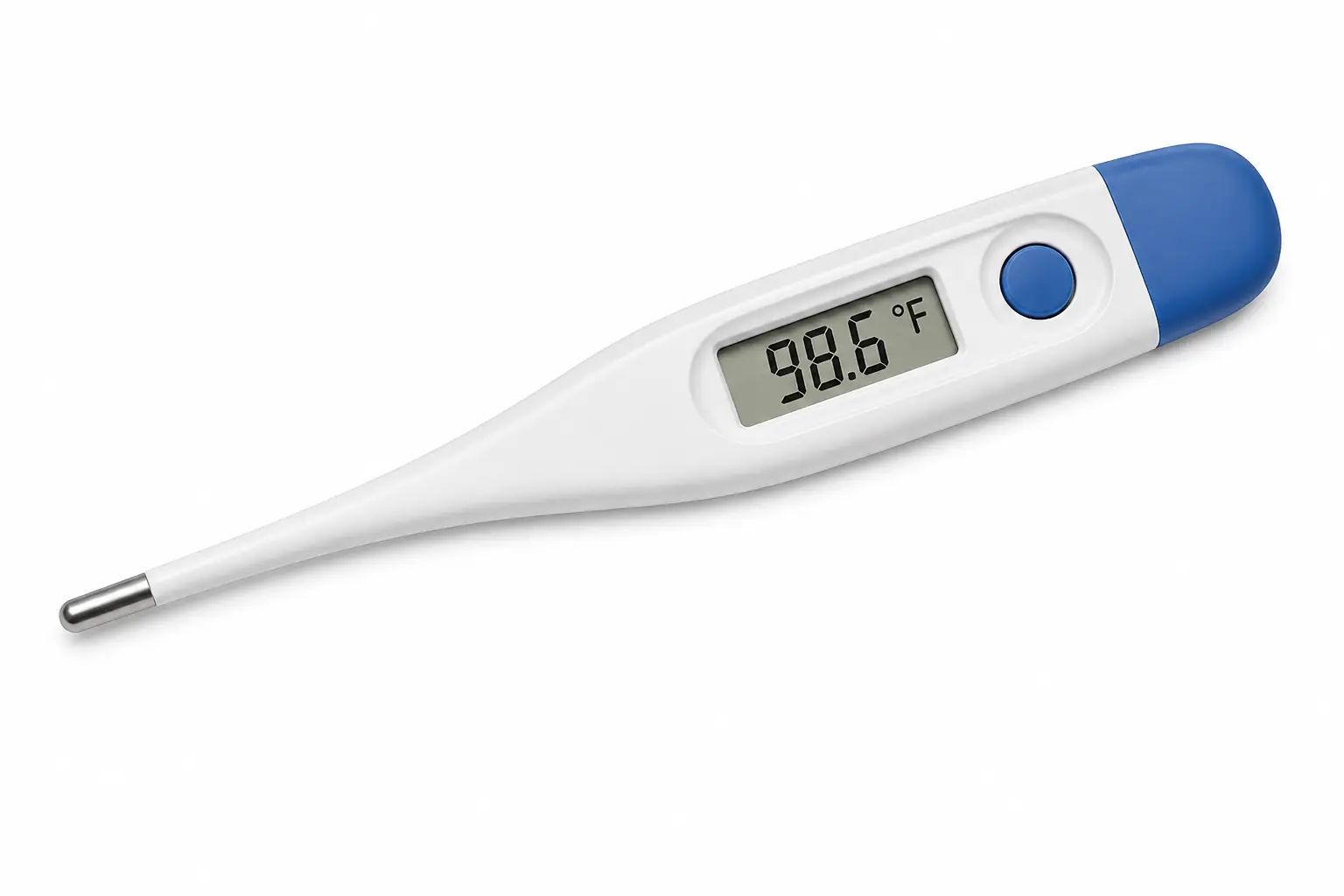
Digital thermometer used for measuring body temperature
Digital thermometer

Digital thermometers are battery operated. Disposable covers fit snugly over the probes and are easily and quickly removed by pushing in the colored end of the probe. The instrument sounds a beep when the process is complete (in 10 to 60 seconds), and the reading appears on a screen on the face of the instrument. Because the only part of the instrument that comes in contact with the patient is the probe, which is covered, the risk of cross-infection is greatly reduced.

When using a digital thermometer to take an oral temperature, it is important to ask if the patient has recently had anything to eat, drink, or smoke. These factors may artificially alter the patient’s temperature. Wait for 10 to 15 minutes before taking an oral temperature if those factors have occurred. In addition, the patient must be able to hold the thermometer under the tongue with the lips tightly sealed around the probe if an accurate oral reading is to be obtained. Be sure to use the blue probe for an oral temperature.

A digital thermometer with a blue probe can also be used for an axillary temperature. It is important to make sure that there is a tight seal around the probe. This can be done by holding the patient’s arm snugly across the chest. Remember, this site is considered the least accurate.

A digital thermometer with a red probe is used for rectal temperatures. This site is used most often for infants. To take an infant’s temperature rectally, lubricate the probe tip (most facilities use a lubricating product, such as K-Y Jelly), hold the baby securely with the legs elevated, and insert the probe approximately 1 inch; hold the probe carefully and continue to secure the infant’s legs throughout the procedure to prevent rectal damage.

The digital unit or individual digital thermometers should be routinely cleaned with disinfectant. When ejecting the probe cover, be careful not to contaminate the probe or the processing unit. The probe cover should be deposited directly into a waste container. If a chance exists that a patient’s body fluids touched the unit, wipe it with disinfectant before returning it to the storage area.

Fever

  • Most common cause: infection (bacterial or viral)
  • Fever patterns:
    • Continuous: minimal fluctuation, always above normal
    • Intermittent: alternates between normal and elevated
    • Remittent: fluctuates >3°F, never returns to normal
  • Key signs: anorexia, headache, thirst, flushed face, hot skin, malaise
  • Serious risks: febrile seizures in young children
  • Fever thresholds:
    • Rectal/temporal/aural: >100.4°F (38°C)
    • Oral: >100°F (37.8°C)
    • Axillary: >99°F (37.2°C)
  • Antipyretic drugs: acetaminophen, ibuprofen

Sites

  • Average adult temperatures:
    • Axillary: 97.6°F (36.4°C)
    • Oral: 98.6°F (37°C)
    • Tympanic/Rectal/Temporal: 99.6°F (37.6°C)
  • Site abbreviations: (T) tympanic, (A) axillary, ® rectal, (TA) temporal artery, (IFR) infrared
  • Temperature differences:
    • Axillary/TA: ~1°F lower than oral
    • Tympanic/Rectal: ~1°F higher than oral
  • Oral site: not for children <3 years
  • Preferred for infants: temporal artery thermometer

Types of thermometers and their uses

  • Temporal artery thermometer: most common in healthcare
  • Other types: tympanic, digital (oral, axillary, rectal)

Temporal artery thermometer

  • Uses infrared to measure blood temp in temporal artery
  • Fast, accurate, noninvasive (~3 seconds)
  • Procedure: scan across forehead, then behind earlobe
  • Not usable if forehead is bandaged

Tympanic thermometer

  • Measures infrared energy from tympanic membrane
  • Fast (<2 seconds), accurate, noninvasive
  • Not for use with ear pain, otitis externa, or impacted cerumen
  • Technique:
    • <3 years: pull earlobe down and back
    • ≥3 years: pull pinna up and back

Digital thermometer

  • Battery operated, uses disposable probe covers
  • Oral use: wait 10–15 min after eating, drinking, or smoking
  • Blue probe: oral/axillary; red probe: rectal
  • Axillary: least accurate site
  • Rectal: preferred for infants, use lubrication, insert ~1 inch
  • Clean with disinfectant after use, avoid contamination

Sign up for free to take 18 quiz questions on this topic

Previous
Next  | 5.4 Respiration and oxygen saturation
All rights reserved ©2016 - 2026 Achievable, Inc.

Fever and temperature management

Fever

Infection, either bacterial or viral, is the most common cause of fever in both children and adults. Infants do not usually develop febrile illnesses during the first 3 months of life; if one is present, it usually is very serious. However, fever, or pyrexia, is common in young children and accounts for an estimated 30% of office visits. Fevers are classified according to the 24-hour pattern they follow. The three most common patterns are as follows:

  • Continuous fever rises and falls only slightly during a 24-hour period. The temperature consistently remains above the patient’s average normal temperature range and fluctuates less than 3 degrees.
  • Intermittent fever comes and goes, alternating between elevated and normal levels.
  • Remittent fever fluctuates considerably (i.e., by more than 3 degrees) and never returns to the normal range.

Variation in the patient’s average body temperature range may be the first warning of an illness or a change in the patient’s current condition. Patients with fever usually have the following indicators:

  • Loss of appetite (anorexia)
  • Headache
  • Thirst
  • Flushed face
  • Hot skin
  • General malaise

Some patients experience an acute onset of chills and shivering, followed by an increase in body temperature. A possible serious complication in young children with high fevers is a febrile seizure. Medication to reduce the fever, or antipyretic drugs (e.g., acetaminophen or ibuprofen), should be taken as instructed to prevent dangerous spikes in temperature. A rectal, temporal, or aural (ear) temperature over 100.4°F (38°C), an oral temperature over 100°F (37.8°C), and an axillary temperature over 99°F (37.2°C) are all considered a fever.

Sites

Average adult temperatures

Site Fahrenheit Celsius
Axillary 97.6° 36.4°
Oral 98.6° 37°
Tympanic 99.6° 37.6°
Rectal 99.6° 37.6°
Temporal artery 99.6° 37.6°

Several types of thermometers and various sites can be used to take temperature readings. A digital thermometer is placed under the tongue, in the armpit, or the rectum; a tympanic thermometer is inserted into the ear, and a temporal artery thermometer is moved across the forehead. Temperatures can be read in either Fahrenheit or Celsius. Most thermometers will convert from one scale to the other.

When an oral temperature is obtained, you do not have to indicate the site when documenting the reading in the patient’s health record. If you use an alternate site, you should document the following identifiers after recording the temperature:

  • (T) for tympanic
  • (A) for axillary
  • ® for rectal
  • (TA) for temporal artery
  • (IFR) for infrared

For example, T: 99.4°F (T) clarifies that an alternate site, tympanic, was used.

Axillary temperatures (A) and temporal artery temperatures (TA) are approximately 1°F (0.6°C) lower than oral readings because axillary readings are not taken in an enclosed body cavity. Tympanic and rectal temperatures are approximately 1°F (0.6°C) higher than oral readings. The actual reading from the thermometer should be documented with the correct abbreviation for the site.

The oral site is not typically used with young children. This site requires the patient to hold the thermometer under the tongue and keep the mouth closed, a task that can be difficult for children younger than age 3. A rectal temperature is most often used for infants. It is important to use the proper technique to avoid damaging the rectal tissue. However, most pediatricians prefer that infants’ temperatures be taken with a temporal artery thermometer because it is more comfortable for the baby, less invasive, and eliminates the possible complication of a perforated rectum.

When taken correctly, the tympanic (ear/aural)** temperature (T)** is an accurate measure because it records the temperature of the blood closest to the hypothalamus. However, research on the temporal artery (TA) thermometer indicates that this method is more accurate than tympanic measurement for identifying elevated temperatures in infants. Pediatricians, therefore, may prefer TA temperatures in infants suspected of having a fever. The TA thermometer also records accurate temperature readings in all age groups. The tympanic method is still considered a fast, accurate, and noninvasive way of recording temperatures for older children and adults.

For patients younger than 3 years and those unable to hold a thermometer properly in their mouth during the procedure, a tympanic or temporal artery thermometer can be used; if not, a less accurate axillary temperature can be obtained.

Types of thermometers and their uses

The temporal artery thermometer has become the most commonly used thermometer in healthcare, but other methods are still used. All of the thermometers are discussed in the following sections.

Temporal artery thermometer

The temporal artery thermometer uses an infrared beam to assess the temperature of the blood flowing through the temporal artery of the forehead, where the artery lies about 1 mm below the skin. Because the artery is so close to the skin, it provides good surface heat conduction, allowing the thermometer to obtain a fast, accurate, and noninvasive measurement of body temperature. To perform the procedure, place the probe in the center of the forehead, halfway between the eyebrows and the hairline. Bangs should be pushed back off the forehead (this method cannot be used if bandages cover the area). Depress the button on the scanner and gently stroke the probe across the forehead toward the hairline (at the temples), keeping the probe flat on the patient’s skin. As the scanner moves across the forehead, repeated temperature measurements are taken, and the highest measurement is recorded; keeping the button depressed, lift the scanner from the temporal area and lightly place the probe behind the earlobe. Release the button and remove the probe. Recording an accurate temperature takes about 3 seconds. Depending on the facility’s infection control procedures, disposable covers can be used on the scanner, or it can be cleaned between patients with an alcohol wipe.

Tympanic thermometer

The tympanic membrane of the ear can be used for quick, accurate, and safe assessment of a patient’s temperature. It shares the blood supply with the hypothalamus, which is the brain’s temperature regulator. The ear canal is a protected cavity. This means factors such as an open mouth, hot or cold drinks, or even a stuffy nose do not affect aural temperature.

The tympanic thermometer system consists of a handheld unit equipped with a tympanic probe, which is covered with a disposable probe cover. When the probe is placed into the ear canal, it gently seals the external opening of the canal, and the sensor detects the infrared energy produced by the tympanic membrane. This signal is digitized by the thermometer and shown on the display screen. Accurate readings are obtained in less than 2 seconds. The tympanic thermometer is popular due to the speed of obtaining the temperature and the comfort it affords the patient. This site should not be used if the patient is complaining of pain in both ears when the ear is touched. The patient may have bilateral otitis externa, making the procedure uncomfortable. In addition, if the patient has a history of or has impacted cerumen in both ears, do not use a tympanic thermometer because the reading may be inaccurate.

Insert the probe into the ear canal far enough to seal the opening without applying pressure. To expose the tympanic membrane in children younger than age 3, gently pull the earlobe down and back; for patients older than age 3, gently pull the pinna (top of the ear) up and back.

Digital thermometer

Digital thermometers are battery operated. Disposable covers fit snugly over the probes and are easily and quickly removed by pushing in the colored end of the probe. The instrument sounds a beep when the process is complete (in 10 to 60 seconds), and the reading appears on a screen on the face of the instrument. Because the only part of the instrument that comes in contact with the patient is the probe, which is covered, the risk of cross-infection is greatly reduced.

When using a digital thermometer to take an oral temperature, it is important to ask if the patient has recently had anything to eat, drink, or smoke. These factors may artificially alter the patient’s temperature. Wait for 10 to 15 minutes before taking an oral temperature if those factors have occurred. In addition, the patient must be able to hold the thermometer under the tongue with the lips tightly sealed around the probe if an accurate oral reading is to be obtained. Be sure to use the blue probe for an oral temperature.

A digital thermometer with a blue probe can also be used for an axillary temperature. It is important to make sure that there is a tight seal around the probe. This can be done by holding the patient’s arm snugly across the chest. Remember, this site is considered the least accurate.

A digital thermometer with a red probe is used for rectal temperatures. This site is used most often for infants. To take an infant’s temperature rectally, lubricate the probe tip (most facilities use a lubricating product, such as K-Y Jelly), hold the baby securely with the legs elevated, and insert the probe approximately 1 inch; hold the probe carefully and continue to secure the infant’s legs throughout the procedure to prevent rectal damage.

The digital unit or individual digital thermometers should be routinely cleaned with disinfectant. When ejecting the probe cover, be careful not to contaminate the probe or the processing unit. The probe cover should be deposited directly into a waste container. If a chance exists that a patient’s body fluids touched the unit, wipe it with disinfectant before returning it to the storage area.

Key points

Fever

  • Most common cause: infection (bacterial or viral)
  • Fever patterns:
    • Continuous: minimal fluctuation, always above normal
    • Intermittent: alternates between normal and elevated
    • Remittent: fluctuates >3°F, never returns to normal
  • Key signs: anorexia, headache, thirst, flushed face, hot skin, malaise
  • Serious risks: febrile seizures in young children
  • Fever thresholds:
    • Rectal/temporal/aural: >100.4°F (38°C)
    • Oral: >100°F (37.8°C)
    • Axillary: >99°F (37.2°C)
  • Antipyretic drugs: acetaminophen, ibuprofen

Sites

  • Average adult temperatures:
    • Axillary: 97.6°F (36.4°C)
    • Oral: 98.6°F (37°C)
    • Tympanic/Rectal/Temporal: 99.6°F (37.6°C)
  • Site abbreviations: (T) tympanic, (A) axillary, ® rectal, (TA) temporal artery, (IFR) infrared
  • Temperature differences:
    • Axillary/TA: ~1°F lower than oral
    • Tympanic/Rectal: ~1°F higher than oral
  • Oral site: not for children <3 years
  • Preferred for infants: temporal artery thermometer

Types of thermometers and their uses

  • Temporal artery thermometer: most common in healthcare
  • Other types: tympanic, digital (oral, axillary, rectal)

Temporal artery thermometer

  • Uses infrared to measure blood temp in temporal artery
  • Fast, accurate, noninvasive (~3 seconds)
  • Procedure: scan across forehead, then behind earlobe
  • Not usable if forehead is bandaged

Tympanic thermometer

  • Measures infrared energy from tympanic membrane
  • Fast (<2 seconds), accurate, noninvasive
  • Not for use with ear pain, otitis externa, or impacted cerumen
  • Technique:
    • <3 years: pull earlobe down and back
    • ≥3 years: pull pinna up and back

Digital thermometer

  • Battery operated, uses disposable probe covers
  • Oral use: wait 10–15 min after eating, drinking, or smoking
  • Blue probe: oral/axillary; red probe: rectal
  • Axillary: least accurate site
  • Rectal: preferred for infants, use lubrication, insert ~1 inch
  • Clean with disinfectant after use, avoid contamination

More from Introduction to vital signs

  • Introduction to vital signs
  • Pulse sites and characteristics
  • Respiration and oxygen saturation