


Achievable logoAchievable logo
CCMA
Sign in
Sign up
Purchase
Textbook
Practice exams
Support
How it works
Resources
Exam catalog
Mountain with a flag at the peak
Textbook
Introduction
1. Medical assistant
2. Electronic records
3. Medical terminology and anatomy
4. The fundamentals of infection control
5. Introduction to vital signs
6. The patient interview and history
7. The physical examination
8. Appointment scheduling
9. Insurance billing
10. Diagnostic coding and the ICD-10-CM System
11. Procedural coding
12. Medical billing and reimbursement essentials
13. Assisting with medical specialties
14. Assisting with the musculoskeletal system
15. Assisting with the cardiovascular system
16. Assisting with the respiratory system
17. Assisting with the nervous system
18. Anatomy and physiology of the urinary system
19. Assisting in obstetrics and gynecology
20. Assisting in endocrinology
21. Assisting in ophthalmology & otolaryngology
22. Assisting in gastroenterology
23. Assisting in the immune & lymphatic systems
24. Assisting in pediatrics: the developmental stages and care
25. The medical assistant’s role in caring for the older patient
26. The role of the medical assistant in physical therapy examination and assessment
27. Preparing for minor surgery: room, solutions, and supplies
28. Introduction to the clinical laboratory
29. Urinalysis
30. Blood collection
31. Analysis of blood
32. Electrocardiography and heart structure
33. The principles of pharmacology
34. Essential calculations and measurement systems
35. Solid, liquid, & solutions medication doses
36. Administering medications
36.1 Administering medications
36.2 Administering vaccines
36.3 Routes of medication
36.4 Intradermal injections and tuberculin testing
36.5 Needles and syringes
36.6 Preparing parenteral medication
36.7 Reconstitution, mixing, and general injection guidelines
36.8 Subcutaneous and intramuscular injections
36.9 Intramuscular injections and professional issues
37. Metabolism and core nutrient roles
38. Medical emergencies in the healthcare setting
Achievable logoAchievable logo
36.9 Intramuscular injections and professional issues
Achievable CCMA
36. Administering medications

Intramuscular injections and professional issues

10 min read
Font
Discuss
Share
Feedback

Intramuscular injections

Intramuscular injections involve placing medication into the muscle. There are more blood vessels in the muscles; thus, absorption is faster than in the subcutaneous layer. For medications given by IM injection, aqueous (watery) medications should be given with a higher gauge needle (a higher gauge number means a thinner needle) than that used for oil-based medications. Common medications given via the intramuscular route include the following:

  • Several vaccines (e.g., hepatitis A and B, tetanus-diphtheria (Td) or with pertussis (TDaP), influenza, and meningococcal)
  • Antibiotics and medroxyprogesterone (Depo-Provera)

Administration techniques

As with all injections, it is important to do the procedure safely. The medical assistant must identify the correct site and follow the guidelines for medical asepsis. When administering an IM injection, it is important to use a 90-degree angle for entry. The skin should be flattened or stretched over the site with the nondominant hand. Administration techniques for IM injections consist of being safe, minimizing pain, and finding the correct site. The following sections address these three goals.

Aspiration

Whether to aspirate before injecting depends on the medication and the site. According to the CDC, aspiration is not recommended before administering vaccines at the recommended IM sites, since there are no large blood vessels there. For other IM medications, when aspiration is indicated, the medical assistant should pull back on the plunger for 5 seconds and check the barrel of the syringe once the needle is in the site. A lack of blood in the barrel means the needle is not in a blood vessel, so it is safe to inject the medication. If blood appears in the barrel, remove the needle, discard the syringe, and restart the procedure.

Sealing techniques

Air lock and Z-track are two techniques that reduce pain from irritating IM medications. Both work the same way: they seal the medication in the muscle so it cannot track back through the tissue to the skin.

  • Air lock: Remove the bubbles in the syringe and measure the exact amount of medication needed, then add 0.2 to 0.5 mL of air into the syringe. During the injection, the medication is pushed in first, followed by the air. As the needle is withdrawn, the air fills the needle track, sealing the medication in the muscle.
  • Z-track: Used for irritating medications, most often at the ventrogluteal site. Pull the skin laterally with your nondominant hand before cleansing the site and injecting, then release the skin as the needle is withdrawn - the skin’s return to its normal position creates the seal.

Intramuscular sites

When giving an intramuscular injection, certain sites are used for different ages of patients. For instance, the deltoid site is not used for infants. Certain medications can only be given in specific sites. For example, medroxyprogesterone (Depo-Provera) intramuscular injection can be given in the deltoid and ventrogluteal sites. Knowing how to locate the intramuscular sites is critical when giving intramuscular injections.

Deltoid site

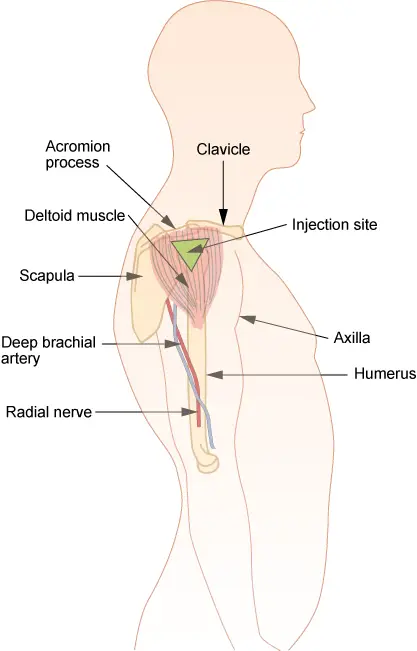
The deltoid is a triangular-shaped muscle located near the shoulder and upper arm. This muscle site is used to give a small volume of aqueous medications, such as vitamin B12 and vaccines. The CDC recommends this site be used when vaccines are given to teens and adults. To find the site, expose the upper arm. Make sure the sleeve does not act as a tourniquet. If the sleeve is tight, have the patient slip the arm out of the shirt.

Palpate the acromion process, then place two fingerbreadths (about 1 to 2 inches) below it - that marks the top of the site. The bottom of the site is at the anterior axillary fold (top of the axilla). The injection site should be somewhere between the top and the bottom of the site. Once the medical assistant finds the site, it is a good idea to have the patient lift their arm. The medical assistant can find the bulk (biggest part) of the deltoid muscle. The injection should be given into the bulk of the deltoid muscle.

Those two landmarks are boundaries, not targets - staying in the muscle bulk between them keeps the needle clear of the bursa and shoulder joint above and the radial nerve below, which is what prevents both joint injury and shoulder injury related to vaccine administration (SIRVA).

Vastus lateralis site

The vastus lateralis site is used on patients from birth through adulthood. This site uses a thick, well-developed muscle. The CDC recommends this site until the deltoid muscle is the appropriate size for vaccines (after the patient is 1 year or older). Have patients remove the clothing over the thigh. Remember to give patients a drape sheet to protect their modesty during the procedure.

To find the site, divide the thigh into three sections and use the middle third as the injection site. Picture a rectangle formed by four borders:

  1. Top border: one hand’s width below the greater trochanter
  2. Bottom border: one hand’s width above the knee
  3. Inner border: the midline of the thigh (equal right and left sides)
  4. Outer border: the midline of the outer thigh (equal front and back sections)

Once the site is identified, have the patient slightly lift the thigh so you can see whether the injection site is in the muscle bulk, which is the goal.

Ventrogluteal site

The ventrogluteal site is an excellent site for oil-based medications and irritating medications. This site is being used more often because the dorsogluteal site is no longer a recommended site for IM injections due to the risk of injury. It is important to have patients remove clothing from this area to administer an injection in the ventrogluteal site. Offering a drape sheet to protect their modesty is important. For this injection, the patient needs to be in a side-lying position.

The most complex part of using the ventrogluteal site is to ensure that the correct hand is used to find the site. Remember to use the hand opposite the injection site. For instance, if the injection site is on the patient’s left side, then use your right hand. Follow these steps to find the site:

  1. Place the palm of your hand on the patient’s greater trochanter.
  2. Your fingers need to point toward the patient’s head and your thumb to the patient’s groin. (If your thumb is facing the patient’s backside, you are using the wrong hand!)
  3. Place your index finger on the anterior superior iliac spine. If your fingers are short or if the patient is tall, point your index finger toward the anterior superior iliac spine.
  4. Move your middle finger back along the iliac crest toward the patient’s buttock

The positioning of your index and middle fingers forms a triangle. The injection point is at the center of the triangle. Remember, if you are giving an irritating medication, use the Z-track method to reduce pain.

Common intramuscular and subcutaneous injection sites labeled
Injection sites
Wikimedia Commons
/
CC BY 4.0

Summary of intramuscular injections

Syringe used 1 to 3mL
Needle size 1 to 1½ inches; 22-25 gauge. A 5⁄8-inch needle may be used in the deltoid of an adult weighing less than 130 pounds when the skin is stretched flat and the needle is inserted at 90 degrees
Maximum volume Deltoid: 1mL. Vastus lateralis and ventrogluteal: up to 3mL in an adult
Common sites Deltoid, vastus lateralis, and ventrogluteal
Patient position Deltoid: sitting. Vastus lateralis: sitting or lying down. Ventrogluteal: side-lying
Administration Flatten or stretch the skin with the nondominant hand before inserting the needle

Patient coaching

If a patient mentions being a recovering alcoholic or addict, acknowledge it and tell the provider, since some medications contain alcohol and the provider may need to choose an alternative.

Legal and ethical issues

The medical assistant’s scope of practice regarding injections differs across the nation. It is important for medical assistants to know their scope of practice in their own state before giving any injection.

In most states a medical assistant is not independently licensed, and the authority to give an injection is delegated by the supervising provider. A delegated task is lawful only when all of the following hold: the provider is authorized to perform the task and to delegate it, state law allows it to be delegated to unlicensed personnel, the medical assistant has been trained and has demonstrated competency, and the level of supervision the state requires is actually in place. The provider remains responsible for the order, for the delegation, and for responding to a complication. Delegation never extends to deciding that a patient needs an injection; that decision belongs to the provider.

States differ in how much of this they write down. Some rely on the general delegation rule alone. Others set specific requirements for injections - minimum training hours, a set number of supervised injections, direct rather than general supervision, or limits on which medications may be given. A national credential is not a state license, and holding one does not by itself grant authority a state has not given.

Because the rules differ by state and by setting, look them up rather than assume. The controlling answer is the current statute, regulation, or board guidance - from the state medical board, from the state board of nursing where an advanced practice nurse is the supervisor, or from the state department of health for immunizations - and not an employer’s job description. The American Association of Medical Assistants keeps a state-by-state summary of scope of practice laws that is a useful place to start looking for the right provision.

Patient-centered care

For injections given to small children, the subcutaneous (SUBQ) and intramuscular (IM) sites in the thigh are in the same location. Have the parent or guardian hold the child’s upper body and hands, but anticipate that the adult may not hold securely; a second staff member holding the lower extremities helps. When a child needs more than one injection, having two medical assistants inject at the same time reduces how many times the child has to be restrained.

The medical assistant should hold the joint above the injection site and gently secure the lower leg, carefully bending it off the table and holding it between the table and their own body without hurting the child. Because one hand is holding the leg near the site, injections for children are given using the one-handed technique.

Professional behaviors

The medical assistant has an important role in administering medications, and paying attention to details is critical. If a medication error occurs, the medical assistant must immediately notify the provider, who determines the next steps, and the supervisor, who typically ensures the patient isn’t charged for the error and may need to file a state or federal report. The medical assistant also completes an incident report.

Sign up for free to take 13 quiz questions on this topic

Previous
Next  | 37.1 Health, nutrition, and metabolism
All rights reserved ©2016 - 2026 Achievable, Inc.

Intramuscular injections and professional issues

Intramuscular injections

Intramuscular injections involve placing medication into the muscle. There are more blood vessels in the muscles; thus, absorption is faster than in the subcutaneous layer. For medications given by IM injection, aqueous (watery) medications should be given with a higher gauge needle (a higher gauge number means a thinner needle) than that used for oil-based medications. Common medications given via the intramuscular route include the following:

  • Several vaccines (e.g., hepatitis A and B, tetanus-diphtheria (Td) or with pertussis (TDaP), influenza, and meningococcal)
  • Antibiotics and medroxyprogesterone (Depo-Provera)

Administration techniques

As with all injections, it is important to do the procedure safely. The medical assistant must identify the correct site and follow the guidelines for medical asepsis. When administering an IM injection, it is important to use a 90-degree angle for entry. The skin should be flattened or stretched over the site with the nondominant hand. Administration techniques for IM injections consist of being safe, minimizing pain, and finding the correct site. The following sections address these three goals.

Aspiration

Whether to aspirate before injecting depends on the medication and the site. According to the CDC, aspiration is not recommended before administering vaccines at the recommended IM sites, since there are no large blood vessels there. For other IM medications, when aspiration is indicated, the medical assistant should pull back on the plunger for 5 seconds and check the barrel of the syringe once the needle is in the site. A lack of blood in the barrel means the needle is not in a blood vessel, so it is safe to inject the medication. If blood appears in the barrel, remove the needle, discard the syringe, and restart the procedure.

Sealing techniques

Air lock and Z-track are two techniques that reduce pain from irritating IM medications. Both work the same way: they seal the medication in the muscle so it cannot track back through the tissue to the skin.

  • Air lock: Remove the bubbles in the syringe and measure the exact amount of medication needed, then add 0.2 to 0.5 mL of air into the syringe. During the injection, the medication is pushed in first, followed by the air. As the needle is withdrawn, the air fills the needle track, sealing the medication in the muscle.
  • Z-track: Used for irritating medications, most often at the ventrogluteal site. Pull the skin laterally with your nondominant hand before cleansing the site and injecting, then release the skin as the needle is withdrawn - the skin’s return to its normal position creates the seal.

Intramuscular sites

When giving an intramuscular injection, certain sites are used for different ages of patients. For instance, the deltoid site is not used for infants. Certain medications can only be given in specific sites. For example, medroxyprogesterone (Depo-Provera) intramuscular injection can be given in the deltoid and ventrogluteal sites. Knowing how to locate the intramuscular sites is critical when giving intramuscular injections.

Deltoid site

The deltoid is a triangular-shaped muscle located near the shoulder and upper arm. This muscle site is used to give a small volume of aqueous medications, such as vitamin B12 and vaccines. The CDC recommends this site be used when vaccines are given to teens and adults. To find the site, expose the upper arm. Make sure the sleeve does not act as a tourniquet. If the sleeve is tight, have the patient slip the arm out of the shirt.

Palpate the acromion process, then place two fingerbreadths (about 1 to 2 inches) below it - that marks the top of the site. The bottom of the site is at the anterior axillary fold (top of the axilla). The injection site should be somewhere between the top and the bottom of the site. Once the medical assistant finds the site, it is a good idea to have the patient lift their arm. The medical assistant can find the bulk (biggest part) of the deltoid muscle. The injection should be given into the bulk of the deltoid muscle.

Those two landmarks are boundaries, not targets - staying in the muscle bulk between them keeps the needle clear of the bursa and shoulder joint above and the radial nerve below, which is what prevents both joint injury and shoulder injury related to vaccine administration (SIRVA).

Vastus lateralis site

The vastus lateralis site is used on patients from birth through adulthood. This site uses a thick, well-developed muscle. The CDC recommends this site until the deltoid muscle is the appropriate size for vaccines (after the patient is 1 year or older). Have patients remove the clothing over the thigh. Remember to give patients a drape sheet to protect their modesty during the procedure.

To find the site, divide the thigh into three sections and use the middle third as the injection site. Picture a rectangle formed by four borders:

  1. Top border: one hand’s width below the greater trochanter
  2. Bottom border: one hand’s width above the knee
  3. Inner border: the midline of the thigh (equal right and left sides)
  4. Outer border: the midline of the outer thigh (equal front and back sections)

Once the site is identified, have the patient slightly lift the thigh so you can see whether the injection site is in the muscle bulk, which is the goal.

Ventrogluteal site

The ventrogluteal site is an excellent site for oil-based medications and irritating medications. This site is being used more often because the dorsogluteal site is no longer a recommended site for IM injections due to the risk of injury. It is important to have patients remove clothing from this area to administer an injection in the ventrogluteal site. Offering a drape sheet to protect their modesty is important. For this injection, the patient needs to be in a side-lying position.

The most complex part of using the ventrogluteal site is to ensure that the correct hand is used to find the site. Remember to use the hand opposite the injection site. For instance, if the injection site is on the patient’s left side, then use your right hand. Follow these steps to find the site:

  1. Place the palm of your hand on the patient’s greater trochanter.
  2. Your fingers need to point toward the patient’s head and your thumb to the patient’s groin. (If your thumb is facing the patient’s backside, you are using the wrong hand!)
  3. Place your index finger on the anterior superior iliac spine. If your fingers are short or if the patient is tall, point your index finger toward the anterior superior iliac spine.
  4. Move your middle finger back along the iliac crest toward the patient’s buttock

The positioning of your index and middle fingers forms a triangle. The injection point is at the center of the triangle. Remember, if you are giving an irritating medication, use the Z-track method to reduce pain.

Summary of intramuscular injections

Syringe used 1 to 3mL
Needle size 1 to 1½ inches; 22-25 gauge. A 5⁄8-inch needle may be used in the deltoid of an adult weighing less than 130 pounds when the skin is stretched flat and the needle is inserted at 90 degrees
Maximum volume Deltoid: 1mL. Vastus lateralis and ventrogluteal: up to 3mL in an adult
Common sites Deltoid, vastus lateralis, and ventrogluteal
Patient position Deltoid: sitting. Vastus lateralis: sitting or lying down. Ventrogluteal: side-lying
Administration Flatten or stretch the skin with the nondominant hand before inserting the needle

Patient coaching

If a patient mentions being a recovering alcoholic or addict, acknowledge it and tell the provider, since some medications contain alcohol and the provider may need to choose an alternative.

Legal and ethical issues

The medical assistant’s scope of practice regarding injections differs across the nation. It is important for medical assistants to know their scope of practice in their own state before giving any injection.

In most states a medical assistant is not independently licensed, and the authority to give an injection is delegated by the supervising provider. A delegated task is lawful only when all of the following hold: the provider is authorized to perform the task and to delegate it, state law allows it to be delegated to unlicensed personnel, the medical assistant has been trained and has demonstrated competency, and the level of supervision the state requires is actually in place. The provider remains responsible for the order, for the delegation, and for responding to a complication. Delegation never extends to deciding that a patient needs an injection; that decision belongs to the provider.

States differ in how much of this they write down. Some rely on the general delegation rule alone. Others set specific requirements for injections - minimum training hours, a set number of supervised injections, direct rather than general supervision, or limits on which medications may be given. A national credential is not a state license, and holding one does not by itself grant authority a state has not given.

Because the rules differ by state and by setting, look them up rather than assume. The controlling answer is the current statute, regulation, or board guidance - from the state medical board, from the state board of nursing where an advanced practice nurse is the supervisor, or from the state department of health for immunizations - and not an employer’s job description. The American Association of Medical Assistants keeps a state-by-state summary of scope of practice laws that is a useful place to start looking for the right provision.

Patient-centered care

For injections given to small children, the subcutaneous (SUBQ) and intramuscular (IM) sites in the thigh are in the same location. Have the parent or guardian hold the child’s upper body and hands, but anticipate that the adult may not hold securely; a second staff member holding the lower extremities helps. When a child needs more than one injection, having two medical assistants inject at the same time reduces how many times the child has to be restrained.

The medical assistant should hold the joint above the injection site and gently secure the lower leg, carefully bending it off the table and holding it between the table and their own body without hurting the child. Because one hand is holding the leg near the site, injections for children are given using the one-handed technique.

Professional behaviors

The medical assistant has an important role in administering medications, and paying attention to details is critical. If a medication error occurs, the medical assistant must immediately notify the provider, who determines the next steps, and the supervisor, who typically ensures the patient isn’t charged for the error and may need to file a state or federal report. The medical assistant also completes an incident report.

More from Administering medications

  • Administering medications
  • Administering vaccines
  • Routes of medication
  • Intradermal injections and tuberculin testing
  • Needles and syringes