


Achievable logoAchievable logo
CCMA
Sign in
Sign up
Purchase
Textbook
Practice exams
Support
How it works
Resources
Exam catalog
Mountain with a flag at the peak
Textbook
Introduction
1. Medical assistant
2. Electronic records
3. Medical terminology and anatomy
4. The fundamentals of infection control
5. Introduction to vital signs
6. The patient interview and history
7. The physical examination
7.1 Introduction
7.2 Body mechanics and examination methods
7.3 Assisting with the general physical exam
7.3.1 Draping and instruments
7.3.2 Patient positioning
7.3.3 Sequence and head-to-neck assessment
7.3.4 Chest-to-rectum assessment and patient care
8. Appointment scheduling
9. Insurance billing
10. Diagnostic coding and the ICD-10-CM System
11. Procedural coding
12. Medical billing and reimbursement essentials
13. Assisting with medical specialties
14. Assisting with the musculoskeletal system
15. Assisting with the cardiovascular system
16. Assisting with the respiratory system
17. Assisting with the nervous system
18. Anatomy and physiology of the urinary system
19. Assisting in obstetrics and gynecology
20. Assisting in endocrinology
21. Assisting in ophthalmology & otolaryngology
22. Assisting in gastroenterology
23. Assisting in the immune & lymphatic systems
24. Assisting in pediatrics: the developmental stages and care
25. The medical assistant’s role in caring for the older patient
26. The role of the medical assistant in physical therapy examination and assessment
27. Preparing for minor surgery: room, solutions, and supplies
28. Introduction to the clinical laboratory
29. Urinalysis
30. Blood collection
31. Analysis of blood
32. Electrocardiography and heart structure
33. The principles of pharmacology
34. Essential calculations and measurement systems
35. Solid, liquid, & solutions medication doses
36. Administering medications
37. Metabolism and core nutrient roles
38. Medical emergencies in the healthcare setting
Achievable logoAchievable logo
7.3.1 Draping and instruments
Achievable CCMA
7. The physical examination
7.3. Assisting with the general physical exam

Draping and instruments

6 min read
Font
Discuss
Share
Feedback

During the actual physical examination, the medical assistant can be responsible for several different aspects of patient care. Throughout the examination, the patient may need to be placed in a number of different positions. To protect the patient’s modesty, you should use the proper draping technique for each position. To protect yourself and your patient, you should also use proper body mechanics - keep your back straight, bend at the knees rather than your waist, and position the exam table at a comfortable working height before you assist a patient into place. This section covers draping technique and the instruments used during the exam.

Positioning and draping the patient for the physical examination

Various patient positions are used to facilitate a physical examination. The medical assistant instructs the patient and assists the patient into these positions, ensuring as much ease and modesty as possible. The medical assistant may also help the patient maintain the position during the examination with as little discomfort as possible. Do not place a patient into a position that is uncomfortable or that compromises the patient’s privacy until it is necessary to complete that part of the examination. Never leave the patient’s side if the position could result in a fall.

Draping the patient with a sheet protects the individual from embarrassment and keeps the patient warm. However, the sheet must be positioned so that it allows complete visibility for the examiner and does not interfere with the examination. During the general examination, each part of the body is exposed one portion at a time - for example, when examining the abdomen, the medical assistant folds the sheet down to expose only the abdomen, then repositions it to cover that area before the next region is exposed. For gynecologic and rectal examinations, the sheet is positioned on the diagonal across the patient, or in a diamond shape, with the patient in the lithotomy position and only the perineal area exposed, to provide maximum comfort for the patient while allowing the provider to perform the examination.

Common instruments used during a physical examination displayed
Instruments used for physical exam
Wikimedia Commons
/
Public Domain

Instruments needed for the physical examination

Instrument Use
Ophthalmoscope To inspect the inner structures of the eye. It consists of a stainless-steel handle containing batteries and an attached head, which has a light, magnifying lenses, and an opening through which the eye is viewed.
Tongue depressor A flat, wooden blade used to hold down the tongue when the throat is examined.
Otoscope To examine the external auditory canal and tympanic membrane. It has a stainless-steel handle containing batteries or is part of a wall-mounted electrical unit. The head of the otoscope has a light that is focused through a magnifying lens; it should be covered with a disposable ear speculum. The light also may be used to illuminate the nasal passages and throat.
Tuning fork Aluminum, fork-shaped instrument that consists of a handle and two prongs. The prongs produce a humming sound when the provider strikes them against his or her hand. Tuning forks are available in different sizes, and each size produces a different pitch level. A tuning fork is used to check the patient’s auditory acuity and to test bone vibration. A tuning fork can also be used to test for diabetic peripheral neuropathy.
Tape measure A flexible ribbon ruler that is usually printed in inches and feet on one side and in centimeters and meters on the reverse side. Measurements may be used to assess length and head circumference in infants, wound size, etc.
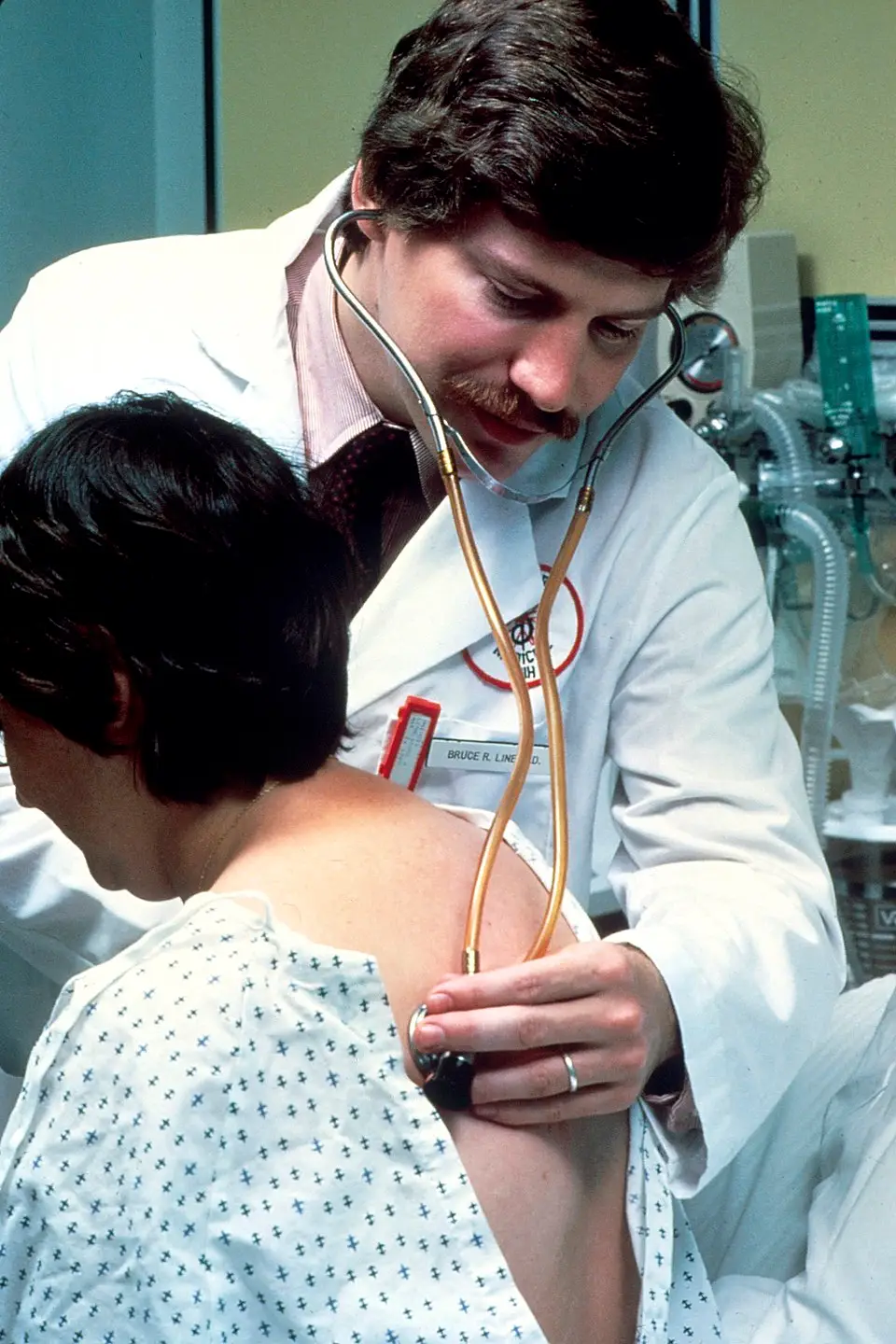
Stethoscope A listening device used when certain areas of the body are auscultated, particularly the heart and lungs. This instrument is available in many shapes and sizes. All have two earpieces that are connected to flexible rubber or vinyl tubing. At the distal end of the tubing is a diaphragm or bell (many have both); when it is placed securely on the patient’s skin, it enables the provider to hear internal body sounds.
Reflex hammer Sometimes called a percussion hammer. This stainless-steel instrument has a hard rubber head that is used to strike the tendons of the knee and elbow to test the neurologic reflexes.
Gloves Gloves protect the healthcare worker and the patient from microorganisms. According to Standard Precautions, gloves must be worn whenever the potential exists for contact with any body fluid, broken skin or wounds, or contaminated items.
Additional supplies Gauze, cotton balls, cotton-tipped applicators, disposable tissues, specimen containers, fecal occult blood test cards, Pap test supplies for female patients, lubricating jelly for vaginal and rectal examinations, and laboratory request forms should be easily accessible during the examination.

Standard Precautions: these apply to every patient, regardless of diagnosis, and are the baseline for glove use - gloves go on whenever contact with blood, body fluids, non-intact skin, or contaminated items is possible. Transmission-based precautions are added on top of Standard Precautions only for patients with a known or suspected infection.

Assisting with the general physical exam

  • Medical assistant roles: positioning, draping, patient comfort
  • Use proper draping for modesty and warmth
  • Apply correct body mechanics for safety

Positioning and draping the patient

  • Assist and instruct patient into exam positions
  • Maintain privacy and comfort; only expose areas as needed
  • Never leave patient unattended in unstable positions

Instruments needed for the physical examination

  • Ophthalmoscope: inspects inner eye structures
  • Tongue depressor: holds down tongue for throat exam
  • Otoscope: examines ear canal, tympanic membrane, nasal passages, throat
  • Tuning fork: tests auditory acuity, bone vibration, peripheral neuropathy
  • Tape measure: measures length, head circumference, wound size
  • Stethoscope: auscultates heart, lungs, internal sounds
  • Reflex hammer: tests neurologic reflexes (knee, elbow)
  • Gloves: protect against microorganisms, required for contact with fluids or wounds
  • Additional supplies: gauze, cotton balls, tissues, specimen containers, test cards, lubricating jelly, lab forms

Fowler position

  • Patient seated, head of table at 90°
  • Used for head, neck, chest exams; patients with breathing difficulty
  • Drape placement varies for modesty

Semi-fowler position

  • Head of table at 45°
  • Used for postoperative, breathing disorders, head trauma/pain
  • Drape covers from nipple line down

Supine (horizontal recumbent) position

  • Patient flat, face up
  • Examines front of body: heart, breasts, abdomen
  • Gown opens in front; drape covers unexamined areas

Prone position

  • Patient face down, ventral surface on table
  • Used for back exams, certain procedures
  • Drape from mid-back to below knees; gown opens in back

Dorsal recumbent position

  • Patient face up, knees flexed, feet flat
  • Relieves abdominal muscle tension
  • Used for rectal, vaginal, perineal exams (not with speculum)
  • Drape in diamond shape for privacy

Lithotomy position

  • Patient on back, knees flexed, feet in stirrups
  • Used for vaginal exams with speculum, Pap tests
  • Drape diagonally, covers knees to ankles and sides of thighs
  • Position only when provider is ready

Left lateral position

  • Patient on left side, left arm/shoulder back, right leg flexed upward
  • Used for rectal, perineal, pelvic exams, rectal medication
  • Drape diagonally under arms to below knees

Knee-chest position

  • Patient on knees and chest, buttocks elevated, back straight
  • Used for proctologic, sigmoid, rectal, some vaginal exams
  • Gown opens in back; drape diagonally over sacral area
  • Requires assistance; alternative: knee-elbow position for easier maintenance

Sign up for free to take 10 quiz questions on this topic

Previous
Next  | 7.3.2 Patient positioning
All rights reserved ©2016 - 2026 Achievable, Inc.

Draping and instruments

During the actual physical examination, the medical assistant can be responsible for several different aspects of patient care. Throughout the examination, the patient may need to be placed in a number of different positions. To protect the patient’s modesty, you should use the proper draping technique for each position. To protect yourself and your patient, you should also use proper body mechanics - keep your back straight, bend at the knees rather than your waist, and position the exam table at a comfortable working height before you assist a patient into place. This section covers draping technique and the instruments used during the exam.

Positioning and draping the patient for the physical examination

Various patient positions are used to facilitate a physical examination. The medical assistant instructs the patient and assists the patient into these positions, ensuring as much ease and modesty as possible. The medical assistant may also help the patient maintain the position during the examination with as little discomfort as possible. Do not place a patient into a position that is uncomfortable or that compromises the patient’s privacy until it is necessary to complete that part of the examination. Never leave the patient’s side if the position could result in a fall.

Draping the patient with a sheet protects the individual from embarrassment and keeps the patient warm. However, the sheet must be positioned so that it allows complete visibility for the examiner and does not interfere with the examination. During the general examination, each part of the body is exposed one portion at a time - for example, when examining the abdomen, the medical assistant folds the sheet down to expose only the abdomen, then repositions it to cover that area before the next region is exposed. For gynecologic and rectal examinations, the sheet is positioned on the diagonal across the patient, or in a diamond shape, with the patient in the lithotomy position and only the perineal area exposed, to provide maximum comfort for the patient while allowing the provider to perform the examination.

Instruments needed for the physical examination

Instrument Use
Ophthalmoscope To inspect the inner structures of the eye. It consists of a stainless-steel handle containing batteries and an attached head, which has a light, magnifying lenses, and an opening through which the eye is viewed.
Tongue depressor A flat, wooden blade used to hold down the tongue when the throat is examined.
Otoscope To examine the external auditory canal and tympanic membrane. It has a stainless-steel handle containing batteries or is part of a wall-mounted electrical unit. The head of the otoscope has a light that is focused through a magnifying lens; it should be covered with a disposable ear speculum. The light also may be used to illuminate the nasal passages and throat.
Tuning fork Aluminum, fork-shaped instrument that consists of a handle and two prongs. The prongs produce a humming sound when the provider strikes them against his or her hand. Tuning forks are available in different sizes, and each size produces a different pitch level. A tuning fork is used to check the patient’s auditory acuity and to test bone vibration. A tuning fork can also be used to test for diabetic peripheral neuropathy.
Tape measure A flexible ribbon ruler that is usually printed in inches and feet on one side and in centimeters and meters on the reverse side. Measurements may be used to assess length and head circumference in infants, wound size, etc.
Stethoscope A listening device used when certain areas of the body are auscultated, particularly the heart and lungs. This instrument is available in many shapes and sizes. All have two earpieces that are connected to flexible rubber or vinyl tubing. At the distal end of the tubing is a diaphragm or bell (many have both); when it is placed securely on the patient’s skin, it enables the provider to hear internal body sounds.
Reflex hammer Sometimes called a percussion hammer. This stainless-steel instrument has a hard rubber head that is used to strike the tendons of the knee and elbow to test the neurologic reflexes.
Gloves Gloves protect the healthcare worker and the patient from microorganisms. According to Standard Precautions, gloves must be worn whenever the potential exists for contact with any body fluid, broken skin or wounds, or contaminated items.
Additional supplies Gauze, cotton balls, cotton-tipped applicators, disposable tissues, specimen containers, fecal occult blood test cards, Pap test supplies for female patients, lubricating jelly for vaginal and rectal examinations, and laboratory request forms should be easily accessible during the examination.

Standard Precautions: these apply to every patient, regardless of diagnosis, and are the baseline for glove use - gloves go on whenever contact with blood, body fluids, non-intact skin, or contaminated items is possible. Transmission-based precautions are added on top of Standard Precautions only for patients with a known or suspected infection.

Key points

Assisting with the general physical exam

  • Medical assistant roles: positioning, draping, patient comfort
  • Use proper draping for modesty and warmth
  • Apply correct body mechanics for safety

Positioning and draping the patient

  • Assist and instruct patient into exam positions
  • Maintain privacy and comfort; only expose areas as needed
  • Never leave patient unattended in unstable positions

Instruments needed for the physical examination

  • Ophthalmoscope: inspects inner eye structures
  • Tongue depressor: holds down tongue for throat exam
  • Otoscope: examines ear canal, tympanic membrane, nasal passages, throat
  • Tuning fork: tests auditory acuity, bone vibration, peripheral neuropathy
  • Tape measure: measures length, head circumference, wound size
  • Stethoscope: auscultates heart, lungs, internal sounds
  • Reflex hammer: tests neurologic reflexes (knee, elbow)
  • Gloves: protect against microorganisms, required for contact with fluids or wounds
  • Additional supplies: gauze, cotton balls, tissues, specimen containers, test cards, lubricating jelly, lab forms

Fowler position

  • Patient seated, head of table at 90°
  • Used for head, neck, chest exams; patients with breathing difficulty
  • Drape placement varies for modesty

Semi-fowler position

  • Head of table at 45°
  • Used for postoperative, breathing disorders, head trauma/pain
  • Drape covers from nipple line down

Supine (horizontal recumbent) position

  • Patient flat, face up
  • Examines front of body: heart, breasts, abdomen
  • Gown opens in front; drape covers unexamined areas

Prone position

  • Patient face down, ventral surface on table
  • Used for back exams, certain procedures
  • Drape from mid-back to below knees; gown opens in back

Dorsal recumbent position

  • Patient face up, knees flexed, feet flat
  • Relieves abdominal muscle tension
  • Used for rectal, vaginal, perineal exams (not with speculum)
  • Drape in diamond shape for privacy

Lithotomy position

  • Patient on back, knees flexed, feet in stirrups
  • Used for vaginal exams with speculum, Pap tests
  • Drape diagonally, covers knees to ankles and sides of thighs
  • Position only when provider is ready

Left lateral position

  • Patient on left side, left arm/shoulder back, right leg flexed upward
  • Used for rectal, perineal, pelvic exams, rectal medication
  • Drape diagonally under arms to below knees

Knee-chest position

  • Patient on knees and chest, buttocks elevated, back straight
  • Used for proctologic, sigmoid, rectal, some vaginal exams
  • Gown opens in back; drape diagonally over sacral area
  • Requires assistance; alternative: knee-elbow position for easier maintenance

More from Assisting with the general physical exam

  • Patient positioning
  • Sequence and head-to-neck assessment
  • Chest-to-rectum assessment and patient care