


Achievable logoAchievable logo
CCMA
Sign in
Sign up
Purchase
Textbook
Practice exams
Support
How it works
Exam catalog
Mountain with a flag at the peak
Textbook
1. Medical assistant
2. Electronic records
3. Medical terminology and anatomy
4. The fundamentals of infection control
5. Introduction to vital signs
6. The patient interview and history
7. The physical examination
7.1 Introduction
7.2 Body mechanics and examination methods
8. Appointment scheduling
9. Insurance billing
10. Diagnostic coding and the ICD-10-CM System
11. Procedural coding
12. Medical billing and reimbursement essentials
13. Assisting with medical specialties
14. Assisting with the musculoskeletal system
15. Assisting with the cardiovascular system
16. Assisting with the respiratory system
17. Assisting with the nervous system
18. Anatomy and physiology of the urinary system
19. Assisting in obstetrics and gynecology
20. Assisting in endocrinology
21. Assisting in ophthalmology & otolaryngology
22. Assisting in gastroenterology
23. Assisting in the immune & lymphatic systems
24. Assisting in pediatrics: the developmental stages and care
25. The medical assistant’s role in caring for the older patient
26. The role of the medical assistant in physical therapy examination and assessment
27. Preparing for minor surgery: room, solutions, and supplies
28. Introduction to the clinical laboratory
29. Urinalysis
30. Blood collection
31. Analysis of blood
32. Electrocardiography and heart structure
33. The principles of pharmacology
34. Essential calculations and measurement systems
35. Solid, liquid, & solutions medication doses
36. Administering medications
37. Metabolism and core nutrient roles
38. Medical emergencies in the healthcare setting
Achievable logoAchievable logo
7.2 Body mechanics and examination methods
Achievable CCMA
7. The physical examination
Our CCMA course is currently in development and is a work-in-progress.

Body mechanics and examination methods

10 min read
Font
Discuss
Share
Feedback

Principles of body mechanics

Medical assistants should consistently use proper body mechanics throughout the work environment when sitting or standing, lifting, or carrying objects, pushing or pulling, or transferring patients. Without consistent application of correct anatomic alignment, injuries, especially lower back injuries, easily occur.

Proper body alignment begins with good posture. Maintaining posture requires a combination of muscle efforts. Good posture keeps the spine balanced and aligned while a person is sitting or standing. A person in good body alignment can maintain balance without undue strain on the musculoskeletal system.

When reaching for an object, avoid twisting or turning; instead, move the feet to face the object needed; this prevents undue strain on the lumbar region. Do not cross the legs while sitting because this interferes with circulation to the legs and feet. When sitting, keep the popliteal area (behind the knees) free of the edge of the chair. Pressure in this area interferes with circulation and may damage nerves behind the knees. Do a mental check of your posture regularly. Hold the head erect, the face forward and the chin slightly up, the abdominal muscles contracted up and in, the shoulders relaxed and back, the feet pointed forward and slightly apart, and the weight evenly distributed to both legs, with the knees slightly bent. Always be alert for poor body mechanics that may cause injury.

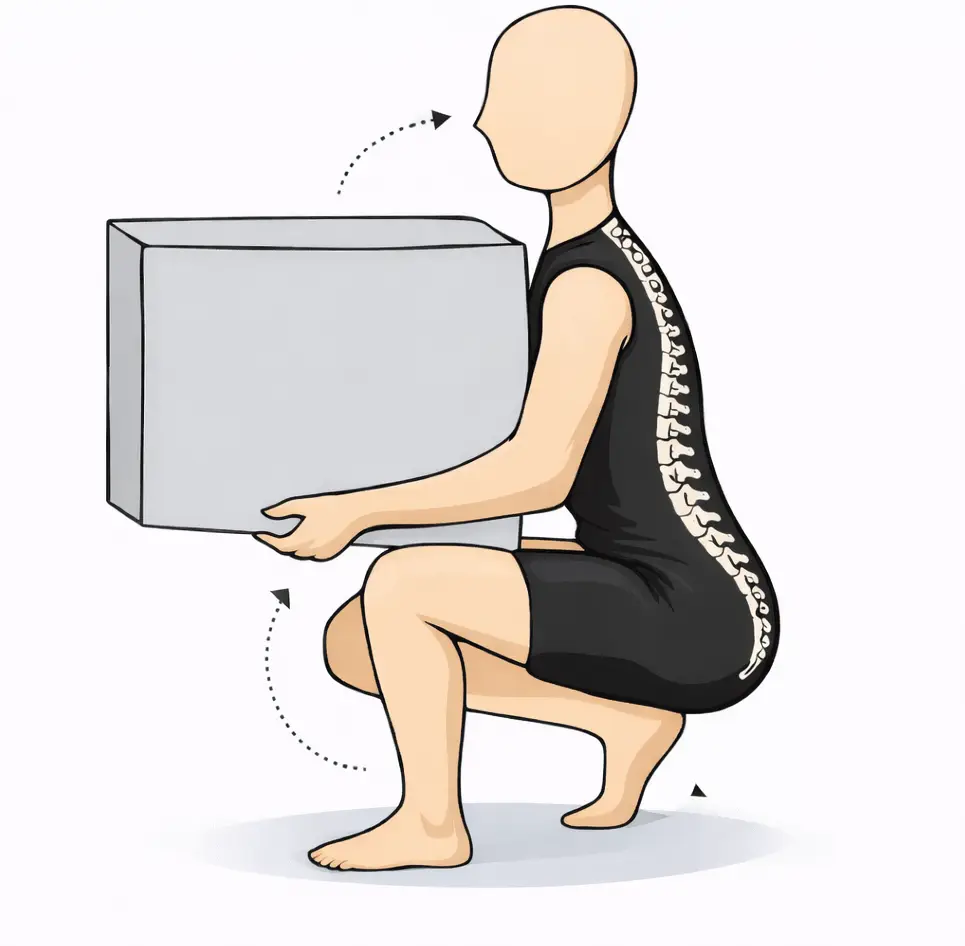
Proper and improper body mechanics for lifting compared
Proper and Improper lifting techniques
Wikimedia Commons
/
CC BY-SA 4.0

Safe lifting techniques

  • Always get help if the load is too heavy.
  • Maintain correct body alignment, with the legs spread apart for a broad base of support.
  • Do not reach for items; clear barriers out of the way and get as close as possible to what needs to be lifted.
  • Bend at the knees with the feet shoulder-width apart and keep the back straight. Use the major muscle groups of the arms and legs rather than the weaker ones of the back to help lift a heavy item.

Transferring a patient

Patients may need assistance moving from a chair to the examination table or back again. Patients can be transferred in multiple ways, but all should focus on correct body mechanics. If the patient is in a wheelchair, move the chair at a 45-degree angle toward the footrest that extends from the bottom of the exam table, lock the wheels, and lift the footrests of the wheelchair out of the way. Explain the procedure to the patient and ask for his or her assistance.

If one side of the patient is weaker than the other, always provide support on the weak side.

Support the patient close to your body on the strong side, with one hand under the axillary region and the other either grasping the patient’s hand or holding the forearm. When bending, always bend at the knees and maintain the back’s three natural curves, allowing the leg muscles to help in lifting. Give the patient a signal and lift as the patient assists. Help the patient step up onto the footrest with the strong leg first, then pivot. Ease the patient down onto the table, bending your knees while keeping your back aligned. Make sure the patient is comfortable and safely positioned on the table.

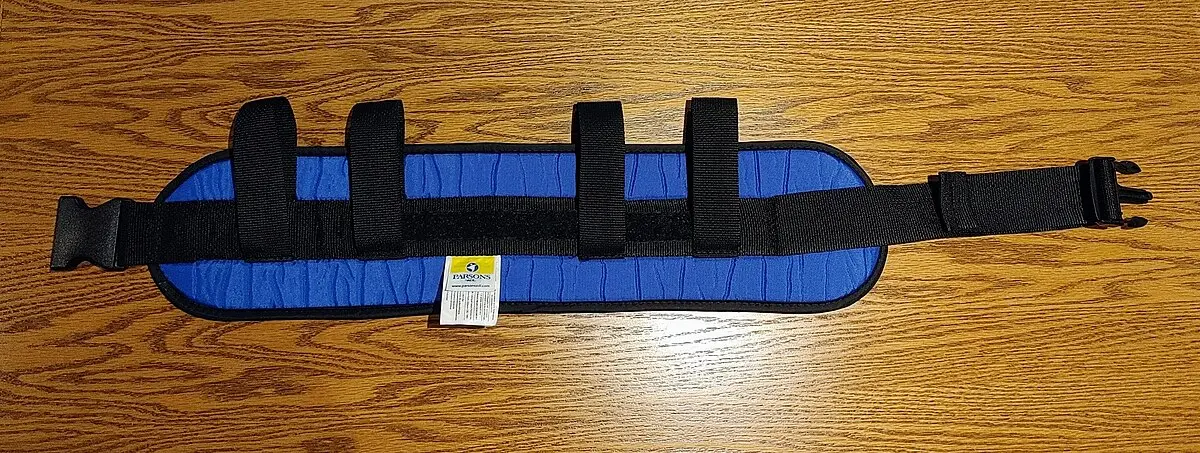
Use a gait belt as needed to help transfer patients, prevent injury to yourself, and safeguard patients from falling. A gait belt is a safety device that is used to help transfer a patient from a wheelchair to the exam table or to help a patient walk. The gait belt helps you support the patient while keeping your body in proper alignment to prevent back injuries. A gait belt should be used if the patient is weak and at risk of falling. Follow these steps to use a gait belt:

  • Place the belt around the individual’s waist over clothing with the buckle in front.
  • Insert the belt through the teeth of the buckle and pull it tight to lock it.
  • The belt should be tight, with just enough room to place your fingers under it.
  • Grip the belt tightly, bend your knees and keep your back straight.
  • Ask the patient to assist you; then lift using your arm and leg muscles.
  • Avoid twisting or turning as you help the patient stand.
  • Keep your body close to the patient with your knees in front of his or hers at all times to stabilize the patient and prevent falls.
  • Complete the transfer without bending or twisting your body; encourage the patient to bear as much weight as possible and gently sit down on the table.
  • After transferring the patient, remove the gait belt for the provider’s examination and replace it to help transfer the patient back to the wheelchair after the provider is finished.
  • If the patient should start to fall during a transfer, do not try to stop the fall because you may be injured; use the gait belt to help guide the patient to the floor as gently as possible.

You may need to remain with the patient until the examination has been completed to ensure his or her safety. If the provider prefers that the patient is in a supine position, place one arm across the patient’s shoulders and the other under the knees and smoothly lower the patient’s upper body to the table while raising the legs. Use the same pivoting techniques with proper body mechanics to help transfer the patient from the examination table back to the locked wheelchair. If the patient must hold onto you, have the person hold your waist or shoulders, not your neck

Gait belt used to assist patients with mobility
Gait belt
Wikimedia Commons
/
CC BY-SA 4.0

Methods of examination

Examinations are performed as both a routine confirmation of wellness and a means of diagnosing disease. Healthcare providers use six methods to examine the human body:

  • Inspection
  • Palpation
  • Percussion
  • Auscultation
  • Mensuration
  • Manipulation

All six are part of a complete physical examination.

Inspection

During the inspection, the examiner uses observation to detect significant physical features or objective data. This method of examination ranges from focusing on the patient’s general appearance (general state of health, including posture, mannerisms, and grooming) to more detailed observations, including body contour, gait, symmetry, visible injuries and deformities, tremors, rashes, and color changes. Inspection will be done before palpation or percussion so that there will be no changes made to the appearance of the skin.

Palpation

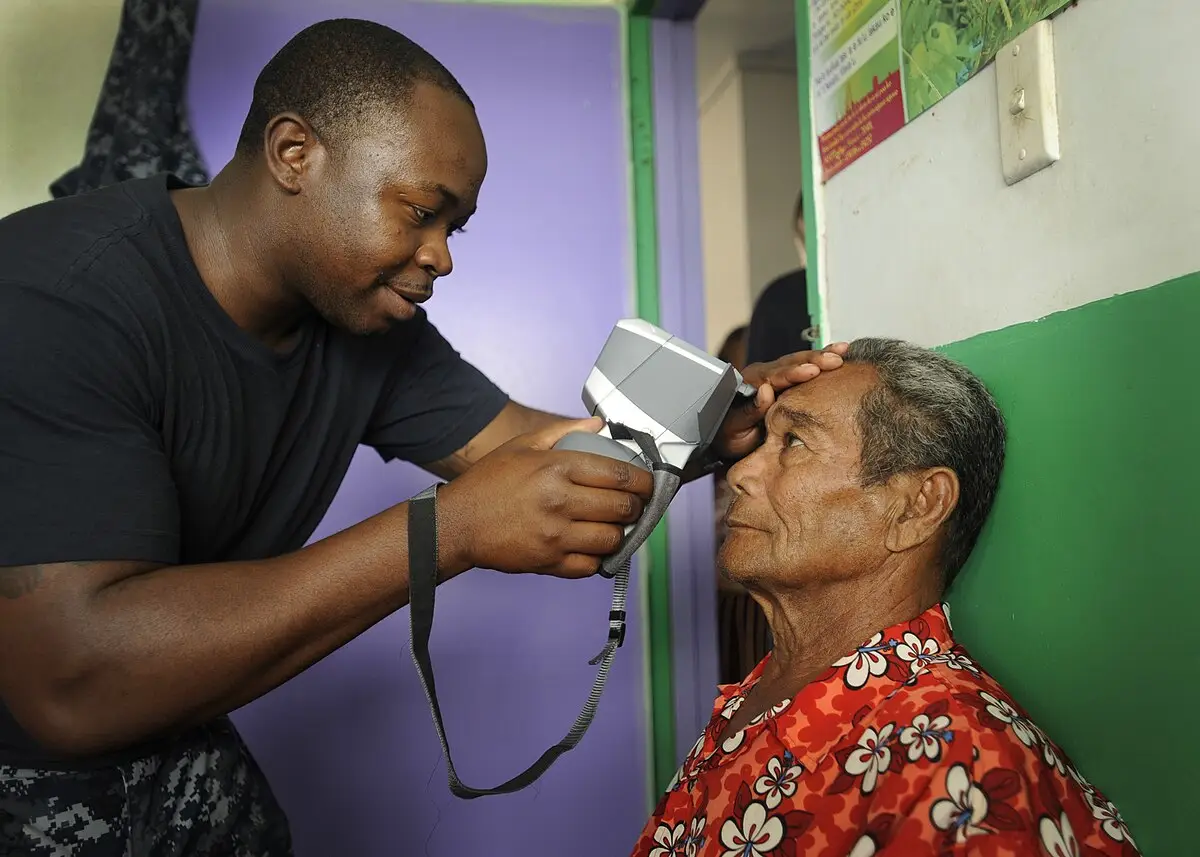
In palpation, the examiner uses the sense of touch. A part of the body is felt with the hand to determine its condition or the condition of an underlying organ. Palpation may involve touching the skin or performing a firmer exploration of the abdomen for underlying masses. With this technique, the provider is assessing the following:

  • Temperature
  • Vibration
  • Consistency
  • Form
  • Size
  • Rigidity
  • Elasticity
  • Moisture
  • Texture
  • Position
  • Contour

Palpation is performed with one hand, both hands (bimanual), one finger (digital), the fingertips, or the palmar aspect of the hand. A pelvic examination is done bimanually, whereas an anal examination is performed digitally. Do not confuse palpation with palpitation, which is a throbbing pulsation felt in the chest.

Percussion

Percussion involves tapping or striking the body, usually with the fingers or a small hammer. This will cause sounds, vibratory sensations, or involuntary reactions. Percussion can help to determine the position, size, and density of an underlying organ or cavity. The examiner both hears and feels the effect of percussion. It is helpful in determining the amount of air or solid matter in an underlying organ or cavity. The two basic methods of percussion are direct percussion and indirect percussion. Direct percussion is performed by striking the body with a finger or a reflex hammer. With indirect percussion, which is used more frequently, the provider places his or her hand on the area and then strikes the placed hand with a finger of the other hand. Both a sound and a sense of vibration are evident. The examiner assesses the sound in terms of pitch, quality, duration, and resonance.

Auscultation

For auscultation, the provider uses a stethoscope to listen to sounds from the body. Auscultation is a complex method of examination because the provider must distinguish between a normal sound and an abnormal sound. It is particularly useful for evaluating sounds originating in the lungs, heart, and abdomen, such as a murmur, a bruit, and bowel sounds.

Palpation, percussion, and auscultation techniques demonstrated
Physical examination techniques of palpation, percussion, and auscultation
Wikimedia Commons
/
Public Domain

Mensuration

Mensuration is the process of measuring. Measurements that are recorded include the following:

  • Height and Weight
  • Size and depth of a wound
  • Extent of flexion or extension of an extremity
  • Size of the uterus during pregnancy
  • Pressure of a grip
  • Length and diameter of an extremity

Measurements are taken with a flexible tape measure, a circular wound measurement device, or a specialized piece of equipment (e.g., a goniometer, which is used to measure joint angles) and usually are recorded in centimeters.

Manipulation

Manipulation is the passive movement of a joint to determine the range of extension or flexion of a part of the body. Insurance and industrial reports often request this information in detail. For example, a patient involved in a work-related accident that caused joint damage may have to perform assisted range-of-motion (ROM) exercises to the joint, with subsequent joint flexion and extension measurements to demonstrate improvement or lack thereof.

Principles of body mechanics

  • Consistent use prevents injuries, especially lower back
  • Good posture: balanced spine, muscle effort, regular self-checks
  • Avoid twisting; move feet to face objects; do not cross legs when sitting

Safe lifting techniques

  • Get help for heavy loads
  • Legs apart for broad base; bend at knees, back straight
  • Use arm and leg muscles, not back; get close to object before lifting

Transferring a patient

  • Support patient on weak side; use proper body alignment
  • Use gait belt for safety and support
    • Belt snug at waist, grip firmly, bend knees, keep back straight
    • Avoid twisting; keep body close to patient
  • If patient falls, guide gently to floor using gait belt

Methods of examination

  • Six methods: Inspection, Palpation, Percussion, Auscultation, Mensuration, Manipulation
  • Used for routine wellness and disease diagnosis

Inspection

  • Visual observation for physical features and objective data
  • Assess general appearance, posture, symmetry, injuries, rashes

Palpation

  • Examiner uses touch to assess temperature, size, consistency, position, etc.
  • Techniques: one hand, both hands (bimanual), one finger (digital), fingertips, or palm

Percussion

  • Tapping body to assess organ position, size, density
  • Direct (striking body) and indirect (striking hand on body) methods
  • Assesses sound: pitch, quality, duration, resonance

Auscultation

  • Listening with stethoscope to body sounds
  • Evaluates lungs, heart, abdomen (e.g., murmurs, bruits, bowel sounds)

Mensuration

  • Measurement of body parts or wounds
  • Includes height, weight, wound size, joint angles (goniometer), grip pressure

Manipulation

  • Passive joint movement to assess range of motion (ROM)
  • Used for insurance/industrial reports, injury assessment, rehabilitation progress

Sign up for free to take 12 quiz questions on this topic

Previous
Next  | 8.1 Introduction
All rights reserved ©2016 - 2026 Achievable, Inc.

Body mechanics and examination methods

Principles of body mechanics

Medical assistants should consistently use proper body mechanics throughout the work environment when sitting or standing, lifting, or carrying objects, pushing or pulling, or transferring patients. Without consistent application of correct anatomic alignment, injuries, especially lower back injuries, easily occur.

Proper body alignment begins with good posture. Maintaining posture requires a combination of muscle efforts. Good posture keeps the spine balanced and aligned while a person is sitting or standing. A person in good body alignment can maintain balance without undue strain on the musculoskeletal system.

When reaching for an object, avoid twisting or turning; instead, move the feet to face the object needed; this prevents undue strain on the lumbar region. Do not cross the legs while sitting because this interferes with circulation to the legs and feet. When sitting, keep the popliteal area (behind the knees) free of the edge of the chair. Pressure in this area interferes with circulation and may damage nerves behind the knees. Do a mental check of your posture regularly. Hold the head erect, the face forward and the chin slightly up, the abdominal muscles contracted up and in, the shoulders relaxed and back, the feet pointed forward and slightly apart, and the weight evenly distributed to both legs, with the knees slightly bent. Always be alert for poor body mechanics that may cause injury.

Safe lifting techniques

  • Always get help if the load is too heavy.
  • Maintain correct body alignment, with the legs spread apart for a broad base of support.
  • Do not reach for items; clear barriers out of the way and get as close as possible to what needs to be lifted.
  • Bend at the knees with the feet shoulder-width apart and keep the back straight. Use the major muscle groups of the arms and legs rather than the weaker ones of the back to help lift a heavy item.

Transferring a patient

Patients may need assistance moving from a chair to the examination table or back again. Patients can be transferred in multiple ways, but all should focus on correct body mechanics. If the patient is in a wheelchair, move the chair at a 45-degree angle toward the footrest that extends from the bottom of the exam table, lock the wheels, and lift the footrests of the wheelchair out of the way. Explain the procedure to the patient and ask for his or her assistance.

If one side of the patient is weaker than the other, always provide support on the weak side.

Support the patient close to your body on the strong side, with one hand under the axillary region and the other either grasping the patient’s hand or holding the forearm. When bending, always bend at the knees and maintain the back’s three natural curves, allowing the leg muscles to help in lifting. Give the patient a signal and lift as the patient assists. Help the patient step up onto the footrest with the strong leg first, then pivot. Ease the patient down onto the table, bending your knees while keeping your back aligned. Make sure the patient is comfortable and safely positioned on the table.

Use a gait belt as needed to help transfer patients, prevent injury to yourself, and safeguard patients from falling. A gait belt is a safety device that is used to help transfer a patient from a wheelchair to the exam table or to help a patient walk. The gait belt helps you support the patient while keeping your body in proper alignment to prevent back injuries. A gait belt should be used if the patient is weak and at risk of falling. Follow these steps to use a gait belt:

  • Place the belt around the individual’s waist over clothing with the buckle in front.
  • Insert the belt through the teeth of the buckle and pull it tight to lock it.
  • The belt should be tight, with just enough room to place your fingers under it.
  • Grip the belt tightly, bend your knees and keep your back straight.
  • Ask the patient to assist you; then lift using your arm and leg muscles.
  • Avoid twisting or turning as you help the patient stand.
  • Keep your body close to the patient with your knees in front of his or hers at all times to stabilize the patient and prevent falls.
  • Complete the transfer without bending or twisting your body; encourage the patient to bear as much weight as possible and gently sit down on the table.
  • After transferring the patient, remove the gait belt for the provider’s examination and replace it to help transfer the patient back to the wheelchair after the provider is finished.
  • If the patient should start to fall during a transfer, do not try to stop the fall because you may be injured; use the gait belt to help guide the patient to the floor as gently as possible.

You may need to remain with the patient until the examination has been completed to ensure his or her safety. If the provider prefers that the patient is in a supine position, place one arm across the patient’s shoulders and the other under the knees and smoothly lower the patient’s upper body to the table while raising the legs. Use the same pivoting techniques with proper body mechanics to help transfer the patient from the examination table back to the locked wheelchair. If the patient must hold onto you, have the person hold your waist or shoulders, not your neck

Methods of examination

Examinations are performed as both a routine confirmation of wellness and a means of diagnosing disease. Healthcare providers use six methods to examine the human body:

  • Inspection
  • Palpation
  • Percussion
  • Auscultation
  • Mensuration
  • Manipulation

All six are part of a complete physical examination.

Inspection

During the inspection, the examiner uses observation to detect significant physical features or objective data. This method of examination ranges from focusing on the patient’s general appearance (general state of health, including posture, mannerisms, and grooming) to more detailed observations, including body contour, gait, symmetry, visible injuries and deformities, tremors, rashes, and color changes. Inspection will be done before palpation or percussion so that there will be no changes made to the appearance of the skin.

Palpation

In palpation, the examiner uses the sense of touch. A part of the body is felt with the hand to determine its condition or the condition of an underlying organ. Palpation may involve touching the skin or performing a firmer exploration of the abdomen for underlying masses. With this technique, the provider is assessing the following:

  • Temperature
  • Vibration
  • Consistency
  • Form
  • Size
  • Rigidity
  • Elasticity
  • Moisture
  • Texture
  • Position
  • Contour

Palpation is performed with one hand, both hands (bimanual), one finger (digital), the fingertips, or the palmar aspect of the hand. A pelvic examination is done bimanually, whereas an anal examination is performed digitally. Do not confuse palpation with palpitation, which is a throbbing pulsation felt in the chest.

Percussion

Percussion involves tapping or striking the body, usually with the fingers or a small hammer. This will cause sounds, vibratory sensations, or involuntary reactions. Percussion can help to determine the position, size, and density of an underlying organ or cavity. The examiner both hears and feels the effect of percussion. It is helpful in determining the amount of air or solid matter in an underlying organ or cavity. The two basic methods of percussion are direct percussion and indirect percussion. Direct percussion is performed by striking the body with a finger or a reflex hammer. With indirect percussion, which is used more frequently, the provider places his or her hand on the area and then strikes the placed hand with a finger of the other hand. Both a sound and a sense of vibration are evident. The examiner assesses the sound in terms of pitch, quality, duration, and resonance.

Auscultation

For auscultation, the provider uses a stethoscope to listen to sounds from the body. Auscultation is a complex method of examination because the provider must distinguish between a normal sound and an abnormal sound. It is particularly useful for evaluating sounds originating in the lungs, heart, and abdomen, such as a murmur, a bruit, and bowel sounds.

Mensuration

Mensuration is the process of measuring. Measurements that are recorded include the following:

  • Height and Weight
  • Size and depth of a wound
  • Extent of flexion or extension of an extremity
  • Size of the uterus during pregnancy
  • Pressure of a grip
  • Length and diameter of an extremity

Measurements are taken with a flexible tape measure, a circular wound measurement device, or a specialized piece of equipment (e.g., a goniometer, which is used to measure joint angles) and usually are recorded in centimeters.

Manipulation

Manipulation is the passive movement of a joint to determine the range of extension or flexion of a part of the body. Insurance and industrial reports often request this information in detail. For example, a patient involved in a work-related accident that caused joint damage may have to perform assisted range-of-motion (ROM) exercises to the joint, with subsequent joint flexion and extension measurements to demonstrate improvement or lack thereof.

Key points

Principles of body mechanics

  • Consistent use prevents injuries, especially lower back
  • Good posture: balanced spine, muscle effort, regular self-checks
  • Avoid twisting; move feet to face objects; do not cross legs when sitting

Safe lifting techniques

  • Get help for heavy loads
  • Legs apart for broad base; bend at knees, back straight
  • Use arm and leg muscles, not back; get close to object before lifting

Transferring a patient

  • Support patient on weak side; use proper body alignment
  • Use gait belt for safety and support
    • Belt snug at waist, grip firmly, bend knees, keep back straight
    • Avoid twisting; keep body close to patient
  • If patient falls, guide gently to floor using gait belt

Methods of examination

  • Six methods: Inspection, Palpation, Percussion, Auscultation, Mensuration, Manipulation
  • Used for routine wellness and disease diagnosis

Inspection

  • Visual observation for physical features and objective data
  • Assess general appearance, posture, symmetry, injuries, rashes

Palpation

  • Examiner uses touch to assess temperature, size, consistency, position, etc.
  • Techniques: one hand, both hands (bimanual), one finger (digital), fingertips, or palm

Percussion

  • Tapping body to assess organ position, size, density
  • Direct (striking body) and indirect (striking hand on body) methods
  • Assesses sound: pitch, quality, duration, resonance

Auscultation

  • Listening with stethoscope to body sounds
  • Evaluates lungs, heart, abdomen (e.g., murmurs, bruits, bowel sounds)

Mensuration

  • Measurement of body parts or wounds
  • Includes height, weight, wound size, joint angles (goniometer), grip pressure

Manipulation

  • Passive joint movement to assess range of motion (ROM)
  • Used for insurance/industrial reports, injury assessment, rehabilitation progress

More from The physical examination

  • Introduction