Update it, or open this page in a current version of Chrome, Safari, Firefox or Edge. On an iPhone or iPad, update iOS: every browser there runs on the version of Safari that comes with it.
3.2.2 Anatomical planes, directions, and body cavities
In healthcare, we use medical terminology to communicate a precise message to others. Earlier in the chapter, medical terminology word parts were discussed. Medical terminology also includes directional terms, planes, body cavities, and abdominopelvic quadrants and regions. All of these terms are used in healthcare to give precise descriptions and are based on a standard frame of reference, the anatomic position. The anatomic position means the body stands erect with the face forward, arms at the sides, palms forward, and toes pointed forward.
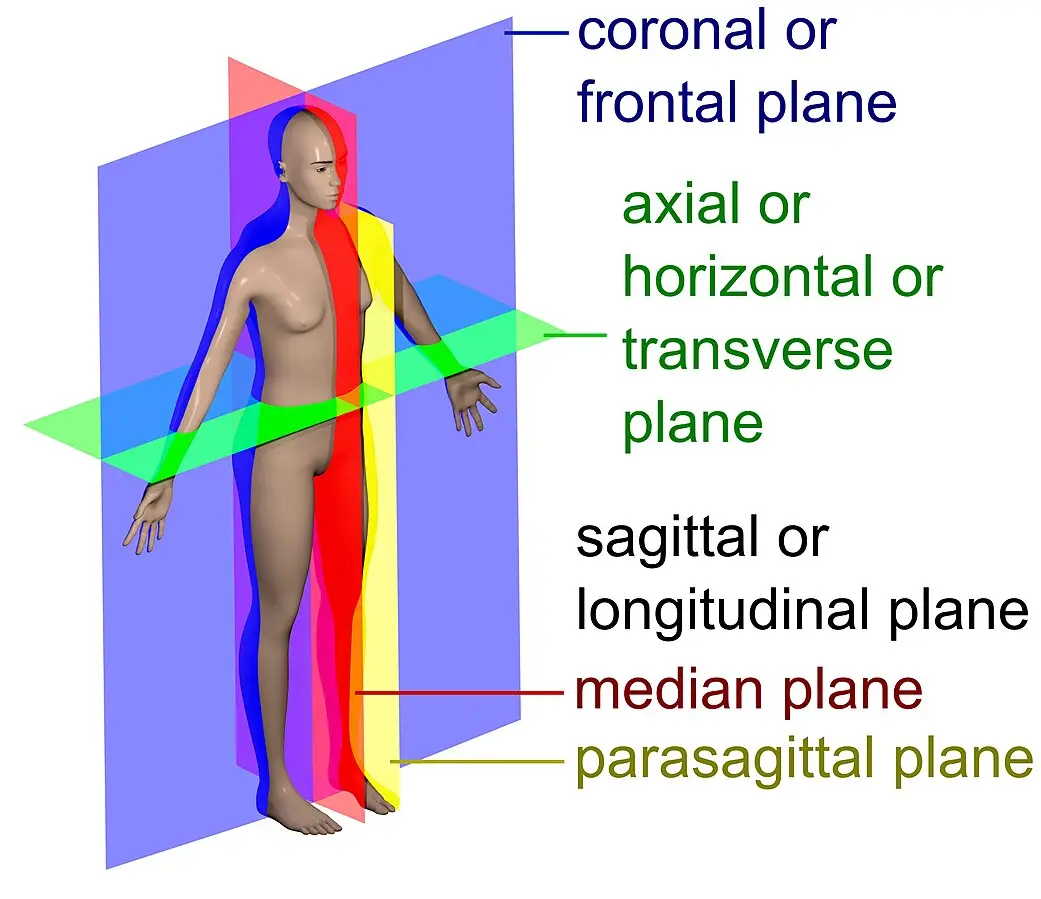
The body can be divided into planes using the anatomic position as another frame of reference. Planes are imaginary cuts or sections through the body. The use of plane terminology is common when discussing diagnostic imaging (e.g., computed tomography [CT] scan) of the body. Diagnostic imaging will be discussed in more detail later in the chapter.
Besides the directional terms discussed in the prior section (e.g., anterior, posterior, superior), additional terms can be used to indicate a position on the patient. Here are some additional positional and directional terms:
Real world examples
The right leg is ipsilateral to the right arm but contralateral to the left arm.
The skin is superficial, whereas bones are deep in the body.
The toes are distal to the knee, while the hip is proximal to the knee.
The afferent arteriole brings blood to the glomerulus; the efferent arteriole carries blood away from the glomerulus.
Body cavities
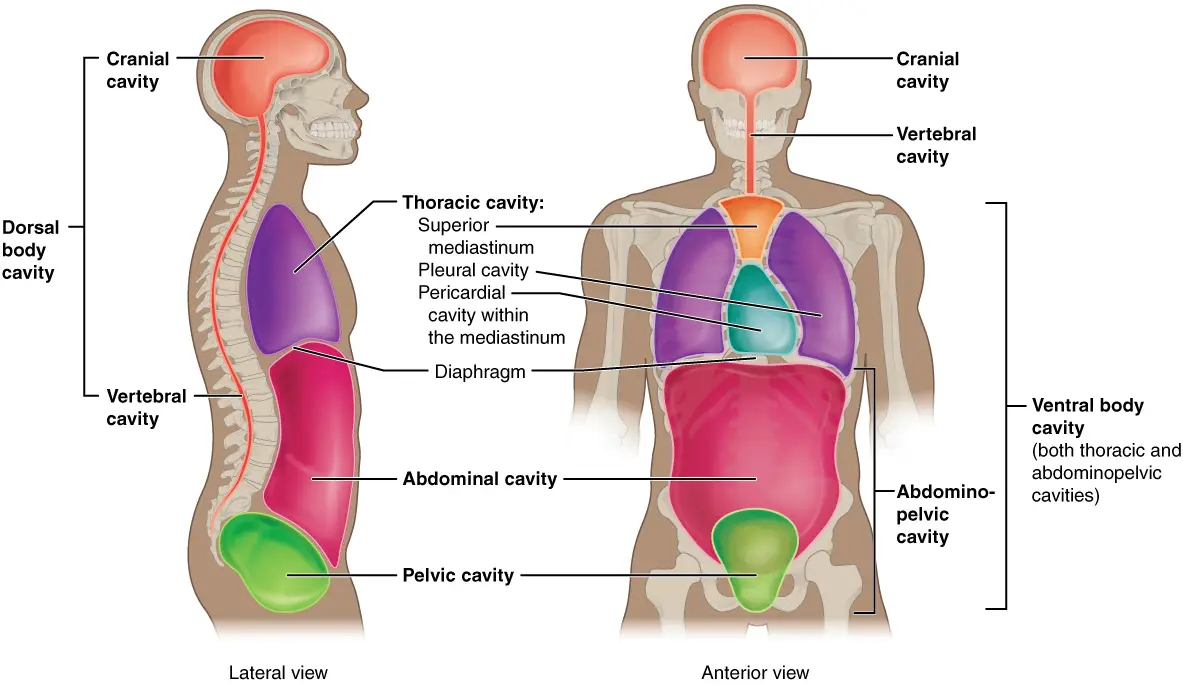
The body contains cavities or hollow areas that are filled with organs. The body is separated into the dorsal (posterior) and ventral (anterior) body cavities.
The dorsal body cavity protects the nervous system organs and contains the following:
The ventral body cavity consists of two cavities that are divided by the diaphragm:
The abdominopelvic cavity is extensive. Either the four quadrants or the nine regions can be used to help describe a location in the abdominopelvic area. Descriptions that focus on the quadrants are simpler to understand and may be used with patients. The regions are more specific and are typically used by healthcare providers.
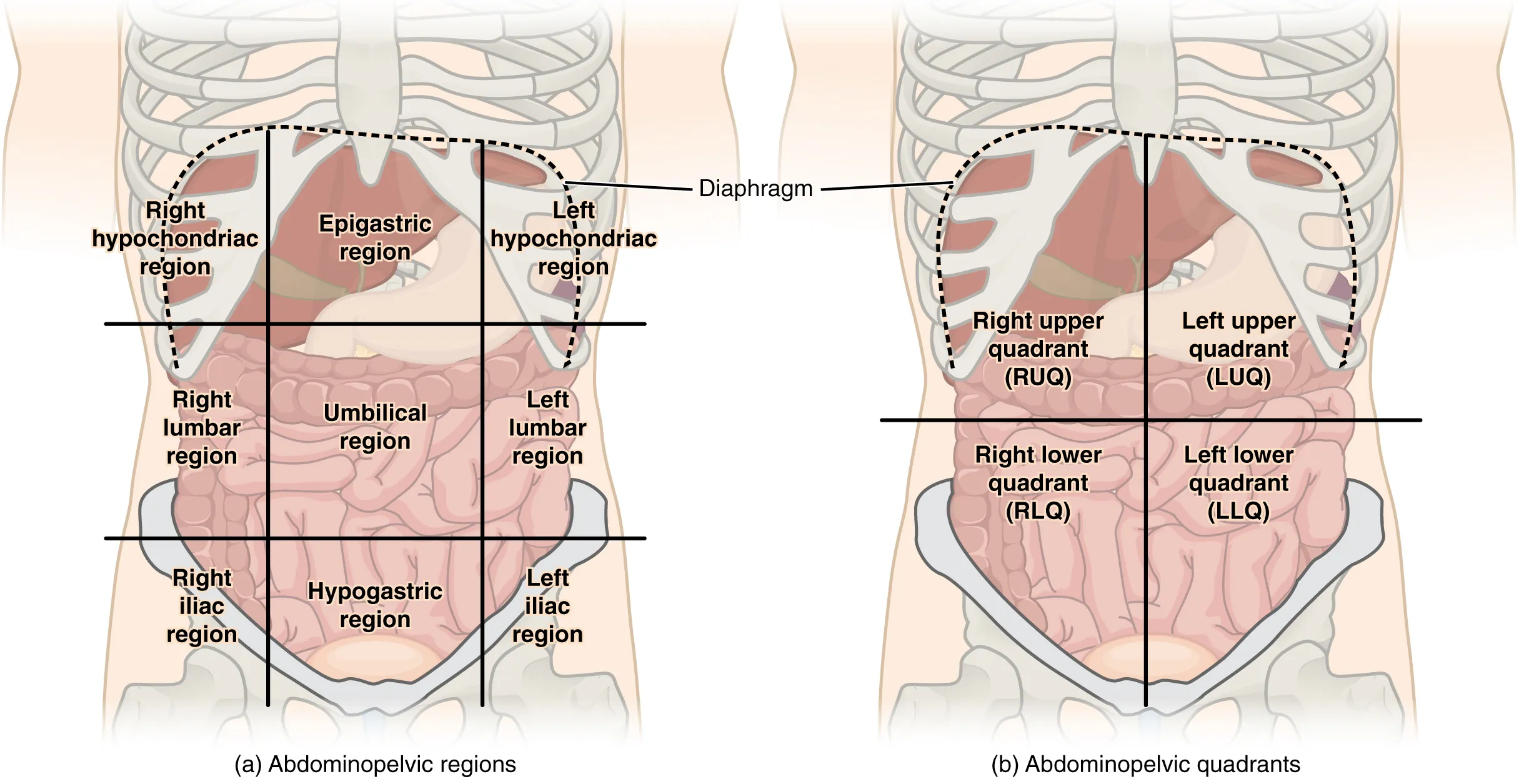
With the abdominopelvic quadrants, an imaginary line is drawn down the midline of the body. A horizontal line is drawn across the abdominopelvic cavity, intersecting at the navel. These quadrants are referred to as either right or left and upper or lower. Typically, abbreviations are used when documenting information about the patient.
The nine abdominopelvic regions lie over the abdominopelvic cavity. They provide a more specific location than the quadrants.
The regions sit in three rows of three, like a tic-tac-toe grid laid over the abdomen: the two hypochondriac regions with the epigastric between them across the top, the two lumbar regions with the umbilical between them across the middle, and the two iliac regions with the hypogastric between them across the bottom. As with the quadrants, right and left always mean the patient’s right and left.
In healthcare, we use medical terminology to communicate a precise message to others. Earlier in the chapter, medical terminology word parts were discussed. Medical terminology also includes directional terms, planes, body cavities, and abdominopelvic quadrants and regions. All of these terms are used in healthcare to give precise descriptions and are based on a standard frame of reference, the anatomic position. The anatomic position means the body stands erect with the face forward, arms at the sides, palms forward, and toes pointed forward.
The body can be divided into planes using the anatomic position as another frame of reference. Planes are imaginary cuts or sections through the body. The use of plane terminology is common when discussing diagnostic imaging (e.g., computed tomography [CT] scan) of the body. Diagnostic imaging will be discussed in more detail later in the chapter.
Directional and positional terms
Besides the directional terms discussed in the prior section (e.g., anterior, posterior, superior), additional terms can be used to indicate a position on the patient. Here are some additional positional and directional terms:
Real world examples
The right leg is ipsilateral to the right arm but contralateral to the left arm.
The skin is superficial, whereas bones are deep in the body.
The toes are distal to the knee, while the hip is proximal to the knee.
The afferent arteriole brings blood to the glomerulus; the efferent arteriole carries blood away from the glomerulus.
Body cavities
The body contains cavities or hollow areas that are filled with organs. The body is separated into the dorsal (posterior) and ventral (anterior) body cavities.
The dorsal body cavity protects the nervous system organs and contains the following:
The ventral body cavity consists of two cavities that are divided by the diaphragm:
Abdominopelvic quadrants and regions
The abdominopelvic cavity is extensive. Either the four quadrants or the nine regions can be used to help describe a location in the abdominopelvic area. Descriptions that focus on the quadrants are simpler to understand and may be used with patients. The regions are more specific and are typically used by healthcare providers.
With the abdominopelvic quadrants, an imaginary line is drawn down the midline of the body. A horizontal line is drawn across the abdominopelvic cavity, intersecting at the navel. These quadrants are referred to as either right or left and upper or lower. Typically, abbreviations are used when documenting information about the patient.
The nine abdominopelvic regions lie over the abdominopelvic cavity. They provide a more specific location than the quadrants.
The regions sit in three rows of three, like a tic-tac-toe grid laid over the abdomen: the two hypochondriac regions with the epigastric between them across the top, the two lumbar regions with the umbilical between them across the middle, and the two iliac regions with the hypogastric between them across the bottom. As with the quadrants, right and left always mean the patient’s right and left.