



Wrapping up
You’ve finished AP Statistics, a college-level course that covers data, probability, and statistical inference. Along the way, you’ve learned how to design studies, analyze data, run statistical tests, and communicate conclusions in context.
Registering for the AP Statistics exam
The College Board offers the AP Statistics exam each May.
Registration is usually handled through your school’s AP coordinator. If your school doesn’t have an AP coordinator, ask your guidance counsellor who manages AP exam registration.
If your school doesn’t offer AP exams, you can register through an approved test center. Visit the College Board website and follow the instructions for testing as a homeschooled or independent student.
When you register, you’ll typically need:
- Your full legal name
- Your school information (or homeschool status)
- The AP subjects you plan to test in (not necessarily just AP Statistics)
If you register through your school, your AP coordinator will give you an AP ID and any other identifying information that links you to your exam registration.
Exam costs
The AP Statistics exam has a registration fee of $99 USD set by the College Board, but your school may charge a different total due to local fees.
Some schools offer reduced or subsidised fees for students with financial need through local or state-funded programs. Check with your guidance counsellor or AP coordinator to see what fee reductions you may be eligible for.
Passing score
The AP Statistics exam is scored on a 1-5 scale.
A score of 3 or higher is considered passing.
For enrollment or placement, some colleges and universities require a 4 or 5 for certain types of credit or placement. Check the AP credit policy for the specific colleges or universities you’re interested in.
If you don’t earn the score you need, you can register to retake the exam the following May. There isn’t a separate waiting period beyond the fact that AP exams are offered once per year.
Aids policy
- A non-programmable calculator is allowed. Many students use a TI-84, but you should check the official list of approved calculators on the College Board website, since policies can change.
- A formula sheet is not provided, but a few key formulas and the necessary distribution tables are provided at the end of the exam booklet.
Accommodations
If you have a documented disability and need accommodations, talk with your school’s AP coordinator or your guidance counsellor well in advance.
Accommodations must be approved by the College Board Services for Students with Disabilities, and deadlines are often several months before the exam date.
Dump sheet
Many test takers use “dump sheets” as study supplements and as a way to create a legal reference during the exam. A dump sheet typically includes visual guides and condensed notes on key topics. The idea is to memorize the material ahead of time and then “dump” it onto your notepad at the beginning of the exam.
These are allowed in the test center as long as they are created after the test has started (and not during the initial tutorial). They aren’t required to succeed, but some test takers find them helpful.
You can certainly create your own, but here are Achievable’s AP Stats dump sheets:
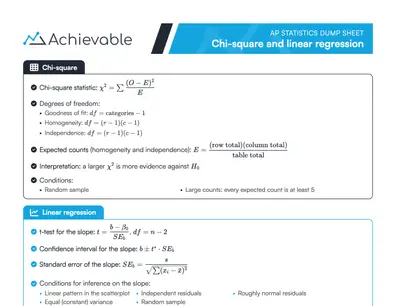
Download: AP Stats Dump Sheet - Chi-square
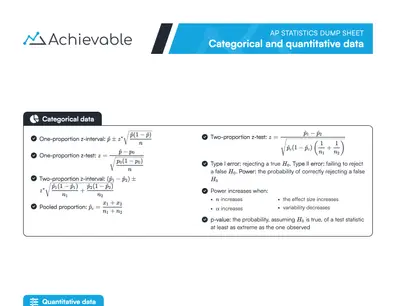
Download: AP Stats Dump Sheet - Categorical data
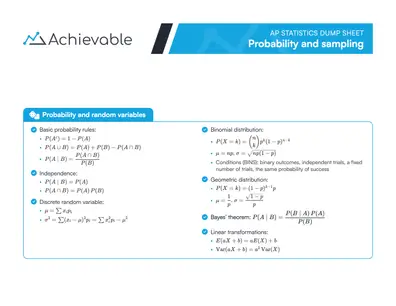
Download: AP Stats Dump Sheet - Probability
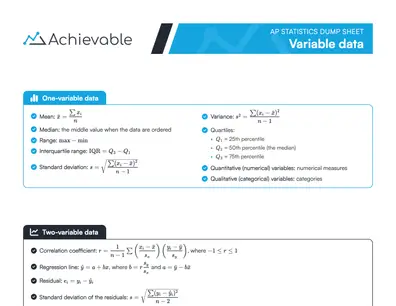
Download: AP Stats Dump Sheet - Variable data
Tips for success
- Take mock exams under realistic conditions: use only an approved calculator, set a time limit, and avoid unauthorized aids (including the internet and artificial intelligence). Otherwise, your mock score won’t reflect what you can do on the real exam.
- For free-response questions, write explanations that a knowledgeable reader can follow. Graders look for clear reasoning and correct statistical communication, not just final answers.
- Get comfortable with your calculator so you can use the right functions quickly and interpret the output correctly.
- Review key concepts by focusing on the big ideas and main takeaways from each unit, not just memorizing formulas.
- Plan the night before: pack your approved calculator, pencils, erasers, and any required ID or documents. Aim for a good night’s sleep and a solid breakfast on exam day.