


Achievable logoAchievable logo
AP Physics 1
Sign in
Sign up
Purchase
Textbook
Practice exams
Support
How it works
Exam catalog
Mountain with a flag at the peak
Textbook
Introduction
1. Decoding the exam
2. Vectors and their analysis
2.1 Basics of vectors
2.2 Components analysis
3. Kinematics
4. Laws of motion
5. Work, energy, and power
6. Linear momentum and collisions
7. Torque and rotational mechanics
8. Oscillations
9. Fluids
Wrapping up
Achievable logoAchievable logo
2.2 Components analysis
Achievable AP Physics 1
2. Vectors and their analysis
Our AP Physics 1 course is currently in development and is a work-in-progress.

Components analysis

9 min read
Font
Discuss
Share
Feedback

This sub-chapter builds on the Basics of vectors section by looking more closely at how to break vectors into components and switch between different representations. These skills show up constantly in physics, especially when you’re resolving forces or motion along convenient directions.

In this sub-chapter, we’ll cover:

  • Review and transition
  • Conversion between polar and rectangular forms
  • Decomposition along standard axes
  • Resolving vectors in rotated or non-standard axes
  • Projection of vectors
  • Applications and example problems

Review and transition

Here’s a quick recap of the key ideas we’ll use throughout this sub-chapter:

  • Vector basics: A vector is a quantity with both magnitude and direction. You can represent vectors graphically (arrows) and algebraically (components), and you can add or subtract them.

  • Magnitude of a vector: For a vector expressed as

    v=vx​i^+vy​j^​,

    the magnitude is

    ∣v∣=vx2​+vy2​​.

With those fundamentals in place, we can focus on two core tasks:

  • breaking a vector into components along chosen axes
  • converting between polar and rectangular forms

Conversion between polar and rectangular forms

Vectors are commonly written in two equivalent ways:

  • Polar form: A magnitude V and an angle θ (measured from the horizontal axis).

  • Rectangular (component) form: Components along the x- and y-axes:

    V=Vx​i^+Vy​j^​.

Converting from polar to rectangular form

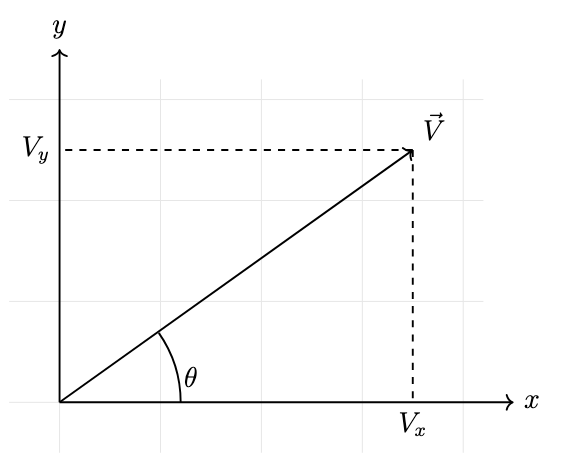
If a vector V has magnitude V and angle θ, its components come from right-triangle trigonometry:

  • Horizontal component:

    Vx​=Vcosθ

  • Vertical component:

    Vy​=Vsinθ

Vector resolved into horizontal and vertical components

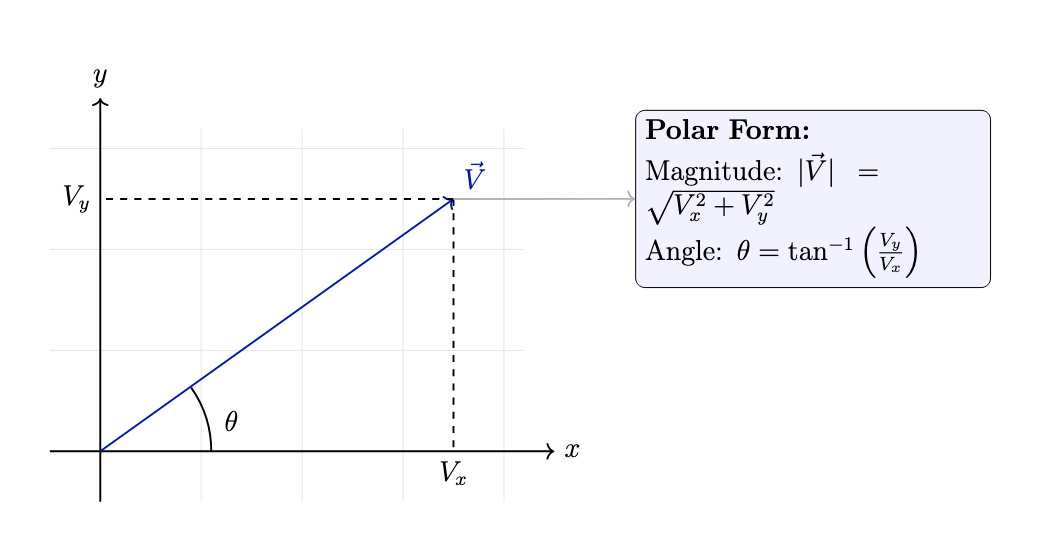
Converting from rectangular to polar form

If you’re given components,

V=Vx​i^+Vy​j^​,

you can recover the magnitude and direction:

  • Magnitude:

    V=Vx2​+Vy2​​

  • Direction:

    θ=tan−1(Vx​Vy​​)

Conversion from rectangular components to polar form

Decomposition along standard axes

When your axes are the usual horizontal (x) and vertical (y) directions, resolving a vector is straightforward. For a vector V making an angle θ with the horizontal:

  • Horizontal component:

    Vx​=Vcosθ

  • Vertical component:

    Vy​=Vsinθ

Example problem 1

A vector has a magnitude of 12 units and makes an angle of 40∘ with the horizontal. Find its components.

Solution:

(spoiler)

Vx​=12cos40∘≈12×0.766=9.19

Vy​=12sin40∘≈12×0.643=7.72

Thus,

V≈(9.19,7.72).

Resolving vectors in rotated or non-standard axes

In many physics problems, the most useful axes aren’t horizontal and vertical. For example, on an inclined plane it’s often easiest to choose one axis along the plane and the other perpendicular to it.

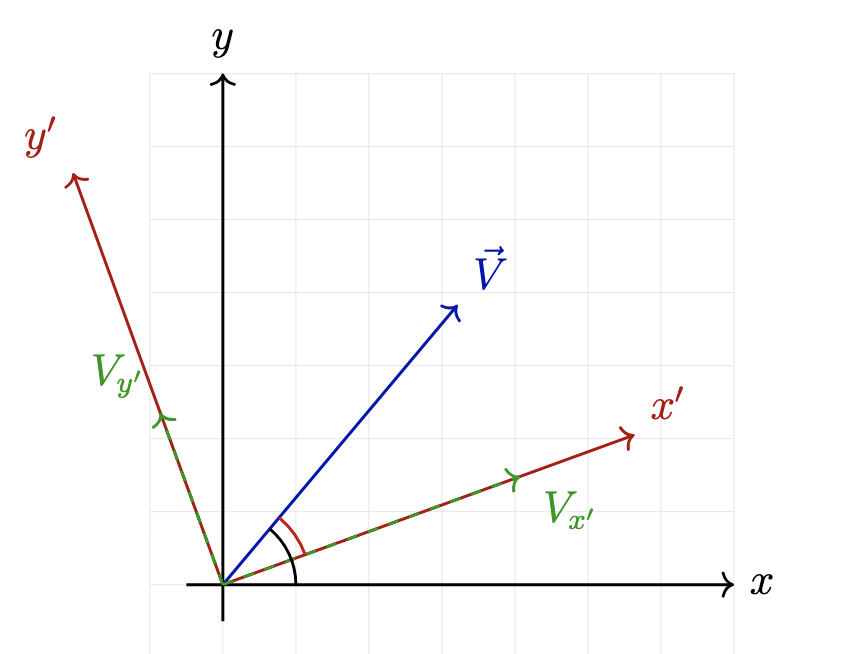
Decomposition in a rotated coordinate system

Assume the coordinate system is rotated by an angle α relative to the horizontal. If a vector V makes an angle θ relative to the horizontal, then the angle relative to the rotated x′-axis is:

ϕ=θ−α

Using that relative angle, the components in the rotated system are:

  • Component along x′:

    Vx′​=Vcos(θ−α)

  • Component along y′:

    Vy′​=Vsin(θ−α)

Vectors in a rotated coordinate system

Example problem 2

A force of 30 N acts at an angle of 70∘ from the horizontal. If the coordinate system is rotated by 20∘ clockwise, find the components of the force in the rotated system.

Solution:

(spoiler)
  1. Compute the relative angle:

    ϕ=70∘−20∘=50∘

  2. Resolve into components:

Fx′​=30cos50∘≈30×0.643=19.29N

Fy′​=30sin50∘≈30×0.766=22.98N

Projection of vectors

Why use projections?

A projection tells you how much of one vector points in the direction of another. This matters in physics because:

  • Simplification of problems: Often, only the component of a vector along a particular direction affects the situation you’re analyzing.

  • Understanding work and energy: In work calculations, only the component of force along the displacement contributes to work.

  • Vector decomposition: Projections give a systematic way to break vectors into parts aligned with specific directions, especially when the axes aren’t standard.

Scalar projection

The scalar projection (or component) of vector A onto vector B is:

compB​A=∣B∣A⋅B​=∣A∣cosθ,

where θ is the angle between A and B.

Vector projection

The vector projection of A onto B is:

projB​A=(∣B∣2A⋅B​)B.

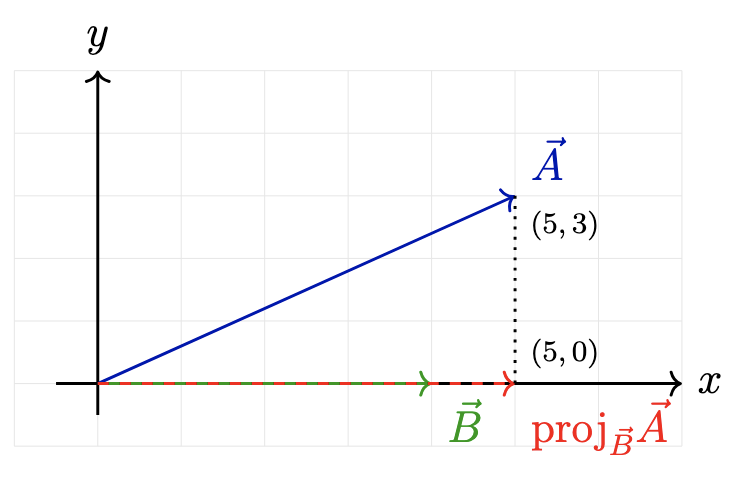
Example problem 3

Find the scalar and vector projections of

A=(5,3)

onto

B=(4,0).

Solution:

(spoiler)
  1. Scalar projection:

    compB​A=∣B∣A⋅B​=45×4+3×0​=420​=5.

  2. Vector projection:

    projB​A=(4220​)B=(1620​)(4,0)=(45​)(4,0)=(5,0).

Projection of vector A onto B

Additional questions

Now let’s apply these techniques in more integrated problems. Example problem 4

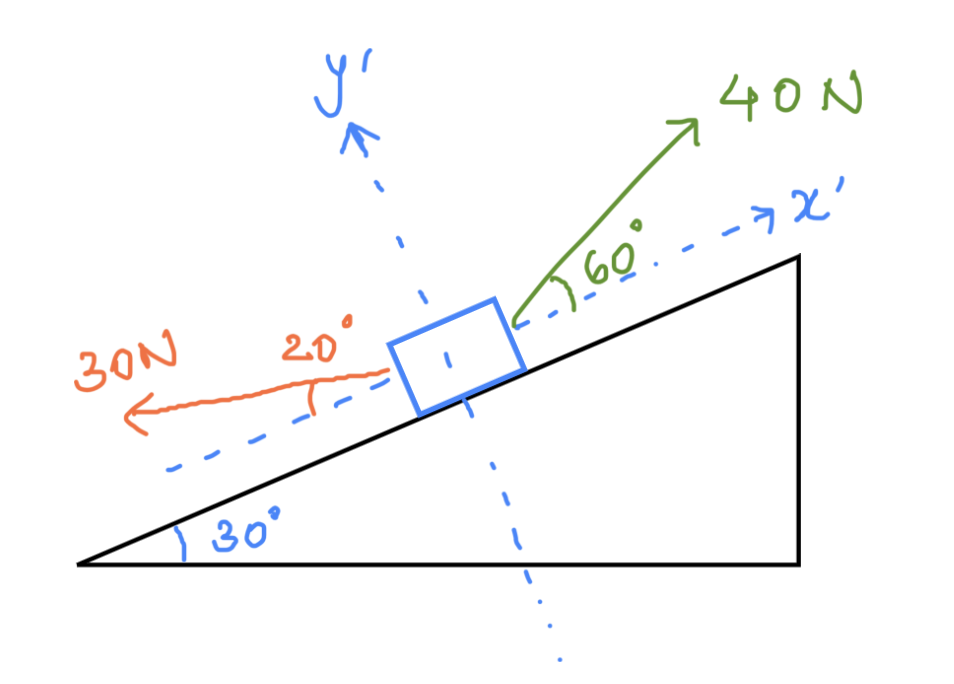
A block on an inclined plane experiences two forces. The first force is 40 N acting at an angle of 60∘ from the plane upwards along the incline, and the second is 30 N acting at an angle of 20∘ from the plane downwards along the incline. The plane is inclined at 30∘ from the horizontal. Find the net force acting along the plane.

Solution:

(spoiler)
  1. Set up the rotated axes: Align the x′-axis along the plane and the y′-axis perpendicular to the plane.

  2. Resolve each force into x′ components:

    • For the 40 N force (acting upward along the plane):

    F1,x′​=40cos60∘=40×0.5=20N.

    • For the 30 N force (acting downward along the plane):

    F2,x′​=30cos20∘≈30×0.94=28.2N.

  3. Determine the net force: Assuming the 28.2 N force acts in the opposite direction to the 20 N force, the net force along the plane is:

    Fnet,x′​=28.2N−20N=8.2N.

Forces and their resolution along the plane

Example problem 5 Problem: Vectors A and B have magnitudes of 6 N and 8 N respectively, and the angle between them is 120∘. Find the magnitude and direction of the resultant vector

R=A+B.

Solution:

(spoiler)
  1. Magnitude (using the cosine rule):

    R2=62+82−2×6×8cos120∘.

    Since

cos120∘=−0.5,

R2=36+64+96×0.5=100+48=148,

R≈148​≈12.17N.

  1. Direction (using the sine rule): Let θ be the angle between A and R. Then:

    8sinθ​=12.17sin120∘​.

    Calculate

sin120∘≈0.866

and solve for θ:

sinθ≈12.178×0.866​≈0.569,

θ≈34.7∘.

This is the angle between A and the resultant R.

Review and transition\

  • Vectors: quantities with magnitude and direction
  • Magnitude formula: ∣v∣=vx2​+vy2​​
  • Key skills: breaking vectors into components, converting between polar and rectangular forms

Conversion between polar and rectangular forms\

  • Polar form: magnitude V and angle θ
  • Rectangular form: components Vx​=Vcosθ, Vy​=Vsinθ
  • From components to polar:
    • Magnitude: V=Vx2​+Vy2​​
    • Direction: θ=tan−1(Vy​/Vx​)

Decomposition along standard axes\

  • Standard axes: horizontal (x) and vertical (y)
  • Components:
    • Vx​=Vcosθ
    • Vy​=Vsinθ
  • Used when axes are not rotated

Resolving vectors in rotated or non-standard axes\

  • Rotated axes: axes at angle α from horizontal
  • Relative angle: ϕ=θ−α
  • Components in rotated system:
    • Vx′​=Vcos(θ−α)
    • Vy′​=Vsin(θ−α)

Projection of vectors\

  • Scalar projection: compB​A=∣B∣A⋅B​=∣A∣cosθ
  • Vector projection: projB​A=(∣B∣2A⋅B​)B
  • Projections simplify problems, especially with non-standard axes

Applications and example problems\

  • Use component methods to resolve forces and motion along chosen axes
  • For multiple vectors, use cosine and sine rules to find resultant magnitude and direction
  • Always align axes with the problem’s geometry for simplification

Sign up for free to take 5 quiz questions on this topic

Previous
Next  | 3.1 Introduction and basic concepts
All rights reserved ©2016 - 2026 Achievable, Inc.

Components analysis

This sub-chapter builds on the Basics of vectors section by looking more closely at how to break vectors into components and switch between different representations. These skills show up constantly in physics, especially when you’re resolving forces or motion along convenient directions.

In this sub-chapter, we’ll cover:

  • Review and transition
  • Conversion between polar and rectangular forms
  • Decomposition along standard axes
  • Resolving vectors in rotated or non-standard axes
  • Projection of vectors
  • Applications and example problems

Review and transition

Here’s a quick recap of the key ideas we’ll use throughout this sub-chapter:

  • Vector basics: A vector is a quantity with both magnitude and direction. You can represent vectors graphically (arrows) and algebraically (components), and you can add or subtract them.

  • Magnitude of a vector: For a vector expressed as

    v=vx​i^+vy​j^​,

    the magnitude is

    ∣v∣=vx2​+vy2​​.

With those fundamentals in place, we can focus on two core tasks:

  • breaking a vector into components along chosen axes
  • converting between polar and rectangular forms

Conversion between polar and rectangular forms

Vectors are commonly written in two equivalent ways:

  • Polar form: A magnitude V and an angle θ (measured from the horizontal axis).

  • Rectangular (component) form: Components along the x- and y-axes:

    V=Vx​i^+Vy​j^​.

Converting from polar to rectangular form

If a vector V has magnitude V and angle θ, its components come from right-triangle trigonometry:

  • Horizontal component:

    Vx​=Vcosθ

  • Vertical component:

    Vy​=Vsinθ

Converting from rectangular to polar form

If you’re given components,

V=Vx​i^+Vy​j^​,

you can recover the magnitude and direction:

  • Magnitude:

    V=Vx2​+Vy2​​

  • Direction:

    θ=tan−1(Vx​Vy​​)

Decomposition along standard axes

When your axes are the usual horizontal (x) and vertical (y) directions, resolving a vector is straightforward. For a vector V making an angle θ with the horizontal:

  • Horizontal component:

    Vx​=Vcosθ

  • Vertical component:

    Vy​=Vsinθ

Example problem 1

A vector has a magnitude of 12 units and makes an angle of 40∘ with the horizontal. Find its components.

Solution:

(spoiler)

Vx​=12cos40∘≈12×0.766=9.19

Vy​=12sin40∘≈12×0.643=7.72

Thus,

V≈(9.19,7.72).

Resolving vectors in rotated or non-standard axes

In many physics problems, the most useful axes aren’t horizontal and vertical. For example, on an inclined plane it’s often easiest to choose one axis along the plane and the other perpendicular to it.

Decomposition in a rotated coordinate system

Assume the coordinate system is rotated by an angle α relative to the horizontal. If a vector V makes an angle θ relative to the horizontal, then the angle relative to the rotated x′-axis is:

ϕ=θ−α

Using that relative angle, the components in the rotated system are:

  • Component along x′:

    Vx′​=Vcos(θ−α)

  • Component along y′:

    Vy′​=Vsin(θ−α)

Example problem 2

A force of 30 N acts at an angle of 70∘ from the horizontal. If the coordinate system is rotated by 20∘ clockwise, find the components of the force in the rotated system.

Solution:

(spoiler)
  1. Compute the relative angle:

    ϕ=70∘−20∘=50∘

  2. Resolve into components:

Fx′​=30cos50∘≈30×0.643=19.29N

Fy′​=30sin50∘≈30×0.766=22.98N

Projection of vectors

Why use projections?

A projection tells you how much of one vector points in the direction of another. This matters in physics because:

  • Simplification of problems: Often, only the component of a vector along a particular direction affects the situation you’re analyzing.

  • Understanding work and energy: In work calculations, only the component of force along the displacement contributes to work.

  • Vector decomposition: Projections give a systematic way to break vectors into parts aligned with specific directions, especially when the axes aren’t standard.

Scalar projection

The scalar projection (or component) of vector A onto vector B is:

compB​A=∣B∣A⋅B​=∣A∣cosθ,

where θ is the angle between A and B.

Vector projection

The vector projection of A onto B is:

projB​A=(∣B∣2A⋅B​)B.

Example problem 3

Find the scalar and vector projections of

A=(5,3)

onto

B=(4,0).

Solution:

(spoiler)
  1. Scalar projection:

    compB​A=∣B∣A⋅B​=45×4+3×0​=420​=5.

  2. Vector projection:

    projB​A=(4220​)B=(1620​)(4,0)=(45​)(4,0)=(5,0).

Additional questions

Now let’s apply these techniques in more integrated problems. Example problem 4

A block on an inclined plane experiences two forces. The first force is 40 N acting at an angle of 60∘ from the plane upwards along the incline, and the second is 30 N acting at an angle of 20∘ from the plane downwards along the incline. The plane is inclined at 30∘ from the horizontal. Find the net force acting along the plane.

Solution:

(spoiler)
  1. Set up the rotated axes: Align the x′-axis along the plane and the y′-axis perpendicular to the plane.

  2. Resolve each force into x′ components:

    • For the 40 N force (acting upward along the plane):

    F1,x′​=40cos60∘=40×0.5=20N.

    • For the 30 N force (acting downward along the plane):

    F2,x′​=30cos20∘≈30×0.94=28.2N.

  3. Determine the net force: Assuming the 28.2 N force acts in the opposite direction to the 20 N force, the net force along the plane is:

    Fnet,x′​=28.2N−20N=8.2N.

Example problem 5 Problem: Vectors A and B have magnitudes of 6 N and 8 N respectively, and the angle between them is 120∘. Find the magnitude and direction of the resultant vector

R=A+B.

Solution:

(spoiler)
  1. Magnitude (using the cosine rule):

    R2=62+82−2×6×8cos120∘.

    Since

cos120∘=−0.5,

R2=36+64+96×0.5=100+48=148,

R≈148​≈12.17N.

  1. Direction (using the sine rule): Let θ be the angle between A and R. Then:

    8sinθ​=12.17sin120∘​.

    Calculate

sin120∘≈0.866

and solve for θ:

sinθ≈12.178×0.866​≈0.569,

θ≈34.7∘.

This is the angle between A and the resultant R.

Key points

Review and transition\

  • Vectors: quantities with magnitude and direction
  • Magnitude formula: ∣v∣=vx2​+vy2​​
  • Key skills: breaking vectors into components, converting between polar and rectangular forms

Conversion between polar and rectangular forms\

  • Polar form: magnitude V and angle θ
  • Rectangular form: components Vx​=Vcosθ, Vy​=Vsinθ
  • From components to polar:
    • Magnitude: V=Vx2​+Vy2​​
    • Direction: θ=tan−1(Vy​/Vx​)

Decomposition along standard axes\

  • Standard axes: horizontal (x) and vertical (y)
  • Components:
    • Vx​=Vcosθ
    • Vy​=Vsinθ
  • Used when axes are not rotated

Resolving vectors in rotated or non-standard axes\

  • Rotated axes: axes at angle α from horizontal
  • Relative angle: ϕ=θ−α
  • Components in rotated system:
    • Vx′​=Vcos(θ−α)
    • Vy′​=Vsin(θ−α)

Projection of vectors\

  • Scalar projection: compB​A=∣B∣A⋅B​=∣A∣cosθ
  • Vector projection: projB​A=(∣B∣2A⋅B​)B
  • Projections simplify problems, especially with non-standard axes

Applications and example problems\

  • Use component methods to resolve forces and motion along chosen axes
  • For multiple vectors, use cosine and sine rules to find resultant magnitude and direction
  • Always align axes with the problem’s geometry for simplification

More from Vectors and their analysis

  • Basics of vectors