



Basics of vectors
Vectors are essential in AP Physics 1 because they let you describe quantities that have both magnitude and direction. Here’s what this section focuses on:
What is a vector?
A vector is a quantity that has both magnitude and direction. This contrasts with a scalar, which has only magnitude (such as mass or temperature).
- Notation: Vectors are typically written in bold (e.g., v) or with an arrow over the letter (e.g., ). The magnitude of a vector is written as .
Representing vectors on the coordinate plane
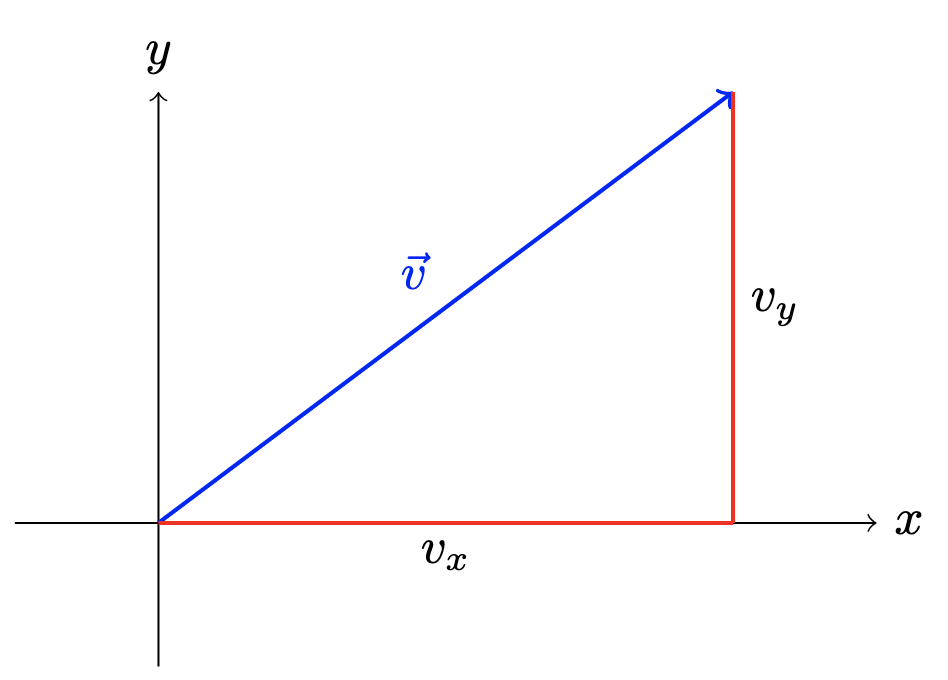
We usually draw a vector as an arrow:
- The length of the arrow represents the magnitude.
- The direction of the arrow shows which way the vector points.
In two dimensions, a vector can be written in component form as:
where:
- is the component along the -axis,
- is the component along the -axis,
- and are the unit vectors in the and directions respectively.
For example, the vector with components and can be written in component form as
or equivalently in coordinate form as .
Finding the magnitude of a vector
The magnitude (or length) of a vector tells you how large the vector is, independent of its direction. For a vector written in component form:
you find the magnitude using the Pythagorean theorem:
Example: If , then the magnitude is:
Being able to compute magnitude matters because many physics vectors - like displacement, velocity, and force - often need to be reported as a single “size” value.
Vector addition and subtraction methods
In physics, you often need to combine vectors to find a net effect (for example, the net force on an object). Two common graphical methods are the tip-to-tail method and the parallelogram method.
Tip-to-tail method
Procedure:
- Draw the first vector with its tail at a chosen starting point.
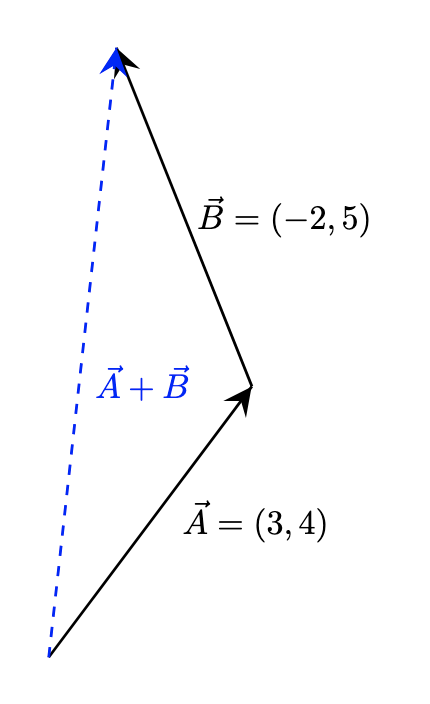
- Place the tail of the second vector at the tip of the first.
- For additional vectors, continue by placing each new vector’s tail at the tip of the previous one.
- Draw the resultant vector from the tail of the first vector to the tip of the final vector.
Parallelogram method
Procedure:
- Draw the two vectors so that their tails start at the same point.
- Construct a parallelogram using the two vectors as adjacent sides.
- Draw the diagonal from the common tail; that diagonal is the resultant vector.
Subtraction of vectors
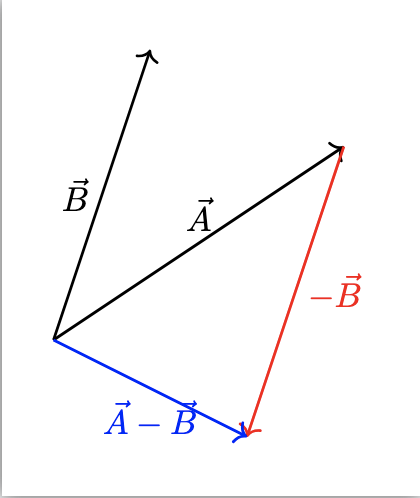
Vector subtraction is done by adding the negative of a vector. To compute :
- Reverse the direction of to get .
- Add and using either the tip-to-tail or parallelogram method.
For example, if
then:
Example problem 1
Given: Vector A = Vector B =
Find:
Solution:
-
Components:
-
Sum components:
-
Resultant:
-
Interpretation: The resultant vector points 1 unit to the right (positive x-direction) and 9 units upward (positive y-direction).
Example problem 2
Given: Vector E = Vector F = Vector G =
Find:
Solution:
-
Components:
-
Sum components:
-
Resultant:
-
Interpretation: The resultant vector points 5 units to the right and 2 units upward, representing the combined effect of all three vectors.