


Achievable logoAchievable logo
AP Physics 1
Sign in
Sign up
Purchase
Textbook
Practice exams
Support
How it works
Exam catalog
Mountain with a flag at the peak
Textbook
Introduction
1. Decoding the exam
1.1 Purpose and structure
1.2 Problem solving strategies
2. Vectors and their analysis
3. Kinematics
4. Laws of motion
5. Work, energy, and power
6. Linear momentum and collisions
7. Torque and rotational mechanics
8. Oscillations
9. Fluids
Wrapping up
Achievable logoAchievable logo
1.2 Problem solving strategies
Achievable AP Physics 1
1. Decoding the exam
Our AP Physics 1 course is currently in development and is a work-in-progress.

Problem solving strategies

6 min read
Font
Discuss
Share
Feedback

Success on the AP Physics 1 exam comes from two things working together: a strong understanding of core physics ideas and a consistent problem-solving routine. The strategies below show how to approach both the Multiple-Choice (MCQ) and Free-Response (FRQ) sections, with representative examples.

Multiple-choice question (MCQ) strategies

  • Read carefully and identify key details
  • Analyze and translate the question
  • Eliminate and verify

Read carefully and identify key details

  • Understand the scenario: Read each question carefully and mark key phrases (for example, “frictionless surface,” “free-fall,” or “oscillation”). These phrases tell you what assumptions you’re allowed to make.

  • Determine the focus: Identify the main physics concept being tested (such as kinematics, dynamics, or energy conservation). This helps you choose the right relationships without getting distracted by extra details.

Analyze and translate the question

  • Visualize the problem: Sketch a quick diagram if it helps you keep directions, forces, or motion straight.
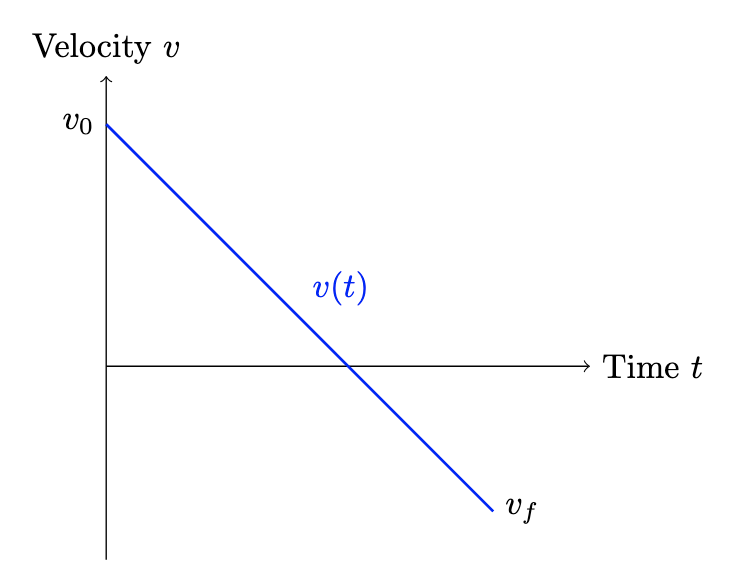
Velocity time graph
Velocity time graph
  • List known and unknown quantities: Write down what’s given and what you need to find. If the question is conceptual, translate it into a statement about how a quantity should change (increase/decrease, linear/curved, constant/non-constant).

Eliminate and verify

  • Eliminate incorrect options: Use conceptual checks (sign, direction, units, and graph shape) to rule out choices that can’t be right.

  • Check boundary conditions: Test extreme or limiting cases when possible. If an answer fails a simple reality check, eliminate it.

Representative example (MCQ)

Example question:

A small ball is thrown vertically upward with an initial speed v0​. Which of the following best describes the velocity vs. time graph for the ball (neglect air resistance)?

(A) A horizontal line at v=v0​
(B) A straight line with a constant positive slope
(C) A straight line with a constant negative slope
(D) A parabolic curve opening downward

(spoiler)

Correct answer : C

Strategy walk-through:

  1. Identify the concept: This is uniformly accelerated motion under gravity. The acceleration is constant and downward.

  2. Visualize and analyze: With upward taken as positive, the acceleration is negative. The velocity starts at v0​, decreases at a constant rate, reaches zero at the top, and then becomes negative on the way down. A constant acceleration means a straight-line v vs. t graph.

  3. Eliminate choices:

    • (A) is incorrect because the velocity changes over time.
    • (B) is incorrect because the slope should be negative (velocity is decreasing).
    • (D) is incorrect because a parabola would indicate changing acceleration.
  4. Select the correct answer: (C) is correct: a straight line with a constant negative slope.

Tip: Keep your sign convention consistent. If you choose up as positive, gravity must be negative throughout your work.

Free-response question (FRQ) strategies

  • Initial reading and planning
  • Organize your work clearly
  • Explain your reasoning thoroughly

Initial reading and planning

  • Read the entire question: Skim the whole FRQ first to see what it’s asking overall, then re-read and note the details that matter (given values, constraints, and what each part asks you to find).

  • Plan your approach: Before you calculate, outline the principles and equations you expect to use and the order you’ll use them in. This helps you avoid starting down an approach that doesn’t match the question.

Organize your work clearly

  • Structure your answer: Divide your response into clear sections:
    1. Diagram and given information: Draw a diagram and label all known values and variables.

      Free body diagram
      Free body diagram
    2. Relevant equations and concepts: List the physics principles you plan to use (for example, conservation of momentum or kinematics).

    3. Step-by-step calculations: Show each step clearly so the grader can follow your logic.

    4. Final answer with units: State the final result clearly and include proper units.

Explain your reasoning thoroughly

  • Use complete sentences: Explain why each principle applies (for example, why momentum is conserved in the situation described).

  • Justify assumptions: State any assumptions you’re using (such as negligible friction or ideal conditions) so it’s clear what model you’re applying.

Representative example (FRQ)

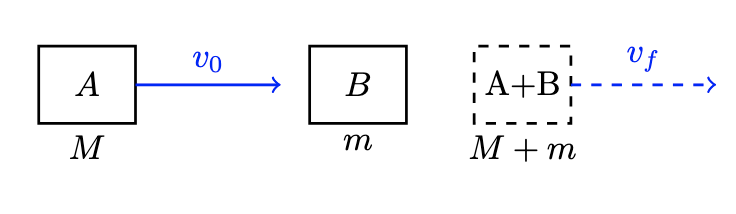
Block A of mass M moves with speed v0​ toward Block B of mass m (with m≪M) which is initially at rest. When the two collide, they stick together. (a) Using conservation of momentum, derive an expression for the final speed vf​ of the combined mass. (b) Explain qualitatively why, when m is much smaller than M, vf​ is nearly equal to v0​.

Strategy walk-through

  1. Identify the relevant principle

    Linear momentum is conserved for this collision. Before the collision, only Block A is moving:

    pinitial​=Mv0​

    After the collision, the combined mass (M+m) moves with speed vf​:

    pfinal​=(M+m)vf​

  2. Solve the equation

    By conservation of momentum:

    Mv0​=(M+m)vf​

    Rearranging to solve for vf​:

    vf​=M+mMv0​​

    Since m≪M, we can approximate M+m≈M, hence:

    vf​≈MMv0​​=v0​

  3. Explain your reasoning

    When m is much smaller than M, adding Block B doesn’t change the total mass very much. Because the initial momentum is fixed at Mv0​, the speed after they stick together stays close to v0​.

  4. Final answer

    • Derived expression:

      vf​=M+mMv0​​

    • Qualitative explanation:

      Since m≪M, the increase in mass is negligible, so vf​ is approximately equal to v0​.

Tip: In FRQs, clear labels and a visible chain of reasoning often earn as much credit as the final number.

General tips for both sections

  • Practice regularly: Work a variety of problems so you recognize common setups and the principles that go with them.
  • Review mistakes: When you miss a problem, identify whether the issue was a concept, a setup choice, an algebra step, or a sign/unit error.
  • Manage your time: For MCQs, practice pacing so you can read carefully without getting stuck. For FRQs, budget time to plan before you calculate.

Using these strategies consistently helps you approach both MCQs and FRQs in a structured way, manage time effectively, and communicate your reasoning clearly.

Multiple-choice question (MCQ) strategies\

  • Read carefully; mark key phrases and assumptions
  • Identify main physics concept being tested
  • Visualize with diagrams; list knowns/unknowns
  • Eliminate choices using sign, direction, units, graph shape
  • Check boundary/extreme cases for reality checksRepresentative example (MCQ)\
  • Uniformly accelerated motion: constant acceleration, straight-line v vs. t graph
  • Correct answer: straight line with constant negative slope (velocity decreases due to gravity)
  • Keep sign convention consistent throughout solutionFree-response question (FRQ) strategies\
  • Read entire question; note details, values, constraints
  • Plan approach: outline principles, equations, solution order
  • Organize response: diagram, list givens, equations, step-by-step work, final answer with units
  • Explain reasoning: use complete sentences, justify assumptionsRepresentative example (FRQ)\
  • Conservation of momentum: Mv0​=(M+m)vf​
  • Derived final speed: vf​=M+mMv0​​
    • If m≪M, vf​≈v0​
  • Qualitative explanation: small m means combined speed barely changes from v0​General tips for both sections\
  • Practice regularly with varied problems
  • Review and analyze mistakes for concept/setup errors
  • Manage time: pace MCQs, plan before calculating on FRQs
Previous
Next  | 2.1 Basics of vectors
All rights reserved ©2016 - 2026 Achievable, Inc.

Problem solving strategies

Success on the AP Physics 1 exam comes from two things working together: a strong understanding of core physics ideas and a consistent problem-solving routine. The strategies below show how to approach both the Multiple-Choice (MCQ) and Free-Response (FRQ) sections, with representative examples.

Multiple-choice question (MCQ) strategies

  • Read carefully and identify key details
  • Analyze and translate the question
  • Eliminate and verify

Read carefully and identify key details

  • Understand the scenario: Read each question carefully and mark key phrases (for example, “frictionless surface,” “free-fall,” or “oscillation”). These phrases tell you what assumptions you’re allowed to make.

  • Determine the focus: Identify the main physics concept being tested (such as kinematics, dynamics, or energy conservation). This helps you choose the right relationships without getting distracted by extra details.

Analyze and translate the question

  • Visualize the problem: Sketch a quick diagram if it helps you keep directions, forces, or motion straight.
  • List known and unknown quantities: Write down what’s given and what you need to find. If the question is conceptual, translate it into a statement about how a quantity should change (increase/decrease, linear/curved, constant/non-constant).

Eliminate and verify

  • Eliminate incorrect options: Use conceptual checks (sign, direction, units, and graph shape) to rule out choices that can’t be right.

  • Check boundary conditions: Test extreme or limiting cases when possible. If an answer fails a simple reality check, eliminate it.

Representative example (MCQ)

Example question:

A small ball is thrown vertically upward with an initial speed v0​. Which of the following best describes the velocity vs. time graph for the ball (neglect air resistance)?

(A) A horizontal line at v=v0​
(B) A straight line with a constant positive slope
(C) A straight line with a constant negative slope
(D) A parabolic curve opening downward

(spoiler)

Correct answer : C

Strategy walk-through:

  1. Identify the concept: This is uniformly accelerated motion under gravity. The acceleration is constant and downward.

  2. Visualize and analyze: With upward taken as positive, the acceleration is negative. The velocity starts at v0​, decreases at a constant rate, reaches zero at the top, and then becomes negative on the way down. A constant acceleration means a straight-line v vs. t graph.

  3. Eliminate choices:

    • (A) is incorrect because the velocity changes over time.
    • (B) is incorrect because the slope should be negative (velocity is decreasing).
    • (D) is incorrect because a parabola would indicate changing acceleration.
  4. Select the correct answer: (C) is correct: a straight line with a constant negative slope.

Tip: Keep your sign convention consistent. If you choose up as positive, gravity must be negative throughout your work.

Free-response question (FRQ) strategies

  • Initial reading and planning
  • Organize your work clearly
  • Explain your reasoning thoroughly

Initial reading and planning

  • Read the entire question: Skim the whole FRQ first to see what it’s asking overall, then re-read and note the details that matter (given values, constraints, and what each part asks you to find).

  • Plan your approach: Before you calculate, outline the principles and equations you expect to use and the order you’ll use them in. This helps you avoid starting down an approach that doesn’t match the question.

Organize your work clearly

  • Structure your answer: Divide your response into clear sections:
    1. Diagram and given information: Draw a diagram and label all known values and variables.

    2. Relevant equations and concepts: List the physics principles you plan to use (for example, conservation of momentum or kinematics).

    3. Step-by-step calculations: Show each step clearly so the grader can follow your logic.

    4. Final answer with units: State the final result clearly and include proper units.

Explain your reasoning thoroughly

  • Use complete sentences: Explain why each principle applies (for example, why momentum is conserved in the situation described).

  • Justify assumptions: State any assumptions you’re using (such as negligible friction or ideal conditions) so it’s clear what model you’re applying.

Representative example (FRQ)

Block A of mass M moves with speed v0​ toward Block B of mass m (with m≪M) which is initially at rest. When the two collide, they stick together. (a) Using conservation of momentum, derive an expression for the final speed vf​ of the combined mass. (b) Explain qualitatively why, when m is much smaller than M, vf​ is nearly equal to v0​.

Strategy walk-through

  1. Identify the relevant principle

    Linear momentum is conserved for this collision. Before the collision, only Block A is moving:

    pinitial​=Mv0​

    After the collision, the combined mass (M+m) moves with speed vf​:

    pfinal​=(M+m)vf​

  2. Solve the equation

    By conservation of momentum:

    Mv0​=(M+m)vf​

    Rearranging to solve for vf​:

    vf​=M+mMv0​​

    Since m≪M, we can approximate M+m≈M, hence:

    vf​≈MMv0​​=v0​

  3. Explain your reasoning

    When m is much smaller than M, adding Block B doesn’t change the total mass very much. Because the initial momentum is fixed at Mv0​, the speed after they stick together stays close to v0​.

  4. Final answer

    • Derived expression:

      vf​=M+mMv0​​

    • Qualitative explanation:

      Since m≪M, the increase in mass is negligible, so vf​ is approximately equal to v0​.

Tip: In FRQs, clear labels and a visible chain of reasoning often earn as much credit as the final number.

General tips for both sections

  • Practice regularly: Work a variety of problems so you recognize common setups and the principles that go with them.
  • Review mistakes: When you miss a problem, identify whether the issue was a concept, a setup choice, an algebra step, or a sign/unit error.
  • Manage your time: For MCQs, practice pacing so you can read carefully without getting stuck. For FRQs, budget time to plan before you calculate.

Using these strategies consistently helps you approach both MCQs and FRQs in a structured way, manage time effectively, and communicate your reasoning clearly.

Key points

Multiple-choice question (MCQ) strategies\

  • Read carefully; mark key phrases and assumptions
  • Identify main physics concept being tested
  • Visualize with diagrams; list knowns/unknowns
  • Eliminate choices using sign, direction, units, graph shape
  • Check boundary/extreme cases for reality checksRepresentative example (MCQ)\
  • Uniformly accelerated motion: constant acceleration, straight-line v vs. t graph
  • Correct answer: straight line with constant negative slope (velocity decreases due to gravity)
  • Keep sign convention consistent throughout solutionFree-response question (FRQ) strategies\
  • Read entire question; note details, values, constraints
  • Plan approach: outline principles, equations, solution order
  • Organize response: diagram, list givens, equations, step-by-step work, final answer with units
  • Explain reasoning: use complete sentences, justify assumptionsRepresentative example (FRQ)\
  • Conservation of momentum: Mv0​=(M+m)vf​
  • Derived final speed: vf​=M+mMv0​​
    • If m≪M, vf​≈v0​
  • Qualitative explanation: small m means combined speed barely changes from v0​General tips for both sections\
  • Practice regularly with varied problems
  • Review and analyze mistakes for concept/setup errors
  • Manage time: pace MCQs, plan before calculating on FRQs

More from Decoding the exam

  • Purpose and structure