


Achievable logoAchievable logo
AP Macroeconomics
Sign in
Sign up
Purchase
Textbook
Practice exams
Support
How it works
Exam catalog
Mountain with a flag at the peak
Textbook
Example
1. Core economic concepts
2. Measurement of economic performance
3. Modeling of income and prices
4. Financial sector
5. Long-run consequences of stabilization policy
6. Open economy
6.1 Exchange rates
6.2 Foreign exchange market
6.3 Balance of payments
6.4 Exchange rate regimes and the long run
6.5 Open economy $AD$ and policy
Achievable logoAchievable logo
6.1 Exchange rates
Achievable AP Macroeconomics
6. Open economy
Our AP Macroeconomics course is currently in development and is a work-in-progress.

Exchange rates

9 min read
Font
Discuss
Share
Feedback

For transactions that cross a border, exchange rates play a key role. Recall that an exchange rate is the rate at which the currency of one country can be traded for that of another. Each exchange rate is specific to a pair of currencies and some currencies are shared across countries.

You have likely seen the dollar sign $ in use for regular transactions. Other countries have their own currency symbols, such as the euro €, British pound £ and Japanese yen ¥. Confusingly many countries use similar currency names and many do not have their own symbol.

Canada, Australia and New Zealand also use dollars. Great Britain, Egypt and Lebanon all use pounds. Mexico, Argentina, Chile and Colombia all use pesos. A way to avoid confusion is to use three letter abbreviations for currencies. For example USD for the US dollar this is USD, CAD for the Canadian dollar, AUD for the Australian dollar and NZD for the New Zealand dollar. Other large currency abbreviations are EUR for the euro, GBP for the British pound, and JPY for the Japanese yen…

Beyond providing clarity if context is not clear, abbreviations also make it easier to look up exchange rates. On many websites you can look up USDEUR or USD/EUR to see the dollar to euro exchange rate, while EURUSD or EUR/USD gives the euro to dollar exchange rate.

Foreign exchange market concepts

A time element is also possible in exchange rates. There are forward rates, where you lock in a rate now and make the exchange at a contractually specified date in the future. For our discussions we will exclusively be discussing the spot rate, the price for a trade today, which is determined in the foreign exchange market. Day to day there are not usually significant differences, but that does not have to be the case when looking at longer time periods.

The currency in the denominator or the currency listed after “per” is the market that is being focused on. So Eeuro per dollar​ will be looking at the quantity of dollars, or treating US dollars as the home currency.

When an exchange rate rises, there are two equivalent ways to describe the result. The first is that the home country currency is appreciating. It takes more euros to buy one dollar. The second is to say the foreign currency is depreciating. It takes fewer dollars to buy a euro. This dichotomy reflects that changes in exchange rates are a tug of war. For one currency to gain value the other must lose value.

Exchange rate parity refers to an exchange rate of 1. Values above one mean that the home currency is stronger. Values below one mean that the foreign currency is stronger.

US dollar and the euro

As an example, let us take the history of the US dollar and the euro. The euro represents a special case called a currency union, where many countries agree to use a common currency. It included 11 European nations when it was introduced on January 1, 1999 and as of 2026 includes 21 countries.

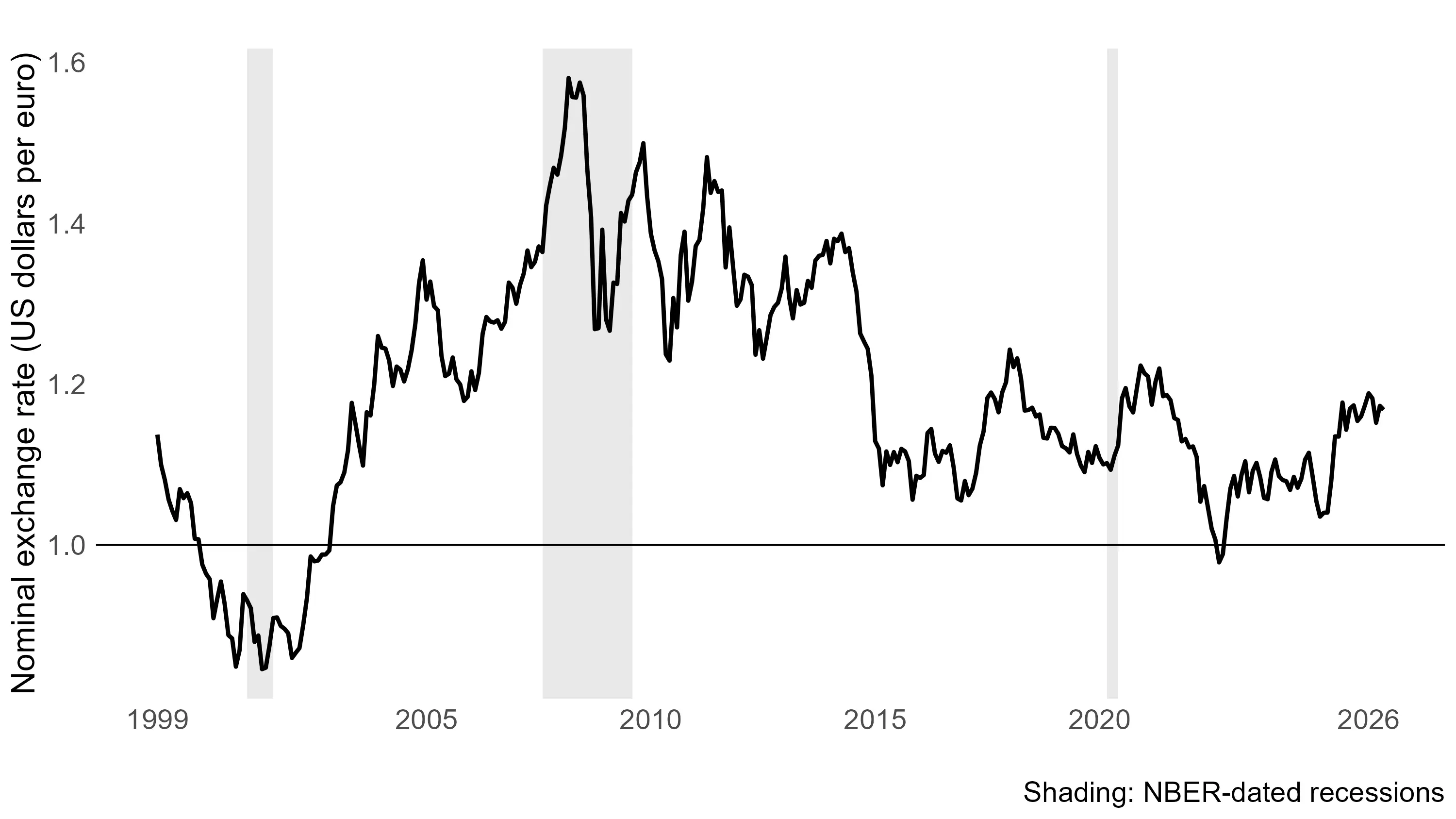
Below is the US dollar to euro exchange rate. The units are US dollars per euro, so any of the original Eurozone countries can be considered the “home country” and the US the “foreign country.”

History of the dollar to euro exchange rate from 1991 (1.1) through 2025 (1.7)
USD-EUR exchange rate (Jan 1999 - May 2026)
Public domain

One large event that is clearly visible in this chart is the Great Recession, the shaded bar around 2008. In the middle of that grey bar there is a significant appreciation of the US dollar versus the Euro, which coincides with the Global Financial Crisis.

Financial markets had been experiencing significant issues due to sub-prime mortgage lending in the US and recent years of declining house prices in many countries around the world. A number of large financial institutions went bankrupt, including the largest bank failure in US history, Washington Mutual on September 26th, 2008. Economic uncertainty was greatly increased, major stock markets had multiple days of 5-10% declines. Many financial companies converted themselves to bank holding companies to receive more assistance from the Federal Reserve.

Given these details, why would the US dollar get stronger during a crisis that started in our financial sector?

(spoiler)

Answer: It is reflective of a “flight to safety.” Even though the crisis began in the US, short-term US government bonds were the safest asset. The story, which will be presented again the next subchapter, is that an increase in demand for the risk-free asset leads to an increase in demand for dollars. This causes the dollar to appreciate.

Numerical example

If we purchase a protein bar in Germany for €1.19 and the exchange rate is 0.8604 euros per dollar or 1.1623 dollars per euro, we can find the price in dollars as follows:

Foreign Price×EHome/Foreign​1.19×.8604EForeign/Home​Foreign Price​1.16231.19​​=Domestic Price=1.02or=Domestic Price=1.02.​

So at the given exchange rate, the 1.19 euro price for a protein bar is the same as a $1.02 price in the US.

There are always two ways to complete simple conversion such as this, one using multiplication by an exchange rate and another using division by the exchange rate with the currencies switched, the inverse rate.

A trick to complete the correct calculation is to focus on the units. The units should “cancel” to leave a price denominated in the currency of interest. This is true even beyond calculations for a single good, when examining baskets of goods and services.

Real exchange rates

When you look up an exchange rate or make a purchase denominated in a foreign currency, that is the spot rate. However these are nominal rates, so for someone using an American bank account this would be euros per dollar when in Berlin, yen per dollars when in Tokyo, British pound per dollar when in London and so on.

As with GDP and interest rates, these nominal values can be turned into real amounts with an adjustment for prices. The formula for real exchange rate is given by

Real exchange rate​=Nominal exchange rate×Domestic priceForeign price​.​​

The real exchange rate has no units, it reflects physical amounts production. It is a measure of how many units of goods and services in the foreign country are exchangeable for a unit of goods and services in the home country.

Just as with nominal exchange rates, parity is a real exchange rate equal to 1. A value above one means the home country is more valuable. A value below one means that the foreign country is more valuable.

Real exchange rates may be calculated for individual goods or services, as well as for baskets of goods. As long as the good or service is nearly identical across countries, the comparison can have some relevance.

The real power of the real exchange rate is shown if we analyze it using aggregate measures of price levels in each country. Using the CPI or an alternative macroeconomic price index, the real exchange rate provides a way to measure the competitiveness of the country in international markets. Because of this real exchange rates are important for analysis of macroeconomic factors, such as the level of exports and imports and international financial flows.

Setting aside the nominal exchange rate piece of that equation for the moment, relative prices are the other key factor in determining real exchange rates. Holding the nominal exchange rate constant, a higher level of foreign inflation causes the real exchange rate to rise, increasing the purchasing power of the home currency. On the other hand, a higher domestic inflation rate would cause the real exchange rate to fall, allowing the foreign currency to buy more domestic goods and services.

Purchasing Power Parity (PPP)

Real comparisons across borders

While real exchange rates do account for differences in inflation, that is not a sufficient adjustment when it comes to international comparisons. The missing issue is that countries will have different available consumption baskets. If we imagine a version of the CPI for Mexico, the fractions of income spent on key items such as food and housing would not be the same as they are in the United States. When we get further into specifics inside categories, it is more likely that there are significant differences.

The way around this is to force the basket of goods to be identical across countries when making the real exchange rate adjustment. This is called a purchasing power parity adjustment. PPP-adjusted GDP, for example, is directly comparable across countries. This is accomplished by making adjustments so that the CPI-type baskets are as similar as possible. The main downside of these adjustments, is that they require lots of data and lots of time to calculate, often taking a few years to complete. The World Bank International Comparison Program manages and updates a database as a part of the United Nations Statistical Commission.

Previous
Next  | 6.2 Foreign exchange market
All rights reserved ©2016 - 2026 Achievable, Inc.

Exchange rates

For transactions that cross a border, exchange rates play a key role. Recall that an exchange rate is the rate at which the currency of one country can be traded for that of another. Each exchange rate is specific to a pair of currencies and some currencies are shared across countries.

You have likely seen the dollar sign $ in use for regular transactions. Other countries have their own currency symbols, such as the euro €, British pound £ and Japanese yen ¥. Confusingly many countries use similar currency names and many do not have their own symbol.

Canada, Australia and New Zealand also use dollars. Great Britain, Egypt and Lebanon all use pounds. Mexico, Argentina, Chile and Colombia all use pesos. A way to avoid confusion is to use three letter abbreviations for currencies. For example USD for the US dollar this is USD, CAD for the Canadian dollar, AUD for the Australian dollar and NZD for the New Zealand dollar. Other large currency abbreviations are EUR for the euro, GBP for the British pound, and JPY for the Japanese yen…

Beyond providing clarity if context is not clear, abbreviations also make it easier to look up exchange rates. On many websites you can look up USDEUR or USD/EUR to see the dollar to euro exchange rate, while EURUSD or EUR/USD gives the euro to dollar exchange rate.

Foreign exchange market concepts

A time element is also possible in exchange rates. There are forward rates, where you lock in a rate now and make the exchange at a contractually specified date in the future. For our discussions we will exclusively be discussing the spot rate, the price for a trade today, which is determined in the foreign exchange market. Day to day there are not usually significant differences, but that does not have to be the case when looking at longer time periods.

The currency in the denominator or the currency listed after “per” is the market that is being focused on. So Eeuro per dollar​ will be looking at the quantity of dollars, or treating US dollars as the home currency.

When an exchange rate rises, there are two equivalent ways to describe the result. The first is that the home country currency is appreciating. It takes more euros to buy one dollar. The second is to say the foreign currency is depreciating. It takes fewer dollars to buy a euro. This dichotomy reflects that changes in exchange rates are a tug of war. For one currency to gain value the other must lose value.

Exchange rate parity refers to an exchange rate of 1. Values above one mean that the home currency is stronger. Values below one mean that the foreign currency is stronger.

US dollar and the euro

As an example, let us take the history of the US dollar and the euro. The euro represents a special case called a currency union, where many countries agree to use a common currency. It included 11 European nations when it was introduced on January 1, 1999 and as of 2026 includes 21 countries.

Below is the US dollar to euro exchange rate. The units are US dollars per euro, so any of the original Eurozone countries can be considered the “home country” and the US the “foreign country.”

One large event that is clearly visible in this chart is the Great Recession, the shaded bar around 2008. In the middle of that grey bar there is a significant appreciation of the US dollar versus the Euro, which coincides with the Global Financial Crisis.

Financial markets had been experiencing significant issues due to sub-prime mortgage lending in the US and recent years of declining house prices in many countries around the world. A number of large financial institutions went bankrupt, including the largest bank failure in US history, Washington Mutual on September 26th, 2008. Economic uncertainty was greatly increased, major stock markets had multiple days of 5-10% declines. Many financial companies converted themselves to bank holding companies to receive more assistance from the Federal Reserve.

Given these details, why would the US dollar get stronger during a crisis that started in our financial sector?

(spoiler)

Answer: It is reflective of a “flight to safety.” Even though the crisis began in the US, short-term US government bonds were the safest asset. The story, which will be presented again the next subchapter, is that an increase in demand for the risk-free asset leads to an increase in demand for dollars. This causes the dollar to appreciate.

Numerical example

If we purchase a protein bar in Germany for €1.19 and the exchange rate is 0.8604 euros per dollar or 1.1623 dollars per euro, we can find the price in dollars as follows:

Foreign Price×EHome/Foreign​1.19×.8604EForeign/Home​Foreign Price​1.16231.19​​=Domestic Price=1.02or=Domestic Price=1.02.​

So at the given exchange rate, the 1.19 euro price for a protein bar is the same as a $1.02 price in the US.

There are always two ways to complete simple conversion such as this, one using multiplication by an exchange rate and another using division by the exchange rate with the currencies switched, the inverse rate.

A trick to complete the correct calculation is to focus on the units. The units should “cancel” to leave a price denominated in the currency of interest. This is true even beyond calculations for a single good, when examining baskets of goods and services.

Real exchange rates

When you look up an exchange rate or make a purchase denominated in a foreign currency, that is the spot rate. However these are nominal rates, so for someone using an American bank account this would be euros per dollar when in Berlin, yen per dollars when in Tokyo, British pound per dollar when in London and so on.

As with GDP and interest rates, these nominal values can be turned into real amounts with an adjustment for prices. The formula for real exchange rate is given by

Real exchange rate​=Nominal exchange rate×Domestic priceForeign price​.​​

The real exchange rate has no units, it reflects physical amounts production. It is a measure of how many units of goods and services in the foreign country are exchangeable for a unit of goods and services in the home country.

Just as with nominal exchange rates, parity is a real exchange rate equal to 1. A value above one means the home country is more valuable. A value below one means that the foreign country is more valuable.

Real exchange rates may be calculated for individual goods or services, as well as for baskets of goods. As long as the good or service is nearly identical across countries, the comparison can have some relevance.

The real power of the real exchange rate is shown if we analyze it using aggregate measures of price levels in each country. Using the CPI or an alternative macroeconomic price index, the real exchange rate provides a way to measure the competitiveness of the country in international markets. Because of this real exchange rates are important for analysis of macroeconomic factors, such as the level of exports and imports and international financial flows.

Setting aside the nominal exchange rate piece of that equation for the moment, relative prices are the other key factor in determining real exchange rates. Holding the nominal exchange rate constant, a higher level of foreign inflation causes the real exchange rate to rise, increasing the purchasing power of the home currency. On the other hand, a higher domestic inflation rate would cause the real exchange rate to fall, allowing the foreign currency to buy more domestic goods and services.

Purchasing Power Parity (PPP)

Real comparisons across borders

While real exchange rates do account for differences in inflation, that is not a sufficient adjustment when it comes to international comparisons. The missing issue is that countries will have different available consumption baskets. If we imagine a version of the CPI for Mexico, the fractions of income spent on key items such as food and housing would not be the same as they are in the United States. When we get further into specifics inside categories, it is more likely that there are significant differences.

The way around this is to force the basket of goods to be identical across countries when making the real exchange rate adjustment. This is called a purchasing power parity adjustment. PPP-adjusted GDP, for example, is directly comparable across countries. This is accomplished by making adjustments so that the CPI-type baskets are as similar as possible. The main downside of these adjustments, is that they require lots of data and lots of time to calculate, often taking a few years to complete. The World Bank International Comparison Program manages and updates a database as a part of the United Nations Statistical Commission.

More from Open economy

  • Foreign exchange market
  • Balance of payments
  • Exchange rate regimes and the long run
  • Open economy $AD$ and policy