


Achievable logoAchievable logo
AP Calculus AB
Sign in
Sign up
Purchase
Textbook
Practice exams
Support
How it works
Exam catalog
Mountain with a flag at the peak
Textbook
Introduction
1. Limits
2. Derivative basics
3. Advanced differentiation
3.1 Chain rule
3.2 Implicit differentiation
3.3 Logarithmic differentiation
3.4 Derivatives of inverse functions
3.5 Inverse trig derivatives
4. Contextual uses
5. Analytical uses
6. Integration
7. Differential equations
8. Applications of integrals
9. Testing details tag
10. test
Wrapping up
Achievable logoAchievable logo
3.5 Inverse trig derivatives
Achievable AP Calculus AB
3. Advanced differentiation
Our AP Calculus AB course is currently in development and is a work-in-progress.

Inverse trig derivatives

7 min read
Font
Discuss
Share
Feedback

What you’ll learn:

  • How to differentiate inverse trig functions using the chain rule or by simplifying

Inverse trigonometric functions

Regular trigonometric functions take an angle θ as the input, and output a trigonometric ratio. In the context of triangles, the ratio would be the “opposite side over the hypotenuse” for sine, “adjacent side over hypotenuse” for cosine, etc. (remember the mnemonic SOHCAHTOA).

Inverse trigonometric functions swap the input and output - given a trigonometric ratio as the input, the output will be the angle that produces it, but only in certain ranges depending on the function. For example,

sin(4π​)=22​​⟺sin−1(22​​)=4π​

To find the derivative of the inverse sine (sin−1(x) or arcsin(x)) function, we use the fact that

y=sin−1(x)⟺x=sin(y)

Implicitly differentiating x=sin(y),

1=cos(y)⋅y′

y′=cos(y)1​

=cos(sin−1(x))1​

To simplify this composite trig function, note that the output of the sin−1(x) function is an angle (call it θ).

sin−1(x)=θ⟺x=sin(θ)

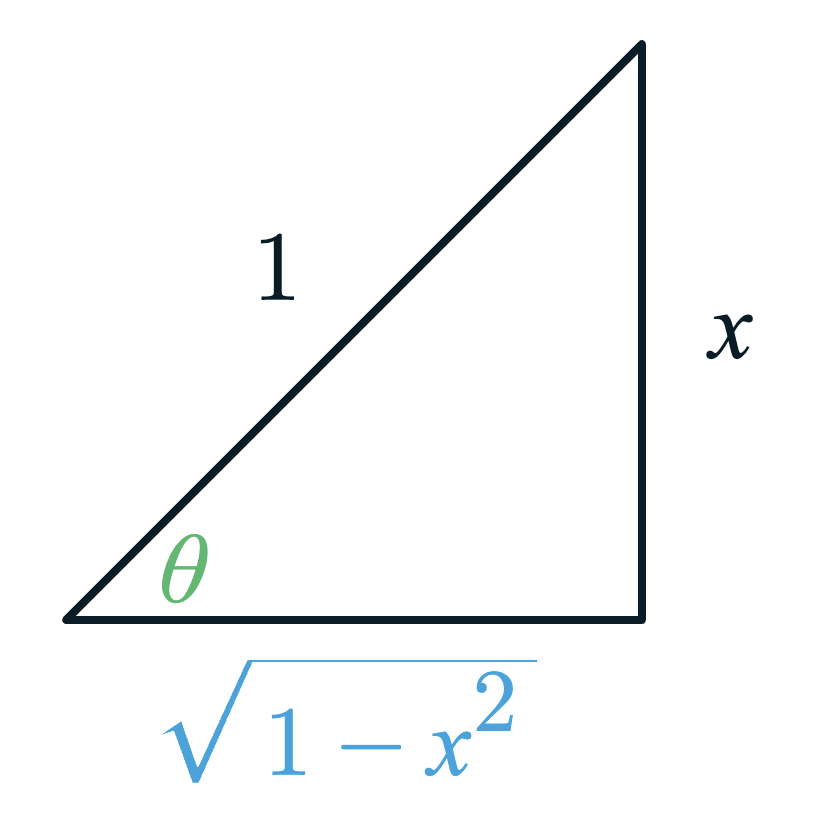
We can then draw a triangle that depicts this relationship. x is the same thing as 1x​, so in the triangle, the side opposite to θ is x, and the hypotenuse is 1. Then using the Pythagorean theorem, the length of the remaining unknown leg is 1−x2​.

Triangle sides
Triangle sides

Using the triangle shown,

y′=cos(sin−1(x))1​

=cos(θ)1​

=1−x2​1​

So the derivative of the arcsin(x) function, y=sin−1(x), is

y′=1−x2​1​

Repeating this process of simplifying nested trig functions and drawing triangles results in the derivatives of the six inverse trig functions:

f(x) f′(x)
sin−1(x) 1−x2​1​
cos−1(x) 1−x2​−1​
tan−1(x) 1+x21​
cot−1(x) 1+x2−1​
sec−1(x) ∣x∣x2−1​1​
csc−1(x) ∣x∣x2−1​−1​

Notice that every other one is simply the negative version of the one above it.

Because the value of the derivative is positive for all x on sec−1(x) (look at the graph and how all tangent lines to it are oriented), the absolute value is just to ensure this is true for all x in the domain.

The same applies to the absolute value on csc−1(x) - for all x in the domain of the inverse trig function, the derivative stays negative.

Examples with chain rule

If an inverse trig function has an argument that isn’t just plain x, then all instances of x in the derivative expressions above should be replaced with the actual argument of the inverse trig function. Don’t forget to use the chain rule as well (multiplying by the derivative of the argument). For example,

1. Find the derivative of

y=sec−1(x2+1)

Solution

The derivative of the basic y=sec−1(x) function is y′=∣x∣x2−1​1​.

For y=sec−1(x2+1), however,

y′=∣x2+1∣(x2+1)2−1​1​⋅2x​

where each instance of x is replaced by the new argument x2+1 and the chain rule is applied by multiplying the derivative of the inner function x2+1, or 2x.

2. Find dx2d2y​ for

y=cot−1(ex)

Solution

(spoiler)

The derivative of y=cot−1(x) is 1+x2−1​.

For y=cot−1(ex) with new argument ex, the 1st derivative is

y′=1+(ex)2−1​⋅ex

=1+e2x−ex​

Then the 2nd derivative using the quotient rule is

y′′=(1+e2x)2(1+e2x)(−ex)−(−ex)(2e2x)​

=(1+e2x)2(−ex)(1+e2x−2e2x)​

=(1+e2x)2−ex(1−e2x)​

=(1+e2x)2ex(e2x−1)​​

3. Find the derivative of

f(x)=tan(cos−1(2x))

Solution

(spoiler)

There are two ways to do this:

  1. Simplify the nested trig function first by drawing a triangle and then differentiate
  2. Differentiate and then simplify with the triangle.

We’ll show both.

Approach 1: Simplify → differentiate

Let cos−1(2x)=θ.

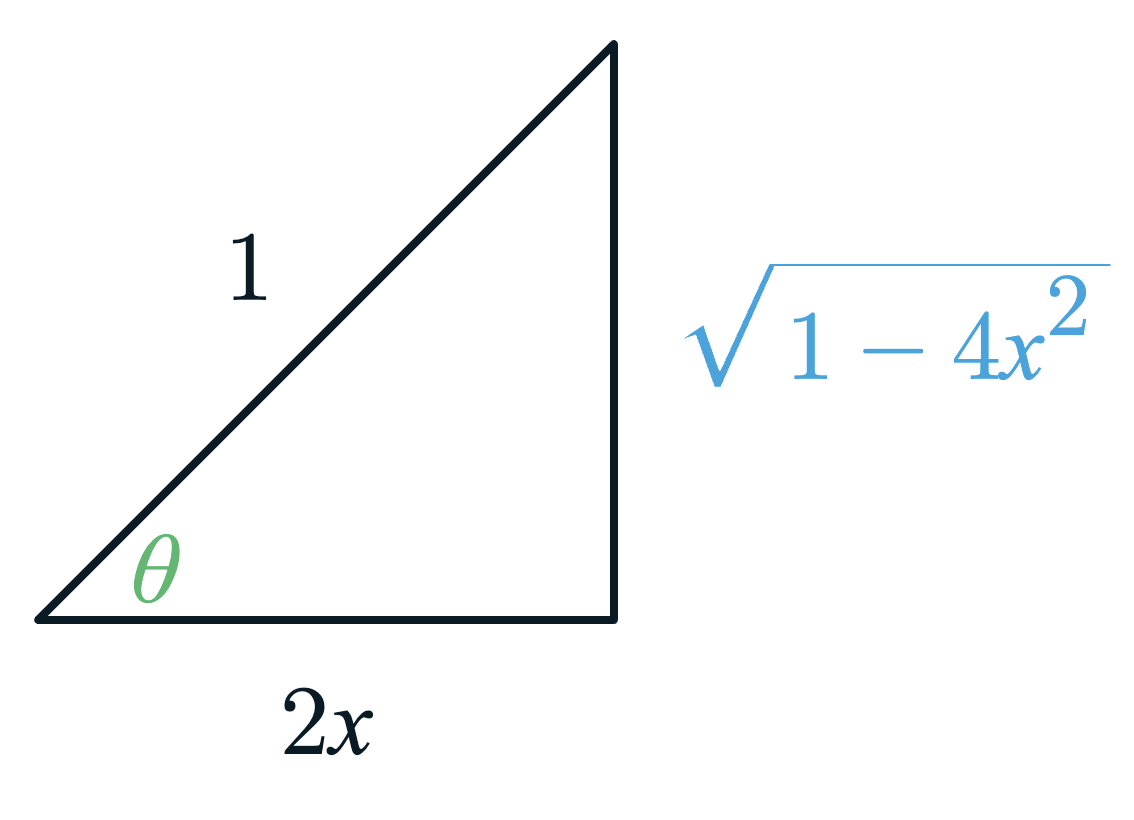
Then cos(θ)=12x​. Using the Pythagorean theorem, the remaining side of the triangle is 1−4x2​, as shown.

Triangle sides (2)
Triangle sides (2)

Then f(x) simplifies to tan(θ)=2x1−4x2​​.

Differentiating this with the quotient rule,

f′(x)=(2x)22x⋅21−4x2​1​⋅(−8x)−1−4x2​⋅2​

=4x221−4x2​−16x2​−21−4x2​​

=4x21−4x2​−8x2​−1−4x2​2(1−4x2)​​

=4x21−4x2​−8x2−2+8x2​​

=−4x21−4x2​2​

=−2x21−4x2​1​​

Approach 2: Differentiate → simplify

Differentiating with the chain rule,

f′(x)=sec2(cos−1(2x))⋅1−(2x)2​−1​⋅2

To simplify sec2(cos−1(2x)), use the same triangle shown above.

sec2(θ)=4x21​

Then

f′(x)=4x21​⋅1−4x2​−2​

=−2x21−4x2​1​​

In most cases, the faster approach will be the one that avoids the quotient rule.

4. Find the equation of the tangent line to y=arccos(x2) at x=22​​.

Solution

(spoiler)

To find the point of tangency, we’ll need to evaluate y=arccos((22​​)2)=arccos(21​).

cos−1(1/2)=y⟺cos(y)=1/2

Referencing either the unit circle or the special 30°- 60°- 90° right triangle, y=3π​.

Then the point of tangency is (22​​,3π​).

To find the slope of the tangent line,

dxd​cos−1(x2)

=−1−(x2)2​1​⋅2x

−1−x4​2x​

Evaluated at x=22​​, the slope of the tangent line is

−1−(22​​)4​2⋅22​​​

=−1−164​​2​​

=−43​​2​​

=−3​22​​

=−326​​

Then the equation of the tangent line to y=cos−1(x2) at x=22​​ is

y−3π​=−326​​(x−22​​)​

Sign up for free to take 9 quiz questions on this topic

All rights reserved ©2016 - 2026 Achievable, Inc.