



Creativity
Introduction
Many AMC problems become much easier once you look at them from a different angle. A question that seems computation-heavy often has a shortcut based on structure: symmetry, counting, similarity, or a clever reframe.
To do well on the competition, you’ll want to recognize when a “creative” approach is available and switch to it quickly. You can often solve these problems with routine calculations, but that usually costs time.
Because “change your perspective” can feel abstract, here are a few concrete habits that make it more likely you’ll spot the shortcut.
- Read multiple explanations for each question: There are multiple ways to approach AMC questions. Each explanation takes a different approach to the problem. Read other explanations not only to understand the problem, but also to notice more efficient approaches you didn’t consider.
- Look for patterns: Most AMC problems, though difficult, aren’t meant to take an exorbitant amount of time. That usually means there’s a pattern or structure hiding under the surface. Symmetry, congruent shapes, and predictable sequences can turn a hard-looking problem into a quick one.
- Practice as many problems as you can: This isn’t flashy, but it works. The more problems you do, the better your pattern recognition gets, and the more flexible you become. Below are examples of two very similar problems from just one year apart that use the same core idea.
The following questions are examples of problems that can all be solved with a creative solution.
Stars and bars
Example: The question below is from 2016 AMC 10A
For some particular value of , when is expanded and like terms are combined, the resulting expression contains exactly terms that include all four variables and , each to some positive power. What is ?
A.
B.
C.
D.
E.
Answer: B.
The key is to count how many terms have all appearing with positive exponents. That’s the same as counting how many ways the exponent can be split among with each getting at least .
Among the answer choices, only equals , so .
=
Similar triangles
Example: The question below is from 2018 AMC 10A
All of the triangles in the diagram below are similar to isosceles triangle , in which . Each of the smallest triangles has area and has area . What is the area of trapezoid ?
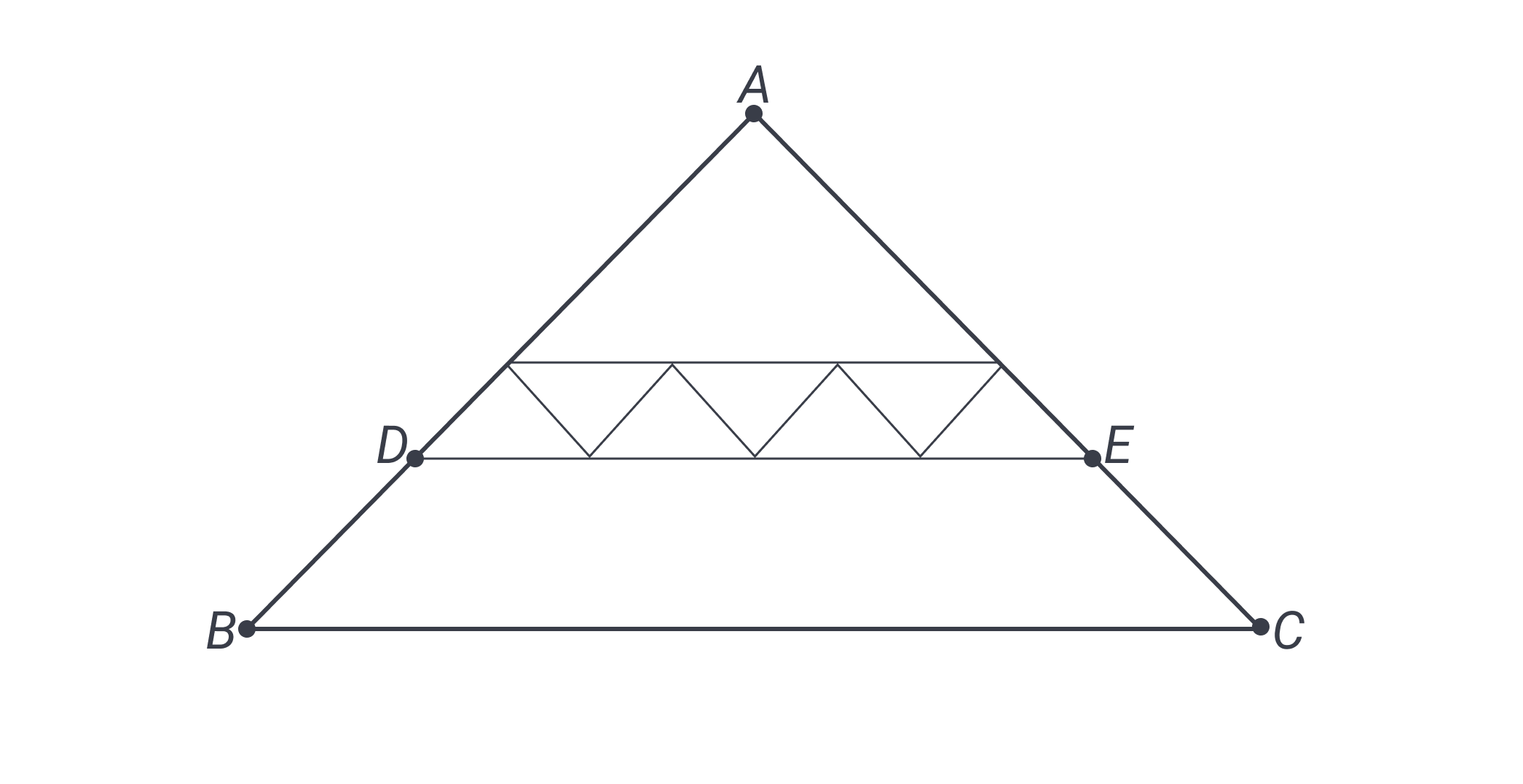
Diagram not drawn to scale A.
B.
C.
D.
E.
Answer: E.
Instead of trying to compute the trapezoid directly, treat the picture as a “tiling” of similar small triangles.
Fill in more small identical triangles above to complete triangle . There is space for more similar isosceles triangles, with the ninth at the peak. That makes total triangles above line , each with area , so the area above is .
Since has total area , the area below line (which is trapezoid ) is .
Repeating shapes
Example: The question below is from 2024 AMC 10A
Let be the kite formed by joining two right triangles with legs and along a common hypotenuse. Eight copies of are used to form the polygon shown below. What is the area of triangle ?
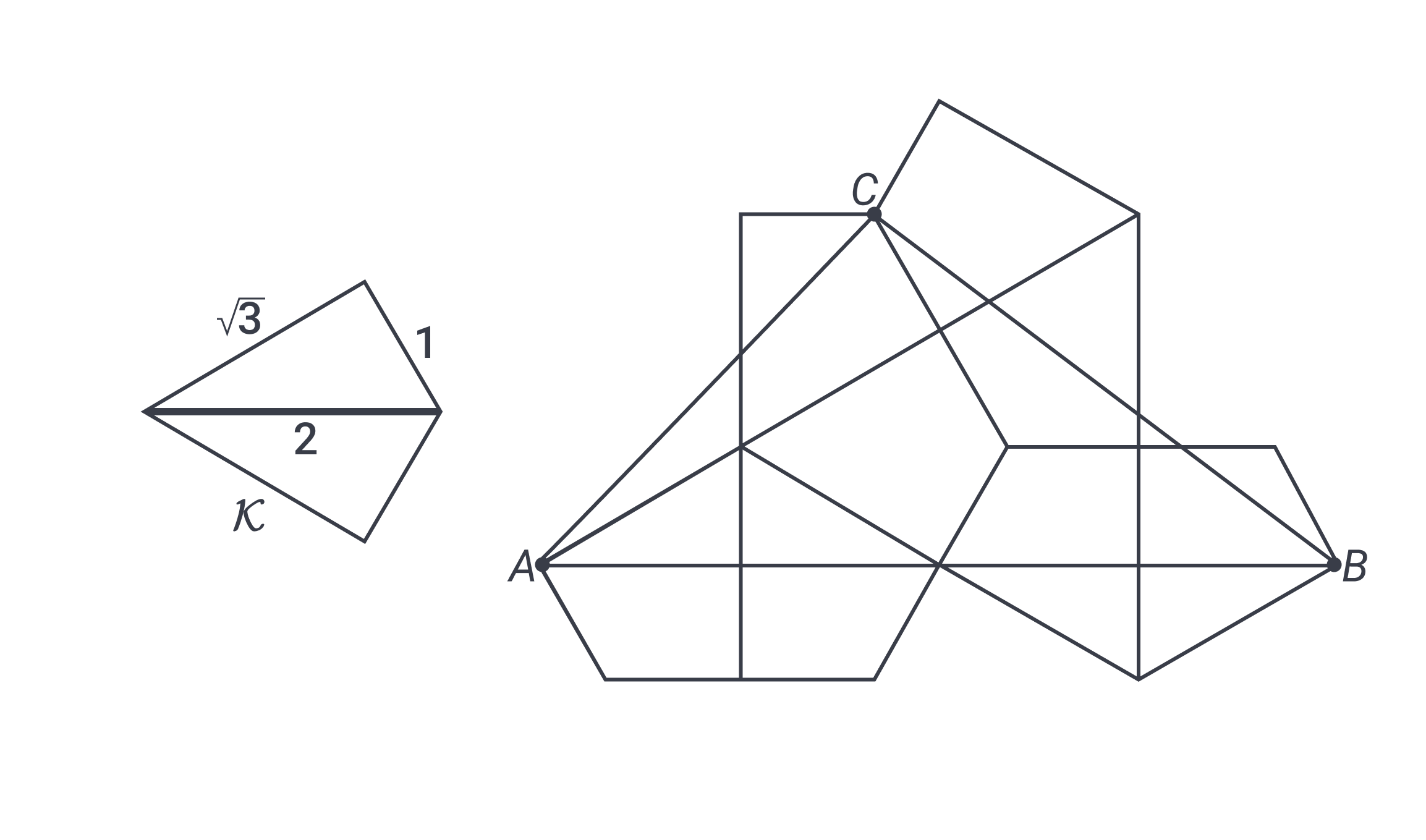
Diagram not drawn to scale A.
B.
C.
D.
E.
Answer: B.
The main move is to look for repetition. Many of the triangles are identical, and larger shapes made from two or more of those triangles repeat as well. Once you group the diagram into matching pieces, the area calculation becomes much more direct.
The best way to solve is “your” way
As you work more problems, you’ll notice that certain approaches feel more natural to you than others. You may also find that an official solution doesn’t match your method, even though your answer is correct.
That’s normal, and it’s useful. The goal is to build a toolbox of perspectives - then choose the one that gets you to a correct solution quickly and reliably. It’s still worth reading other explanations, because they can add new tools to your toolbox, but you don’t need to force yourself into one “standard” method.
Here’s a problem that can be approached in many ways. One clean approach reduces the 3D situation to a basic right triangle: the hypotenuse is (the sphere’s radius), and one leg is (the distance from the sphere’s surface to the line from the center up to the plane). Then you solve for the remaining leg of a right triangle with leg and hypotenuse . That’s the key geometric reduction behind the question below.
Example: The question below is from 2019 AMC 10A
A sphere with center has radius . A triangle with sides of length and is situated in space so that each of its sides is tangent to the sphere. What is the distance between and the plane determined by the triangle?
A.
B.
C.
D.
E.
Solution.
Answer: D.