


This browser is too old to run Achievable.

Update it, or open this page in a current version of Chrome, Safari, Firefox or Edge. On an iPhone or iPad, update iOS: every browser there runs on the version of Safari that comes with it.

Achievable logoAchievable logo
ACCA Financial Accounting
Sign in
Sign up
Purchase
Textbook
Practice exams
Support
How it works
Resources
Exam catalog
Mountain with a flag at the peak
Textbook
Introduction
1. The context and purpose of financial reporting
2. Accounting principles, concepts and qualitative characteristics
3. Double-entry bookkeeping and accounting systems
4. Recording transactions and events
5. Reconciliations
6. Preparing trial balance
7. Preparing financial statements
8. Preparing basic consolidated financial statements
9. Interpretation of financial statements
Wrapping up
Achievable logoAchievable logo
Wrapping up
Achievable ACCA Financial Accounting
Our ACCA course is currently in development and is a work-in-progress.

Wrapping up

16 min read
Font
Discuss
Share
Feedback

You’ve now completed the Achievable FA/FFA Course. At this point, you should have a solid grasp of core financial accounting principles and the technical skills behind double-entry bookkeeping, including how to prepare basic financial statements.

Exam mode, registration, and fees

The FA/FFA exam is delivered exclusively as a computer based exam (CBE). It’s available on-demand, so you can schedule it at any time during the year. Your result is shown immediately after you finish, and it’s uploaded to your ACCA account within 72 hours.

You must take the exam at an authorised exam centre in one of 100+ countries. If there isn’t a centre in your country, you may be eligible to sit the exam remotely.

To find a centre, use Find an on-demand exam centre. Search for your country, then book an available date with a listed centre.

If no centre appears in your search results, use Exam availability and booking. Select your country and register for a remote exam.

Before you can register for exams, you must register as an ACCA student to receive a student registration number. Use ACCA application to complete your registration.

Check ACCA fees and charges for the full fee schedule. Initial registration is a one-time fee of £89, and the 2026 annual subscription fee is £140, due each year to keep your student status active. If you’re exempted from an Applied Knowledge exam, the exemption fee is £86 per exemption awarded.

A remote on-demand FA/FFA exam costs £130 in most countries - check remote on-demand exam fees for the exact figure in your country. For exams taken at a CBE centre, fees are set by the individual centre. If you’re taking the exam at a special centre, you may also need to pay additional local invigilation and accommodation fees.

CBE platform

Passing the exam depends heavily on speed and accuracy under timed conditions. A practical way to build that efficiency is to get comfortable with the CBE platform and practise with simulated exam questions.

Watch the two videos below to learn the CBE platform’s functions, then attempt the full CBE specimen exam under timed conditions. For extra practice on the longer multi-task questions, use the multi-task question set.

Pass mark and other information

The FA/FFA exam is 120 minutes long and has 37 questions, marked out of 100. Section A contains 35 objective test questions worth two marks each (70 marks total). Section B contains two 15-mark multi-task questions - one on consolidated financial statements and one on accounts preparation (30 marks total). Budget around 1.2 minutes per mark to help pace yourself.

  • 50 or above is a pass.
  • Below 50 is a fail.

A score of 85% or above earns ACCA’s Certificate of Achievement, and in some countries ACCA’s local office may also award local prizes - see ACCA’s prizewinners page for details.

If you don’t pass FA/FFA, you can book it again with a centre - on-demand exams run all year and ACCA publishes no waiting period before another attempt. You cannot re-sit an exam you’ve already passed. See ACCA’s exam FAQs for more detail.

You may bring a noiseless, cordless pocket calculator to the exam - it may be programmable, but it must not have a printout facility or a graphic/word display, per ACCA’s exam guidelines. In remote on-demand exams specifically, you cannot use the computer’s on-screen calculator - bring your own approved calculator instead. There are no formula sheets for the FA/FFA course.

Tips

As you approach test day, we recommend the following to make sure you perform at the highest possible level:

  • Rest the day before. Skip last-minute cramming and get a full night’s sleep so you’re alert on exam day.

  • Light exercise and a proper breakfast. A short walk and a solid breakfast help you start the day focused.

  • Arrive early. Log in or arrive about 20 minutes before your start time so you’re not rushed.

  • Stay calm and read carefully. If you feel tense before or during the exam, pause, take a few slow breaths, and reread the question before answering.

  • Flag and move on. If a question is taking too long, flag it on the CBE platform and come back to it later rather than losing time you need elsewhere.

  • Answer every objective test question. There’s no negative marking on Section A, so an educated guess beats leaving a question blank.

Additional resources

As always, refer to the official ACCA Global website for further information.

The Technical Articles by members of the exam team highlight technical areas where students have challenges and provide further explanations to help you avoid those mistakes.

Check out the Achievable Blog for more study tips and best practices.

Dump sheet

Many test takers use “dump sheets” as study supplements and as a way to create a legal reference during the exam. A dump sheet typically includes visual guides and condensed notes on key topics. The idea is to memorise the material ahead of time and then “dump” it onto your notepad at the beginning of the exam.

At a test centre, you’re given two sheets of scrap paper on request (you can’t bring your own), and a dump sheet is something you write from memory onto that paper during the exam itself. At a centre, the invigilator collects your scrap paper at the end; in a remote exam, you must destroy your scrap paper on camera in front of your proctor once you finish. Follow your invigilator’s or proctor’s instructions on when you’re allowed to start writing. They aren’t required to succeed, but some test takers find them helpful.

You can certainly create your own, but here are Achievable’s ACCA FA dump sheets:

Download: ACCA FA Dump Sheet - Financial reporting fundamentals
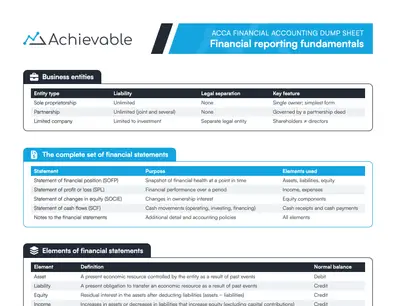
ACCA FA Dump Sheet - Financial reporting fundamentals

Download: ACCA FA Dump Sheet - Regulatory framework and accounting concepts
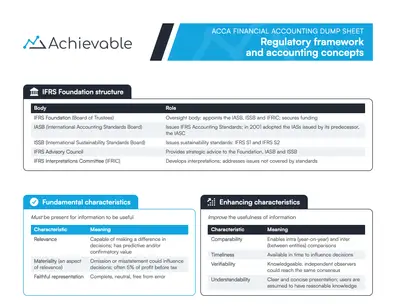
ACCA FA Dump Sheet - Regulatory framework and accounting concepts

Download: ACCA FA Dump Sheet - Double-entry, sales tax and receivables
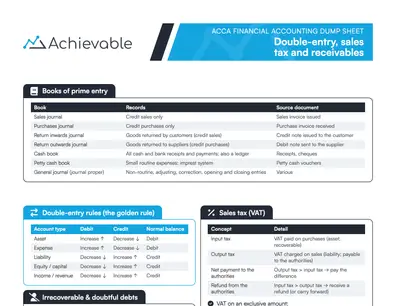
ACCA FA Dump Sheet - Double-entry, sales tax and receivables

Download: ACCA FA Dump Sheet - Inventories
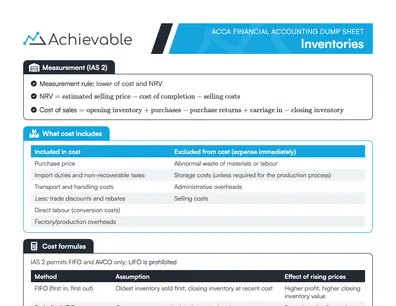
ACCA FA Dump Sheet - Inventories

Download: ACCA FA Dump Sheet - Non-current assets
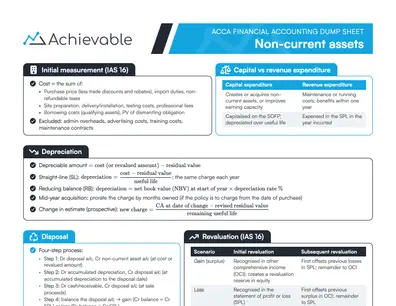
ACCA FA Dump Sheet - Non-current assets

Download: ACCA FA Dump Sheet - Accruals, provisions and share capital
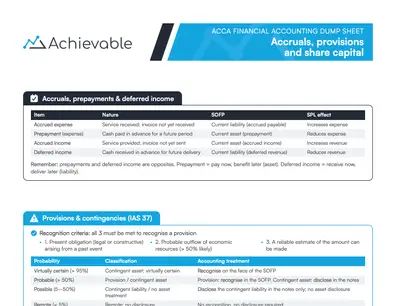
ACCA FA Dump Sheet - Accruals, provisions and share capital

Download: ACCA FA Dump Sheet - Reconciliations and error correction
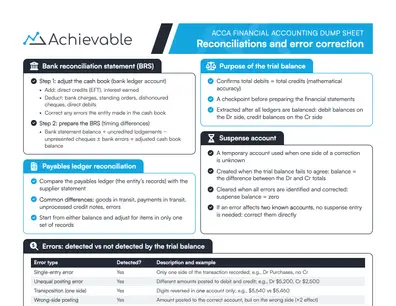
ACCA FA Dump Sheet - Reconciliations and error correction

Download: ACCA FA Dump Sheet - Financial statements and cash flows
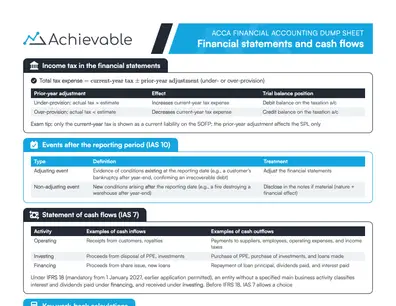
ACCA FA Dump Sheet - Financial statements and cash flows

Download: ACCA FA Dump Sheet - Ratio analysis
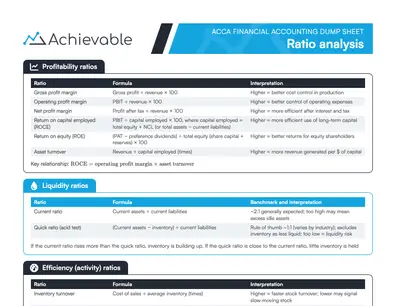
ACCA FA Dump Sheet - Ratio analysis

Download: ACCA FA Dump Sheet - Consolidated financial statements
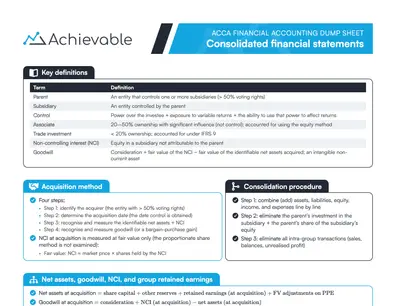
ACCA FA Dump Sheet - Consolidated financial statements

Download: ACCA FA Dump Sheet - Inventory, asset, and equity formulas
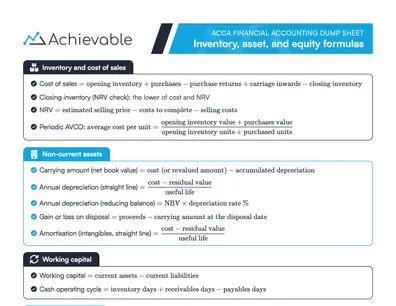
ACCA FA Dump Sheet - Inventory, asset, and equity formulas

Download: ACCA FA Dump Sheet - Ratio and consolidation formulas
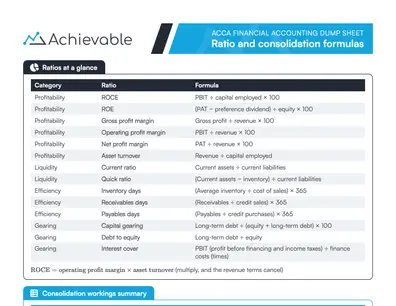
ACCA FA Dump Sheet - Ratio and consolidation formulas

Thank you

Thank you for learning with Achievable. We wish you the very best in the FA/FFA and in your future studies and career.

Exam registration and fees

  • Computer-based exam (CBE), on-demand, available year-round at authorised centres (100+ countries) or remotely if no local centre
  • Must register as ACCA student first (one-time £89 fee) before booking exams
  • Key fees: 2026 annual subscription £140, exemption fee £86 each, remote exam ~£130 (CBE centre fees vary locally)

CBE platform prep

  • Success depends on speed/accuracy under time pressure
  • Practice using official specimen exam and multi-task question sets under timed conditions before test day

Exam structure and pass mark

  • 120 minutes, 37 questions, 100 marks total
  • Section A: 35 objective test questions × 2 marks (70 marks)
  • Section B: two 15-mark multi-task questions — consolidated financial statements and accounts preparation (30 marks)
  • Pace: ~1.2 minutes per mark
  • Pass mark: 50+; 85%+ earns Certificate of Achievement
  • No limit/waiting period on re-sits if failed; can’t re-sit a passed exam
  • Allowed: noiseless, cordless, non-printing/non-graphic calculator (bring your own for remote exams—no on-screen calculator); no formula sheet provided

Exam day tips

  • Rest well, eat breakfast, light exercise beforehand
  • Arrive/log in ~20 minutes early
  • Stay calm, reread questions if stuck; flag difficult questions and return later
  • Answer all Section A questions — no negative marking, so guessing is better than skipping

Dump sheets

  • Allowed memory aid: memorise content beforehand, then write it onto provided scrap paper at exam start
  • At test centres: scrap paper provided (can’t bring own), collected after exam
  • Remote exams: scrap paper must be destroyed on camera after finishing
  • Optional tool — not required for passing, but can help organise key formulas/concepts under time pressure
Previous
Practice exams
All rights reserved ©2016 - 2026 Achievable, Inc.

Wrapping up

You’ve now completed the Achievable FA/FFA Course. At this point, you should have a solid grasp of core financial accounting principles and the technical skills behind double-entry bookkeeping, including how to prepare basic financial statements.

Exam mode, registration, and fees

The FA/FFA exam is delivered exclusively as a computer based exam (CBE). It’s available on-demand, so you can schedule it at any time during the year. Your result is shown immediately after you finish, and it’s uploaded to your ACCA account within 72 hours.

You must take the exam at an authorised exam centre in one of 100+ countries. If there isn’t a centre in your country, you may be eligible to sit the exam remotely.

To find a centre, use Find an on-demand exam centre. Search for your country, then book an available date with a listed centre.

If no centre appears in your search results, use Exam availability and booking. Select your country and register for a remote exam.

Before you can register for exams, you must register as an ACCA student to receive a student registration number. Use ACCA application to complete your registration.

Check ACCA fees and charges for the full fee schedule. Initial registration is a one-time fee of £89, and the 2026 annual subscription fee is £140, due each year to keep your student status active. If you’re exempted from an Applied Knowledge exam, the exemption fee is £86 per exemption awarded.

A remote on-demand FA/FFA exam costs £130 in most countries - check remote on-demand exam fees for the exact figure in your country. For exams taken at a CBE centre, fees are set by the individual centre. If you’re taking the exam at a special centre, you may also need to pay additional local invigilation and accommodation fees.

CBE platform

Passing the exam depends heavily on speed and accuracy under timed conditions. A practical way to build that efficiency is to get comfortable with the CBE platform and practise with simulated exam questions.

Watch the two videos below to learn the CBE platform’s functions, then attempt the full CBE specimen exam under timed conditions. For extra practice on the longer multi-task questions, use the multi-task question set.

Pass mark and other information

The FA/FFA exam is 120 minutes long and has 37 questions, marked out of 100. Section A contains 35 objective test questions worth two marks each (70 marks total). Section B contains two 15-mark multi-task questions - one on consolidated financial statements and one on accounts preparation (30 marks total). Budget around 1.2 minutes per mark to help pace yourself.

  • 50 or above is a pass.
  • Below 50 is a fail.

A score of 85% or above earns ACCA’s Certificate of Achievement, and in some countries ACCA’s local office may also award local prizes - see ACCA’s prizewinners page for details.

If you don’t pass FA/FFA, you can book it again with a centre - on-demand exams run all year and ACCA publishes no waiting period before another attempt. You cannot re-sit an exam you’ve already passed. See ACCA’s exam FAQs for more detail.

You may bring a noiseless, cordless pocket calculator to the exam - it may be programmable, but it must not have a printout facility or a graphic/word display, per ACCA’s exam guidelines. In remote on-demand exams specifically, you cannot use the computer’s on-screen calculator - bring your own approved calculator instead. There are no formula sheets for the FA/FFA course.

Tips

As you approach test day, we recommend the following to make sure you perform at the highest possible level:

  • Rest the day before. Skip last-minute cramming and get a full night’s sleep so you’re alert on exam day.

  • Light exercise and a proper breakfast. A short walk and a solid breakfast help you start the day focused.

  • Arrive early. Log in or arrive about 20 minutes before your start time so you’re not rushed.

  • Stay calm and read carefully. If you feel tense before or during the exam, pause, take a few slow breaths, and reread the question before answering.

  • Flag and move on. If a question is taking too long, flag it on the CBE platform and come back to it later rather than losing time you need elsewhere.

  • Answer every objective test question. There’s no negative marking on Section A, so an educated guess beats leaving a question blank.

Additional resources

As always, refer to the official ACCA Global website for further information.

The Technical Articles by members of the exam team highlight technical areas where students have challenges and provide further explanations to help you avoid those mistakes.

Check out the Achievable Blog for more study tips and best practices.

Dump sheet

Many test takers use “dump sheets” as study supplements and as a way to create a legal reference during the exam. A dump sheet typically includes visual guides and condensed notes on key topics. The idea is to memorise the material ahead of time and then “dump” it onto your notepad at the beginning of the exam.

At a test centre, you’re given two sheets of scrap paper on request (you can’t bring your own), and a dump sheet is something you write from memory onto that paper during the exam itself. At a centre, the invigilator collects your scrap paper at the end; in a remote exam, you must destroy your scrap paper on camera in front of your proctor once you finish. Follow your invigilator’s or proctor’s instructions on when you’re allowed to start writing. They aren’t required to succeed, but some test takers find them helpful.

You can certainly create your own, but here are Achievable’s ACCA FA dump sheets:

Download: ACCA FA Dump Sheet - Financial reporting fundamentals

ACCA FA Dump Sheet - Financial reporting fundamentals

Download: ACCA FA Dump Sheet - Regulatory framework and accounting concepts

ACCA FA Dump Sheet - Regulatory framework and accounting concepts

Download: ACCA FA Dump Sheet - Double-entry, sales tax and receivables

ACCA FA Dump Sheet - Double-entry, sales tax and receivables

Download: ACCA FA Dump Sheet - Inventories

ACCA FA Dump Sheet - Inventories

Download: ACCA FA Dump Sheet - Non-current assets

ACCA FA Dump Sheet - Non-current assets

Download: ACCA FA Dump Sheet - Accruals, provisions and share capital

ACCA FA Dump Sheet - Accruals, provisions and share capital

Download: ACCA FA Dump Sheet - Reconciliations and error correction

ACCA FA Dump Sheet - Reconciliations and error correction

Download: ACCA FA Dump Sheet - Financial statements and cash flows

ACCA FA Dump Sheet - Financial statements and cash flows

Download: ACCA FA Dump Sheet - Ratio analysis

ACCA FA Dump Sheet - Ratio analysis

Download: ACCA FA Dump Sheet - Consolidated financial statements

ACCA FA Dump Sheet - Consolidated financial statements

Download: ACCA FA Dump Sheet - Inventory, asset, and equity formulas

ACCA FA Dump Sheet - Inventory, asset, and equity formulas

Download: ACCA FA Dump Sheet - Ratio and consolidation formulas

ACCA FA Dump Sheet - Ratio and consolidation formulas

Thank you

Thank you for learning with Achievable. We wish you the very best in the FA/FFA and in your future studies and career.

Key points

Exam registration and fees

  • Computer-based exam (CBE), on-demand, available year-round at authorised centres (100+ countries) or remotely if no local centre
  • Must register as ACCA student first (one-time £89 fee) before booking exams
  • Key fees: 2026 annual subscription £140, exemption fee £86 each, remote exam ~£130 (CBE centre fees vary locally)

CBE platform prep

  • Success depends on speed/accuracy under time pressure
  • Practice using official specimen exam and multi-task question sets under timed conditions before test day

Exam structure and pass mark

  • 120 minutes, 37 questions, 100 marks total
  • Section A: 35 objective test questions × 2 marks (70 marks)
  • Section B: two 15-mark multi-task questions — consolidated financial statements and accounts preparation (30 marks)
  • Pace: ~1.2 minutes per mark
  • Pass mark: 50+; 85%+ earns Certificate of Achievement
  • No limit/waiting period on re-sits if failed; can’t re-sit a passed exam
  • Allowed: noiseless, cordless, non-printing/non-graphic calculator (bring your own for remote exams—no on-screen calculator); no formula sheet provided

Exam day tips

  • Rest well, eat breakfast, light exercise beforehand
  • Arrive/log in ~20 minutes early
  • Stay calm, reread questions if stuck; flag difficult questions and return later
  • Answer all Section A questions — no negative marking, so guessing is better than skipping

Dump sheets

  • Allowed memory aid: memorise content beforehand, then write it onto provided scrap paper at exam start
  • At test centres: scrap paper provided (can’t bring own), collected after exam
  • Remote exams: scrap paper must be destroyed on camera after finishing
  • Optional tool — not required for passing, but can help organise key formulas/concepts under time pressure

Related readings

  • Introduction