



Rule 144
There are rules that govern transactions in certain types of stock. This section focuses on Rule 144, which covers restricted and control stock.
Restricted stock
Restricted stock is stock that is not registered with the Securities and Exchange Commission (SEC). Common stock is non-exempt and must be properly registered to be eligible for trading in public markets. Because unregistered stock provides less public disclosure about the security and the issuer, the SEC restricts its free trading.
Restricted stock can be obtained in multiple ways, but private placements are the most common. Regulation D allows issuers to sell unregistered stock to private audiences not exceeding 35 non-accredited investors. Investors who buy in a private placement receive restricted (unregistered) stock.
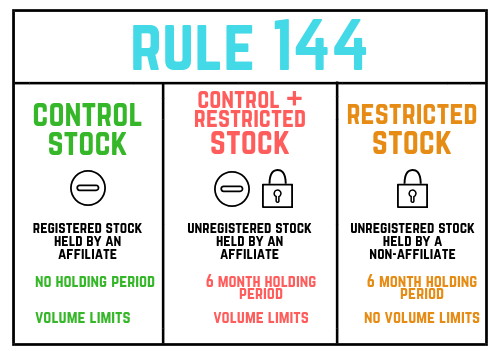
Rule 144 requires restricted stock to be held for 6 months before it can be resold (one year if the issuer doesn’t file reports with the SEC). After the holding period, the investor can sell the shares.
Control stock
Control stock is stock held by an affiliate, meaning an insider of the company. An affiliate is any officer, director, or 10% shareholder, and that is the definition to use on the exam. (Rule 144’s own definition is by control: a person who controls the issuer, is controlled by it, or is under common control with it. It sets no ownership percentage for an affiliate; 10% is the customary rule of thumb.)
For purposes of determining 10% ownership, shares owned by immediate family members, including spouses, may be combined. This means a person may be considered an affiliate even if their individual ownership is below 10%.
In other words, if you’re part of management or you own a large stake in the issuer, you’re considered an insider (affiliate). Rule 144 regulates this type of stock to prevent insiders from selling large amounts of shares too quickly.
This part of Rule 144 is often called the “dribble” rule. Insiders are frequently among the largest shareholders of their companies. Some CEOs own 51% or more of their companies to ensure their vote controls the direction of the organization. If an insider tried to liquidate a large position all at once, it could significantly affect the stock’s price. A 51% shareholder selling all shares in one trade is similar to a manufacturer dropping off 10,000 lawnmowers at a local Home Depot and asking for them to be sold immediately. Dropping the price close to zero might be the only way to get this accomplished.
To reduce this risk, affiliates (insiders) are subject to volume limitations. They’re allowed to sell the greater of:
- 1% of the outstanding shares, or
- the four-week trading average,
up to four times a year. These limits help prevent affiliates from selling significant amounts of shares in short periods of time.
Sometimes an affiliate owns unregistered stock. This is common, for example, when executives of privately held companies own stock in their company. In that case:
- Restricted stock rules apply because the stock is not registered with the SEC.
- Control stock rules apply because the shares are owned by an affiliate.
When both conditions are true, both sets of Rule 144 requirements apply at the same time.
To summarize, here’s a visual representation of Rule 144:
Filings
Regulators aim to create a transparent environment in the securities markets. One way they do this is by requiring public filings of transaction reports related to Rule 144.
Form 144 must be filed when an affiliate intends to trade control or restricted stock at any point in the next 90 days. Non-affiliates are not subject to the Form 144 filing requirement, though restricted stock they hold is still subject to the 6-month holding period. This form is typically filed electronically on the Electronic Data Gathering, Analysis, and Retrieval (EDGAR) system. Form 144 is triggered by an intention to trade control or restricted stock; there is no requirement for a transaction to actually occur.
The SEC, which oversees the filing process and maintains EDGAR, allows affiliates making small control or restricted stock transactions to avoid filing requirements. Specifically, Form 144 must be filed only if the affiliate plans to sell more than 5,000 shares or $50,000 of total stock in any 90-day period.
Form 4 must be filed when an affiliate actually trades control stock. Form 4 reports beneficial changes in ownership for insiders and must be filed within two business days of the transaction. Many financial media outlets pay close attention to these filings, especially forms filed by well-known executives and investors. For example, this Form 4 filing was the reason why Elon Musk’s $6.9 billion sale of Tesla stock November 2021 was widely reported.
Rule 144A
One last item to cover is Rule 144A, which relates to Rule 144. If a sale of restricted or control stock occurs with a Qualified Institutional Buyer (QIB), the requirements of Rule 144 do not apply. A QIB is defined as an institution with $100 million or more of investable assets. When a QIB is involved in the sale of control or restricted stock, the 6-month holding period and volume limitations do not apply.