



Wrapping up
You’ve reached the end of the Achievable Series 63 material.
This final chapter doesn’t introduce new testable content. Instead, it covers what to expect on exam day and a few practical best practices as your test date approaches.
When am I ready for the exam?
There’s no single perfect answer, but Achievable’s exam readiness score is your best overall gauge. At the top of your homepage, you’ll see a 0-100% score that estimates your likelihood of passing. In general, the closer your score is to 100%, the better positioned you are for test day.
Your score reflects multiple factors, including:
- Program completion (for example, reading chapters)
- Practice quiz performance
If you’ve used the system as intended, you’ve likely answered hundreds (or even thousands) of practice questions. Completing practice quizzes and assigned reviews is a key part of building the knowledge you’ll need on the exam.
One of the most important inputs to your readiness score is practice exam performance, including your scores and the number of attempts. Practice exams help you “put the big picture together” by pulling questions from across all chapters in a format similar to the real test. One of the most effective ways to raise your readiness score is to take additional practice exams and improve your scores over time.
Before you take a practice exam, put your notes aside. Using outside resources (for example, the Achievable reading material or Google) will artificially inflate your score. On the actual exam, you won’t have access to resources - only a notepad and a calculator.
After every practice exam, do a thorough review of each question and answer. Make sure you understand why you got each question right or wrong. Also, think beyond the question. A common pitfall is studying specific questions instead of learning the underlying content.
While our questions are written to emulate the real exam, no one knows which questions they’ll see on test day. The North American Securities Administrators Association (NASAA) closely guards its question bank, and its test writers use uniquely worded questions. If you’re memorizing answers without understanding the why, you’re likely to struggle when the scenario or wording changes.
A helpful self-check is:
“If I was given another question, with a completely different scenario and wording, am I confident I would know the answer?”
- If yes, keep moving forward.
- If no, go back and review that topic in the reading materials.
How many practice exams should I take?
There’s no uniform answer. Some people pass without taking a single practice exam, and others can take many and still fall short. It depends on how well you understand and retain the material.
Generally, we recommend taking at least 10 practice exams. Many students start out scoring in the 50s or 60s. The goal is to build knowledge from each exam through careful review and then apply that learning on the next attempt.
A consistent passing score (72% or higher) over five or more exams usually indicates a solid grasp of the material. Higher is better. Plan to spend quality time reviewing each exam right after you take it - review is where most of the improvement happens.
Another reason to take several practice finals is topic coverage. The Series 63 can test you across a very broad range of subtopics. A full-length practice exam covers 60 questions. If you only take one or two practice exams, you’re sampling a relatively small slice of what could appear on test day.
What score should I aim for on my practice exams?
A passing score (72% or above) is a good starting point. However, it’s smart to aim higher.
If you’ve averaged around 72% on your last several practice exams, you have a good chance of passing. Still, the real exam environment is different. You may feel more anxious at a test center, and that anxiety can negatively affect performance.
We recommend aiming for a mid-to-high 70s average (or higher) on your last 2-3 practice finals. That typically gives you a buffer for test-day nerves or other issues.
Exam registration
1. Create and register an account on the FINRA website.
2. If you’re not already registered, you need to submit a Form U4, which is the application for securities industry registration. This form is typically submitted by your sponsoring firm, but if you are applying on your own, you will submit it through FINRA’s CRD (Central Registration Depository) system.
3. Enroll for the The Series 63 exam - the Uniform Securities State Law Examination from the list of available exams. As stated previously, the Series 63 does not require sponsorship from a firm, but if you plan to register with a firm, they may assist with the process. If you don’t have a firm sponsor, you can still proceed with registration independently.
4. Schedule your exam. The exam will be administered at a Prometric test center. The Series 63 exam will only be available online for candidates who require a testing accommodation.
Additional exam information
The FINRA Series 63 exam costs $147 per attempt. The passing score is a 72% or higher.
There are waiting periods after failed attempts: 30 days after the first two failed attempts, and 180 days after the third and subsequent failures within a two-year period.
Beginning January 4, 2027, the waiting period after a third or subsequent failure drops from 180 days to 60 days. The 30-day waiting periods after the first two failed attempts are unchanged. The shorter window applies only to exam windows opened on or after January 4, 2027 — a window opened before that date follows the rules that were in effect when it opened.
Tips for testing day
As you approach test day, we recommend the following to help you perform at your best:
-
Review your email confirmation.
Give yourself time to review the appointment details either the night before your exam or the morning of it.
-
Bring your ID.
Regardless of how you are testing, bring one valid, government-issued identification document with a signature and picture, such as an unexpired driver’s license, passport, or military ID. Also, make sure the name on your ID exactly matches the name under which your exam is scheduled.
-
Arrive early.
This helps ensure you arrive at the testing center on time.
Additional resources
As always, refer to the FINRA website for further information.
Check out the Achievable blog for more study tips and best practices.
Dump sheet
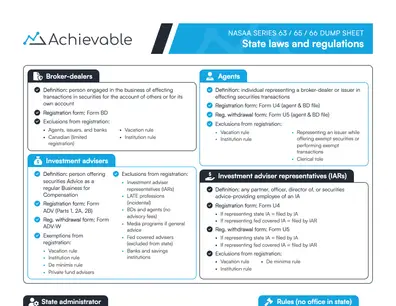
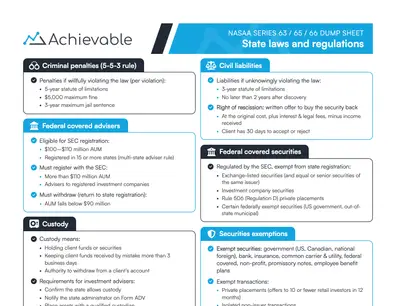
Many test takers use “dump sheets” as study supplements and as a guide for what they want to recall quickly on exam day. Dump sheets typically include visual guides and summarized notes of important test topics.
The idea is that you memorize the key items and then write them onto your notepad at the beginning of the exam. These are allowed in the test center as long as they are created after the test has started (and not during the initial tutorial). They aren’t necessary to succeed, but some test takers find them helpful.
You can certainly create your own, but here’s Achievable’s Series 63 dump sheet:
Download: Series 63 Exam Dump Sheet - State laws and regulations front
Download: Series 63 Exam Dump Sheet - State laws and regulations back
Final thoughts
NASAA exams can feel stressful. The most reliable way to prepare is to use the Achievable system as intended, take enough full-length practice exams, and review them carefully in the days or weeks leading up to your test.
Thanks again for choosing Achievable for the NASAA Series 63. If you have feedback, please let us know!
Wishing you the best,
the Achievable team