



System development life cycle
Learning outcome statements
The learning outcome statements relevant for this section are:
- define the system development life cycle, including systems analysis, conceptual design, physical design, implementation and conversion, and operations and maintenance
The System Development Life Cycle
Technology has revolutionized financial management by enhancing efficiency, accuracy, and decision-making. The integration of technology into finance processes enables organizations to streamline operations, reduce errors, and improve financial reporting. From automated transaction processing to advanced analytics, finance transformation leverages technology to drive strategic insights and optimize performance. Understanding the key technological advancements and their applications in finance is essential for organizations to remain competitive in a rapidly evolving digital landscape.
The SDLC is important because it provides a structured approach to designing, developing, testing, and deploying systems. Without a clear methodology, organizations risk inefficient processes, security vulnerabilities, and costly failures. The SDLC ensures that projects align with business objectives, reduce errors, enhance security, and optimize system performance.
Stages of the System Development Life Cycle
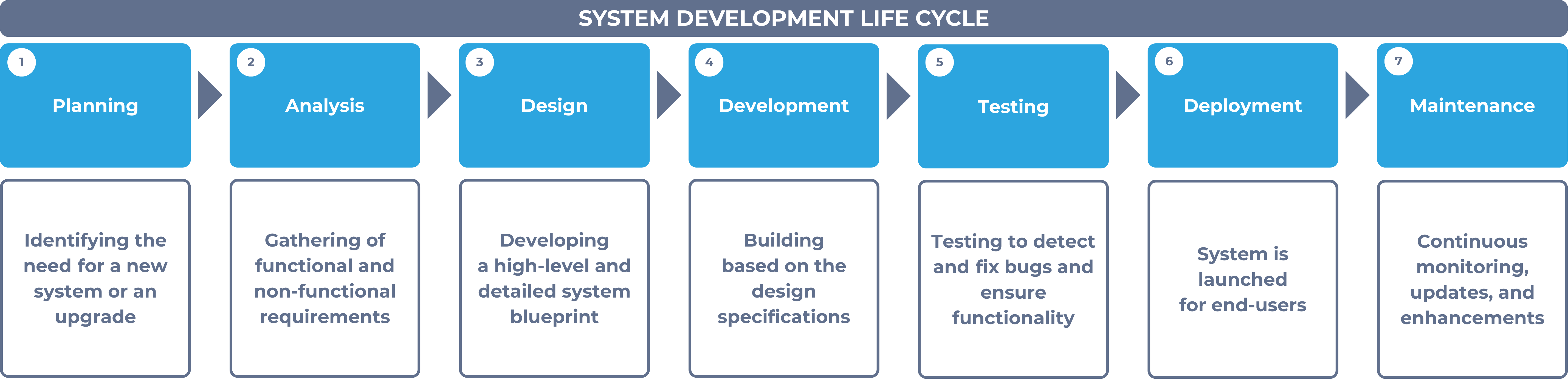
The SDLC consists of seven key stages. By following these stages, companies can systematically build robust financial systems, reduce operational risks, and maintain compliance with industry standards. This structured process is essential for successful technology-driven finance transformation.
1. Planning
This initial stage involves identifying the need for a new system or an upgrade and defining project objectives. A feasibility study is conducted to assess technical, operational, and financial viability.
Key Activities:
- Defining project scope and objectives
- Conducting feasibility studies
- Estimating costs and resources
- Establishing a project timeline
2. Analysis
The system’s functional and non-functional requirements are gathered, and a comprehensive analysis of business needs is performed. This stage ensures that the new system aligns with business goals.
Key Activities:
- Gathering user and stakeholder requirements
- Identifying current system inefficiencies
- Documenting functional and technical requirements
- Conducting risk assessments
3. Design
This stage focuses on developing a high-level and detailed system blueprint, outlining system architecture, data flow, and security protocols.
Key Activities:
- Creating system models and wireframes
- Designing database structures and workflows
- Establishing security protocols
- Selecting technology stack (hardware and software)
4. Development
The system is built based on the design specifications. Developers write code, configure databases, and integrate different components.
Key Activities:
- Writing and testing code
- Setting up databases and servers
- Integrating third-party services
- Ensuring compliance with security and regulatory standards
5. Testing
The system undergoes rigorous testing to detect and fix bugs, ensure functionality, and validate performance before deployment.
Key Activities:
- Conducting unit, integration, and user acceptance testing
- Identifying and fixing errors
- Validating system performance under various conditions
- Security and compliance testing
6. Deployment
The system is launched for end-users. The transition may involve phased implementation or direct system replacement.
Key Activities:
- Deploying the system to production
- Migrating data from the old system
- Training employees and stakeholders
- Monitoring initial performance and addressing early issues
7. Maintenance
Post-deployment, the system requires continuous monitoring, updates, and enhancements to ensure its longevity and optimal performance.
Key Activities:
- Monitoring system performance and resolving issues
- Applying security patches and software updates
- Enhancing features based on user feedback
- Scaling the system as business needs evolve
Roles in the System Development Life Cycle
Successful system development requires collaboration among multiple professionals, each responsible for different aspects of the project. The key roles involved in the SDLC include:
1. System analyst
The system analyst is responsible for conducting feasibility studies and analyzing business and technical requirements to determine system needs. They design functional specifications and workflows that guide system development and ensure alignment with business objectives. Additionally, they identify inefficiencies in current systems and recommend solutions to enhance performance, improve automation, and support decision-making.
2. Information System architect
The information system architect is responsible for defining system architecture and selecting appropriate technologies that ensure scalability and security. They establish security protocols and data structures to protect sensitive information and maintain data integrity. Additionally, they ensure interoperability with other enterprise systems, allowing seamless integration and communication between various software applications and platforms.
3. Project manager
The project manager is responsible for planning and managing project timelines and resources to ensure the successful execution of the system development process. They coordinate cross-functional teams, ensuring smooth collaboration between developers, analysts, testers, and business stakeholders. Additionally, they conduct risk assessment and mitigation planning to address potential challenges and ensure that the project is completed on time and within budget.
4. Software developer
Software developers write the code that powers the system, implementing the features designed in the planning and design stages. They are responsible for writing, testing, and debugging software code, integrating software components and databases, and collaborating with analysts and testers to meet system requirements.
5. Tester (QA - Quality Assurance)
Quality assurance testers ensure that the system functions correctly, meets business requirements, and is free of defects before deployment. They perform functional, integration, and performance testing, identify and document bugs and inconsistencies, and ensure system compliance with security and industry standards.
6. DevOps Engineer
A DevOps engineer focuses on continuous integration, deployment, and system reliability, ensuring that the development and IT operations teams collaborate effectively. They automate system deployment and monitoring, manage cloud infrastructure and server configurations, and enhance system performance and scalability.