Achievable logoAchievable logo
CMA Part 1
Sign in
Sign up
Purchase
Textbook
Practice exams
Support
How it works
Exam catalog
Mountain with a flag at the peak
Textbook
1. External financial reporting decisions
2. Planning, budgeting, and forecasting
3. Performance management
4. Cost management
5. Internal control
6. Technology and analytics
6.1 Information systems
6.2 Data governance
6.2.1 Technology-enabled finance transformation
6.2.2 Data policies and procedures
6.2.3 Life cycle of data
6.2.4 Data management
6.2.5 Controls against security breaches
6.3 Data analytics
Achievable logoAchievable logo
6.2.5 Controls against security breaches
Achievable CMA Part 1
6. Technology and analytics
6.2. Data governance
Our CMA Part 1 course is currently in development and is a work-in-progress.

Controls against security breaches

8 min read
Font
Discuss
Share
Feedback

Learning outcome statements

The learning outcome statements relevant for this section are:

  1. identify and explain controls and tools to detect and thwart cyberattacks, such as penetration and vulnerability testing, biometrics, advanced firewalls, and access controls

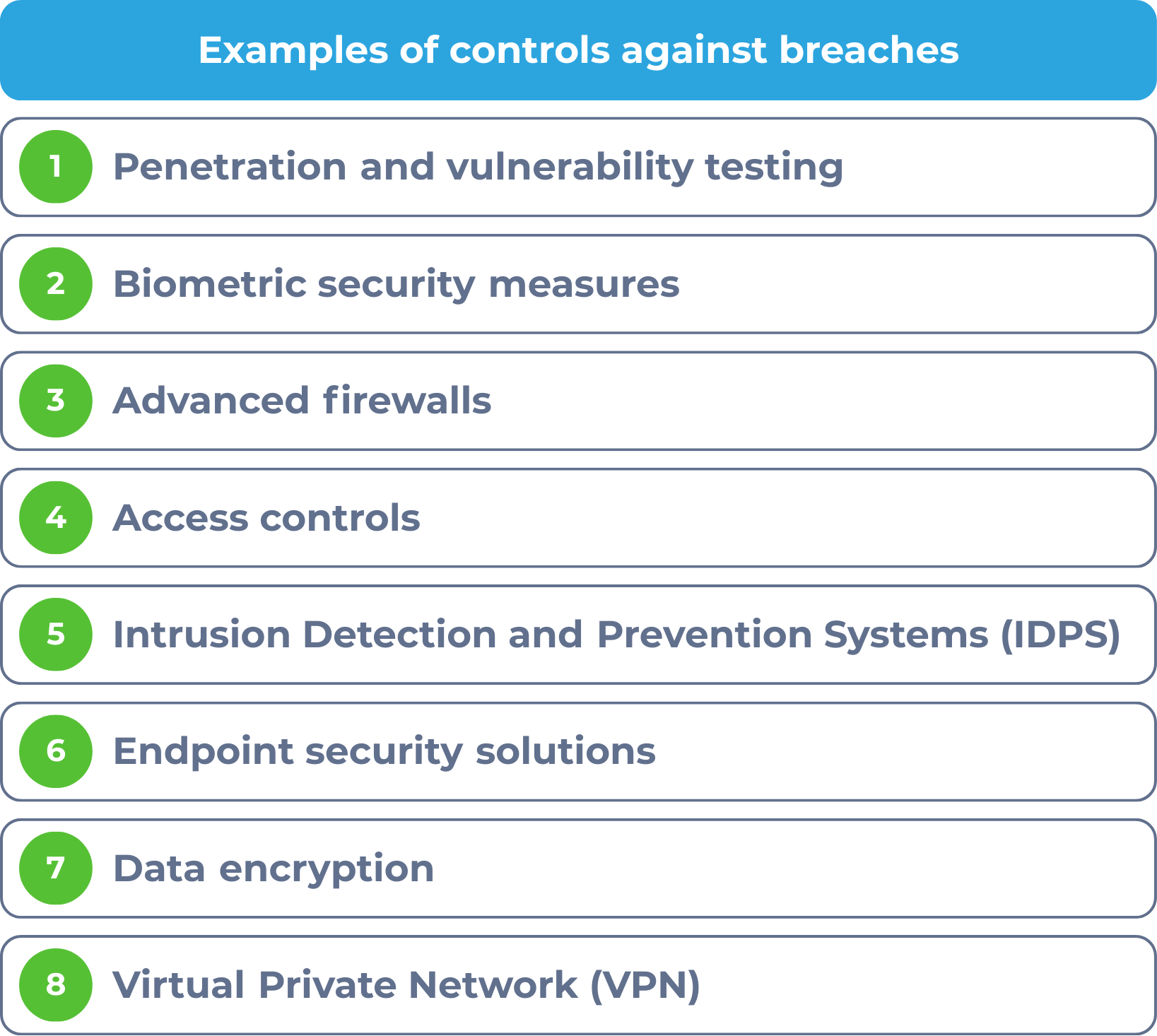
Examples of controls

As organizations increasingly rely on digital systems for financial transactions, data management, and business operations, they face growing threats from cyberattacks. Security breaches can lead to financial losses, reputational damage, and legal consequences. To mitigate these risks, organizations implement various security controls and tools to detect and prevent cyberattacks.

Below are key mechanisms used to strengthen cybersecurity defenses:

Controls against security breaches

1. Penetration and vulnerability testing

Penetration and vulnerability testing are proactive security measures that help organizations identify weaknesses in their IT infrastructure before malicious actors exploit them.

Vulnerability testing involves automated scans to detect security weaknesses in networks, applications, and systems. These tests assess system configurations, outdated software, and known vulnerabilities that hackers could exploit.

Penetration testing (pen testing) is a simulated cyberattack performed by ethical hackers (or penetration testers) to evaluate the effectiveness of an organization’s security defenses. Pen testing helps identify exploitable vulnerabilities and provides recommendations for strengthening system security.

These tests are essential for ensuring compliance with industry standards and maintaining strong cybersecurity postures.

2. Biometric security measures

Biometrics enhance authentication by using unique biological characteristics to verify user identity. Unlike traditional password-based security, biometrics provide an additional layer of protection against unauthorized access.

Examples of biometric security measures include:

  • Fingerprint recognition: Scans and matches a user’s fingerprint to stored biometric data before granting access to systems or devices.
  • Facial recognition: Uses artificial intelligence (AI) to analyze facial features for identity verification, commonly used in smartphones and corporate security systems.
  • Iris and retina scans: Optical recognition methods that offer a highly secure authentication mechanism for sensitive environments.
  • Voice recognition: Identifies users based on voice patterns, providing an alternative method of biometric authentication.

Biometric security is widely used in financial institutions, healthcare, and government agencies to prevent identity fraud and enhance system security.

3. Advanced firewalls

Firewalls serve as the first line of defense in network security, preventing unauthorized access to internal systems. Advanced firewalls offer enhanced features to combat modern cyber threats.

Examples of firewalls include:

  • Traditional firewalls: Filter incoming and outgoing network traffic based on predefined security rules.
  • Next-Generation Firewalls (NGFWs): Incorporate deep packet inspection, intrusion prevention systems (IPS), and advanced threat intelligence to detect and block sophisticated cyber threats.
  • Web Application Firewalls (WAFs): Specifically designed to protect web applications from common attacks such as SQL injection and cross-site scripting (XSS).

Firewalls are crucial for protecting an organization’s network from external threats while ensuring that only authorized traffic is allowed.

4. Access controls

Access control mechanisms regulate who can view, modify, and use system resources, minimizing the risk of unauthorized access and data breaches. These controls can be physical, technical, or administrative in nature.

Examples of access controls include:

  • Role-Based Access Control (RBAC): Assigns user permissions based on job roles, ensuring that employees only have access to the data necessary for their responsibilities.
  • Multi-Factor Authentication (MFA): Requires users to verify their identity through multiple authentication factors, such as passwords, biometrics, or security tokens, reducing the risk of unauthorized access.
  • Least privilege principle: Limits user access to the minimum level necessary to perform their tasks, reducing the impact of potential security breaches.
  • Zero Trust Architecture (ZTA): Assumes that threats may exist inside and outside the network, enforcing strict verification processes for every access request.
  • CAPTCHA (Completely Automated Public Turing test to tell Computers and Humans Apart): Prevents automated bots from gaining unauthorized access to systems by requiring users to complete a challenge-response test.
  • Physical access controls: Includes barriers such as security doors, biometric scanners, and locked server rooms to restrict physical access to critical IT infrastructure.
  • Security badges and ID cards: Enforces identity verification for employees and visitors accessing restricted areas within an organization.
  • Time-based and location-based access controls: Restricts system access based on the time of day or geographic location to prevent unauthorized use outside of designated parameters.

Effective access control strategies protect sensitive data, prevent insider threats, and enhance overall security posture.

5. Intrusion Detection and Prevention Systems (IDPS)

Intrusion Detection and Prevention Systems monitor network traffic for signs of malicious activity and respond to potential threats in real time.

Examples include:

  • Intrusion Detection Systems (IDS): Passively monitor network traffic, alerting administrators when suspicious activity is detected.
  • Intrusion Prevention Systems (IPS): Actively block detected threats, preventing unauthorized access and mitigating security risks.
  • Behavioral analysis: Uses AI and machine learning to detect anomalies in user behavior that may indicate cyberattacks.

IDPS solutions enhance security by identifying and neutralizing threats before they can compromise critical systems.

6. Endpoint security solutions

Endpoint security protects individual devices, such as laptops, desktops, and mobile phones, from cyber threats.

Examples of endpoint security solutions include:

  • Antivirus and anti-malware software: Scans and removes malicious software from endpoints.
  • Endpoint Detection and Response (EDR): Provides continuous monitoring and threat detection for endpoint devices.
  • Mobile Device Management (MDM): Enforces security policies on mobile devices to prevent unauthorized access and data leaks.

Securing endpoints ensures that remote and office-based employees can work safely without compromising enterprise security.

7. Data encryption

Encryption protects sensitive data by converting it into an unreadable format that can only be deciphered with the appropriate decryption key. Encryption is vital for protecting confidential data from cybercriminals and ensuring compliance with privacy regulations.

There are two main types of encryption used in cybersecurity:

  • Public key encryption (asymmetric encryption): Uses a pair of keys: one public and one private. The public key encrypts data, while the private key decrypts it. The public key is available to anyone who wants to send an encrypted message to the owner of the private key. It is used to encrypt the data and can be shared freely. The private key, conversely, is kept secret and is used to decrypt the encrypted message. This method is commonly used in secure communications, such as SSL/TLS protocols for web security and email encryption.
  • Private key encryption (symmetric encryption): Uses a single secret key for both encryption and decryption. This method is faster and more efficient but requires secure key management to prevent unauthorized access. Examples include AES (Advanced Encryption Standard) and DES (Data Encryption Standard).

By leveraging both encryption techniques, organizations can ensure data security across different use cases, balancing performance with protection.

8. Virtual Private Network (VPN)

A VPN enhances security by creating an encrypted tunnel between a user’s device and a secure server. This process masks the user’s IP address and encrypts all data transmitted, protecting sensitive information from interception and surveillance.

Key security benefits of a VPN

  • Secure remote access: VPNs provide a secure way for employees to access an organization’s internal network from remote locations. By establishing an encrypted connection to the corporate network, a VPN prevents unauthorized users from accessing sensitive systems and data, which is critical for remote work and business continuity.

  • Data confidentiality: The primary function of a VPN is data encryption. By encrypting all data that travels through the tunnel, it ensures that even if the data is intercepted on a public or unsecured network, it remains unreadable to hackers and other malicious actors. This significantly reduces the risk of data breaches.

  • Anonymity and privacy: A VPN hides the user’s IP address by routing traffic through its own server. This makes online activities more private and makes it difficult for third parties, such as internet service providers (ISPs) or advertisers, to track user behavior and location. While VPNs increase privacy, complete anonymity depends on the provider’s policies (e.g., whether activity logs are retained).

Types of VPNs

  • Remote-Access VPNs: These are the most common type, used by individuals and remote workers to connect to a private network over the internet.

  • Site-to-Site VPNs: These are used to connect entire networks to each other, for example, linking the main office network to a branch office network to securely share resources.

VPNs are a fundamental tool in modern cybersecurity for both individuals and organizations. They are essential for securing communications over public networks, protecting sensitive business data, and enabling a secure remote workforce.

Penetration and vulnerability testing

  • Identify system weaknesses before exploitation
  • Vulnerability testing: automated scans for known issues
  • Penetration testing: ethical hackers simulate attacks to test defenses

Biometric security measures

  • Use unique biological traits for authentication
  • Examples: fingerprint, facial, iris/retina, and voice recognition
  • Enhance protection against unauthorized access

Advanced firewalls

  • Control network traffic to block unauthorized access
  • Types:
    • Traditional: rule-based filtering
    • Next-Generation (NGFW): deep inspection, intrusion prevention
    • Web Application Firewalls (WAF): protect web apps from attacks

Access controls

  • Regulate user permissions and resource access
  • Key methods:
    • Role-Based Access Control (RBAC)
    • Multi-Factor Authentication (MFA)
    • Least privilege, Zero Trust Architecture (ZTA)
    • Physical controls: security doors, badges, scanners
    • CAPTCHA, time/location-based restrictions

Intrusion Detection and Prevention Systems (IDPS)

  • Monitor and respond to malicious network activity
  • IDS: alerts on suspicious behavior
  • IPS: blocks detected threats
  • Behavioral analysis for anomaly detection

Endpoint security solutions

  • Protect individual devices from threats
  • Tools: antivirus/anti-malware, Endpoint Detection and Response (EDR), Mobile Device Management (MDM)
  • Safeguard remote and office-based endpoints

Data encryption

  • Converts data to unreadable format for protection
  • Types:
    • Public key (asymmetric): uses public/private key pairs (e.g., SSL/TLS)
    • Private key (symmetric): single secret key (e.g., AES, DES)
  • Ensures confidentiality and regulatory compliance

Virtual Private Network (VPN)

  • Encrypts data between user and secure server
  • Benefits: secure remote access, data confidentiality, increased privacy
  • Types:
    • Remote-Access VPNs: for individuals/remote workers
    • Site-to-Site VPNs: connect entire networks securely

Sign up for free to take 15 quiz questions on this topic

Previous
Next  | 6.3.1 Business intelligence
All rights reserved ©2016 - 2026 Achievable, Inc.

Controls against security breaches

Learning outcome statements

The learning outcome statements relevant for this section are:

  1. identify and explain controls and tools to detect and thwart cyberattacks, such as penetration and vulnerability testing, biometrics, advanced firewalls, and access controls

Examples of controls

As organizations increasingly rely on digital systems for financial transactions, data management, and business operations, they face growing threats from cyberattacks. Security breaches can lead to financial losses, reputational damage, and legal consequences. To mitigate these risks, organizations implement various security controls and tools to detect and prevent cyberattacks.

Below are key mechanisms used to strengthen cybersecurity defenses:

1. Penetration and vulnerability testing

Penetration and vulnerability testing are proactive security measures that help organizations identify weaknesses in their IT infrastructure before malicious actors exploit them.

Vulnerability testing involves automated scans to detect security weaknesses in networks, applications, and systems. These tests assess system configurations, outdated software, and known vulnerabilities that hackers could exploit.

Penetration testing (pen testing) is a simulated cyberattack performed by ethical hackers (or penetration testers) to evaluate the effectiveness of an organization’s security defenses. Pen testing helps identify exploitable vulnerabilities and provides recommendations for strengthening system security.

These tests are essential for ensuring compliance with industry standards and maintaining strong cybersecurity postures.

2. Biometric security measures

Biometrics enhance authentication by using unique biological characteristics to verify user identity. Unlike traditional password-based security, biometrics provide an additional layer of protection against unauthorized access.

Examples of biometric security measures include:

  • Fingerprint recognition: Scans and matches a user’s fingerprint to stored biometric data before granting access to systems or devices.
  • Facial recognition: Uses artificial intelligence (AI) to analyze facial features for identity verification, commonly used in smartphones and corporate security systems.
  • Iris and retina scans: Optical recognition methods that offer a highly secure authentication mechanism for sensitive environments.
  • Voice recognition: Identifies users based on voice patterns, providing an alternative method of biometric authentication.

Biometric security is widely used in financial institutions, healthcare, and government agencies to prevent identity fraud and enhance system security.

3. Advanced firewalls

Firewalls serve as the first line of defense in network security, preventing unauthorized access to internal systems. Advanced firewalls offer enhanced features to combat modern cyber threats.

Examples of firewalls include:

  • Traditional firewalls: Filter incoming and outgoing network traffic based on predefined security rules.
  • Next-Generation Firewalls (NGFWs): Incorporate deep packet inspection, intrusion prevention systems (IPS), and advanced threat intelligence to detect and block sophisticated cyber threats.
  • Web Application Firewalls (WAFs): Specifically designed to protect web applications from common attacks such as SQL injection and cross-site scripting (XSS).

Firewalls are crucial for protecting an organization’s network from external threats while ensuring that only authorized traffic is allowed.

4. Access controls

Access control mechanisms regulate who can view, modify, and use system resources, minimizing the risk of unauthorized access and data breaches. These controls can be physical, technical, or administrative in nature.

Examples of access controls include:

  • Role-Based Access Control (RBAC): Assigns user permissions based on job roles, ensuring that employees only have access to the data necessary for their responsibilities.
  • Multi-Factor Authentication (MFA): Requires users to verify their identity through multiple authentication factors, such as passwords, biometrics, or security tokens, reducing the risk of unauthorized access.
  • Least privilege principle: Limits user access to the minimum level necessary to perform their tasks, reducing the impact of potential security breaches.
  • Zero Trust Architecture (ZTA): Assumes that threats may exist inside and outside the network, enforcing strict verification processes for every access request.
  • CAPTCHA (Completely Automated Public Turing test to tell Computers and Humans Apart): Prevents automated bots from gaining unauthorized access to systems by requiring users to complete a challenge-response test.
  • Physical access controls: Includes barriers such as security doors, biometric scanners, and locked server rooms to restrict physical access to critical IT infrastructure.
  • Security badges and ID cards: Enforces identity verification for employees and visitors accessing restricted areas within an organization.
  • Time-based and location-based access controls: Restricts system access based on the time of day or geographic location to prevent unauthorized use outside of designated parameters.

Effective access control strategies protect sensitive data, prevent insider threats, and enhance overall security posture.

5. Intrusion Detection and Prevention Systems (IDPS)

Intrusion Detection and Prevention Systems monitor network traffic for signs of malicious activity and respond to potential threats in real time.

Examples include:

  • Intrusion Detection Systems (IDS): Passively monitor network traffic, alerting administrators when suspicious activity is detected.
  • Intrusion Prevention Systems (IPS): Actively block detected threats, preventing unauthorized access and mitigating security risks.
  • Behavioral analysis: Uses AI and machine learning to detect anomalies in user behavior that may indicate cyberattacks.

IDPS solutions enhance security by identifying and neutralizing threats before they can compromise critical systems.

6. Endpoint security solutions

Endpoint security protects individual devices, such as laptops, desktops, and mobile phones, from cyber threats.

Examples of endpoint security solutions include:

  • Antivirus and anti-malware software: Scans and removes malicious software from endpoints.
  • Endpoint Detection and Response (EDR): Provides continuous monitoring and threat detection for endpoint devices.
  • Mobile Device Management (MDM): Enforces security policies on mobile devices to prevent unauthorized access and data leaks.

Securing endpoints ensures that remote and office-based employees can work safely without compromising enterprise security.

7. Data encryption

Encryption protects sensitive data by converting it into an unreadable format that can only be deciphered with the appropriate decryption key. Encryption is vital for protecting confidential data from cybercriminals and ensuring compliance with privacy regulations.

There are two main types of encryption used in cybersecurity:

  • Public key encryption (asymmetric encryption): Uses a pair of keys: one public and one private. The public key encrypts data, while the private key decrypts it. The public key is available to anyone who wants to send an encrypted message to the owner of the private key. It is used to encrypt the data and can be shared freely. The private key, conversely, is kept secret and is used to decrypt the encrypted message. This method is commonly used in secure communications, such as SSL/TLS protocols for web security and email encryption.
  • Private key encryption (symmetric encryption): Uses a single secret key for both encryption and decryption. This method is faster and more efficient but requires secure key management to prevent unauthorized access. Examples include AES (Advanced Encryption Standard) and DES (Data Encryption Standard).

By leveraging both encryption techniques, organizations can ensure data security across different use cases, balancing performance with protection.

8. Virtual Private Network (VPN)

A VPN enhances security by creating an encrypted tunnel between a user’s device and a secure server. This process masks the user’s IP address and encrypts all data transmitted, protecting sensitive information from interception and surveillance.

Key security benefits of a VPN

  • Secure remote access: VPNs provide a secure way for employees to access an organization’s internal network from remote locations. By establishing an encrypted connection to the corporate network, a VPN prevents unauthorized users from accessing sensitive systems and data, which is critical for remote work and business continuity.

  • Data confidentiality: The primary function of a VPN is data encryption. By encrypting all data that travels through the tunnel, it ensures that even if the data is intercepted on a public or unsecured network, it remains unreadable to hackers and other malicious actors. This significantly reduces the risk of data breaches.

  • Anonymity and privacy: A VPN hides the user’s IP address by routing traffic through its own server. This makes online activities more private and makes it difficult for third parties, such as internet service providers (ISPs) or advertisers, to track user behavior and location. While VPNs increase privacy, complete anonymity depends on the provider’s policies (e.g., whether activity logs are retained).

Types of VPNs

  • Remote-Access VPNs: These are the most common type, used by individuals and remote workers to connect to a private network over the internet.

  • Site-to-Site VPNs: These are used to connect entire networks to each other, for example, linking the main office network to a branch office network to securely share resources.

VPNs are a fundamental tool in modern cybersecurity for both individuals and organizations. They are essential for securing communications over public networks, protecting sensitive business data, and enabling a secure remote workforce.

Key points

Penetration and vulnerability testing

  • Identify system weaknesses before exploitation
  • Vulnerability testing: automated scans for known issues
  • Penetration testing: ethical hackers simulate attacks to test defenses

Biometric security measures

  • Use unique biological traits for authentication
  • Examples: fingerprint, facial, iris/retina, and voice recognition
  • Enhance protection against unauthorized access

Advanced firewalls

  • Control network traffic to block unauthorized access
  • Types:
    • Traditional: rule-based filtering
    • Next-Generation (NGFW): deep inspection, intrusion prevention
    • Web Application Firewalls (WAF): protect web apps from attacks

Access controls

  • Regulate user permissions and resource access
  • Key methods:
    • Role-Based Access Control (RBAC)
    • Multi-Factor Authentication (MFA)
    • Least privilege, Zero Trust Architecture (ZTA)
    • Physical controls: security doors, badges, scanners
    • CAPTCHA, time/location-based restrictions

Intrusion Detection and Prevention Systems (IDPS)

  • Monitor and respond to malicious network activity
  • IDS: alerts on suspicious behavior
  • IPS: blocks detected threats
  • Behavioral analysis for anomaly detection

Endpoint security solutions

  • Protect individual devices from threats
  • Tools: antivirus/anti-malware, Endpoint Detection and Response (EDR), Mobile Device Management (MDM)
  • Safeguard remote and office-based endpoints

Data encryption

  • Converts data to unreadable format for protection
  • Types:
    • Public key (asymmetric): uses public/private key pairs (e.g., SSL/TLS)
    • Private key (symmetric): single secret key (e.g., AES, DES)
  • Ensures confidentiality and regulatory compliance

Virtual Private Network (VPN)

  • Encrypts data between user and secure server
  • Benefits: secure remote access, data confidentiality, increased privacy
  • Types:
    • Remote-Access VPNs: for individuals/remote workers
    • Site-to-Site VPNs: connect entire networks securely

More from Data governance

  • Data policies and procedures
  • Life cycle of data
  • Data management