



Data mining
Learning outcome statements
The learning outcome statements relevant for this section are:
- define data mining
- describe the challenges of data mining
- explain why data mining is an iterative process and both an art and a science
- explain the purpose of Structured Query Language (SQL)
- describe how an analyst would mine large data sets to reveal patterns and provide insights
Definition of data mining
Organizations use data mining to identify trends, detect anomalies, and gain a competitive edge in various industries such as finance, healthcare, marketing, and e-commerce. For example, in the retail industry, companies analyze customer purchasing patterns to recommend personalized products and optimize inventory management. Similarly, in financial services, banks use data mining to detect fraudulent transactions by identifying unusual spending behaviors. By leveraging data mining techniques, businesses can improve customer targeting, risk assessment, fraud detection, and operational efficiency.
Challenges of data mining
While data mining offers significant advantages, it also presents several challenges that organizations must navigate to effectively extract insights from large datasets:
- Data Quality Issues: Raw data often contains errors, inconsistencies, and missing values, which can compromise the accuracy of analysis. Preprocessing techniques such as data cleaning and normalization are required to improve data quality.
- Scalability and Performance: As datasets grow in size and complexity, traditional data mining tools may struggle to process them efficiently. Organizations must invest in high-performance computing, cloud-based solutions, or distributed data processing frameworks like Apache Hadoop and Spark to handle large-scale data mining tasks.
- Data Privacy and Security: Extracting insights from sensitive information, such as customer transactions or healthcare records, raises concerns about data privacy and compliance with regulations like GDPR and CCPA. Ensuring data security through encryption, anonymization, and access control mechanisms is crucial.
- High Implementation Costs: Developing and maintaining a data mining infrastructure requires significant investment in software, hardware, and skilled personnel. Businesses need to balance costs with expected benefits to justify their investments in data mining technologies.
- Algorithm Complexity and Selection: There is no one-size-fits-all algorithm for data mining. Choosing the right model requires expertise in machine learning and statistical methods, as well as a deep understanding of the data’s characteristics.
- Interpretability of Results: Many data mining models, such as deep learning algorithms, operate as “black boxes,” making it difficult to interpret and validate their findings. Businesses may struggle to translate complex models into actionable insights that stakeholders can understand and trust.
- Integration with Business Processes: Successfully integrating data mining insights into decision-making processes requires collaboration between data scientists and business leaders. Without clear communication and alignment, valuable insights may not translate into effective business strategies.
Addressing these challenges is essential for organizations to fully leverage the power of data mining while ensuring accuracy, efficiency, and compliance in their analytical processes.
Data mining as an iterative process: the art and science
As a science, data mining is based on rigorous methodologies, statistical algorithms, and machine learning techniques that help uncover patterns and relationships within large datasets. The process involves systematic data preprocessing, model selection, and validation to ensure accuracy and reliability. For example, in healthcare, machine learning models analyze patient records to predict disease outbreaks based on historical data and medical trends.
As an art, data mining requires human intuition, domain expertise, and strategic thinking to interpret patterns and translate them into actionable insights. Analysts must understand business context, ask the right questions, and apply creativity to derive meaningful conclusions. For example, in marketing, a data analyst may recognize that social media engagement patterns indicate a growing interest in a specific product, prompting the company to adjust its advertising strategy accordingly.
Moreover, data mining is an iterative process, meaning that it is refined over multiple cycles. Analysts continually test hypotheses, adjust models, and validate outcomes to improve predictive accuracy and optimize results. Each iteration refines the insights generated, leading to better decision-making and strategic planning. In fraud detection, for instance, financial institutions refine their data mining models over time by incorporating new fraudulent activity patterns, ensuring that detection mechanisms remain effective against evolving threats.
The integration of both artistic intuition and scientific rigor allows businesses to maximize the value of their data mining efforts, making informed, data-driven decisions while adapting to changing environments.
Purpose of Structured Query Language (SQL)
SQL enables users to extract, manipulate, and analyze structured data stored in databases efficiently. It provides a standardized way to interact with data, allowing users to filter, aggregate, and join datasets to derive meaningful insights.
In the context of data mining, SQL plays a crucial role in preprocessing large datasets, retrieving specific information, and preparing data for advanced analysis. Data analysts use SQL to clean and structure raw data before applying machine learning models and statistical techniques. For example, a retail company may use SQL queries to segment customer transactions based on purchase history, which can then be analyzed to identify purchasing trends and forecast future demand.
SQL is also essential for integrating data from multiple sources, ensuring consistency, and optimizing database performance. Many business intelligence and data mining tools, such as Tableau and Power BI, rely on SQL to extract relevant data for visualization and decision-making. As a result, SQL remains a fundamental tool for data analysts, data scientists, and database administrators working with large-scale datasets.
Steps of data mining
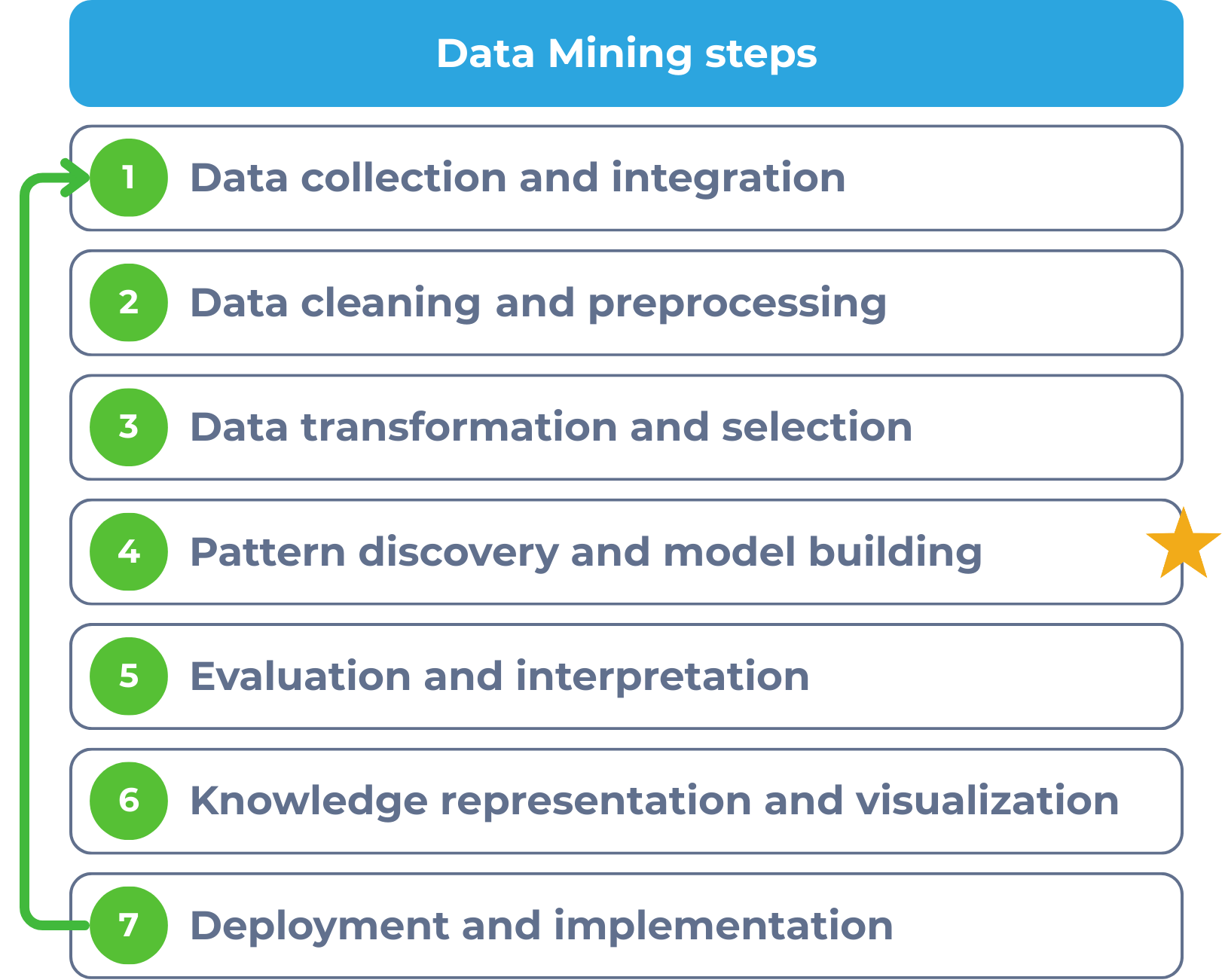
Data mining follows a systematic process that ensures the extraction of meaningful insights from large datasets. The key steps include:
Step 1: Data collection and integration
The first step involves gathering data from multiple sources such as databases, spreadsheets, APIs, and external datasets. The data is then integrated into a central repository, such as a data warehouse, for easier access and processing.
Step 2: Data cleaning and preprocessing
Raw data often contains inconsistencies, missing values, and errors that must be addressed before analysis. This step involves removing duplicates, filling missing values, and standardizing formats to ensure data quality and reliability.
Step 3: Data transformation and selection
Once cleaned, the data is transformed into a suitable format for analysis. This may include normalization, aggregation, or encoding categorical variables. Analysts then select relevant features or attributes that are most useful for extracting insights.
Step 4: Pattern discovery and model building
This is the core of data mining, where machine learning algorithms, statistical techniques, or rule-based methods are applied to uncover patterns, correlations, and anomalies.
Step 5: Evaluation and interpretation
After patterns and models are developed, their accuracy and effectiveness are evaluated. Analysts assess performance metrics such as precision, recall, and accuracy to determine how well the model predicts or classifies outcomes.
Step 6: Knowledge representation and visualization
Insights derived from data mining are presented in a user-friendly format such as dashboards, graphs, or reports. Business intelligence tools like Tableau, Power BI, and Python visualization libraries (e.g., Matplotlib, Seaborn) help in making insights accessible to decision-makers.
Step 7: Deployment and implementation
The final step involves integrating the findings into business operations. This may include automating processes based on predictive models, adjusting marketing strategies, or optimizing supply chain logistics based on discovered trends.
Data mining is an iterative process, meaning that insights gained from one cycle may prompt refinements in future analyses, leading to continuous improvements in decision-making and strategic planning.