



Responsibility centers
Learning outcome statements
The learning outcome statements relevant for this section are:
- identify and explain the different types of responsibility centers
- recommend appropriate responsibility centers given a business scenario
Types of Responsibility Centers
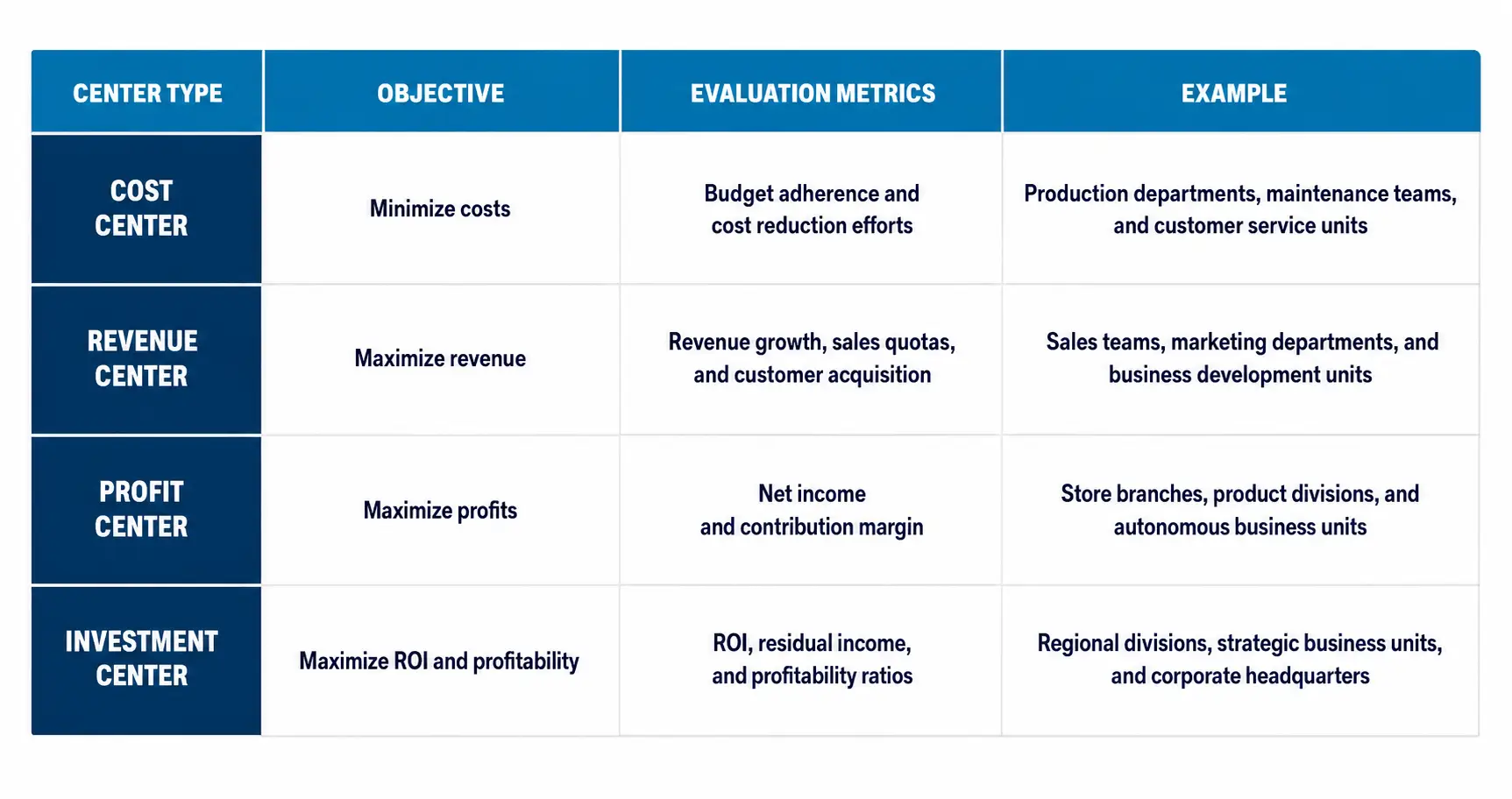
The four main types of responsibility centers are:
- Cost Center
- Revenue Center
- Profit Center
- Investment Center
1. Cost center
The primary goal of a cost center is to minimize costs while maintaining the required level of quality and efficiency. Cost centers are evaluated based on their ability to adhere to budgeted expenses and maintain operational performance. In a clothing manufacturing company, the production department functions as a cost center. It is responsible for managing labor, raw material usage, and overhead costs, focusing on producing goods efficiently without exceeding budgeted expenses.
2. Revenue center
Revenue centers are evaluated based on their ability to meet or exceed revenue targets. A sales department in a retail chain is a revenue center. It focuses on achieving sales quotas, building customer relationships, and driving store revenue.
3. Profit center
Profit centers are evaluated based on their net income and overall contribution to the organization’s financial performance. In a multi-department store, individual store locations can operate as profit centers. Each location is responsible for managing its revenue from sales and controlling operational expenses to maximize profits.
4. Investment center
Investment centers are evaluated based on profitability and the efficiency of asset utilization. The regional headquarters of a global retail chain operates as an investment center, with responsibilities including managing regional sales, operational costs, and decisions about opening new store locations.
Assigning responsibility centers
Responsibility centers are essential tools for aligning organizational goals with operational performance.
By assigning specific types of responsibility centers, such as cost centers, revenue centers, profit centers, or investment centers, organizations can address unique challenges and opportunities in various business scenarios.
If appearing in the CMA exams, it is crucial to:
- carefully analyze the scenario provided and identify the primary goal or challenge, such as cost control, revenue generation, or investment management
- then, recommend the responsibility center that best aligns with that objective, ensuring your answer includes specific functions or actions the center would oversee.
The following examples demonstrate how to apply these concepts effectively.
Scenario 1: Increasing sales in a retail chain
Recommendation: In this scenario, it would be appropriate to establish a revenue center for the sales department. The revenue center should focus on driving sales, increasing customer engagement, and meeting revenue targets. This center would be responsible for implementing promotional campaigns, developing pricing strategies, and expanding the customer base.
Additionally, a marketing revenue center could be established to support the sales team by increasing brand visibility and creating targeted advertising strategies. By assigning these responsibility centers, the retail chain can focus its efforts on generating revenue and achieving growth goals.
Scenario 2: Balancing costs and revenue in a restaurant chain
Recommendation: To address this challenge, the restaurant chain should establish profit centers for each restaurant location. These profit centers would be accountable for managing both revenue and expenses, enabling managers to focus on achieving profitability.
Each location’s profit center should monitor food costs, labor expenses, and sales performance. Managers can implement strategies such as optimizing menus, reducing waste, and increasing table turnover to boost profit margins. By designating restaurant branches as profit centers, the organization can identify high-performing locations and address inefficiencies in underperforming ones.
Scenario 3: Maximizing returns in a technology company
Recommendation: In this case, the company should designate strategic business units as investment centers. These centers would be responsible for managing revenues, controlling costs, and making investment decisions related to product development and market expansion.
For instance, a division responsible for launching a new software product could be evaluated based on ROI and residual income metrics. By assigning investment center responsibilities, the company ensures that divisions with high decision-making autonomy are held accountable for their overall financial performance.
Scenario 4: Managing costs in a healthcare organization
Recommendation: In this scenario, the hospital should establish cost centers for its support service departments. Each cost center would be responsible for controlling expenses while maintaining operational standards. For example, the housekeeping cost center would monitor labor hours, cleaning supplies, and equipment usage to minimize costs while ensuring cleanliness and compliance with health regulations.
By implementing cost centers, the hospital can focus on efficient resource utilization in non-revenue-generating departments, supporting overall financial health.
Scenario 5: Streamlining production in a manufacturing plant
Recommendation: The manufacturing plant should establish a cost center for the production department to monitor and control expenses, such as raw materials and labor. Additionally, a revenue center can be assigned to the sales team to focus on improving customer relationships and meeting delivery schedules.
By coordinating efforts between the production cost center and the sales revenue center, the plant can address operational inefficiencies while maintaining customer satisfaction, ultimately boosting overall performance.